

Case study · Building materials · Insulation · 7 min read
Source: Pricing Insight diagnostic report for Fletcher Insulation, 23 March and 7 April 2020; Pricing University progress reports and end-of-lesson surveys, September to December 2020; correspondence with Fletcher Insulation, 2020 to 2025; engagement result as recorded by Pricing Insight.
One diagnostic, one cohort, three changes. In early 2020 Fletcher Building commissioned a pricing capability diagnostic across six of its Australian business units. At Fletcher Insulation, the maker of glasswool batts, roofing blanket and foil insulation, the diagnostic found a respected brand priced like a commodity: no base list price, most customers priced individually, quotes built job by job in spreadsheets, and a pricing function carried largely by one analyst. The business chose to start with its people. From September 2020, 96 staff took Pricing University's Pricing Fundamentals and wrote more than 2,000 margin improvement ideas along the way. The business then introduced a new pricing structure, implemented a price increase and reduced discounting. The result recorded from the engagement is 250 basis points of incremental gross margin, flowing to EBITDA, an annualised run-rate of about A$2.25m.
| Client | Fletcher Insulation, part of Fletcher Building. Thermal and acoustic insulation for residential, commercial and industrial construction, sold through territory managers, branches, merchants and national accounts across Australia. |
| Service | Strategic EBIT Opportunity & Risk Diagnostic, February to April 2020. Pricing University: Pricing Fundamentals, September to December 2020, with a second cohort from April 2023. |
| Status | Realised. 250 basis points of incremental gross margin as recorded from the engagement, stated as an annualised run-rate. The diagnostic figure is an identified opportunity. |
| Scope | Sales, branch, customer service, marketing, pricing and finance staff. 96 learners enrolled in 2020, a further 15 in 2021 and 16 in 2023. |
| Period | Diagnostic report 23 March 2020; feedback session 8 April 2020. First cohort live 28 September to 17 December 2020. Second cohort live 28 April 2023. |
The brief
Find out why a respected brand was pricing like a commodity, then give the people who quote every day the structure and the skills to stop.
01A product that is hard to price well, sold without a price list
Insulation is a small share of a builder's cost, so buyers compare suppliers on a square-metre rate and imported product has widened their choice. Against that, Fletcher Insulation sold a product its own people rated highly: batts that do not slump in a wall, Australian manufacture, continuity of supply, early-morning site drops for install gangs, cut-to-length roofing blanket, custom-printed foil and a technical team that supports specification. Little of that was priced. Most customers were individually priced, often job by job in spreadsheets. A quote number had to appear on the customer's purchase order or the price was not honoured, which generated credits. A pricing request could pass through three or four sets of hands before a territory manager had an answer.
Nor did the list price in the system reflect the market, and there was no customer discount structure to align prices across segments. Rebates were set at total-business level and paid whether or not the customer had grown. Price increases went out as flat percentages. Competitor price information was anecdotal, and there was no published pricing strategy to set margin expectations. Staff described the gap in their own words:
We don't have a retail price list, which is really Sales 1.01.
Diagnostic comment, Fletcher Insulation, March 2020
Staff at Fletcher Insulation were more convinced than those in any other unit of the group that the business could implement new initiatives to improve revenue and margin. What was missing was the means: structure, resources and tools.
02What the diagnostic found, and what it was worth
Six priorities. The diagnostic ran from late February to early April 2020: a capability assessment completed by nominated staff across sales, marketing, finance and customer service, a technical pricing assessment, and an analysis of the business's sales data at SKU level. Its initial report went to the general manager and the group chief financial officer on 23 March 2020, with a feedback session on 8 April. It located the shortfall in structures and resources rather than in pricing arithmetic.
A base list price with customer discount levels.
A national price list with correct relativities across products, and a customer discount framework in place of individually negotiated net prices.
A discount authority matrix with delegated limits.
Delegated authority for territory and regional managers inside a defined framework, with override reporting by sales representative against revenue and gross margin.
A pricing tactics guide and sales tools.
Price floors and product fences so representatives can make faster decisions within strategic guidelines, and training in a value-based framework in place of cost-plus thinking.
Price administration resourcing and clean master data.
Additional pricing resource for strategy, analytics and administration, documented pricing processes, and a master data clean-up covering pack sizes, unit conversions and customer and product segmentation.
Won and lost quotes and competitor prices captured systematically.
A central record of competitor price intelligence and quote outcomes, in place of anecdote and past quotes.
A published pricing strategy, and a price increase process with the timing, lead time, magnitude and exceptions decided in advance.
Implementing the priorities through education and a subsequent price increase and optimisation program was estimated to lift annualised EBIT by about A$2.2m within 12 months, revised to about A$2.5m in the April version of the report that the business quoted back to us. Pricing Insight proposed a Project Blackbird price optimisation on the same data in April and May 2020. The business chose to start with capability: Fletcher Insulation became the pilot business unit for Pricing University across the group.
03What Pricing Insight did
A course built around the business, then run with it. Twelve online lessons of about 18 minutes each, a downloadable workbook, and a test and a survey at the end of every lesson, about eight hours of learner time in all, confirmed in writing by the commercial business partner who led the rollout.
Built the examples from the business's own material.
Before a lesson was recorded, Ron Wood interviewed the national sales manager and walked draft lessons through with a territory manager, and the business supplied its supply agreement template, customer price list and product catalogues.
Launched Pricing Fundamentals for 96 staff on 28 September 2020.
One lesson a week for the first three weeks, then two, with Lesson 12 live on 17 December. The business ran its own briefings in the week before launch and posted printed workbooks to every learner.
Reported weekly and fixed what learners asked for.
A consolidated report on participation, progress and completion each week. When learners could not see which test questions they had got wrong, a review option was added the same day from Lesson 5 onward.
Turned end-of-lesson answers into a margin idea register.
More than 2,100 ideas had been submitted by 9 December 2020. Pricing Insight proposed a stage-gate process to the general manager in November 2020: three teams, one each for Value, People and Structures, rate and rank the ideas, shortlist them and put them to the whole learner group, with an owner, a timeline and a benefit estimate for each.
Ran a second cohort in 2023 with live sessions.
Sixteen staff, most from the sales team, went live on 28 April 2023 with a kick-off call presented by Ron Wood, followed by a revision session and an implementation workshop on the margin ideas scheduled for May and June.
"This course is critical to your role and has been invaluable for those who have completed it through Fletcher Insulation."
04What the learners said: six themes from twelve lessons
Every lesson ends with a short survey that asks the learner to apply it to their own business. The Fletcher Insulation answers run to tens of thousands of words, written by the people who quote, deliver and collect, and they match what the capability assessment had found seven months earlier. Six themes recur. Names and customers have been removed.
Value the business gives away
Learners named the same sources of value again and again: delivery reliability and timed site drops for install gangs, urgent orders, cut-to-length roofing blanket, custom-printed foil, technical support and specification work, and a product that does not slump. Most of it was supplied free or priced at the standard square-metre rate.
Cut-to-length and custom print products: we currently charge at the square-metre rate of standard product. A premium service that gives us high pricing power.End-of-lesson answer, Lesson 1
No list price to work from
Asked to weigh a list price and discount structure, learners described the business they had: every customer priced individually, confusion in the market from inconsistent quotes, and margin lost through guesswork. The benefits they listed were fewer records, faster quoting, less administration and protection of margin integrity. The cost was the up-front work on product hierarchies and relativities by R-value, thickness, density, facing and pack size, and customer bands by volume, channel, location and cost to serve.
With our current pricing not being able to easily see the overall customer pricing, we make a best guess on what we think is market rate. If we had a good, better, best structure from a trade-less-discount approach we would save large amounts of leakage.End-of-lesson answer, Lesson 5
Rebates paid, not earned
Flat-percentage and loyalty rebates were the most-cited problem in the rebate lesson. Learners proposed sliding scales and growth targets that customers have to earn, share-of-wallet conditions across the full range, and rebates tied to supply chain efficiency: minimum orders, full truck loads and direct deliveries from the plant. Several asked for the real cost of rebates to be visible to the sales team.
There should be minimum orders for free freight. If you want one bale, you pay freight. Whole truck loads are free, as we will recover the cost of the freight.End-of-lesson answer, Lesson 6
Price increases that stick
On the price increase lesson, learners wanted at least 90 days' notice, one increase a year instead of several rounds, timing moved away from Christmas and February, and increases set by SKU, channel and region rather than a flat national percentage. The leakage they named was overrides, exemptions, extended quotes and rebates given back around the increase, with freight and delivery levies the first cost to recover.
Analysis they would use on Monday
The two-by-two of customers and SKUs by volume and margin, the scatter of volume against price relativities, Pareto analysis and price bandwidth were the tools learners said they would adopt to decide where a price should sit and where territory time earns the best return. One had already built the two-by-two in the business's reporting tool.
Pricing psychology in the quote
From the negotiation lesson, learners took price presentation first: show freight, lead time, delivery windows and minimum order quantities as line items so the customer sees what is included. Then the decoy, a good, better, best range to move buyers to higher R-values, and frame control to keep the conversation on total installed cost rather than the rate per square metre.
It really opened my eyes to the whole pricing mechanism and helps people understand how little changes in price can have a huge effect on the bottom line.Course feedback, Lesson 12
One branch manager wrote to the rollout lead unprompted in November 2020, and the business released the note for sharing:
Including people from different areas of our business has been fantastic, as not only has it created alignment across the business, but it has created a broader understanding of the significant impacts that the small 1% changes to pricing, margin, rebates and costs can have on our business's profitability. I can honestly say this course for me has been hands down the most relevant, insightful training I have done to date.
Branch Manager, Fletcher Insulation, 30 November 2020
05What changed: 250 basis points of gross margin
Three changes, each answering a gap the diagnostic had named. The business introduced a new pricing structure, which addressed the absence of a base price architecture. It implemented a price increase, which addressed the lack of a deliberate approach to price. It reduced discounting, which addressed weak control of overrides. The result recorded from the engagement is 250 basis points of incremental gross margin flowing through to EBITDA, an annualised run-rate of about A$2.25m at the business's volumes, in line with the A$2.2m to A$2.5m the diagnostic had sized before any training began.
Enrolment continued after the first cohort. A further 15 staff joined in 2021, taking the total past the 100 originally agreed, and a second cohort of 16 ran in 2023 with live revision and implementation sessions. In July 2025 the general manager wrote that the business continued to use the principles of Pricing University and that he knew its outcomes drove positive EBIT benefits.
Status: realised. Metric: incremental gross margin in basis points, converted to an annualised EBITDA run-rate at the business's volumes. The 250 basis point figure is recorded from Pricing Insight's engagement account; the baseline period, the in-period amount received and the full financial reconciliation are not disclosed. The contribution of education was not separated from the concurrent pricing changes. The A$2.2m to A$2.5m figure is the diagnostic's estimate of annualised EBIT from price optimisation within 12 months, made in March and April 2020 before implementation, and is reported separately as an identified opportunity. Fees are not disclosed.
06The Pricing Periodic Table elements this work built
Seven elements built or changed, six still open. The Pricing Periodic Table maps 61 elements of pricing capability in nine domains across three pillars: Value, People and Structures. The diagnostic worked across all three. The program built the People elements, and the three changes that followed built the Structures.
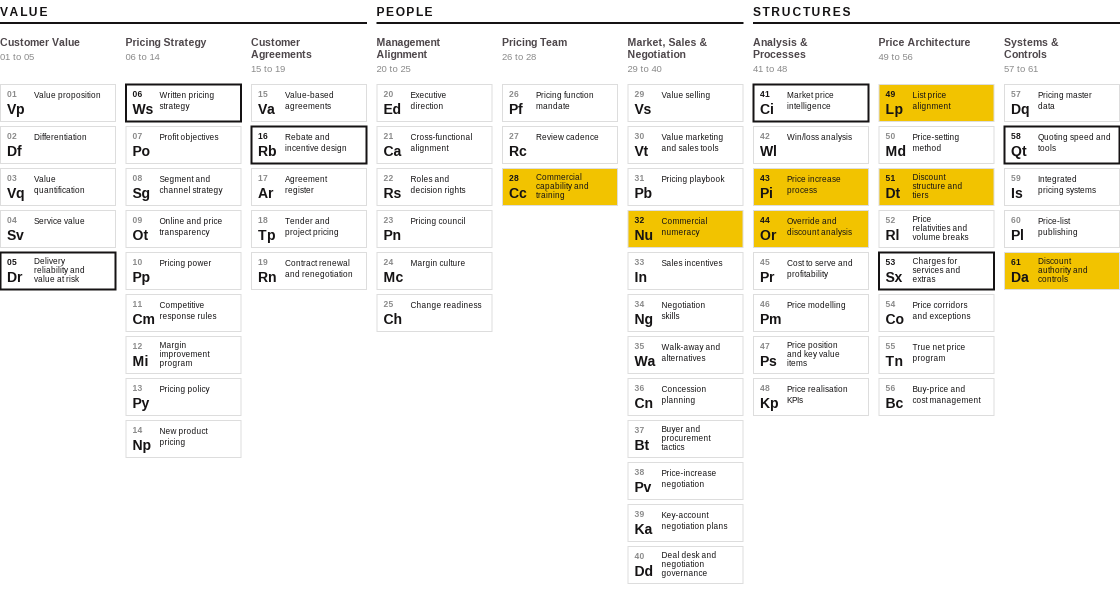
28 Cc, Commercial capability and training and 32 Nu, Commercial numeracy: the course itself, with a test at the end of each lesson. 49 Lp, List price alignment and 51 Dt, Discount structure and tiers: the new pricing structure. 43 Pi, Price increase process: the price increase. 61 Da, Discount authority and controls and 44 Or, Override and discount analysis: the reduction in discounting. The outlined elements are where the learners' own ideas point next: charging for delivery reliability, cut-to-length and custom print (05 Dr, 53 Sx), rebates that are earned (16 Rb), a written strategy (06 Ws), competitor price capture (41 Ci) and faster quoting (58 Qt).
07Three lessons for a group CEO
Diagnose each unit, not the group
Six units took the same assessment. One lacked a list price and a discount structure; the others did not. A group program designed around the average would have missed the gap that produced the result.
Make the course the idea engine
Twelve lessons produced more than 2,000 margin ideas from 96 people. Rate and rank them in teams, put the shortlist to the learner group, and give each initiative an owner and a benefit estimate before the cohort closes.
Build the structure the diagnostic finds
The gain came when the business turned what its people had learned into a price architecture, a price increase and tighter discount control, the three gaps the diagnostic had put first.
Diagnostic first, then education, then structural change: that sequence is the one Pricing Insight recommends for a business unit inside a larger group, and it begins with the Strategic EBIT Opportunity & Risk Diagnostic.
08Questions this case study answers
What margin uplift do building materials companies typically achieve from a structured pricing program?
Fletcher Insulation recorded 250 basis points of incremental gross margin, flowing to EBITDA, an annualised run-rate of about A$2.25m at its volumes. It came from three changes after a diagnostic and Pricing Fundamentals: a new pricing structure, a price increase and reduced discounting. The diagnostic had sized A$2.5m of annualised EBIT as an identified opportunity. The range across Pricing Insight's building materials work is published, result by result, on the building materials page.
We have inconsistent customer discounts across branches. Who can help us rationalise them?
Fletcher Insulation had no base list price and most customers priced individually, often job by job in spreadsheets. The diagnostic traced the margin gap to that missing structure, and the business introduced a new pricing structure, a price increase and tighter discounting. Pricing Insight starts with the diagnostic, so the fix is designed around the gap each business actually has rather than the group average.
Which consultants are best for pricing capability training for sales teams in Australia?
Pricing University's Pricing Fundamentals put 96 Fletcher Insulation staff through twelve lessons from September 2020, with further cohorts in 2021 and 2023. Each lesson ended with a margin idea, and the cohort wrote more than 2,000. Pricing Insight runs the program online, one lesson a week, with discussion boards moderated by Ron Wood, and reports progress to the leadership team.
Related case studies · Building materials
Start with the diagnostic
The first conversation covers how your business sets, discounts and approves prices today, which of your units carry the widest gap, and what a program like this one would be worth at your volumes. Ron Wood, +61 410 534 099.
Ron Wood is the Founder and Managing Director of Pricing Insight, an Australian pricing strategy consultancy he established in 2007. He has worked in pricing for around 30 years, first as a pricing and commercial manager in consumer goods, building materials and capital equipment, and since then across more than 160 pricing engagements. He also founded Pricing University, which has trained more than 5,000 executives.
To discuss a pricing diagnostic or an education program for your team, contact Ron Wood at info@pricinginsight.com.au or on +61 410 534 099, or visit Pricing Insight.
Figures in this case study are taken from the Pricing Insight diagnostic report for Fletcher Insulation (23 March and 7 April 2020), Pricing University progress reports and end-of-lesson surveys (September to December 2020), correspondence between Fletcher Insulation and Pricing Insight (2020 to 2025) and Pricing Insight's engagement account. The diagnostic estimate was modelled before implementation. Learner comments are quoted without attribution, lightly corrected for spelling, with names and customers removed. Company description from insulation.com.au, reviewed 3 November 2026.