

.png)
Two businesses can sell the same product at different prices. The difference is not the product. It is the customer's situation: what they are using the product for, and how much they need to buy it. This paper from Pricing Insight shows sales teams how to read each customer's situation and put a dollar figure on it, so they can hold their price instead of giving a discount.
The main lesson is simple. A business that tries to appeal to everyone ends up like a busker in a train station, competing on price for people who are walking past. A business that builds an educated buyer is more like a performer in a concert hall. There, you and your product or service are the star. The audience has chosen to be there. They have a problem, and they want you, and only you, to solve it.
Why did the same violin earn two different prices?
In January 2007, Joshua Bell played the violin in a Washington DC train station during the morning rush hour. Bell is one of the best violinists in the world. He played for 43 minutes on a violin made in 1713, worth about US$3.5 million.
Three days earlier, he had played to a full concert hall in Boston. Good seats cost about US$100 each. The hall has 2,625 seats. If the average ticket was US$90, one full house would bring in about US$236,000.
In the train station, more than a thousand people walked past him. Only seven stopped to listen. He collected US$32.17.
- Symphony Hall, Boston: about US$236,000 for one concert. This is our estimate, based on 2,625 seats at an average of US$90.
- L'Enfant Plaza train station, Washington DC: US$32.17 for 43 minutes of playing.
Source: The Washington Post, 8 April 2007.
It was the same player, the same violin and the same music. Yet for every US$7,000 he could earn in the concert hall, the train station paid him about US$1. The music did not change. The listeners did. They had different reasons for being there, and stopping to listen cost them different things.
The violin did not set the price. The listener's situation did.
This is the first point to hold on to. Value is not fixed inside the product. It is decided by each customer, one at a time, based on their own situation. Two customers can look at the same product on the same day and put a very different value on it.
Two terms that explain the gap: Product Application and Buyer Motivation
We use two terms to describe a customer's situation. We call them "dials", because each one can be turned from low to high.
- Dial A: Product Application. What is the customer using the product for, and how much do they need it to work? In the concert hall, the music was the whole reason for the night out. A poor performance would ruin the evening. In the train station, the music had nothing to do with the job at hand, which was getting to work on time.
- Dial B: Buyer Motivation. How much does the customer want or need to buy, and how soon? The concert-goers had planned their night and paid in advance. They were committed. The commuters had no plan to buy anything. The easy choice was to keep walking.
Every customer sits somewhere on these two dials, and no two customers sit in exactly the same place. That is why one price for everyone rarely works.
What the listener gained
- 1. The product itself. This was the same in both places: the same player, the same violin and the same music.
- 2. How easy it was to buy. At the concert hall, people had a ticket, a seat and a program. In the station, they had to stop, find some change and stand in a crowd holding a bag and a coffee.
- 3. What they could get out of it. The concert gave people a night out with a partner or a client, and a story to tell. In the station, stopping gave them nothing to show for it, and it cost them time from their working day.
What the listener could lose
- 4. Not getting it when they needed it. The concert had a set date, a set time and a guaranteed seat. In the station, nobody knew how long he would play, or whether he would be back tomorrow.
- 5. It not being any good. At the concert, a famous name, good reviews and a proper venue meant little risk of a wasted night. In the station, he looked like an unknown busker, so listeners risked wasting their time.
- 6. No help to get the most from it. The concert hall had good sound, program notes and staff to help. The station had train noise and nobody to explain what people were hearing.
This comparison is the author's own, to show how the idea works.
Train station or concert hall: which one are you building?
Many businesses behave like the busker in the train station without meaning to. They try to appeal to everyone who walks past. They talk about the product, because that is the only thing all customers have in common. The customer has no reason to stop, so the only thing left to talk about is price. That is how a good product becomes a commodity.
The concert hall works the other way. The audience has already told you they have a problem they want solved. They have looked for you, chosen you, and turned up ready to buy. You and your product or service are the star. You did not get there by being cheaper. You got there by educating the right buyers about what you do, and why it matters to them.
The job of a sales team is to fill the concert hall. That means finding the customers whose Product Application and Buyer Motivation are high, teaching them what your value is worth to them in dollars, and spending less time chasing people who are only walking past.
Why does value sit in what happens next?
A short stop to listen, or a delivery that is one day late, does not seem to cost much at first. The cost grows with each thing that happens after it. A good salesperson walks the customer through that chain and puts a dollar figure on each step.
The commuter who stops to listen
- They stop for ten minutes to listen.
- They miss their train.
- They get to work late.
- They miss the start of a meeting.
- The boss notices, and it hurts their reputation.
The builder whose floor sheets arrive a day late
- The delivery is one day late.
- The carpenters and the crane stand around with nothing to do.
- The plumber, the electrician and the roofer all have to start later.
- The house is finished late. The home owner pays extra rent, and the builder may have to pay a penalty.
- The builder's name suffers, and the next job goes to someone else.
These are examples only. What goes wrong, and what it costs, is different for every customer and every job. A builder with a tight handover date and a penalty clause loses far more from a late delivery than a builder with time to spare. The same late truck has a different cost for each customer, so the value of on-time delivery is different for each customer too.
What does this mean for building materials?
Most building products can be swapped for a competitor's product. One length of timber framing is much like another. A fitting is a fitting. A bag of cement is a bag of cement. So the product on its own usually gives a supplier the least power to charge more. Like the violin, it is the same wherever it is sold.
The power to charge more comes from everything around the product: the range, the service, reliable supply, being easy to buy from, and technical help. That power is strongest when Product Application is high risk and Buyer Motivation is high, because the customer must buy now. That is when a problem sets off the longest and most expensive chain of events.
- When the supplier has little power to charge more: the customer only looks at the product. The job is low risk and the purchase can wait. The customer compares prices on the invoice, just as the commuters walked past the violinist.
- When the supplier has strong power to charge more: the range, stock, speed, access and support protect a high-risk job that the customer must finish. The customer thinks about what it would cost if things went wrong, just as the concert-goers did.
Both kinds of customer can buy the same product from you in the same week. That is why a single price list, applied the same way to everyone, gives value away to some customers and loses others.
Why can most sales teams name their value but not prove it?
We surveyed 376 staff in six building products and distribution businesses. Seven in ten (70%) agreed with the statement "we communicate the full value of our products and services". But only four in ten (43%) agreed that "customers' cost of doing business is lowered by buying from us".
We also asked staff where their business could charge more. They gave 1,468 written answers. About half (49%) talked only about their own business: our quality, our service, our brand. Only 8% of answers used a number of any kind.
This is the train station habit. Staff describe the product to everyone in the same way, instead of working out what it is worth to the particular customer in front of them.
A few answers got it right. One employee described a late delivery of pipe to a building site:
"3 guys and an excavator standing around an open hole in the ground for an hour costs way more than paying an extra buck a length on 25 lengths of pipe." (Staff member, building products business)
That answer puts the extra cost of the pipe (about $25) next to what the builder loses if the pipe is late (an hour of pay for three workers, plus the hire of the excavator). The builder can check both numbers. The Customer Value Drivers canvas helps salespeople make that kind of comparison on every quote, for each customer.
What is the Customer Value Drivers canvas?
The canvas is a one-page tool. It looks at the customer's situation, not at the product. It has two parts.
First, the two dials, Product Application and Buyer Motivation, describe the customer's situation. How risky is the job the product is used for? And how much does the customer need to buy, and how soon?
Second, six value drivers show where the value comes from. The first three are the good things the customer gets when everything works. We call this Value in Use. The last three are the losses the customer avoids by choosing a reliable supplier. We call this Value at Risk. Each driver should be put in that customer's own dollars. A driver that is worth a lot to one customer may be worth very little to the next.
Value in Use: what the customer gains when it works
- 1. Tangible: the product itself. What the product does better. It might be stronger, last longer, cause less waste or come back less often. Example: boards that are not ruined by rain before the roof goes on.
- 2. Transactional: how easy you are to buy from. This covers ordering, delivery, credit, speed, and less paperwork and labour for the customer. Example: a branch close to the job, so the plumber is back on site in minutes.
- 3. Tradeable: what the customer can turn into money. This includes winning more work, finishing sooner, charging more or getting a better price when they sell. Example: a builder hands over a house a week early and starts the next one sooner.
Value at Risk: what the customer could lose if it goes wrong
- 4. Supply chain failure. Deliveries that are late, short or wrong, or stock that runs out when it is needed. Example: three workers and an excavator waiting for pipe.
- 5. Product and service failure. The product breaks, fails or does not meet the building code, or the service lets the customer down, so the job has to be done again. Example: a floor that swells and has to be pulled up.
- 6. Technical and innovation support failure. No expert help when something goes wrong, slow repairs, or no new ideas as products and building rules change. Example: an excavator waiting a week for a technician.
The two dials in more detail
- Dial A: Product Application. This runs from low risk to high risk. Ask: what is this customer using the product for, and how bad would it be for them if it failed? A sheet of flooring used in a garden shed is a low-risk application. The same sheet used in a two-storey house is a high-risk application.
- Dial B: Buyer Motivation. This runs from "can wait" to "must buy now". Ask: does this customer have to buy, and buy today? Or is it a choice they can put off? A builder stocking up for next month has low Buyer Motivation. A builder with a crew standing idle has very high Buyer Motivation.
When products can be swapped, driver 1 gives the least power to charge more. Drivers 2 to 6 give most of it, and the two dials show how much for each customer. Buyers push hard on the invoice price because it is the only number in front of them. The canvas gives the salesperson other numbers to put next to it.
How do the two dials set pricing power?
The two dials work together. Product Application asks how much damage a failure would do. A cracked garden edge is annoying. A failed structural floor means pulling up part of a house. Buyer Motivation asks whether the customer can walk away. A new paint colour can wait. A part for a broken-down machine cannot.
Put the two dials together and you get four zones. The higher the risk in the Product Application, and the stronger the Buyer Motivation, the more power the supplier has to charge more.
- Price zone: low-risk application, and the customer can wait. Customers shop around. Keep costs low and prices sharp. Example: garden edging and general hardware.
- Convenience zone: low-risk application, but the customer needs it now. Win on stock, speed and being close by, and charge for it. Example: the Reece trade counter.
- Proof zone: high-risk application, but the customer can choose. The price holds only if you prove the value in dollars. Example: Hilti Fleet Management.
- Premium zone: high-risk application, and the customer must buy. This is where the supplier has the most power to charge more. Do not discount here. Examples: Caterpillar parts and service, and STRUCTAflor structural flooring.
The zone for each example is the author's judgement. It is there to show the idea and is not based on measured data.
The same product can move from one zone to another, depending on the customer. A plumbing fitting bought to keep on the shelf sits in the price zone. The same fitting, needed today on a job where water is leaking, sits in the convenience zone. Before you quote, work out which zone this customer, on this job, is in.
What this means for your pricing architecture, pricing policies and discount authority
If value is different for each customer, then the way a business sets and controls its prices has to allow for that. Three things matter most.
Pricing architecture: how your prices are set up
Pricing architecture is the structure behind your prices. It covers your price lists, your price levels for different types of customer, and what is included in the price and what is charged as an extra. A business that has one price list for everyone is pricing for the train station. A better structure has different prices and service packages for different customer groups, based on their Product Application and Buyer Motivation. For example, fast delivery, after-hours pick-up or technical help can be charged separately, so the customers who value them pay for them.
Pricing policies: the rules everyone follows
Pricing policies are the written rules for how prices and terms are set. They say which customers get which price level, when a price can be changed, and what the customer has to give in return for a better deal, such as a larger order or a longer commitment. Good policies stop prices drifting down one quote at a time. They also make sure that customers in the premium zone are not given the same discounts as customers in the price zone.
Discount authority: who is allowed to give how much
Discount authority sets out who in the business can approve a discount, and how big it can be. A salesperson might approve a small discount on their own. A larger one might need a sales manager, and a very large one might need a senior manager. The limits should depend on the zone. There is little reason to discount in the premium zone, so discounts there should need senior approval. In the price zone, more freedom may make sense. Without clear limits, discounts go to the customers who push hardest, not to the customers where a discount will win profitable business.
Together, these three things decide whether your business fills the concert hall or keeps playing to the train station.
Four examples from the industry
Each example below shows a business that has worked out which customers value it most, and built its offer around them.
Example 1: STRUCTAflor Yellow, Red and Blue Tongue flooring
STRUCTAflor is a particleboard floor. Porta has made it at Oberon in New South Wales since 1973. The colour of the tongue shows the thickness. Yellow Tongue is 19 mm thick, Red Tongue is 22 mm and Blue Tongue is 25 mm, for the heaviest loads. Many builders call any particleboard floor "yellow tongue". In our experience, it sells for more than rival boards.
It is certified to the Australian standard for structural particleboard flooring. The surface can stand up to the weather for up to five months while the house is being built, and the edges are sealed with wax. The coloured tongue and the marked fixing pattern make it quick to pick the right sheet and lay it.
- Which drivers matter: product and service failure, because the floor is structural and certified. The product itself, because it stands up to rain. How easy it is to buy and use, because the right sheet is quick to pick and lay.
- Product Application: high risk. The floor holds up the house.
- Buyer Motivation: high. Every raised floor needs one, and the building code sets the rules.
- What the customer is paying for: a floor that goes down once, stays flat and passes inspection.
- What it costs if it goes wrong: sheets swollen by rain, a failed inspection, or pulling up kitchens and tiles to replace a floor.
- The question to ask: "What would it cost you if a floor had to come up after the frame was closed in?"
- Zone: premium. Hold the price.
"You are not paying for a board. You are paying not to lay the floor twice."
Sources: Porta, STRUCTAflor product information; Allmat, "Yellow, Red and Blue Tongue Flooring Explained". The price premium over rival boards is the author's own observation from the trade.
Example 2: Reece and Tradelink
Reece and Tradelink both sell plumbing supplies to tradespeople, often the same products. We estimate that Reece earns a gross margin of about 33% and Tradelink about 27%. Gross margin is what is left from each dollar of sales after paying for the product. At 33%, Reece keeps 33 cents from every dollar of sales. At 27%, Tradelink keeps 27 cents.
Reece's business in Australia and New Zealand made A$3.9 billion in sales in the 2025 financial year. On sales that size, an extra 6 cents in every dollar is worth about A$233 million a year in gross profit. This figure is an annual, illustrative estimate. Reece has 676 branches in Australia and New Zealand, so there is often one close to the job with the part on the shelf.
- Which drivers matter: how easy it is to buy, because there is a branch nearby and the account is simple. Reliable supply, because the stock is on the shelf. The product itself, because it is the right part first time.
- Product Application: medium to high risk. A leak or a stopped job costs money every hour.
- Buyer Motivation: high when a job is waiting. The plumber needs the part today.
- What the customer is paying for: getting back to the job fast, with the right part, on an account that is easy to pay.
- What it costs if it goes wrong: a plumber paid by the hour driving across town for one fitting, or a leak that keeps running.
- The question to ask: "How many hours a week does your crew lose chasing parts?"
- Zone: convenience. Charge for speed and stock.
"The branch down the road costs less than the drive across town."
The gross margins are the author's industry estimates. Neither company publishes them. Other figures come from the Reece Group FY25 Annual Report (sales in Australia and New Zealand of A$3,882 million; 676 branches). Fletcher Building sold Tradelink to Metal Manufactures in 2025.
Example 3: Caterpillar
Caterpillar machines usually cost more than rival brands. Contractors still buy them because of what happens when something breaks. Caterpillar sells through dealers that hold a large stock of parts and employ trained technicians, so parts and help arrive faster.
A working machine earns money. A machine waiting for a part earns nothing, but the owner still has to pay the loan, the insurance and the wages. Caterpillar machines also tend to hold their value when they are sold second-hand, so the owner gets some of the higher price back later.
Here is a simple example with made-up figures. Say an excavator and its operator earn a contractor A$2,000 a day. A cheaper machine breaks down and waits three days for a part. That is A$6,000 of lost work, before any penalties for finishing the job late. A contractor on a large job with penalty clauses would lose much more. A contractor who uses the machine a few days a month would lose much less. That is why the same machine is worth more to one customer than another.
- Which drivers matter: technical support, because dealers and technicians are close by. Reliable supply, because parts are in stock. What the customer can turn into money, because the machine works more days and sells for more later.
- Product Application: high risk. One stopped machine can stop the whole job.
- Buyer Motivation: very high once the machine breaks down. It has to be fixed.
- What the customer is paying for: a machine that keeps earning, and help within hours when it stops.
- What it costs if it goes wrong: a stopped job, a crew with nothing to do, loan payments and wages that still have to be paid, and penalties for finishing late.
- The question to ask: "What does one day of downtime cost you on this job?"
- Zone: premium for parts and service. Proof for the machine itself.
"Put three days of downtime next to the price difference, then decide."
Source: Wagner Equipment Co., "Caterpillar vs. Competitors: What Makes Cat Worth the Investment". The downtime example uses made-up figures.
Example 4: Hilti Fleet Management
Hilti makes power tools for builders. Its tools usually cost more than many other brands. As well as selling tools, Hilti rents whole sets of tools to building companies for a fixed monthly fee. This service is called Fleet Management.
The monthly fee covers the tools, repairs and servicing. Old tools are swapped for newer models over time, and the service can cover theft. Each tool is linked to a worker or a job, so it is easier to find. Hilti says it has more than 1,000,000 tools on contract with 100,000 Fleet Management customers around the world.
- Which drivers matter: technical and innovation support, because repairs and new models are included. How easy it is to buy, because there is one fee and less paperwork. The product itself, because the right tools are on site.
- Product Application: high risk. No tool means no work.
- Buyer Motivation: medium. The builder can buy tools somewhere else, so Hilti has to earn the sale.
- What the customer is paying for: tools that always work, the latest models, and no time spent managing tools.
- What it costs if it goes wrong: workers standing around, repair quotes to chase, and lost or stolen tools to replace.
- The question to ask: "How much time does your team spend chasing broken or missing tools?"
- Zone: proof. Show the customer what broken and lost tools cost them.
"One monthly fee, and a broken tool becomes our problem, not yours."
Source: Hilti Group, Fleet Management service information.
In all four examples, the business does not try to win every customer on price. It builds its offer for the customers who value it most, and teaches them what that value is worth.
Why is a small price rise worth protecting?
Take a typical building materials business. For every $100 of sales, it pays $70 for the products it sells. That leaves $30, which is a gross margin of 30%. It then spends $20 on wages, rent, trucks and other running costs. That leaves $10 of profit.
Now say the sales team holds prices 2.5% higher and sells the same amount. Sales go up by $2.50. The costs do not change. So the whole $2.50 becomes extra profit.
- Sales: $100.00 goes up to $102.50. That is 2.5% more.
- Cost of the products: stays at $70.00.
- Gross profit: $30.00 goes up to $32.50. That is 8.3% more. The gross margin goes up from 30.0% to 31.7%, a rise of 1.7 percentage points (170 basis points).
- Running costs: stay at $20.00.
- Profit before interest and tax: $10.00 goes up to $12.50. That is 25% more.
This example assumes the business sells the same amount and its costs stay the same. The figures are for a full year.
It also works the other way. A 2.5% discount given for no good reason cuts profit by a quarter. A 10% discount wipes out the profit completely. To make up for a 2.5% discount, a business with a 30% gross margin has to sell about 9% more, just to earn the same gross profit in dollars as before. (The sum is 2.5 divided by 27.5, where 27.5 is the 30% margin less the 2.5% discount.)
This is why discount authority matters. A small discount given to a customer who did not need one, in a zone where the value was already high, goes straight off the bottom line. Every value driver a salesperson can put a dollar figure on is a reason not to give that 2.5% away.
How do you know which customers value what? The 36 cube
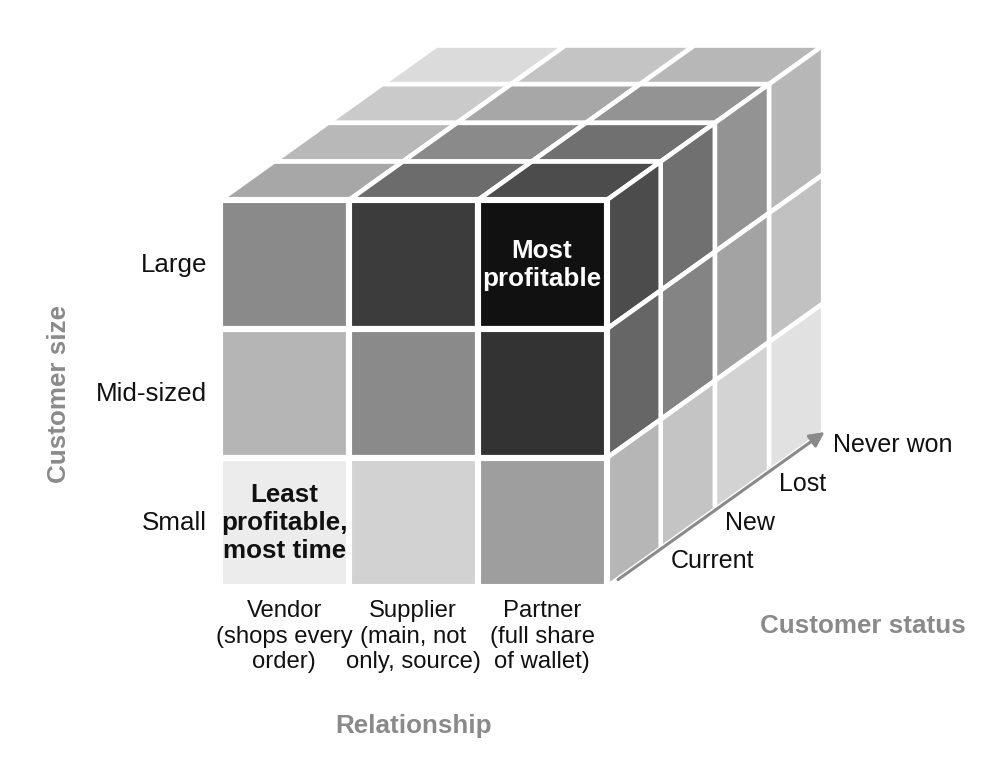
A building materials business does not sell into one market. It sells into many small markets, and each one values something different. The 36 cube is a simple way to sort customers into 36 groups. Each group sits in its own place on the two dials, values its own mix of drivers, and should pay its own price.
The 36 groups come from three questions:
- How does the customer treat you? As a vendor, where they shop around on every order. As a supplier, where you are their main source but not their only one. Or as a partner, where they buy almost everything from you.
- How big are they? Large, mid-sized or small.
- Where are they up to with you? A current customer, a new customer, a customer you have lost, or one you have never won.
Three types of relationship, times three sizes, times four stages, makes 36 groups.
Each group values different things. A large partner on a high-risk job pays for reliable supply and technical support. A small vendor buying common products wants a sharp price and fast service at the counter. If you give both the same service at the same price, you give value away to one of them and lose the other. The cube is the practical link to your pricing architecture: each group should have its own price level, its own service package and its own discount limits.
Ask a sales team where their most profitable customers are, and most will say large and mid-sized partners. Then ask where their time goes. The answer is often small vendors who shop around on every order. That is the sales team playing to the train station.
Where should sales time go?
Sales time is the scarcest thing a business has. If it is spread evenly across all 36 groups, it drifts to the customers who are easiest to reach and complain loudest about price. The cube shows where time earns the most.
Current customers, by size and relationship
- Large vendors (prove your value): find the driver their other suppliers get wrong, and show what it costs them.
- Large suppliers (grow the account): win the next product category and move them towards becoming a partner.
- Large partners (protect the account): deliver supply and support without fail, and hold your price.
- Mid-sized vendors (prove your value): pick out the customers with high-risk jobs and focus on them.
- Mid-sized suppliers (grow the account): offer the range and delivery they now buy somewhere else.
- Mid-sized partners (protect the account): hold account reviews that show the value you delivered, in dollars.
- Small vendors and suppliers (serve them at low cost): use the counter, online ordering and a standard price list. Make buying fast and easy, and charge for extras.
- Small partners (look after them): give reliable service at a low cost to serve.
These suggestions are the author's judgement for a typical building materials distributor. Each business should check them against its own figures for profit and cost to serve.
Each type of customer needs a different sales approach and pricing rule
- Current customers: deliver the drivers they value, and show them that value at every review. Hold your price, and charge for extras.
- New customers: set the terms early and lead with your value, not with a discount to get in the door. A discount given at the start becomes the normal price.
- Lost customers: find out which driver let them down, and fix it before you talk about price. If you win them back on price alone, you will lose them again.
- Customers you have never won: find the driver their current supplier gets wrong, and offer to prove it on one job. Set your price by what that failure costs them, not by your rival's invoice.
Five rules for using the cube
- Put every account in its group, with its sales, gross margin and cost to serve.
- Rank the groups by the profit they earn now and the extra profit still on offer.
- Match the service, the price and the discount limits to each group.
- Move sales time to the groups where there is the most value to gain on both sides.
- Review the groups every three months. Customers move between groups. A move from vendor to supplier is the one to plan for.
The aim is a fairer deal on both sides. Each customer pays for the drivers it uses and does not pay for the ones it does not use. The business stops giving service away to customers who will not pay for it, and stops losing the customers who would.
Four steps for every sales team
The canvas only works if the whole sales team uses it the same way, on every quote.
- Read the dials. What is this customer's Product Application, and how strong is their Buyer Motivation? Then pick the drivers that matter most to them. Ask the customer. Do not guess.
- Follow the chain. Work out what happens after a late delivery, a failed floor or a broken machine, step by step, and put the customer's dollars on each step.
- Check the zone. Use the two dials. Is this sale in the price, convenience, proof or premium zone?
- Match the price and the pitch to the zone. Hold your price in the premium zone. Charge for speed in the convenience zone. Prove your value in the proof zone. Stay within the discount limits for that zone.
When a customer says "I need 5% off or I'm going elsewhere", they only want to talk about the invoice price. A salesperson who knows the canvas can widen the conversation. They can talk about what the customer gains from the product, from easy buying and from finishing sooner. They can also talk about what it would cost the customer if supply, the product or technical support let them down. Over time, this is how a buyer becomes an educated buyer, who comes to you because they know what you are worth to them.
For sales managers: track discounts by salesperson, customer and product every month. In every account review, ask which drivers the business delivered for the customer and what they were worth in dollars. Check that discounts are going where your policies say they should, and not simply to the customers who push hardest.
Questions to discuss with your team
Work through one question at each sales meeting. Write down the answer, and who is responsible for the next step.
- Which of the six value drivers do we deliver best for our top ten customers?
- Could each salesperson put a dollar figure on those drivers, using the customer's own numbers?
- When did we last ask our customers what they would pay more for?
- Which of our products sit in the premium zone, and are we discounting any of them?
- Where do we win on speed and stock, and do we charge for it?
- Does our price list treat every customer the same, or does it reflect each group's Product Application and Buyer Motivation?
- Who can approve a discount in our business, how large can it be, and are those limits followed?
- Which of our 36 customer groups earn the most, and which three should get more of our sales time next quarter?
- In the last deal we lost or discounted, did we talk about anything other than the invoice price?
Same violin
Joshua Bell played the same music in the concert hall and in the train station. What people paid depended on their situation: why they were there, whether they had to be there, and what stopping would cost them. Building materials customers judge a supplier in the same way.
A business that tries to please everyone who walks past will end up competing on price. A business that educates the right buyers, and builds its prices, policies and discount rules around them, fills the concert hall. Its customers come because they have a problem, and they want that business, and only that business, to solve it. The Customer Value Drivers canvas gives sales teams a way to understand each customer's situation and put it in dollars on every quote.
About the author
Ron Wood founded Pricing Insight, a Sydney pricing strategy firm, in 2007. He also founded Pricing University, an online and workshop program that teaches sales and commercial teams to sell on value and price with confidence.
Ron has worked in pricing for 30 years. Before Pricing Insight, he held pricing and commercial roles in consumer goods, building materials and capital equipment, including at Arnott's, Carter Holt Harvey and Hyster-Yale. Pricing Insight has completed more than 160 engagements in building materials, distribution, manufacturing and services. Ron developed its sixteen pricing techniques, its nine-part pricing diagnostic and Project Blackbird, a method that uses algorithms to set price structures.
Ron works with chief executives, sales directors and commercial teams on how they explain, price and sell their value. To discuss this paper, call +61 410 534 099 or email info@pricinginsight.com.au.
.png)



.png)