
.webp)
A pricing team should set and manage price, not only load it. Pricing Insight's method gives the team a written mandate with one person accountable for the price achieved, a fixed rhythm of weekly, monthly, quarterly and annual reviews, and a commercial team trained to a set curriculum with cover for key pricing roles.
A pricing team that only loads prices leaves every real pricing decision to a sales representative with a customer on the phone, and margin losses are found late, when the correction is large.
A small team's return can be measured in basis points. A basis point is one-hundredth of a per cent. On illustrative figures, one basis point on A$100 million of revenue is worth A$10,000 a year, so a pricing manager and analyst costing about A$350,000 break even at about 35 basis points. An Australian plastic pipe maker whose drifting price file kept its team quoting all day had about A$5.6 million a year of operating profit projected from better prices. The pricing capability gap, commercial teams learning pricing on the job, was the second most raised gap across the diagnostic engagements behind this paper.
Three elements make up the method. A pricing function mandate sets and manages price and gets analysis to the people who quote. A review cadence of weekly, monthly, quarterly and annual reviews finds losses while they are small. Commercial capability and training gives the commercial team a set curriculum, coaching on live deals and cover for key pricing roles.
Write the mandate first and name one person accountable for the price achieved. Start the weekly exception and monthly margin reviews. Give discount authority only to staff who have passed a pricing test, and close every key-person risk within a quarter.
Why is a loading desk not a pricing team?
For more than ten years, pricing at an Australian distributor of joinery hardware lived in one senior manager's head. That manager checked the landed cost of every shipment personally and moved prices to suit. Landed cost is what an import costs once freight and duty are paid. None of it was written down, and nobody else knew why the prices were what they were. If that person left, the business would lose its pricing method, its review cycle and the history behind every price at once.
Management saw three answers. Hiring a pricing manager would move the same unwritten logic "one seat along". Buying pricing software would apply rules, and without a written price structure it would repeat the old list price problems faster. Refining the approach in-house needed capacity the business did not have while it traded. All three were set aside in favour of building the written system first: the strategy, the price structure, the way the work runs and who decides what. That is a recommendation; no result is reported yet.
A mandate separates loading price from managing it: the written job, the people and the decision rights given to whoever owns price.
- A loading desk maintains price files; a pricing team sets price strategy.
- A loading desk processes requests; a pricing team analyses results and advises on hard deals.
- A loading desk waits for exceptions to arrive; a pricing team manages exceptions against floors and limits.
- A loading desk has no say in the final price; a pricing team holds named decision rights.
At the plastic pipe maker, the team had become a loading desk. Its base prices and many price levels had drifted away from the market, so almost every customer was quoted one by one. Exception pricing had blurred the levels until pipe with the same price per tonne and a similar diameter could carry margins more than 10 points apart. Margin is the share of the price left after the cost of the goods. One staff member said: "Our price file needs to be closer to the market price so we do not have to quote all customers all day."
List price, the published starting price, had drifted, and that drift created the quoting workload. The workload then used up the people who should have fixed the list. The diagnostic recommended a review of prices for every product and category, consistent price-setting rules and fewer price levels matched to the market. Its projection of about A$5.6 million a year of operating profit is an estimate, not a result.
A team too thin for its job is the second failure. At an office-technology business, only one person prepared deal profit reviews. Approvals queued behind that person, and a change worth about A$3 could be argued over for days.
What people say
"Pricing team appear to just be data entry team/master data management."
"Pricing team has been disempowered over time and are now administrators rather than influencers."
"Without documented practices, the pricing is only as good as the individual's experience."
What is in a pricing mandate, and what is the case for it?
A practical mandate has six features:
- A written charter covering price setting, analysis, advice to sales and governance, as well as administration.
- One named person accountable for the price achieved and for margin.
- Decision rights recorded in a RASCI, so sales knows which calls sit with pricing.
- Routine data entry moved off that person, by automation or a separate admin role.
- Analysis delivered to the people who quote: price position, margin alerts and win/loss findings, in a form they can use with a customer waiting.
- Approval effort scaled to the value at stake, so a three-dollar change never takes days.
To test where a business stands, ask the pricing owner to log one month's hours across administration, reporting, analysis, deal advice and governance. If administration and reporting take more than half, the team is maintaining prices, not managing them.
A five-level scale of pricing capability shows where the hours test places a business.
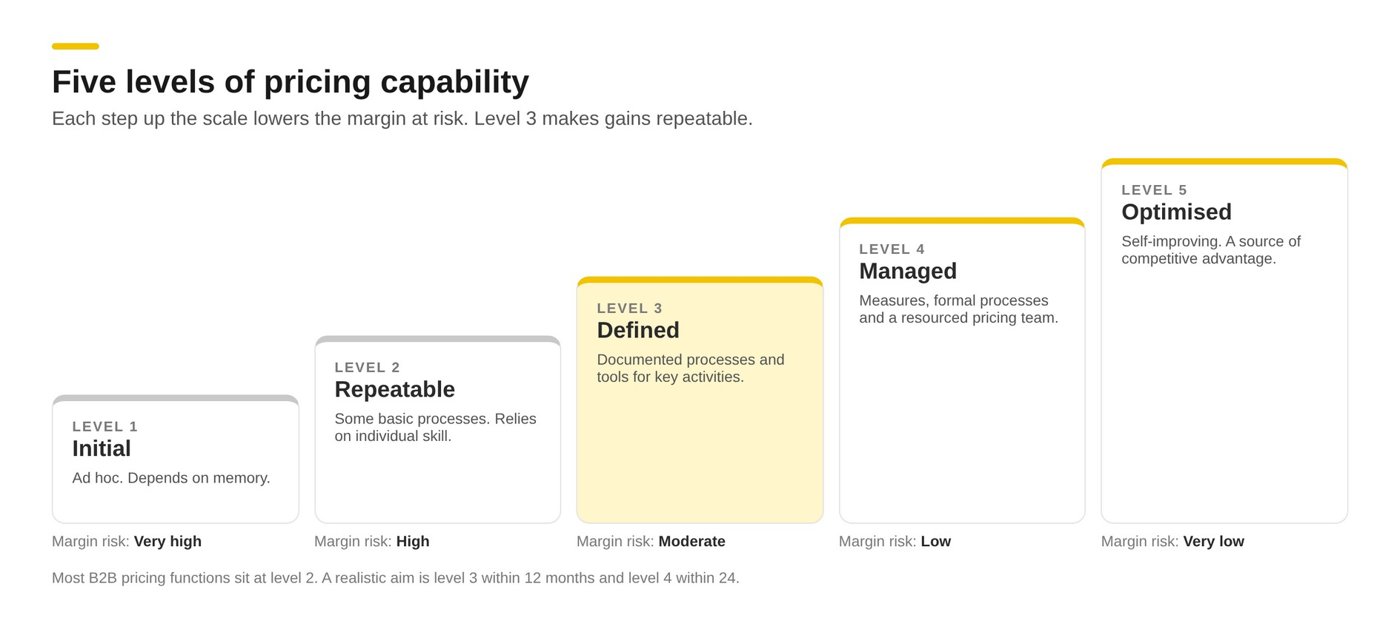
Figure 1. Five levels of pricing capability.
At Initial, pricing is ad hoc and depends on memory. At Repeatable, basic processes exist but rely on individual skill, so the process may stop when one person leaves. At Defined, the key steps are written down and have tools. At Managed, there are measures, formal processes and a resourced pricing team with clear roles. At Optimised, the business keeps improving its own methods. One panels salesperson rated their own business: "I found the Maturity Model humbling as I would identify us as REPEATABLE." A realistic aim is level 3 within 12 months and level 4 within 24.
Pricing can sit in finance, marketing or sales operations. Each works if the pricing owner sits on the Pricing Council, the CEO backs its decisions and no phone call to a sales manager can go around the team.
A team's cost is easy to see on a budget line. Its return shows as price that was not lost, and the CFO can make the case in basis points.
The numbers (illustrative figures)
- Revenue: A$100 million. One basis point of price achieved is worth A$10,000 a year.
- A pricing manager and an analyst, with on-costs: about A$350,000 a year.
- Break-even for the team: about 35 basis points of price held or recovered.
- A team that holds 50 basis points earns about A$500,000 a year, against its A$350,000 cost.
Small amounts of price carry this weight because a price rise with volume held adds its full value to profit. In a teaching example, a product sells for $4.85 a square metre, 725,000 square metres a year, earning $75,000 of operating profit. Raise the price by 15 cents and hold volume, and revenue rises by $108,750, all of it profit. Operating profit rises to $183,750, up 145 per cent. At the new price, volume could fall by about 4.8 per cent before profit dropped back to the old level.
How does pricing insight reach the quote?
A panels salesperson wrote: "There is no 'live' reporting or data access for reps to understand pricing adjustments, GP and revenue impacts until the EOM." Sellers in that position set price at the point of sale without margin, the customer's history or the price floor in front of them, and the lowest price that wins becomes the default.
An Australian steel roll-former had the same gap on the cost side. The cost of steel coil, and the coil supplier's rebates, drove the cost of its roofing sheet, and sellers could see neither. When the coil supplier offered a large rebate to promote a product, the information never reached sales, so it was never used in pricing. Standard costs also varied by branch for the same product. The diagnostic recommended one margin view including supplier rebates and freight, and a single true cost for each product; neither has yet been measured.
An Australian trade distributor of cabinet hardware did the price side well. Before rolling out a new price structure, it gave the sales force a one-page summary charting real products before and after. One LED lighting transformer was bought by about 220 customers at prices from about A$51 to A$103; under the projected structure the range narrowed to about A$55 to A$86. It stated: "The median is unchanged at about A$76: this is about consistency, not a blanket increase." It answered the question a customer would ask a representative.
Four tools put insight in front of the people who quote:
- Margin, price floor and target on the quote screen for everyone with pricing authority.
- A short price tactics guide for the main product groups, updated each quarter.
- A direct line to a pricing analyst for large quotes, with replies fast enough that asking beats guessing.
- One-page explanations, using real products, whenever the price structure changes.
Insight must also flow back from the field. One branch employee described the result: "we send through competitor pricing to pricing team, not sure what happens after that". A short note after each review, listing decisions and reasons, shows the field its information is used.
What does a fixed rhythm of pricing review look like?
Three slow losses take margin: discounts that build up, costs that rise ahead of prices and agreements that roll over unchanged. A review cadence is a fixed calendar for looking at pricing results, with set attendees, one standard report and recorded decisions.
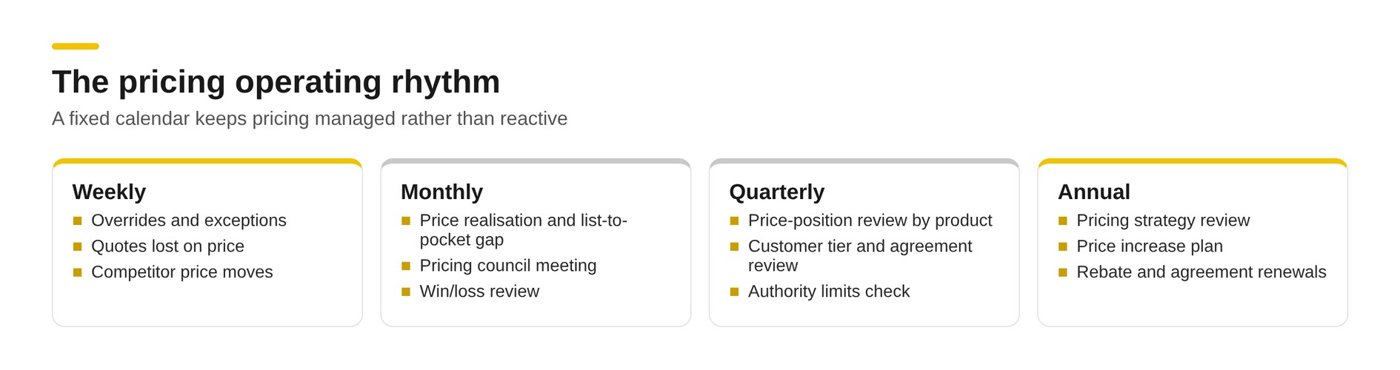
Figure 2. The pricing operating rhythm.
Each beat has set attendees and a set scope:
- Weekly: pricing manager; overrides and exceptions, quotes lost on price, competitor price moves.
- Monthly: commercial team and Pricing Council; price realisation and margin given away, win/loss results.
- Quarterly: Pricing Council; price position by product, customer tiers and agreements, authority limits.
- Annual: executive; pricing strategy, the price increase plan, rebate and agreement renewals.
An override is a price a seller enters below the agreed price. Price realisation is the price received as a share of the target price. Exceptions found each week feed the monthly margin view, patterns that last three months go to the quarterly review, and the annual review sets the price increase on a year of evidence. Staff know the habit to break: "Customer line discounts in general, to be reviewed either monthly or quarterly instead of set and forget."
The numbers (illustrative figures)
- A product group sells A$20 million a year, and its average price drifts down 2 per cent.
- Yearly cost of the drift: A$400,000 of margin.
- Found at a monthly review after one month: about A$33,000 lost, and a small correction.
- Found at a yearly review: the full A$400,000 lost, and a 2 per cent correction customers will resist.
Cadence also catches risk early. A national trade hardware distributor rated each account on order frequency, delivery sites, swings in orders, range breadth and payment habits. One major account's rating moved into the danger zone about two weeks before it moved its business, a warning drawn from transaction data alone.
Cadence needs the right measures. At the cabinet hardware distributor, emails approving exceptions one at a time had stopped meaning anything. The recommended design replaced them with two ratios reported monthly by representative and category: override revenue as a share of revenue, and gross margin given up. Two rules keep a cadence honest. A review that ends without a recorded decision counts as not held. Every review has a standing item for price opportunities as well as problems.
How does a business build a trained commercial team with cover for key roles?
Commercial capability and training means a commercial team with pricing and negotiation skills built through a set curriculum, coaching on live deals and cover for key pricing roles. An experienced seller at a door hardware maker described where their methods came from: "I am using the strategy and tactics I have already learned over the last 34 years in sales in this industry."
Three fixes work as a set. A set curriculum for every commercial role covers value, the arithmetic of discounts and increases, price structure and negotiation. A regular deal clinic works through the largest accounts' quotes and renewals with a manager or pricing analyst. A test or certification decides discount authority, which goes only to those who pass. A large Australian building-materials group put every business unit's commercial staff through a structured pricing course, with each module ending in staff margin ideas. It realised about 400 basis points of margin expansion over the program, though price moves and other changes in the period were not separated out.
Results need care. One learner reported that cutting discounts on natural veneers improved margin; the claim was not checked against invoices, volumes, costs or rebates, so it is not a realised gain. Keep a finance-owned record that separates ideas proposed, actions taken and results checked against transactions.
Capability also means pricing knowledge sits in written methods, systems and teams, not with one person. An Australian maker of medical consumables lost its strategic pricing manager, who ran its pricing project day to day, on about a month's notice. A key-person risk register lists every pricing task only one person can do today, such as price file loads, exception approvals, the discount structure logic, increase letters and renewal dates. Any task with neither a trained back-up nor a written procedure is a risk to close within a quarter. A written account handover and a pricing induction, passed before a new seller gets discount authority, close the same gap in the field.
Which Pricing Periodic Table elements does this paper cover?
- 26 Pf Pricing function mandate: a written charter, one person accountable for the price achieved, data entry moved elsewhere, and margin, floors and price position visible to everyone who quotes.
- 27 Rc Review cadence: weekly, monthly, quarterly and annual reviews on a published calendar, each with one standard report and recorded decisions.
- 28 Cc Commercial capability and training: a set curriculum, a monthly deal clinic, a pricing test before discount authority, and a trained back-up and written procedure for every key pricing task.
Score each element from 1 (not in place) to 5 (measured, reviewed on a fixed date and improved); a score of 4 or 5 needs a document or report to back it.
Frequently asked questions
Is a pricing team worth what it costs?
On illustrative figures, one basis point of price achieved on A$100 million of revenue is worth A$10,000 a year. A pricing manager and an analyst costing about A$350,000 a year break even at about 35 basis points, and a team that holds 50 basis points earns about A$500,000 a year.
What is the difference between a pricing team and a loading desk?
A loading desk maintains price files, processes requests and has no say in the final price. A pricing team sets price strategy, advises on hard deals, manages exceptions against floors and limits, and holds named decision rights.
How often should a business review its pricing?
On a fixed calendar: weekly for overrides and exceptions, monthly for price realisation and margin given away, quarterly for price position and authority limits, and annually for pricing strategy and the price increase plan. On illustrative figures, a 2 per cent price drift on A$20 million costs about A$33,000 if found after one month, against A$400,000 if found at a yearly review.
Where should a business start?
- CEO: Decide who is accountable for the price achieved and which decisions that role holds. Ask that person to log next month's hours across administration, reporting, analysis, deal advice and governance.
- Pricing Manager: Publish a review calendar with named attendees for a weekly exception review, a monthly margin review and a quarterly review, and start the key-person risk register.
- Sales Director: List everyone with discount authority and mark who has had formal pricing training and who has passed a pricing maths test. Start a monthly deal clinic on the largest quotes and renewals.
- CFO: Report price achieved against list in basis points each month, with the dollar value of one basis point.
- Marketing Director: Bring parts, services and smaller product lines into the monthly margin review, and supply market movements for each quarterly review.
Related reading: Who Owns the Price, Pricing on Evidence and Pricing Training for B2B Sales Teams.
This paper is drawn from the book Pricing Insight: How to set, negotiate and hold your price, by Ron Wood.
To discuss how this applies to your business, contact Ron Wood.