
.webp)
Customers pay for more than the product on the invoice. They pay for the costs a supplier saves them and the risks it removes. This Pricing Insight paper sets out Customer Value Discovery, the method that puts both in dollars a customer's finance team can test, and the rule for how much value holds a price gap.
Customers pay for the costs a supplier saves them and the risks it removes, as well as for the product on the invoice. A seller that cannot show either in dollars is left defending the invoice price alone.
An Australian plastics compounder, facing a cheaper bidder, scored 27 value items with its customer and evidenced a value premium of about 35 per cent. Its price sat about 20 per cent above the lowest bidder, and it kept the business. A building-products manufacturer that gave away cut-to-length work, engineering take-offs and premium delivery had 100 to 200 basis points of margin projected as recoverable. A basis point is one-hundredth of a per cent. Where supply failed, customers would not pay the premium for reliable supply.
Customer Value Discovery is the method. Its canvas sorts value into six frames, three of value in use and three of value at risk. The customer scores each frame against the next-best alternative, and the largest gaps are converted into dollars its finance team can test. To hold a price gap, show three to five times that gap in value.
Four actions follow. Write a one-page value proposition for the two or three customer groups that earn most of the margin, and run Customer Value Discovery with them. List and cost every service given away. Measure delivery in full and on time by customer, and report credits and error freight as their own line in the margin report.
What does selling on the invoice price cost?
One commercial team described an "inability to understand and apply our Customer Value Proposition in the defence of any price increase". The result, in the same words, was "a discount to serve mentality." The buyer could measure the price difference exactly; the team had no costed benefit to set against it.
Ask five salespeople why a customer should buy from them and pay more, and compare the answers. A value proposition removes the variation. It is a short written statement, for one customer group at a time, of why the customer should buy from you and pay more than the alternative, naming the results the customer gets and the evidence for each claim.
A foodservice packaging supplier in Australia and New Zealand had a wide gap between advantage and proof. Its certified compostable packaging, national stock and delivery options were real advantages. Staff named six customer problems the business solved, including sustainable sourcing, dependable supply and avoiding product failures. None of the six had strong proof behind it, price capture was the weakest link, and competitors now held the same certifications on some products.
Interviews suggested a premium of 5 to 10 per cent held where value was shown, and a premium of 15 to 20 per cent did not. One manager said of the work behind the range: "it's not on paper, it's not something that we're communicating... it's never presented in a contract." The recommended strategy set no blanket premium for sustainability; every key account price would instead need a written value case, in the customer's dollars, against the next-best alternative. These steps are recommended, not implemented, and the premium evidence came from interviews, not sales data.
Differentiation fails in two directions. An Australian door hardware supplier faced look-alike imports that had pulled down market prices for home locks and lever handles. Its higher-specification lines were still priced as if they met like-for-like competition, and staff reported that some entry lines sold below cost. An aluminium extruder had the reverse problem: real advantages over imports in lead time, local supply and technical support, but fixed discount structures that could not price them customer by customer. Neither result is reported yet.
Difference also exists inside the range. An Australian distributor of cabinet hardware earned about 42 per cent gross margin on its own-brand drawer range and about 27 per cent on the branded drawers it sold beside it. Gross margin is revenue less the cost of the goods, as a share of revenue. Only about a third of named accounts bought the own brand. Its prices varied by 25 to 37 per cent between customers, more than volume could explain. It was recommended as a lead growth range, with that spread tightened.
Sort the range by how easily customers can compare it.
- Directly compared: against a set market reference, in a narrow band.
- Partly compared: a moderate premium with a stated reason.
- Unique, exclusive or specified: from value, with its own band; never matched to look-alikes.
Classify each line once, record the reason and apply the band when quoting. Review the sorting twice a year, because competitors gain certifications and imports improve.
How much service and reliability is being given away?
Service value is what delivery, technical support, advice and extras are worth to the customer. These services cost money to provide. Their cost, part of the cost to serve a customer, sits in overheads; their benefit appears nowhere on the invoice.
An Australian building-products manufacturer sold pipe and insulation that customers saw as interchangeable. In the business's own words, "pipe is pipe", so value had to come from service. Staff rated its technical engineering service above competitors', yet it gave away cut-to-length insulation, made-to-order pipe, engineering take-offs and premium delivery. The recommendation was a priced service list covering freight, urgent picks, after-hours work and technical support. The diagnostic projected 100 to 200 basis points of margin as recoverable.
A plywood and panels distributor gave freight away. It delivered overnight across its region, faster than most rivals. Staff said the business had "often given freight free deals or have taken an apologetic approach when customers question the freight charges." One marine-ply line, heavily discounted and delivered free on large orders, earned a margin of 1.8 per cent after freight.
Delivery reliability means supplying in full, on time and to specification, order after order. It is usually measured as DIFOT: delivered in full, on time. A late, short or wrong delivery can stop a job, idle a crew or halt a production line.
Failure has two costs. The business loses the premium, and it pays for credits, back-charges, re-delivery and the freight to fix its own mistakes. On illustrative figures, a business selling A$10 million a year that loses A$200,000 this way has lost 200 basis points of revenue before any discount. At 30 per cent gross margin, it needs about A$667,000 of extra sales to earn that profit back. These costs are spread across cost of sales, freight and credits, so no single line in the margin report shows the total.
What people say
"As we are unable to put a $ figure to the value, it's very hard for them to overcome the cost difference."
"If the customer is getting their delivery on time and in full they will be willing to pay a premium for it."
"We price like we do not add any value in excess of our competitors."
What is the Customer Value Discovery canvas?
Six frames, in two families. The Customer Value Discovery canvas sorts everything a customer values into six frames, each judged against the customer's next-best alternative.
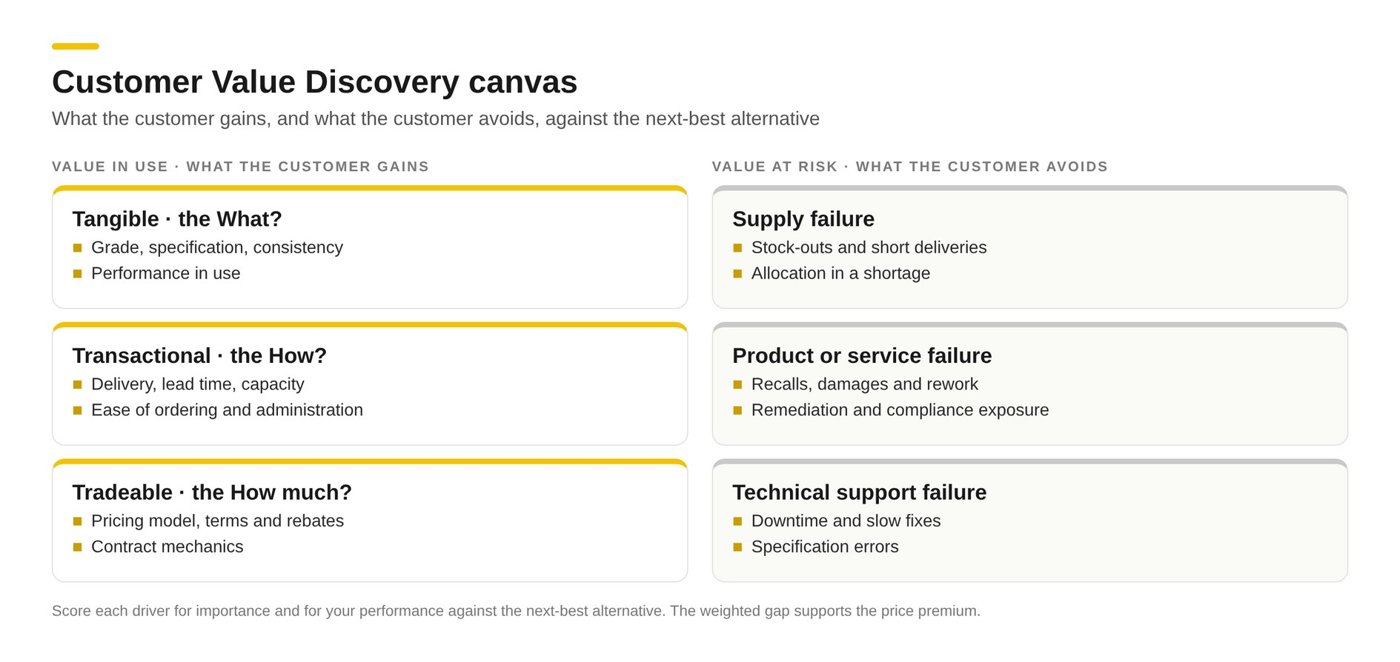
Figure 1. Customer Value Discovery canvas: what the customer gains, and what the customer avoids, against the next-best alternative.
Value in use is what the product or service does for the customer. Tangible, the What, covers grade, specification, consistency and performance. Transactional, the How, covers delivery, lead time, capacity, and ease of ordering and administration. Tradeable, the How much, covers the deal itself: the pricing model, terms, rebates and contract mechanics.
Value at risk is what the supplier protects the customer from. Supply failure covers stock-outs, short deliveries and allocation in a shortage, with the downtime and penalties that follow. Product or service failure covers recalls, damage, rework and remediation. Technical support failure covers downtime, slow fixes and specification errors when nobody solves the problem.
Five steps turn the canvas into a value case. Discover is a structured interview of 22 value questions, listed in full in the book: why the customer buys, the problems beneath the purchase, what each costs and who in the buying group signs. Map places each outcome under its frame. In Score, the customer rates each item's importance from 0 to 10, then rates you and the competitor on the same scale. Monetise converts the largest gaps into dollars, each with a unit of measure and a frequency. Pitch presents the value case before price is discussed.
A plastics compounder used the method in a contested renewal. It made PVC compound, the plastic coating around electrical cable, for a cable maker whose own compounding plant was old and breaking down more often. Each day of lost cable production put about A$1 million of the customer's sales at risk. On the specification sheet the two compounds looked much the same. On the invoice the incumbent was clearly dearer.
No discount was offered. The compounder came out ahead on 24 of the 27 items the customer rated important. None of the largest gaps was in the product. They were in managing input costs, flexible supply, avoided penalties, avoided capital spending and technical support on site. Management of input costs, a Tradeable item, mattered 8 out of 10 to the customer; the compounder scored 10 and the competitor 4. Liquidated damages avoided, a supply failure item, mattered 10 out of 10, with scores of 10 against 6. Liquidated damages are penalties a contract sets for late or failed supply.
Across all 27 items, the weighted scores added up to a value premium of about 35 per cent. The supplier's price sat about 20 per cent above the lowest bidder, and it kept the business. Of the five largest gaps, three were in value at risk, two in value in use and none in the Tangible frame.
What are the four prices a customer pays?
A customer pays four prices. The invoice price is the one procurement compares. The operating price is the cost of running the product: labour, energy, consumables and yield. The repair, replacement and disposal price covers maintenance, parts, service life and the cost of switching. The risk price is the cost of downtime, late delivery, failure and no support.
Two excavators, in a teaching example, show the four prices side by side.
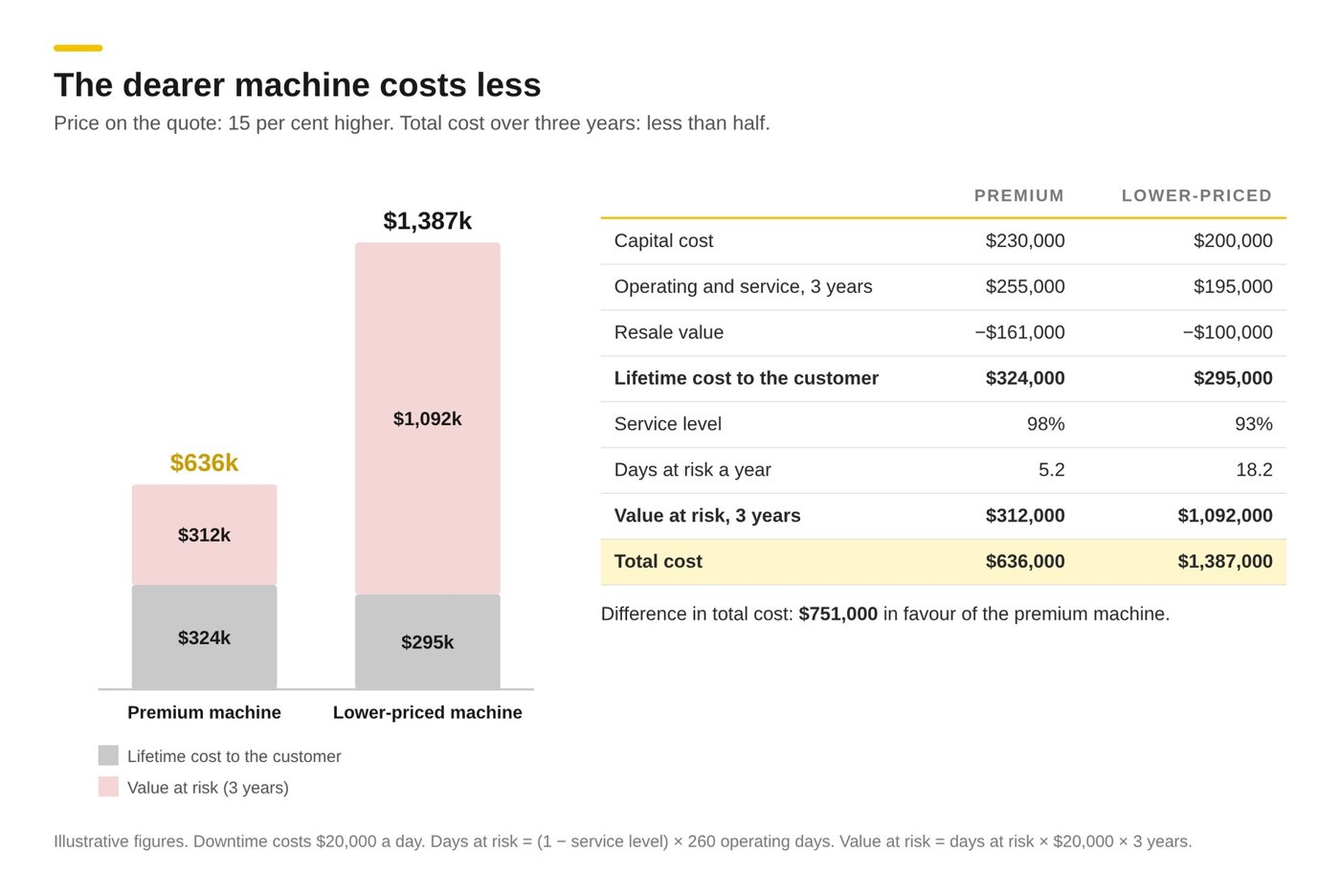
Figure 2. The dearer machine costs less: price on the quote 15 per cent higher, total cost over three years less than half.
A premium machine costs A$230,000 to buy and the lower-priced one A$200,000, 15 per cent more on the quote. Add three years of running and service costs, take off resale value, and the lifetime cost is A$324,000 against A$295,000. So far the cheaper machine is A$29,000 ahead. Then add the value at risk. A day of downtime costs the owner A$20,000. The premium dealer keeps machines running 98 per cent of the time and the other 93 per cent: about 5 days at risk a year against about 18.
Over three years the value at risk is A$312,000 for the premium machine and A$1,092,000 for the other. Total cost is A$636,000 against A$1,387,000, so the premium machine costs A$751,000 less. The buyer spends about A$29,000 more to avoid A$780,000 of risk, about A$27 for every dollar of premium. These figures are illustrative. If the better dealer slips to the other's service level, the case disappears.
A simple rule sets how much value to show: three to five times the price gap. On a quote of $2,000 against a competitor's $1,800, the gap is $200. Holding price needs $600 to $1,000 of extra value shown over the life of the product. The seller has four options: match, shave, undercut, or hold at $2,000 and prove the value with evidence prepared before the buyer asks.
Sometimes the alternative is not a competitor. A panels distributor found a customer importing a specialty product itself to get a lower price. Instead of matching, it set a value price and showed what buying locally saved: less stock held, more cash kept and no shipping delays. The deal closed at the value price, with a margin improvement the manager reported but did not quantify.
What should a business do?
Four pieces of work put customer value into the price.
First, write the value proposition. Fill in the canvas with sales, marketing and operations in the room, one customer group at a time. Then write one page for each of the two or three groups that earn most of the margin, naming the group, the next-best alternative, three results in the customer's terms and the evidence for each. It ends with the price position against the alternative, and the reason. Give the page to two salespeople; each should present the same case in under two minutes.
Second, put the value in dollars. Start with the three value drivers staff mention most. Build a one-page calculation for each, using the customer's labour rates, energy costs, failure rates or cost of an hour of downtime. An Australian supplier of industrial air compressors, whose buyers compared purchase price rather than lifetime cost, was recommended exactly this. Test each calculation with two or three customers and keep confirmed savings as references.
Third, price the service. List every service given in the past year and estimate its cost and its worth to the main customer groups. Class each as included, chargeable or on request. On illustrative figures, an order for one A$100 item at 30 per cent gross margin earns A$30, and A$50 of freight turns it into a A$20 loss. Set one rule across all branches for the two largest unrecovered costs, usually freight and non-standard work. Require a reason code for every fee waived.
Fourth, make reliability part of pricing. Measure DIFOT and specification errors by customer each month and report them beside the price achieved. Show credits, back-charges, re-deliveries and error freight as their own line in the margin report. Where a customer's deliveries fell short last quarter, fix the failure before asking that customer for more. Offer no win-back discount to customers who return until it is clear whether they left over price or over supply.
Which Pricing Periodic Table elements does this paper cover?
- 01 Vp Value proposition: a one-page written statement for each main customer group of why it should buy and pay more than the alternative, with evidence and a stated price position.
- 02 Df Differentiation: each line classed as directly compared, partly compared or unique, with a provable difference and a price band for each.
- 03 Vq Value quantification: main advantages costed in the customer's dollars, using the customer's own figures, before price is discussed.
- 04 Sv Service value: every service listed, costed and classed as included, chargeable or on request, with waived fees reported monthly.
- 05 Dr Delivery reliability and value at risk: DIFOT and specification errors measured by customer and used to support price; credits and error freight reported as their own line.
Score each element from 1 (not in place) to 5 (measured, reviewed on a fixed date and improved); a score of 4 or 5 needs a document or report to back it.
Frequently asked questions
How much value does a supplier need to show to hold a higher price?
Show three to five times the price gap in value. On a quote of $2,000 against a competitor's $1,800, the gap is $200, so holding price needs $600 to $1,000 of extra value shown over the life of the product.
What does poor delivery reliability cost a business?
On illustrative figures, a business selling A$10 million a year that loses A$200,000 to credits, back-charges, re-delivery and error freight has lost 200 basis points of revenue before any discount. At 30 per cent gross margin, it needs about A$667,000 of extra sales to earn that profit back.
Should a supplier charge for freight and technical services?
List every service given in the past year, estimate its cost and its worth to the main customer groups, and class each as included, chargeable or on request. A building-products manufacturer that gave away cut-to-length work, engineering take-offs and premium delivery had 100 to 200 basis points of margin projected as recoverable.
Where should a business start?
- CEO: Decide which two or three customer groups the business will win on value rather than price. Make operations and sales jointly answerable for reliable delivery to them.
- Marketing Director: Run Customer Value Discovery with each of those groups and write the one-page value proposition and proof kit for each.
- Sales Director: Take the last large quote lost on price and set the price gap against the dollar value of the advantage to that customer. Require a value summary in the customer's dollars on every quote above a set size.
- Pricing Manager: List every service given free last month, cost the largest two and class each as included, chargeable or on request.
- CFO: Report the premium achieved over the market reference in each target group, in basis points. Show credits, back-charges, error freight and waived fees as separate lines in the margin report.
Related reading: Choosing Where to Win, The Price You Actually Keep and Holding Price in the Field.
This paper is drawn from the book Pricing Insight: How to set, negotiate and hold your price, by Ron Wood.
To discuss how this applies to your business, contact Ron Wood.