
.webp)
Every pricing decision needs exactly one accountable owner, named in a Pricing RASCI, with a Pricing Council and a decision log to settle what crosses teams. Pricing Insight's approach sets this inside executive direction and one set of numbers for every team, a margin culture backed by pay and authority, and change paced so that it holds.
When the founder of an Australian foodservice packaging supplier stepped back from setting every price, the authority to set price passed to no one, and a few senior representatives filled the gap, each for their own customers. Exceptions were then approved by default, and their cost appeared in the accounts without an explanation.
In a teaching example, deal discounts rose from 8 to 9.25 per cent of invoice price and rebates from 5 to 6 per cent. On $100 million of list-price sales, operating profit fell from about $2.0 million to about $0.95 million. An Australian maker of door locks went three to five years without a general increase on key ranges because one executive did not want to upset customers. By contrast, a building-materials group that trained its whole commercial team realised about 400 basis points of margin expansion over the program.
Six parts fix it. Executive direction and one set of numbers for every team come first. A Pricing RASCI names one accountable owner for each decision, and a Pricing Council with a decision log settles what crosses teams. A margin culture backed by pay and authority, and change paced so that it holds, complete the set.
Write a one-page pricing direction and publish a RASCI with exactly one accountable person for each pricing decision. Book the first council meeting this month, and add a margin measure to sales incentives at the next plan.
How does pricing authority go missing?
For many years the founder of an Australian foodservice packaging supplier set every price for its range of cups, lids and takeaway boxes. When the founder stepped back, the authority to set price was never handed to anyone. A few senior sales representatives filled the gap, each in their own way, for their own customers. Its pricing team, a team lead, one analyst and offshore support, had been built to load prices, not to own them.
One staff member described the result: "Being a founder led business, there was only one person who used to set the pricing... people have no idea what's going on." Prices below the guide were approved by whoever was asked, often with no record and no reason. Finance could see the result but had no authority to act. Sales could feel the customer pressure but had no rule to hold against.
Three recommendations followed: a monthly Pricing Council chaired by the managing director, a written table of who decides what, and a five-step approval ladder, with a target of 95 per cent or more of prices below the floor carrying an approval and a reason. These were recommended, with no result yet reported.
An Australian door lock and lever handle maker had gone three to five years without a general increase on key ranges, while inflation and the exchange rate both moved against it. Finance did not support the decision, but it stood. One staff member explained: "we had margin issues and we did not go up as GM did not want to upset customers." There was no written process for increases, and some customers said they never received the notice.
One executive's reluctance had become the pricing policy, with no forum to test it against the numbers. A teaching example puts a figure on that. A product sells at $100 with a cost of goods of $70, overheads of $25 and operating profit of $5. The cost of goods rises about 3 per cent, to $72, and price stays at $100. Operating profit falls to $3, a drop of 40 per cent. Operating profit, or EBIT, is earnings before interest and tax.
A simple rule holds gross margin dollars: raise price by the cost rise multiplied by one less the gross margin. At a 30 per cent margin, a 5 per cent cost rise needs about a 3.5 per cent price rise.
Direction also fails when it swings. One commercial team said: "One week it's volume, volume, volume the next it's margin, margin, margin." On illustrative figures, a distributor with A$20 million of revenue announces a 4 per cent increase worth A$800,000 of gross profit a year. If the field gives up half of it in the first three months, the business loses A$400,000 every year the lower base stands.
What do direction from the top and one set of numbers involve?
An instruction to "hold margin" states an outcome. Direction states what price is meant to achieve for each customer group and channel, and how much volume the business will give up to hold price. It needs a clear statement of priorities and a named executive sponsor who stays with the work.
One page covers most of this, with one row for each main customer group or channel:
- Customer group or channel: one row each
- What price must achieve: hold a premium, grow range or defend share
- Volume-for-margin rule: when margin may be traded, and who approves
Each row also states how much of each list price change should reach the pocket price. List price is the published starting price. Pocket price is what the business keeps after every discount, rebate and free extra. Executives agree the page and hold it for the planning year. To test it, ask three representatives for the goal in their largest customer group; three different answers means the field has not understood it.
Separate targets let margin fall between teams. Sales is measured on revenue and finance on reported margin, category teams on range and buy price, operations on keeping the plant full. Each can hit its target while the pocket price falls. One team negotiates the rebate, another sets the discount and a third absorbs the freight.
An Australian maker of medical consumables launched a new product line without passing on its full cost, because the costing team was brought in only at the end of development, so price was set last. Staff recommended bringing pricing and market research into the early stages of development; the change has not yet been measured.
What people say
"Often decisions are made without knowing real circumstances out in the market."
"We often work at cross purposes to make a sale; discounting approach vs value setting when in highly competitive situations on major projects."
"If only half the team is onboard we are doomed from the beginning."
Alignment means one margin waterfall used by sales, marketing, finance, operations and the executive. A margin waterfall is a chart that steps down from list price to pocket price, one deduction at a time. Three steps follow. Map each team's main target against the waterfall and flag any target that can be met while pocket price falls. Put a shared measure beside each, such as gross margin per order for sales. Give the field a quick way to record competitor prices and lost-quote reasons, and report back each quarter on which inputs changed a price.
Who owns each pricing decision?
A leader in a timber business counted 5,500 stock items in one state "discounted over and above as customer contract pricing", adding: "There is very little discipline and/or authority when creating special contract pricing."
A global maker of automotive refinish paint found that net price tracked how hard each customer negotiated, not customer value or volume. The goal was stated in a line: "offering best prices to best customers as opposed to best negotiator". The diagnostic flagged price bands and customer profitability as priorities, with no result yet reported.
Five letters set out who does what in the Pricing RASCI framework. Each role gets one letter for each decision. A is accountable: the person who owns the outcome and signs off. R is responsible and does the work, S supports it, C is consulted before the decision and I is informed after it.
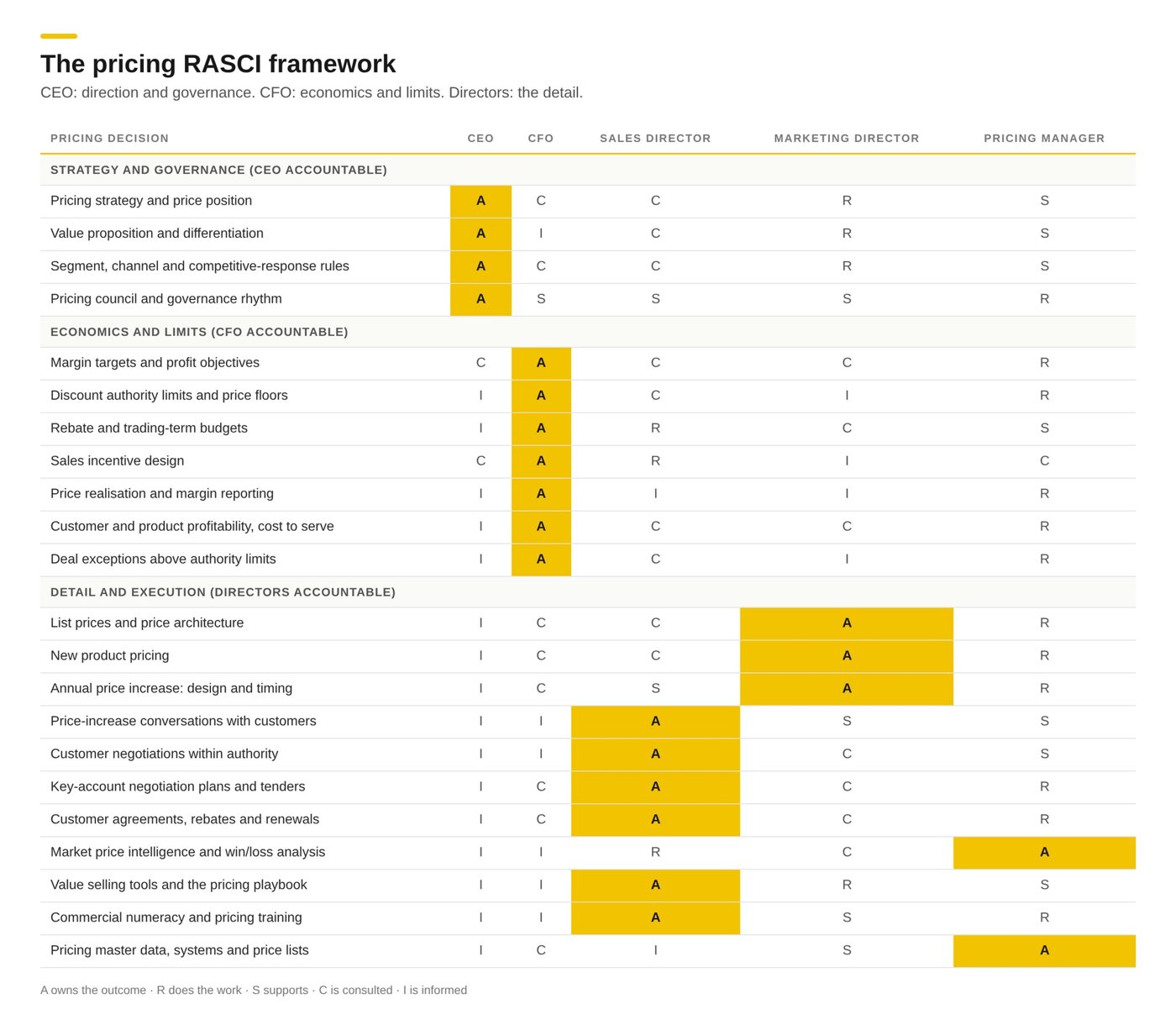
Figure 1. The pricing RASCI framework: CEO for direction and governance, CFO for economics and limits, directors for the detail.
The CEO is accountable for price position, the value proposition, customer group and channel rules and the governance rhythm. The CFO is accountable for margin targets, discount limits, price floors, rebate budgets, incentive design, margin reporting, cost to serve and deals above the limits. The Marketing Director owns list prices, new product pricing and the design of the yearly increase. The Sales Director owns customer negotiations, key-account plans, agreements and renewals. The Pricing Manager owns market price intelligence and pricing master data.
Two features of the grid carry most of its value. First, the single A, because a decision with two owners stalls when they disagree. Second, the Pricing Manager does the work on most decisions without being accountable for many: the pricing team runs the analysis and the process, and the executive who answers for the result signs off. Where a business has an Operations or Supply Chain Director, that person is accountable for delivery reliability and consulted on price increases, because a rise on unreliable supply will not hold.
Four steps build the RASCI. List every pricing task, from list setting and tier design to discount approval, rebate design and system loading. Name exactly one accountable person for each, agree the grid at executive level and publish it. Then load the approval limits into the quoting system so that the system enforces the grid.
What does a Pricing Council do?
National agreements dilute regional margin, acquired businesses keep their own price structures, and project rates in one channel undercut distributors in another. Each of these sits between teams or between head office and the regions. A Pricing Council is a standing meeting where the executive, sales, marketing, finance and pricing make and review major pricing decisions together. It has a written charter, named members and one agenda, and it approves price increases, list and tier changes and major exceptions.
A trade distributor of cabinet and architectural hardware shows how a council fits with approval limits. Discount authority had depended on a single margin floor. The recommended design gave territory managers room to move about 1 per cent around each customer's set price, with three approval levels above that. At the third level, a council of the head of pricing, a category lead, the head of sales, finance and IT set the tolerances and decided structural changes and any rebate. The design was recommended, with the 1 per cent allowance still to be confirmed.
Response-time targets were set so that asking would be quicker than going around the rules. The design principle was written down: "The pathway must be faster than working around it." Send the council only the decisions that need several teams, and leave routine ones with the approval chart.
Checklist
- Results against plan, with the margin waterfall and price achieved.
- Proposed price changes.
- Channel and regional conflicts.
- Major exceptions.
- The decision log: every decision with an owner and a review date.
A decision in the log is not reopened outside the council. The log, checked each quarter against results, also tells the next leadership team why prices are set as they are.
How does a business build a culture that holds price, and change that sticks?
In a strong margin culture, every discount is matched by something in return and the floor is a floor, with the target above it. Staff who decline business below the floor are backed. In a weak one, discounts are given by default and the minimum margin guide becomes the target.
A New Zealand rural supplies co-operative gave the habit a name. Branch staff overrode prices at the point of sale for local customers, often without being asked. One staff member said: "Many pricing adjustments are referred to as the 'good bugger button'." Reps could discount to a floor, regional managers went lower and category staff could approve sales below cost. The recommended four-tier rule set allowed no discretion on key value items and supplier-funded lines and a 2 per cent cap on A-lines, with wider bands below. Discount authority would go only to staff who could show they understood mark-up and margin. The rule set was recommended and has not yet been measured.
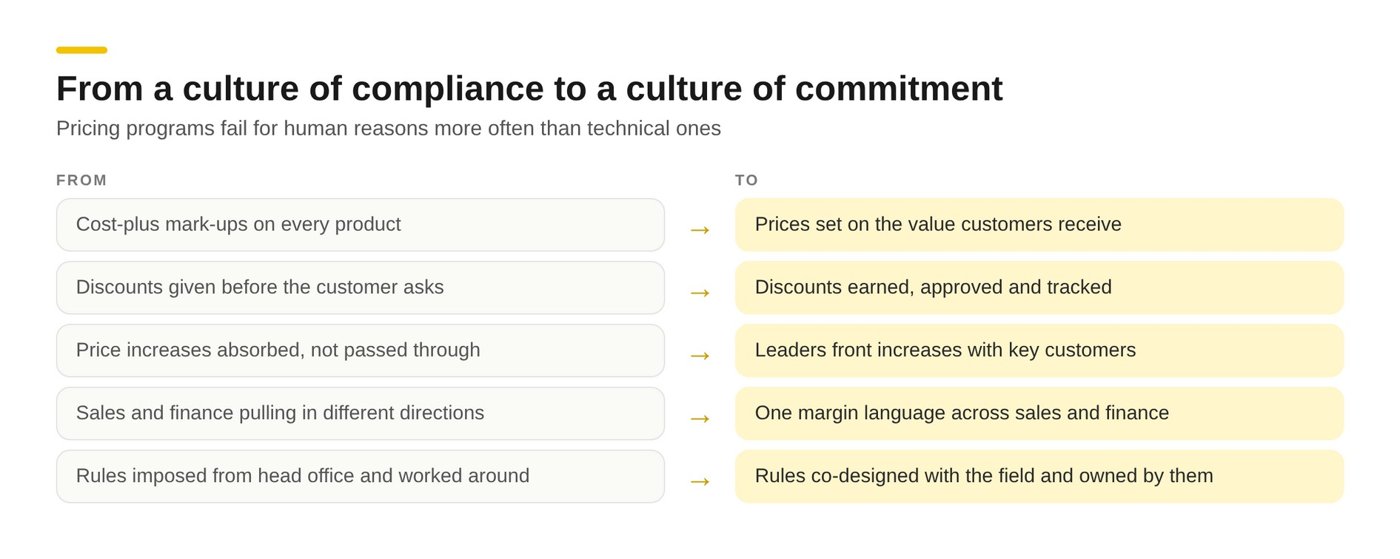
Figure 2. From a culture of compliance to a culture of commitment.
The figure sets a culture of compliance, which follows rules handed down, against a culture of commitment, which owns the result. A large Australian building-materials group facing sharply rising input costs put commercial staff across every business unit through a structured pricing course. Each module ended with staff nominating margin ideas, which management ranked and tested. Over the program the group realised about 400 basis points of margin expansion, and operating profit before one-off items rose by about a quarter on the year before. Price moves in the same period were not separated out, so not all of it can be credited to the course.
Culture also follows pay. An incentive on revenue alone pays a representative to sell at a lower margin to reach budget. The CFO is accountable for incentive design, and the first step is a margin measure in the next sales plan. When a representative walks away from business below the floor, the CEO should back that decision in public.
Change readiness is the capacity to adopt a pricing change and keep the discipline. Staff at one business, having seen projects stall, were waiting to see whether the next one stuck: "Company has a history of good initiatives but poor implementation." One early version of the cabinet hardware distributor's strategy allowed any line to move up or down by as much as 15 per cent. About 30 per cent of walk-up customers would have seen a decrease. The later version changed each point:
- Early version: per-line cap of plus or minus 15%. Later version: first-year cap of about 7.5% per line.
- Early version: some named accounts see decreases. Later version: named accounts see increases only.
- Early version: about 30% of walk-ups see a decrease. Later version: walk-up increase set at about 9%.
In the projected first year, seven in ten customers see a net rise of about 1.6 to 2.0 per cent. That choice gives up some first-year margin to win acceptance, and it is a CEO decision.
Mergers, system changes and restructures also move price files and remove experienced people. Name a pricing owner for each transition, separate from the system project, and check invoiced prices against agreed prices for major customers each month until the errors are cleared.
Which Pricing Periodic Table elements does this paper cover?
- 20 Ed Executive direction: a one-page pricing direction by customer group and channel, agreed by the executive and held for the planning year.
- 21 Ca Cross-functional alignment: one margin waterfall used by every team, with a shared margin measure beside each team's main target.
- 22 Rs Roles and decision rights: a signed RASCI with exactly one accountable person for each pricing decision, and approval limits loaded in the quoting system.
- 23 Pn Pricing council: a council with a charter, a fixed calendar, a five-item agenda and a decision log reviewed against results.
- 24 Mc Margin culture: every discount matched by something in return, discount authority only for staff who can cost a discount, and margin in sales incentives.
- 25 Ch Change readiness: changes paced to what customers and staff can accept, and a named pricing owner for every system change, merger or restructure.
Score each element from 1 (not in place) to 5 (measured, reviewed on a fixed date and improved); a score of 4 or 5 needs a document or report to back it.
Frequently asked questions
Who should be accountable for pricing decisions?
Each pricing decision should have exactly one accountable person, because a decision with two owners stalls when they disagree. The CEO owns price position and the governance rhythm, the CFO owns margin targets, discount limits, price floors and incentive design, the Marketing Director owns list prices and the Sales Director owns customer negotiations.
What is a Pricing Council?
A Pricing Council is a standing meeting where the executive, sales, marketing, finance and pricing make and review major pricing decisions together. It has a written charter, named members and one agenda, and it approves price increases, list and tier changes and major exceptions. Every decision goes in a decision log with an owner and a review date.
How much operating profit is lost when a cost increase is not passed on?
In a teaching example, a product sells at $100 with a cost of goods of $70 and operating profit of $5. When the cost of goods rises to $72 and price stays at $100, operating profit falls to $3, a drop of 40 per cent.
Where should a business start?
- CEO: Write down who sets list price, who approves a discount above the standard limit and who designs rebates, and mark any decision with no name or two names. Book the first Pricing Council for this month, with a one-page charter, a five-item agenda and a decision log.
- CFO: Set the margin floors and approval limits, and add a margin measure to sales incentives at the next plan. Report each month how much of each list price change reaches pocket price.
- Sales Director: Ask three representatives what the business wants price to achieve in their largest customer group and compare the answers. Send exceptions to the council rather than around it.
- Marketing Director: Bring proposed list, tier and increase changes to the council with a written reason and customer talking points.
- Pricing Manager: Draft the RASCI and council charter, keep the decision log and report price achieved against direction each month.
Related reading: The Pricing Team, Holding Price in the Field and Making Pricing Change Happen.
This paper is drawn from the book Pricing Insight: How to set, negotiate and hold your price, by Ron Wood.
To discuss how this applies to your business, contact Ron Wood.