
.webp)
Customer agreements protect margin when Pricing Insight's four disciplines are in place: agreements record the value delivered and the customer's commitments, not price alone; rebates are paid only for growth, range or behaviour the business wants; one register of every agreement is visible to the people who quote; and renewals are prepared at least 60 days ahead.
A foodservice packaging supplier found that a national contract caterer earned site margins of 53 to 56 per cent on the invoice, but 32 to 37 per cent once a rebate of about 30 per cent of purchases was counted. A pricing model read alone said the caterer's invoice prices were about 11 per cent too high; read with the agreement, the account was paying too little on net price. Cutting the invoice would have handed the customer a second discount.
The same supplier paid about 95 per cent of its rebates on turnover, whatever the customer did; the correlation between rebate rate and customer growth was 0.13, which is almost none. Rebates paid without checking the behaviour they buy rank third among the gaps staff raise in diagnostic surveys.
Four disciplines keep the result of a negotiation. Agreements record the value delivered and the customer's commitments, not price alone. Rebates are paid only for growth, range or behaviour the business wants, with a threshold, a cap, checks, claw-back and an end date. One register of every agreement is visible to the people who quote. Renewals are prepared at least 60 days ahead with evidence and a walk-away price.
First actions: score the largest agreements against a nine-term checklist, and total the rebates paid to customers whose spend or margin fell.
Where does the agreement give margin away?
Two readings of one account. The packaging supplier's invoice view made the caterer look healthy; its agreement showed the rebate that cut those margins. A later pricing model found a rebate of about 26 per cent behind invoice prices that looked 11 per cent above fair value. Net price is what the customer pays after every discount and rebate, and on that basis the account was paying too little.
There was a further gap. Forty-five sites, holding nearly half the account's sales, were all flagged as closing on the same date, and no file explained why. The recommendation reversed the usual order, putting the rebate and its terms first in the next negotiation and invoice price second, after confirming the status of the closing sites. Projected pricing opportunity on the account was about A$180,000 a year, almost half of it tied to the sites flagged as closing.
The agreements staff describe record a transaction: the price, the rebate, the payment terms and the rules of supply. Some smaller customers trade on an account application and standard terms alone. Commercial teams describe their own agreements this way: "I don't believe our customer agreements provide any detail on value, but rather focus on rebate support and price." Some have none: "it's based on a do they trust/like us basis."
What does an agreement that records value contain?
A value-based agreement adds two things to the price: the value the business delivers, and what the customer commits to in return, whether volume, share of spend, range or forecast accuracy.
Value comes from the Customer Value Discovery canvas. Value in use has three frames: Tangible (the What, such as grade and consistency), Transactional (the How, such as delivery and lead times) and Tradeable (the How much, such as terms and pricing model). Value at risk covers supply failure, product or service failure and technical support failure. Items the customer scored most important, and where the business outscored its competitor, are written into the agreement with a measure beside each.
Each concession is then tied to a commitment, a give-get written into the contract with a review date, because customers otherwise forget the commitment. A building-products salesperson described stock held for a customer against a promise of future orders: "the customer forgets why they gave the commitment in the first place and expects the same benefits without it."
An Australian supplier of industrial air compressors had no such tie. Its service and parts agreements were discounted to win loyalty, staff delivering the service were unsure what the agreements included, and agreed prices for key customers were often not written down. The recommendation was a value-based service agreement stating what is included and the customer's uptime and energy savings, with set contract prices that could not be changed by hand at the point of sale. No result has been reported.
Nine terms test whether a contract captures value. In one worked training account, only two of the nine were in place.
Checklist
- A price review clause with dates and triggers
- Cost indexation to a named, published index
- Rebate thresholds set above current volume
- A cap on rebates
- Rebate checks and claw-back
- A minimum volume or term
- Payment terms matched to price
- Service levels tied to what the customer values
- Exit and renegotiation triggers
A contract with no review clause or cost indexation, a price that moves with a published cost index, cannot pass on a cost rise until it ends.
Agreements need not be long: a short template for each segment, with a one-page value schedule, is enough for most accounts. The schedule records value in use, value at risk, the service promise, the price basis, freight minimums, returns rules, each give-get and the review date. Accounts move onto the template at renewal, largest first, and clauses that sellers cannot explain or customers will not sign are rewritten before the next tier.
What should a rebate buy?
A rebate is money paid back to the customer after the sale. Designed well, it rewards growth, range, share of spend or prompt payment, and is paid only when the customer does what was agreed. Designed poorly, it is a flat rate paid from the first dollar and rolled over each year.
Rebates sit below the invoice line. They lower the pocket price, what the business keeps after every discount, rebate and cost of the sale, yet seldom appear in the margin reports sales staff use. In the illustrative waterfall below, a list price of 100 becomes an invoice price of 76, and rebates, freight and small orders, and payment terms then take a further 10 points to a pocket price of 66. Rebates are the largest of the steps below the invoice line.
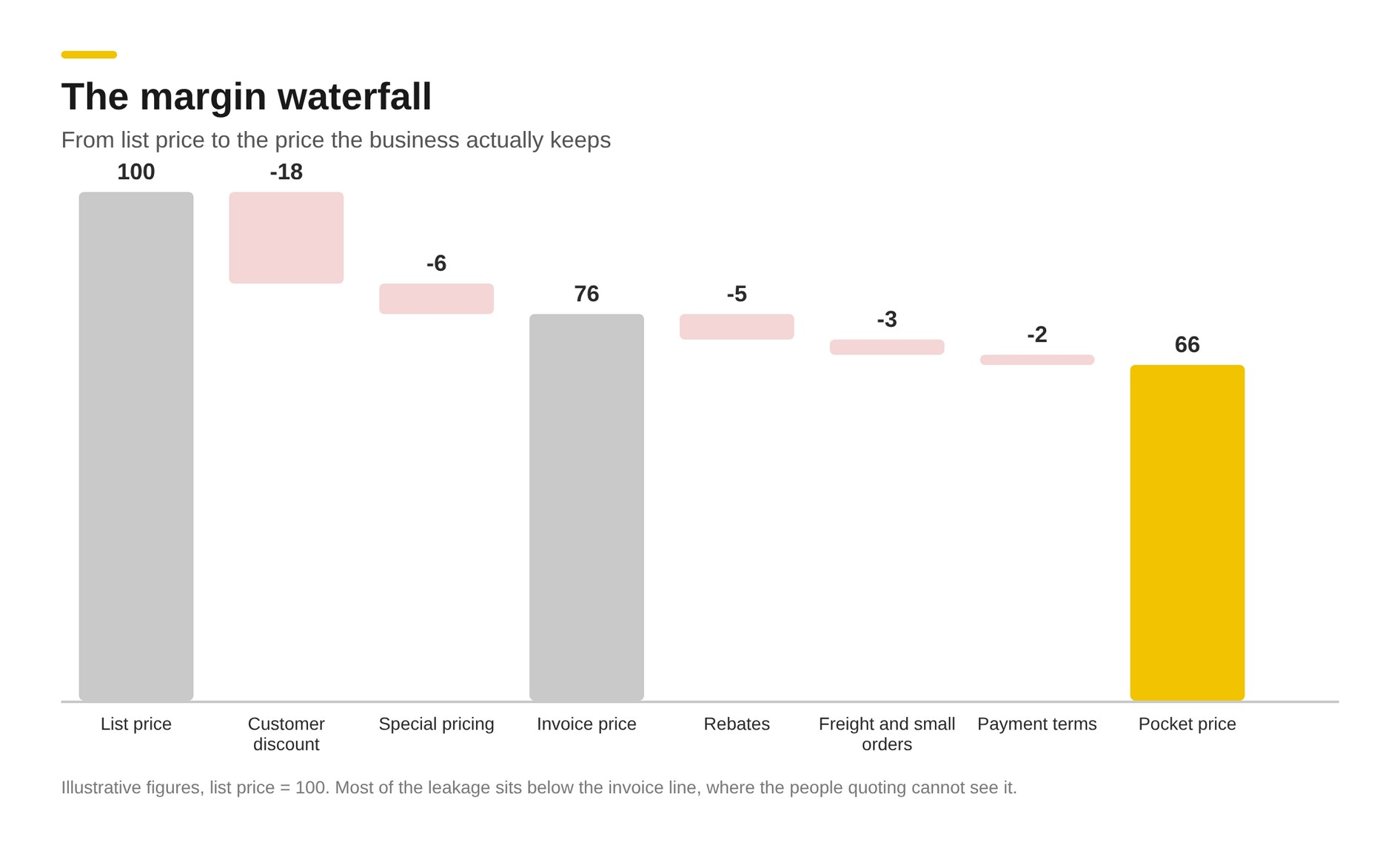
Figure 1. The margin waterfall: from list price to the price the business actually keeps.
At the packaging supplier, about A$3 million of rebates went to groups whose sales did not grow. One distributor's sales fell about 13 per cent while it kept a rebate of about 7.5 per cent. Ten groups were flagged, each with a rebate above 5 per cent while sales fell, or above a quarter of the customer's gross margin. A new policy was recommended: every rebate in a written agreement with a term, a review date and a hurdle, paid in arrears only on growth, range or mix achieved, with the ten flagged groups reset first at renewal. The projected value was about A$0.4 million to A$1.3 million a year, counted within the wider pricing opportunity.
Seven predictable faults, set out in the figure. A myopic rebate is paid on one product rather than total spend. A complicated one has so many terms that customers misread the value. An excessive one goes to head office and never reaches the branches that buy. A passive one is paid whatever the customer achieves. Uncontrolled discounts are price overrides used to help the customer reach its target. A walk in the park sets targets so low, such as last year's sales, that they buy nothing new. The seventh rewards the wrong behaviour, such as loading up stock at quarter-end and then dumping it.
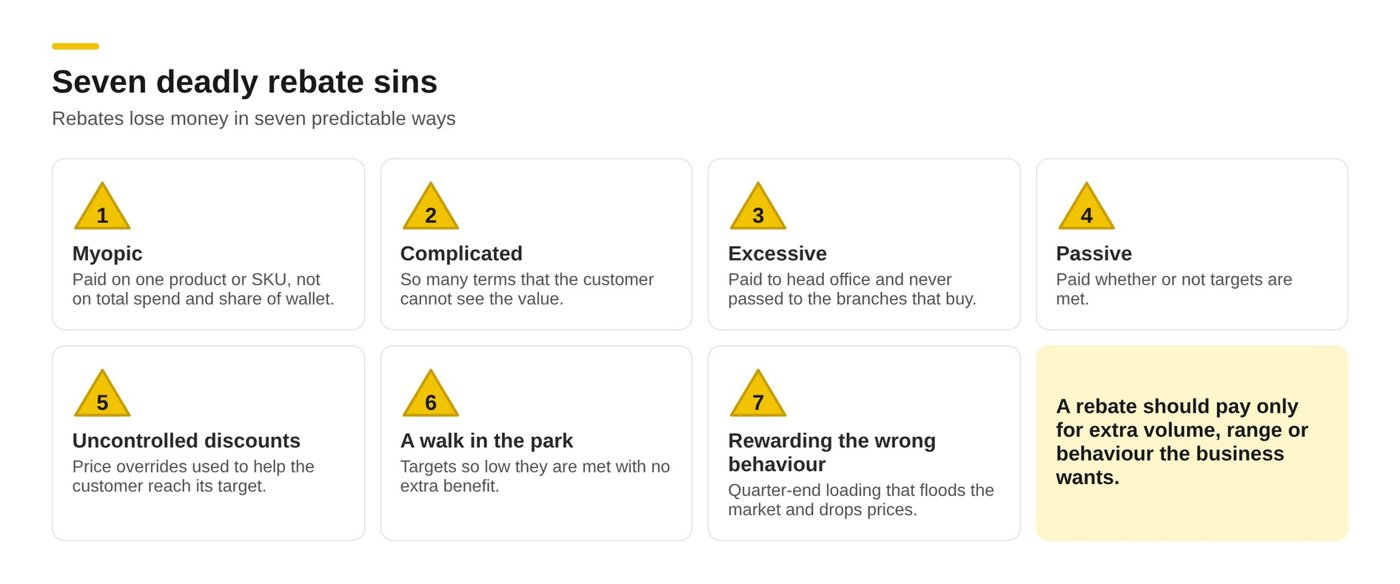
Figure 2. Seven deadly rebate sins: rebates lose money in seven predictable ways.
A sound rebate has five features, each closing a gap a flat rebate leaves open. Each line gives the flat rebate first, then the sound rebate that replaces it.
- Paid from the first dollar: threshold above current spend, so it pays only for growth
- Uncapped: capped, so a good year is not an open-ended cost
- Paid on the claim: checked against what the customer actually did
- No recovery: claw-back if a claim proves wrong
- Rolled over each year: end date, so it must be earned again
Design starts from the behaviour the rebate is meant to buy. Write it down, then model who qualifies, how the rebate is accrued and settled, what is excluded and how it stacks with other discounts, before the first customer hears the offer.
The numbers: illustrative figures
- A customer buys $1,000,000 a year at a 40 per cent gross margin, earning $400,000 of gross profit.
- A flat 5 per cent rebate from the first dollar costs $50,000, or one-eighth of that gross profit.
- A 5 per cent rebate paid only on spend above $1,000,000 costs nothing if spend stays flat.
- If spend grows to $1,200,000, the tiered rebate costs $10,000 against $80,000 of extra gross profit.
- If spend falls to $900,000, the flat rebate still pays $45,000. The tiered rebate pays nothing.
Every rebate is judged by its return: the extra gross margin it buys divided by the extra rebate paid. In a teaching example, a customer's rebate rises from 12 to 12.5 per cent in return for growth, and sales grow from $2.5 million to $3.0 million. The rebate costs $75,000 more and gross margin rises by $154,875, a return of about 207 per cent. A rebate that cannot show a return like this should be redesigned.
Converting a flat rebate is a negotiation in its own right, because the customer treats the old rate as an entitlement. The new structure should offer a path to earn the same or more through growth or range; cutting the rate and leaving the structure unchanged trades a large concession for nothing.
For the CFO, rebate cost is reported in basis points of revenue, a basis point being one-hundredth of a per cent. A sharper measure is the dollars paid to customers whose spend or margin fell in the same year. The person who sets a rebate should not approve its payment.
Why keep one record of every deal?
Special terms kept in filing cabinets, inboxes and the memory of whoever negotiated them are hidden from the people who price and quote. A state manager at one supplier said: "Even as a state manager I do not know what is in the corporate partners agreements."
At an Australian steel roll-former, rebates were agreed with distributors at head-office level, and branch staff at the distributors, not knowing the rebate behind a price, treated the invoice price as the net price and added further discounts, so the customer got both.
Hidden terms also cost business in the other direction. A New Zealand rural supplies co-operative negotiated supplier rebates on farm inputs centrally and did not show them to front-line sales. Reports showed negative invoice margin on deals that were profitable after rebates, so reps avoided them. The recommendation was a margin dashboard showing invoice margin beside margin after rebates, freight and cost to serve, which is what it costs to deliver, support and administer one customer's orders.
An agreement register fixes both problems. It is one list of every customer agreement in force, showing the customer, the price basis, the rebate and other off-invoice terms, the conditions, the named owner and the end date. A spreadsheet will do at first, provided there is one version, kept current and readable at the point of quoting.
A register also stops prices outliving the deals they were set for. An Australian trade distributor of cabinet and architectural hardware ran "tender pricing" that was in practice a six-month contract price with no link to a job and nothing to make it expire. In one state's architectural hardware business alone, about 64,000 tender lines had no sales in twelve months, each still a live price a customer could call on. The recommendation split contract prices into three kinds: key-account and everyday prices with no end date, tender and project prices ending at 12 months, and short-term project prices at three to six months. Dormant lines would be retired and every exception given a reason code, an owner and an end date. The redesign was recommended; it has not yet been measured.
Five rules for a working register:
- Every agreement, rebate and special term is recorded, with a named owner and end date.
- Account managers hold a one-page summary of each customer's terms, and customers get a copy.
- Rebate values appear on the margin report and the quoting screen.
- Renewal dates are grouped where possible, with reminders well before each end date.
- No agreement is paid unless it is in the register.
Rule five gives the register its force: once payment depends on it, the people who negotiate terms have a reason to record them. Each quarter the CFO checks the rebate set aside in the accounts against the register; any gap is margin committed without a record.
Why is renewal the next negotiation?
A renewal handled as a paperwork roll-over carries forward the old price, the old rebate and every concession granted along the way. A staff member at one supplier described it: "A lot of agreements are renewed YOY without any detailed analysis on whether product mix has changed or margin has increased/decreased."
The packaging supplier faced this at scale. Customers took packaging to tender as agreements neared their end, forcing lower margins to secure extensions. One convenience-chain agreement fixed prices for three years, so a 3 per cent general increase did not reach contract customers. The recommended plan left fixed-price contracts out of the first price round rather than breaking them mid-term, and at each renewal added cost-indexation clauses, a price review date, a walk-away price for the tender and a negotiation pack 60 days ahead, with no result yet reported.
What people say
"Rebates are given if targets are met, and possibly even if they are not."
"Most of the live jobs are without a contract or an agreement. I can never understand this but I think it's a big risk to us."
"Pricing that's been locked in and essentially unchecked."
Start from the register's list of agreements ending in the next two quarters. For each one, the account owner prepares a short case on value delivered and margin after all rebates, recording whether the customer met its commitments and how its prices compare with similar customers. Where the customer has not met its commitments, the rebate is reset; where the account is below the floor, the price is corrected. A walk-away price is set before the first meeting.
Which Pricing Periodic Table elements does this paper cover?
- Va Value-based agreements: Major agreements record the value delivered, in value in use and value at risk, and what the customer commits to in return
- Rb Rebate and incentive design: Every rebate is paid only for measurable customer performance above a threshold, capped, checked and reviewed before renewal
- Ar Agreement register: One current register of every agreement, its terms, owner and end date, visible on the quoting screen
- Rn Contract renewal and renegotiation: Renewals prepared at least 60 days ahead with a negotiation pack and a walk-away price, not rolled over
- Tn True net price: The net price after rebates and off-invoice items is visible as a margin waterfall for each account
Score each element from 1, not in place, to 5, best practice, against what the business does today, with a document or record to support any score of 4 or 5.
Frequently asked questions
How should customer rebates be structured so they pay for growth?
A sound rebate has a threshold above current spend, a cap, checks against what the customer actually did, claw-back if a claim proves wrong and an end date. Each rebate is judged by its return: the extra gross margin it buys divided by the extra rebate paid.
What should a B2B customer agreement include besides price?
It should record the value the business delivers, in value in use and value at risk, and what the customer commits to in return, such as volume, share of spend, range or forecast accuracy. Nine terms test whether it captures value, including a price review clause, cost indexation, rebate thresholds and caps, and exit and renegotiation triggers.
How far ahead should a contract renewal be prepared?
At least 60 days ahead, with a negotiation pack and a walk-away price set before the first meeting. The account owner prepares a short case on value delivered and margin after all rebates, and records whether the customer met its commitments.
Where should a business start?
- Sales Director: Pull the ten largest agreements and score each against the nine-term checklist.
- CFO: List every rebate paid last year to a customer whose spend or margin fell, total the dollars, and check the rebate accrual against the agreements on file.
- Sales Director: Name every agreement ending in the next six months, with its owner, and set a negotiation pack date 60 days before each.
- Pricing Manager: Build the agreement register, starting with the largest accounts, and show rebates on the quoting screen.
- Marketing Director: Supply the value statement and service promise for each segment's agreement template from the Customer Value Discovery canvas.
Related reading: The Price You Actually Keep, Price Increases That Stick and Trade Rebates That Pay for Value, Not Volume.
This paper is drawn from the book Pricing Insight: How to set, negotiate and hold your price, by Ron Wood.
To discuss how this applies to your business, contact Ron Wood.