
.webp)
Much of the price a business keeps is set after the invoice, in rebates, discounts, freight and credits, and much of the cost before it, in buy prices. This Pricing Insight paper sets out five disciplines that close the gap: a margin waterfall, rebates judged on what they buy, cost to serve, override analysis and a cost pass-through rule.
A maker of compostable food packaging reported a national contract caterer as one of its best customers. The account was worth around A$3 million a year at an invoice gross margin of about 51 per cent. Its contract carried a rebate of 26 per cent of invoice revenue, booked away from the invoice. Net of the rebate, the margin kept was about 33 per cent, in the lower half of similar customers. Each percentage point of rebate was worth about A$33,000 a year, annualised.
Much of the real price is set after the invoice, in rebates, prompt-payment discounts, freight, promotional payments and credits. Much of the cost is set before it, in buy prices and supplier support that sellers never see.
Five disciplines close the gap: a margin waterfall to pocket margin, rebates judged by the margin they buy, profitability after cost to serve, override analysis, and a written rule for passing cost changes into price.
Build the waterfall for the twenty largest customers. Test every major rebate for what it buys. Rank customers on margin after cost to serve. Set approval limits on true net margin, with one definition of margin across the report, the quote tool and the approval matrix.
What separates the invoice price from the margin kept?
The packaging maker's review walked every figure from invoice revenue down to the margin kept, back to the business system. Invoice prices for the caterer were broadly in line with the market, so the account had never stood out. The review concluded: "Invoice prices are broadly aligned with the market; the rebate is the principal source of margin compression: recovery resides in the contract, not the price list." The work was a diagnostic, and no result from the renegotiation has been reported.
Rebates and cost to serve are among the gaps raised most often across diagnostic engagements, in particular rebates paid without checking the behaviour they buy, and cost to serve absorbed and forgotten.
What is a margin waterfall?
A margin waterfall shows every step between the published price and the money kept. It starts at list price, the standard price before any discount, and steps down through every reduction to the pocket price: the money the business keeps from the sale. Take away net cost and the result is pocket margin.
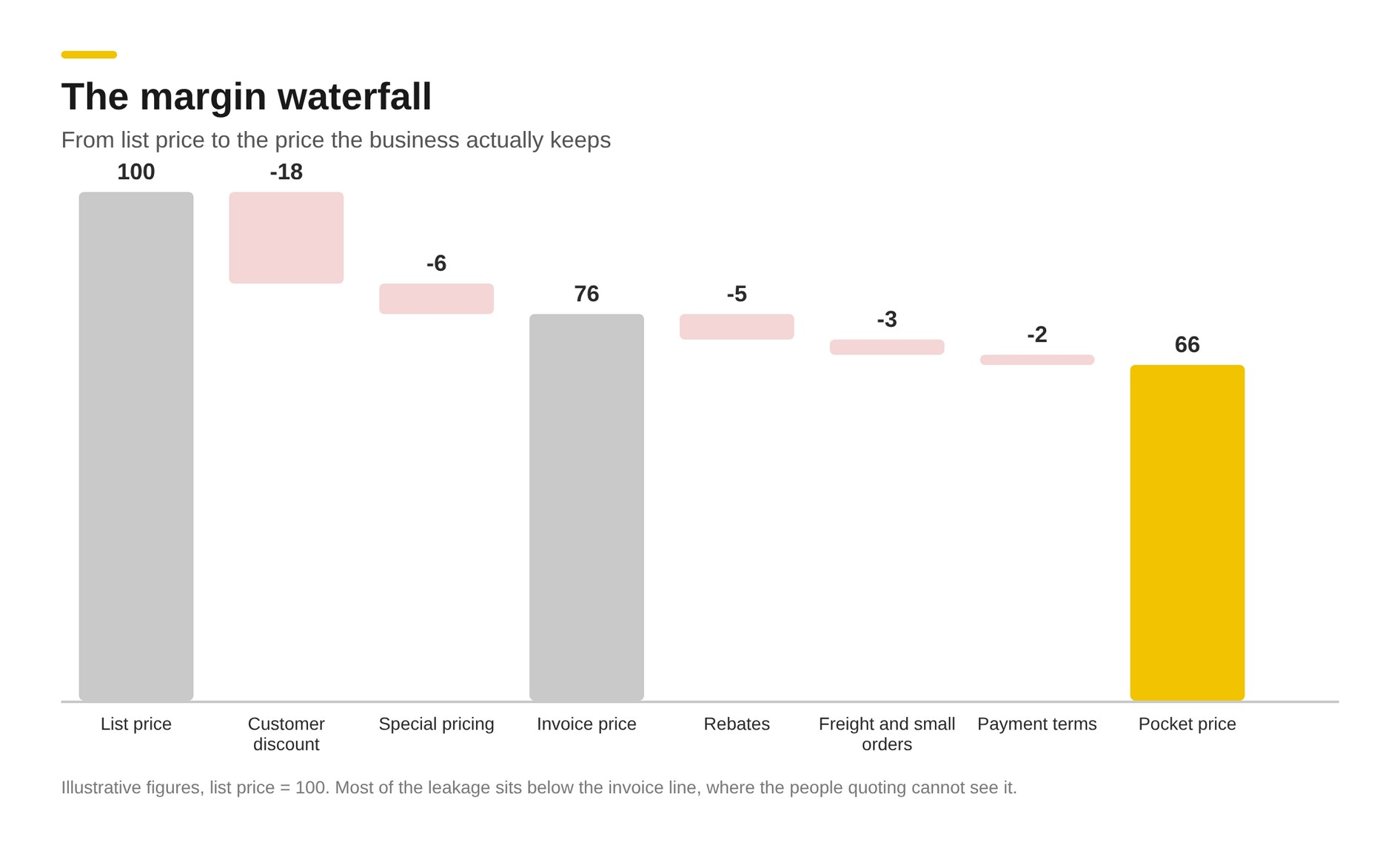
Figure 1. The margin waterfall.
Steps differ by industry; the shape in the figure is common. The customer's standard discount turns list price into invoice price. Below the invoice sit the off-invoice items: rebates, prompt-payment discounts, promotional funds, freight absorbed, payment terms and credits.
The numbers: illustrative figures
- List price $100, less a 20 per cent customer discount, gives an invoice price of $80.
- Off-invoice items take a further $12: rebate $6, prompt-payment discount $2 and freight absorbed $4.
- Pocket price is $68. Net product cost is $60.
- Invoice margin is $20, or 25 per cent. Pocket margin is $8, about 12 per cent.
Three-fifths of the invoice margin is given away after the invoice is raised.
In a teaching example, a business with $100 million of sales at list price kept $42 million after customer discounts, tactical discounts and rebates. Product costs took $30 million and overheads $10 million, leaving operating profit, or EBIT (earnings before interest and tax), of $2 million. The next year, tactical discounts rose from 8 to 9.25 per cent of the invoice price and rebates from 5 to 6 per cent, together about $1 million. Operating profit fell to about $0.95 million, about half, and neither change showed on a list price report.
Three panel sellers in a timber and panels distributor tested it on a key customer's main laminate panel, listed at $360 and invoiced near $240 after standard and tactical discounts. After product cost and overheads, the business earned about $3.40 a panel. Trimming the tactical discount to bring the invoice to $260 lifted modelled earnings to about $23.40. Charging for freight in place of free delivery lifted it to about $10.85 on its own.
An Australian plumbing supplies distributor held supplier rebates and price support behind invoice cost, so staff did not know the true net cost of a product. Special-order quotes went in at nil invoice margin on the belief that supplier rebates would supply the profit, with no check that they did. Its review recommended showing net cost after rebates when quoting, blocking zero-margin special quotes and training staff on supplier support. No result is stated.
No new system is needed to start a waterfall. The data usually sits in the business system, the rebate ledger and the freight accounts. The work is joining them by customer and product, and reconciling the total to reported gross margin.
How should a rebate pay for growth?
A rebate is money paid back to the customer after the sale. Paid on sales the business would have made anyway, it is a discount paid months later.
In a teaching case, a hardware chain's purchases of insulation from a maker fell from $3.0 million to $2.5 million over three years. Over the same years, rebates and price overrides rose from 13 to 20 per cent of sales. In the first year they took about 40 per cent of the account's $1.0 million gross margin. By the third year they came to about $0.5 million, as much as the whole gross margin the account still earned.
Three common faults. A myopic rebate is paid on one product, not total spend, so a competitor can win the rest of the customer's spend. A passive rebate is paid whatever the customer does. A target set at last year's sales pays for nothing new. A leader in a timber distributor wrote about a cladding system: "Instead of offering rebates per m2 of [our cladding system] we should implement a performance target for the customers to achieve e.g. hit 20000m2 get $1 m2 back, rather than just give them the $1 for every m2 they buy."
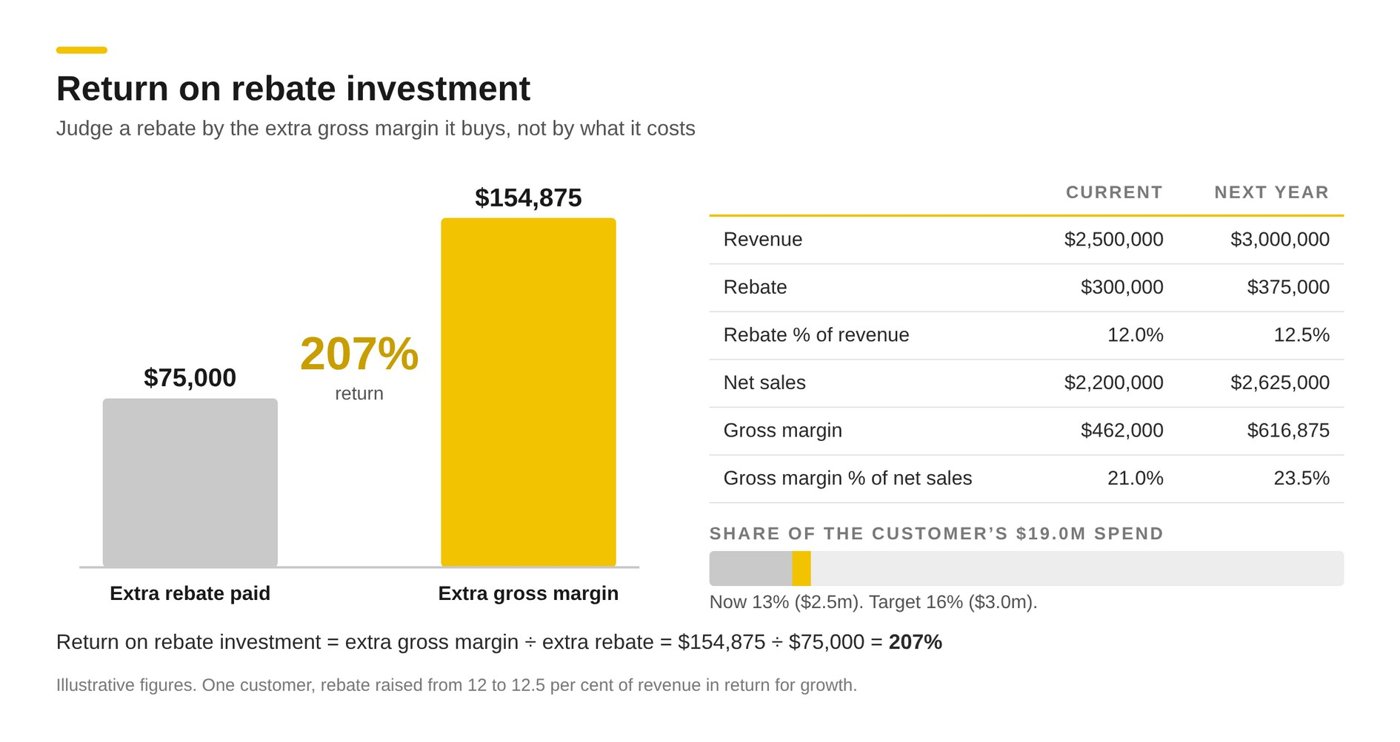
Figure 2. Return on rebate investment.
Judge a rebate like any other investment. Return on rebate investment is the extra gross margin it buys divided by the extra rebate it costs. In the teaching example in the figure, a customer spent $2.5 million a year from a category spend of about $19 million. The supplier offered 12.5 per cent in place of 12 per cent for growth to $3.0 million. The extra rebate cost $75,000 and the extra gross margin was about $155,000, a return of 207 per cent.
Rebates on total spend also make it harder for a rival to pick off one product. A New Zealand competition study found some volume rebates to building merchants made it hard for rival products to reach the shelf. Design rebates to reward growth, not to lock out competitors.
Checklist
- What is the rebate for, in one sentence?
- What target must the customer reach before it pays?
- What performance does it reward, across which products?
- When does it end?
- What extra buying has it won that would not have happened anyway?
Behind each answer sits a model that includes every other discount the rebate stacks on, so the customer's full net price is known before signing. The person who sets a rebate should not approve its payment.
How does cost to serve change customer profitability?
Cost to serve is what it costs to supply a customer beyond the product itself: freight, small and split deliveries, returns, credits, technical support and long payment terms.
An Australian trade distributor of cabinet and architectural hardware scored about 4,900 named accounts on range breadth and margin, each against peers of similar size. Two groups of broad-range, loyal buyers looked almost the same. About 1,400 "strategic partners" earned 38 per cent gross margin, and about 1,100 "loyal but under-priced" accounts earned 29 per cent. The analysis put it plainly: "a nine-percentage-point margin gap ... with no difference in loyalty to justify it." Size explained only about a quarter of the variation. The largest share of the projected uplift, about 38 per cent, was to come from the under-priced group; it is a projection, not a result.
At an Australian insulation maker, a sales manager reviewing one rebate found "we paid more to the customer in advertising support than the gross profit we had made from them." The recommendation was to tie rebates to targets and growth across all significant agreements.
The numbers: illustrative figures
- Two customers each buy $200,000 a year at a 25 per cent gross margin: $50,000 each.
- Customer A takes 50 full-load deliveries a year. Customer B takes 400 small drops.
- At $60 a delivery, A costs $3,000 to deliver and B costs $24,000.
- B also returns goods that cost $1,500 to handle, and pays at 75 days rather than 30, which costs about $2,000 a year at 8 per cent.
- Net margin after cost to serve: A about $47,000; B about $22,500.
On the invoice the two accounts look identical. After cost to serve, B earns less than half of A, and if both pay the same price, A pays part of the cost of serving B. A large costing project is not needed to start: an estimate from order count, order size, delivery distance, returns and credits will rank customers well enough to act on. Rank the largest customers by margin after cost to serve and compare each with peers of similar size. Agree an action and an owner for the bottom group: reprice, restructure rebates, add service charges or, now and then, walk away.
How do overrides and buy prices affect margin?
An override is any sale below the system or agreed price. Together, overrides make up the tactical-discount step in the waterfall. Over six months, revenue and override dollars can rise together while gross margin dollars fall. A panels seller wrote: "We do not track our discounting and overrides."
The chief executive of a New Zealand rural supplies co-operative estimated that about 80 per cent of its lost margin sat in sales under A$2,500, and proposed hiding cost from sellers. The advice was to compare the share of small sales with a manual override against those sold at standard price. If reps were overriding, limits would fix it. If standard prices were too thin, hiding cost would change nothing.
Where overrides cluster shows what is probably wrong:
- A product line: the corridor or base price for that line.
- A person: the authority level or the coaching.
- A customer: the agreement, which needs renegotiating.
A seller at a timber distributor branch reviewed the buy price of thin MDF board, about 9,200 sheets a year at $8.88 a sheet and 16 per cent gross margin. The seller switched to an equal sheet costing $5.51 in place of $7.50 and cut the price 2.7 per cent to $8.64. Gross margin on the line rose from about $12,700 to about $28,800 a year. That result is self-reported and not checked.
At the packaging maker, leaders credited current margin to a strong Australian dollar and supplier cost cuts. A 10 per cent fall in the dollar, not passed on, would cut gross margin by about A$12 million a year, a projected exposure more than four times the pricing opportunity.
The numbers: illustrative figures
- Price $100. Product cost $70. Overheads $25. Operating profit $5.
- The supplier raises cost by $2, to $72.
- If price does not move, operating profit falls to $3: a fall of 40 per cent.
- To hold margin dollars, raise price by cost increase × (1 − gross margin).
- For a 3 per cent cost rise at 30 per cent gross margin: 3 × 0.7 = 2.1 per cent.
Three disciplines protect the cost line. Each item carries one current cost, so floors, approvals and reports rest on the same number. The buying team negotiates every supplier increase before it is loaded. A written rule decides how much of each cost change reaches the sell price, and how quickly, in both directions.
How should deals be approved on the bottom line?
An Australian door hardware supplier set approval limits on gross margin percentage, and reps worked discounts back to just above the limit. One state met its gross margin target every month, yet the business was not profitable, and staff were unclear whether margin meant gross margin or variable margin.
Three parts to the fix. Publish one definition of margin and use it in the monthly report, the quote tool and the approval matrix. Show net cost after supplier rebates, and expected pocket margin, at the point of quoting. Require deals that depend on rebates or off-invoice support to name that support before approval.
Report the result to the board in two numbers. First, the gap between invoice margin and pocket margin, in basis points, for the business and its largest customers; a basis point is one-hundredth of a percentage point. Second, the share of that gap with an owner and a dated action.
What people say
"Rebates are hidden and the Sales force at times are guessing what our real costs are"
"We are not good at negotiation as we don't know our true cost on a lot of items"
"because the LOA are structured on achievement of a GM% , the team can manipulate the discounts to achieve this"
Which Pricing Periodic Table elements does this paper cover?
- 16 Rb Rebate and incentive design: Every rebate has a written purpose, a growth target and an end date, and is judged on return on rebate investment.
- 44 Or Override and discount analysis: Every override carries a reason code, and overrides are reported monthly by rep, customer and product.
- 45 Pr Cost to serve and profitability: Customers and products ranked on net margin after cost to serve, with an action and owner for the bottom group.
- 55 Tn True net price: A margin waterfall from list to pocket margin for the largest customers, reconciled to reported gross margin.
- 56 Bc Buy-price and cost management: One current cost per item, every supplier increase negotiated before loading, and a written pass-through rule.
Score each element from 1 to 5, where 1 means it is absent, with no owner and nothing written down, and 5 means it is in place, used every week and measured.
Frequently asked questions
What is pocket price?
Pocket price is the money the business keeps from a sale after the customer discount and every off-invoice item, such as rebates, prompt-payment discounts, freight absorbed, payment terms and credits. Take away net cost and the result is pocket margin.
How do you tell whether a customer rebate is worth paying?
Return on rebate investment is the extra gross margin a rebate buys divided by the extra rebate it costs. In the paper's teaching example, an extra $75,000 of rebate bought about $155,000 of extra gross margin, a return of 207 per cent.
How much should prices rise to cover a supplier cost increase?
To hold margin dollars, raise price by the cost increase multiplied by one minus the gross margin. For a 3 per cent cost rise at 30 per cent gross margin, that is 2.1 per cent.
Where should a business start?
- CFO: Take the largest customer and list every item between its invoice price and the cash kept, with the dollar value of each. Then work out the extra gross margin each of the three largest rebates bought last year.
- Pricing Manager: Build the waterfall for the twenty largest customers and report overrides by rep, customer and product each month.
- Sales Director: Require a reason code on every override, and set an action for each account below the profitability floor.
- Marketing Director: Test each rebate and promotional payment for what it buys, and use product profitability to decide which lines to promote, reprice or drop.
- CEO: Decide that deals and customers are judged on pocket margin, not invoice margin, and back the decisions that follow when a large customer threatens to leave.
Related reading: A Price Structure That Holds: List Prices, Method, Tiers, Relativities, Service Charges and Corridors; Agreements That Protect Margin: Value-Based Terms, Rebates That Buy Growth and Planned Renewals; Price Increases That Stick: Sizing an Increase, Running It in Sequence and Checking It Reaches the Invoice.
This paper is drawn from the book Pricing Insight: How to set, negotiate and hold your price, by Ron Wood.
To discuss how this applies to your business, contact Ron Wood.