
.webp)
A seller holds price with four tools: a value case in the customer's dollars, written rules on how low to go, the maths to test a discount, and pay that rewards margin. Across Pricing Insight's diagnostic engagements, discounting to close a sale is the gap staff raise most often, and each matched price becomes the customer's new reference point.
In a pricing maths test at a New Zealand rural supplies co-operative, most sales staff could not work out what a discount costs. Field Sales, the team with the most freedom over price, rated its own skill highest and scored no better than the rest.
At a 30 per cent gross margin, a 5 per cent discount needs 20 per cent more volume to earn the same profit. At a 4 per cent EBIT margin (earnings before interest and tax as a share of sales), a 2 per cent price cut halves operating profit if nothing else changes.
Four things let a seller hold price: a value case in the customer's dollars, written rules on how low to go, the maths to test a discount, and pay that rewards margin.
Build a one-page value case for each main customer group from the Customer Value Discovery canvas. Publish a short playbook with floors, fences and permitted trades. Test the pricing maths of everyone who can discount. Add margin dollars or price realisation to every sales scorecard, and measure sellers and their managers on the same goals.
Why do sellers give price away?
Four short questions. The co-operative asked staff for the net price after a discount, the margin on a sale, the extra volume a discount needs to pay for itself, and the price rise that holds margin after a cost increase. Very few answered reliably. Sellers who quoted face to face, and often decided alone how far to discount, scored no better than anyone else.
None had been given a method to defend a price or a way to work out what conceding it cost. The review recommended a training trial for a small group of sellers, which has not yet been measured. A common benchmark for such training is 200 to 300 basis points of margin, where a basis point is one-hundredth of a percentage point, and the review flagged that figure as unproven for this business.
Discounting to close a sale is the gap staff raise most often across diagnostic engagements, and the pricing capability gap is second. Each matched price becomes the customer's new reference point, so the next negotiation starts lower.
What is a value case in the customer's dollars?
A value seller starts by asking what the customer is trying to achieve, what goes wrong and what that costs. The answers show where pricing power comes from: the problems the supplier solves and the risks it removes.
Four prices. Procurement, the team that runs a customer's buying, compares the invoice price. The customer also pays the operating price; the repair, replacement and disposal price; and the risk price, which is what it loses when a delivery is late, a product fails or support does not come. Professional buyers keep the discussion on the invoice: they appear uninterested, say they have only 30 minutes and call the product a commodity. A seller who sets out all four prices from the customer's own figures gives the buyer a cost and risk calculation, which is far harder to dispute than a claim about quality. A hospital tender was won at about a 3 per cent premium this way: the winner put a dollar value on a lower re-admission rate, which reaches the people who run the hospital, while the rival led with being 8 per cent cheaper, a number for procurement.
Customer Value Discovery is the working tool. Its canvas splits value in two. Value in use is what the product or service does for the customer, in three frames: Tangible (the What), Transactional (the How) and Tradeable (the How much). Value at risk is what the supplier protects the customer from: supply failure; product or service failure; technical support failure.
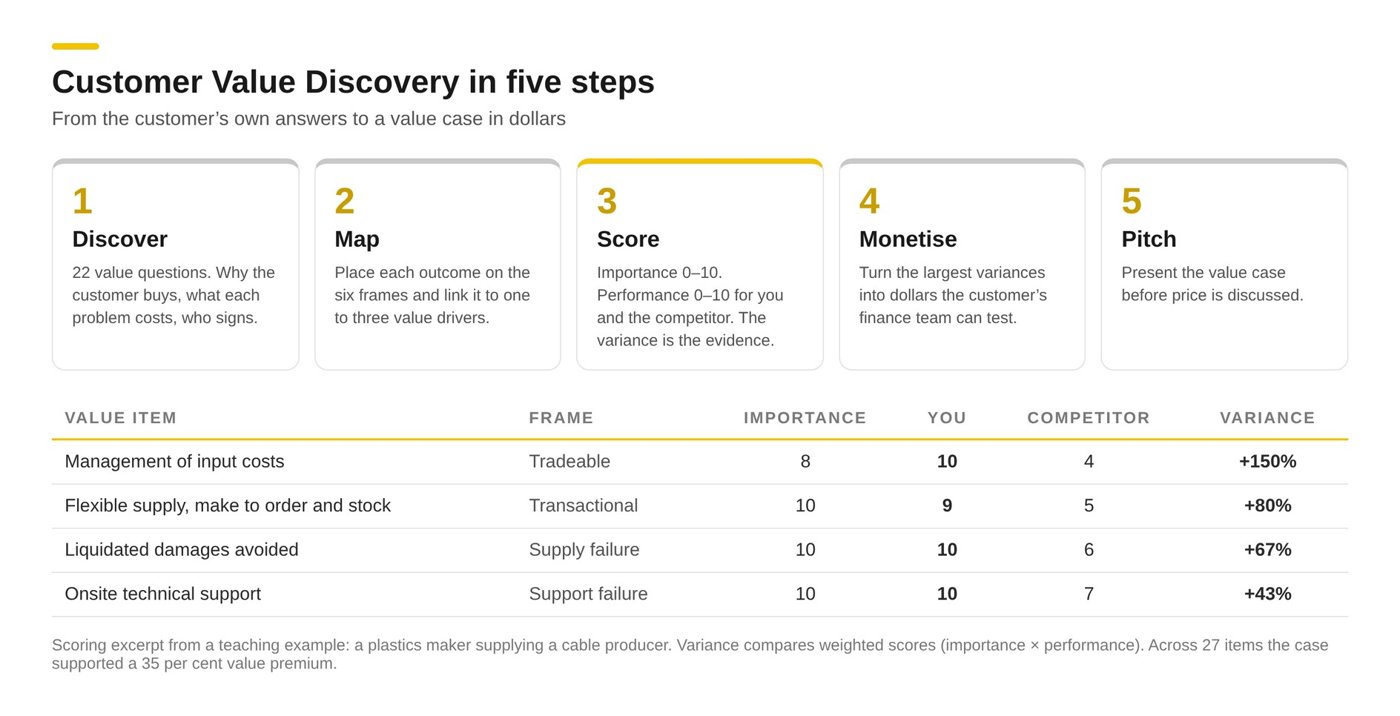
Figure 1. Customer Value Discovery in five steps: from the customer's own answers to a value case in dollars.
Five steps turn the canvas into evidence. Discover the customer's required outcomes in a structured interview. Map each outcome to a frame. Score its importance to the customer from 0 to 10, and score the supplier and the competitor on performance from 0 to 10. Monetise the largest gaps in dollars the customer's finance team can test. Then Pitch the value case before price is discussed.
Alongside the steps, the figure carries an excerpt from a teaching example. A plastics maker scored 27 value items with its cable-making customer. On management of input costs, a Tradeable item, the customer rated importance at 8, the supplier at 10 and the competitor at 4: a 150 per cent gap in weighted score. On liquidated damages avoided, a supply failure item, the scores were 10, 10 and 6. In this illustrative example, the case across all 27 items supported a 35 per cent value premium, against a price 20 per cent above the lowest bidder.
Three to five times the price gap is the working rule for how much value is enough. On a $2,000 quote against a rival's $1,800, the seller shows $600 to $1,000 of extra value over the life of the product.
A value case can be simple. A timber and building-products distributor supplies builders whose crews are paid by the hour and stand idle when frames arrive late. One of its sellers put it this way: "They may need a 7am drop and the ability to rely on that could be more important than a discount." That is a supply failure item, priced as the crew's hourly cost, times the hours lost, times the late deliveries in a year.
How a price seller and a value seller differ:
- Price seller: quotes first, asks questions later. Value seller: asks questions first, and knows which value the price relies on.
- Price seller: shows the invoice price alone. Value seller: shows the invoice price beside the operating, repair and risk prices.
- Price seller: matches a rival on the buyer's word. Value seller: asks to see the rival offer and checks it is like for like.
Ask to see the rival quote and check it line by line. If it leaves out freight, technical support or warranty, matching it discounts a better offer. Record what the rival quote included, so that it feeds the win and loss evidence.
How is the value case put on paper?
Four tools. A one-page value case for each customer group, built from the canvas scores, states benefits in the customer's terms, such as downtime avoided. A quote template shows the value delivered beside the price. Proof stands behind each claim: test results, delivery records and case histories a buyer can check. A short guide on presenting a price completes the set: because a full quote often loses to a stripped one on the headline number, it sets out a core price with each inclusion listed line by line.
Reps at an Australian distributor of cabinet and architectural hardware asked for a gap analysis showing what each customer was not buying. It found that the most profitable customers bought connectors with their drawers about twice as often as other accounts, and that those accessories earned about 47 to 53 per cent margin, against 26 to 31 per cent on drawers and hinges. The review recommended a cross-sell tool aimed at about 1,000 profitable accounts buying a narrow range; no result is stated.
What people say
"A lot of our sales teams have one agenda, price, we devalue our service, technical expertise's and brands."
"I've never seen the teams with a pricing tactics guide"
"The tendency to go to the lowest pricing level as a first step, means there is nowhere to go as a last resort."
What written rules does the field need?
Two of the eight common forms of margin erosion sit with sales: reliance on discounting to win business, and meeting procurement unprepared. Floors, fences and control of discounts address the first; training and a negotiation playbook address the second.
An Australian plumbing supplies distributor had neither. Most staff could not answer basic pricing questions, and branch managers and their assistants held discount rights with little or no pricing training. Its review recommended structured training for everyone able to override price, a published strategy, and a menu of tactics with floors and no-discount fences. It projected about A$10 million a year of extra operating profit within 12 months, with no result yet reported.
A field playbook covers six things.
Checklist
- The target price, the corridor floor and the hard floor for each major product group.
- Fences: lines on which no discount is given.
- The trades a seller may offer, and what each must buy in return.
- The walk-away point, and who may approve a price below it.
- Standard answers to the five or six objections sellers hear most.
- What to do when a customer quotes a rival price.
Keep it short enough to carry into a meeting and settle a decision without a call to head office. Every decision outside it goes to the discount authority matrix with a reason code, and a quarterly review of the codes shows where the same exception returns: either the rule is wrong or the seller needs coaching.
What is the arithmetic of a discount?
A panels seller wrote: "With my veneer customers I try to stick with a 30% margin but sometimes drop to 25% all depends on volume. Which I don't think has a huge impact on EBIT." Cutting margin from 30 to 25 per cent at the same cost takes about 7 per cent off the price and more than a fifth off the margin dollars on each sale, so the seller would need almost 30 per cent more volume to earn the same profit.
An Australian multi-brand specialty retail group tested its staff on similar questions. A 20 per cent discount at a 30 per cent gross margin needs 200 per cent more volume to break even; 300 per cent was a common wrong answer. The price rise that recovers a 5 per cent cost increase at 35 per cent gross margin is 3.25 per cent, and the most common wrong answer was 5.25 per cent. These were review findings, not results.
Two rules cover most of the arithmetic. The price rise that holds margin dollars equals the cost rise times one minus the gross margin. The extra volume needed after a discount equals the discount divided by the gross margin less the discount. Break-even is the point where profit after the change equals profit before it.
The numbers: illustrative figures
- A product sells for $100 and costs $70, so gross margin is $30 a unit.
- A 5 per cent discount cuts the price to $95 and the margin to $25 a unit.
- Five units earned $150 at full price; at $25 a unit, six must be sold to earn the same.
- Extra volume needed: 5 ÷ (30 − 5) = 20 per cent.
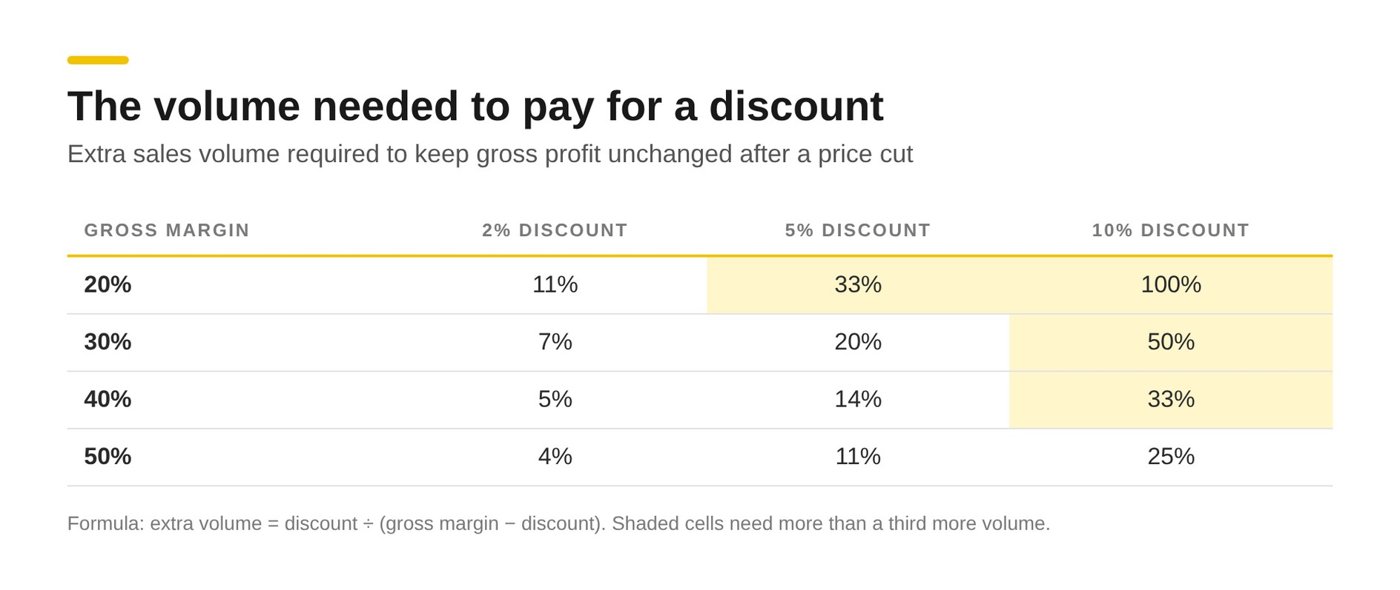
Figure 2. The volume needed to pay for a discount: extra sales volume required to keep gross profit unchanged after a price cut.
The figure gives the volume needed at four gross margins and three discount sizes. At 20 per cent gross margin, a 5 per cent discount needs 33 per cent more volume, and a 10 per cent discount needs 100 per cent more.
Mark-up and margin cause their own errors. Mark-up is gross profit as a share of cost; margin is gross profit as a share of price. A 50 per cent mark-up is only a 33 per cent margin. Sales reports, quotes and the accounts should define margin the same way.
A one-page decision sheet sets out each case. It shows current volume, the price received after rebates, the variable cost and the contribution per unit, then the proposed price, the volume needed to earn the same contribution and the result if that volume does not come. Require the sheet before any price cut meant to win volume is approved. Show break-even volume in the quote tool, and make passing a pricing maths test a condition of discount authority, repeated at induction and each year.
How should pay reward margin?
Account managers are often paid on sales while their sales and branch managers are paid on gross margin and EBIT. One staff member summed it up: "Account Managers incentivised based on sales. Sales Managers and Branch Managers incentivised based on Gross Margin and EBIT. Misalignment of goals." Under that design every discount sets the seller against the manager.
A former foodservice distribution executive described a business that had hidden cost and margin from its reps, who then sent every approval back to finance. The business let reps see cost and added quarterly bonuses linked to margin. By her account the effect was "almost instant", with about 32 per cent margin and about 220 per cent of the EBIT budget in one quarter. The account was cited as a benchmark in an agricultural review and has not been verified.
The numbers: illustrative figures
- A product sells for $100 at 30 per cent gross margin.
- A 5 per cent discount costs the business $5 of margin a unit.
- A seller paid 2 per cent of revenue loses 10 cents.
- A seller paid 10 per cent of margin dollars loses 50 cents, enough to notice.
Add gross margin dollars or price realisation, the price received as a share of the target price, to every sales scorecard beside growth, and measure account managers, sales managers and branch managers on the same goals. Keep the rules simple enough that a seller can work out in minutes what a 5 per cent discount does to their own pay. Before launch, run last year's payouts through the new scheme to check that it rewards what the strategy asks for, and review it whenever the pricing strategy changes. Give ownership of the scheme to the CFO, as owner of the margin target.
Which Pricing Periodic Table elements does this paper cover?
- 29 Vs Value selling: sellers ask before they quote, and present a Customer Value Discovery value case before price is discussed.
- 30 Vt Value marketing and sales tools: a one-page value case per customer group, quote templates that show value beside price, and proof a buyer can check.
- 31 Pb Pricing playbook: a short written guide with floors, fences, permitted trades and walk-away points, with exceptions reason-coded.
- 32 Nu Commercial numeracy: everyone with discount authority passes a pricing maths test, and break-even volume shows in the quote tool.
- 33 In Sales incentives: scorecards carry margin dollars or price realisation, and sellers and managers share the same goals.
Score each element from 1 to 5, where 1 means it is absent, with no owner and nothing written down, and 5 means it is in place, used every week and measured.
Frequently asked questions
How much extra volume does a 5 per cent discount need?
At a 30 per cent gross margin, a 5 per cent discount needs 20 per cent more volume to earn the same profit. At a 20 per cent gross margin it needs 33 per cent more. The rule is the discount divided by the gross margin less the discount.
How much value does a seller need to show to justify a higher price?
The working rule is three to five times the price gap. On a $2,000 quote against a rival's $1,800, the seller shows $600 to $1,000 of extra value over the life of the product.
How should sales commission be set to protect margin?
Add gross margin dollars or price realisation to every sales scorecard beside growth, and measure account managers, sales managers and branch managers on the same goals. A seller paid 2 per cent of revenue loses 10 cents when a 5 per cent discount costs the business $5 of margin, while a seller paid 10 per cent of margin dollars loses 50 cents.
Where should a business start?
- Sales Director: Ask three sellers what extra volume a 5 per cent discount needs at your usual margin. Check the answers against the break-even table.
- Marketing Director: Run Customer Value Discovery on the largest customer group and write the one-page value case from it.
- Pricing Manager: Write the field playbook, with corridors, floors and fences for each major product group, and put break-even figures in the quote tool.
- CFO: List every measure on a typical seller's scorecard and mark each one that rises when the seller gives a discount. Redesign the scheme around margin dollars.
- CEO: Decide whether the business competes on value or on price, and back sellers who hold price, even when a deal is lost.
Related reading: What Customers Pay For, Pricing on Evidence and Preparing for Price Negotiations.
This paper is drawn from the book Pricing Insight: How to set, negotiate and hold your price, by Ron Wood.
To discuss how this applies to your business, contact Ron Wood.