
.webp)
A price structure holds when the list is believable, the method is written down, the tiers are earned, relativities make sense, services are charged by rule and exceptions stay rare. This Pricing Insight paper shows a hardware distributor replacing five discount tiers with one list price less a single discount, for a projected 1.3 points of gross margin.
An Australian trade distributor of cabinet and architectural hardware ran five discount tiers with no link to customer size. An account spending about A$500 a year sat on the top tier beside one spending about A$1.2 million, and discounts ran from about 1 per cent to about 60 per cent. Reps moved customers to the second-highest tier and quoted below it, so every large quote set a new price.
One list, one discount. The redesign replaced the tiers with one national list price less a single discount that deepens with annual spend, with the published trade-counter price as the ceiling. The projected gain was about 1.3 points of gross margin (revenue less the cost of goods sold, as a share of revenue) in the first year, annualised.
The cases in this paper show six failures: inflated lists, cost-plus by habit, tiers granted in negotiation, pack prices that reverse, free services, and special prices that outlive their job. An Australian insulation maker that brought in a new price structure, took an increase and cut discounting lifted gross margin about 250 basis points, an annualised run-rate.
Set a believable list, write the method down, tie tiers to share of spend and fix relativities by rule. Publish a short schedule of service charges. Give every price below the corridor floor a reason code, a named approver and an end date.
When does a price structure stop governing price?
Six conditions. A price structure holds when the list is believable, the method is written down, the tiers are earned, the relativities make sense, services are charged by rule and exceptions stay rare.
At the cabinet-hardware distributor, management assumed the published tiers governed price; reps knew they were only the opening position. Drawer systems, hinges, lighting and joinery fittings all went through the same tiers, and the structure could no longer explain why one customer paid more than another.
The old structure and the new structure that replaced it:
- Five tiers with no link to customer size: replaced by one national list price less a single discount.
- Discounts from about 1% to about 60%: replaced by a discount that grows with annual spend across five spend bands.
- Top tier used as the opening position: replaced by the published trade-counter price as the ceiling.
- Deeper prices granted in negotiation: replaced by deeper discounts earned by placing more spend in key groups.
Its strategy stated the rule in two sentences: "Every price is one National List price less a single discount that deepens with customer size. No customer pays more than the published trade-counter (walk-up) price." All of the projected 1.3 points of gross margin was to come through capped increases.
What makes a list price believable and a pricing method sound?
A list price is what the business charges when nobody negotiates; it is useful only if routine orders can be invoiced from it. One staff member wrote: "Until we do that its a lottery and every price list is hand made."
An Australian decorative panels maker showed the customer's side. Its trade price book sat so far above the market that reps gave large discounts to reach a market price. One rep wrote that "…90% of my client base look at our list price and gasp…". Discount groups had not been reviewed for four years. The review recommended a national list with correct relativities and tiers tied to spend and region, with no result yet reported.
A building-products branch took the opposite course. Its shelf prices on commodity lines were set too high, so staff overrode them each in their own way. On suitable lines the branch replaced the shelf price with a single benchmark price: lower than the old ticket, the same for every customer and not open to further discount. Its manager reports that margin rose because the overrides stopped; the result is self-reported and was not checked.
A national plumbing and bathroom distributor's trade portal shows each plumber their negotiated price next to the recommended retail price, so a list far above any price paid is seen every day and stops being treated as a price.
An inflated list also forces large standard discounts, which leave little margin to absorb any further concession.
The numbers: illustrative figures
- List price $200, less a standard discount of 60 per cent: invoice price $80.
- Cost $60: gross profit $20 a unit.
- A further 5 per cent off list takes another $10.
- Invoice price falls to $70 and gross profit to $10.
A give of 5 per cent on list has halved the profit on the sale.
Test the list by the share of revenue invoiced at list or system price, by category. Where that share is low, the list has stopped governing price. Reset the most-quoted lines first, then check every price customers can see online.
Four methods. A price-setting method is the written way a business decides what customers should pay. Cost plus adds a mark-up to cost. Matching follows competitors. Mark to market sits deliberately above, at or below a competitor. Value pricing sets price as a share of the value the product creates for the customer; it is the only method that asks what the product is worth to the customer, and it takes the most work.
Cost plus with the same mark-up on every line under-prices where the business is strong and over-prices where it is weak. A construction seller at a timber distributor described the first half: "Too often we are drawn into a 'just put 25% on it' mindset, when we can get 35-40% on specialty products that competitors either may not have access to or can't procure." Neither error shows in a report, because each line's margin looks as planned. A UK distributor of healthcare consumables, with about 250 product groups, replaced cost-plus with algorithmic price recommendations based on customer value and pricing power, and realised about 800 basis points of margin expansion within 12 months.
Evidence for a value price comes from the Customer Value Discovery canvas. It scores what the customer gains from the product (value in use) and what it avoids (value at risk) against the next-best alternative, and converts the largest gaps into dollars. In a teaching example, the evidence supported a 35 per cent value premium and the supplier priced 20 per cent above the lowest bidder.
A written method names a reference point for each product class: customer value for lines that stand out, market price for commodity lines. It sets the rules for moving from that reference to a customer price, uses cost as a floor test, and has an owner who reviews it each year. Cost-plus can still be the right written choice for one-off project work with changing specifications. As a practical test, ask two people who set prices to price the same item, and compare both the answer and the route each took.
How should discount tiers and price relativities be set?
Discount structure is the set of standard levels and customer tiers that turn a list price into a customer's price. A sound structure has few levels, each with a stated purpose and an entry rule, checked against every account at least once a year.
Net pricing, where each customer has its own price for each product, looks flexible but does not scale. In a teaching example, a building-products maker with 1,200 products and 2,208 customer accounts would need about 2.6 million price records for 35 staff to keep current. Discounts set by product type and applied to customer groups need about 4,200. A leader in a timber business summed up the choice: "List less discount = far less variables and much easier to maintain. Net pricing = substantial inconsistencies."
An Australian supplier of door locks and architectural hardware, formed from several older businesses, ended up with customer discounts from about 20 to about 51 per cent across seven rates, with contract and special prices on top. Its review recommended a realistic list price and no more than three to five discount levels.
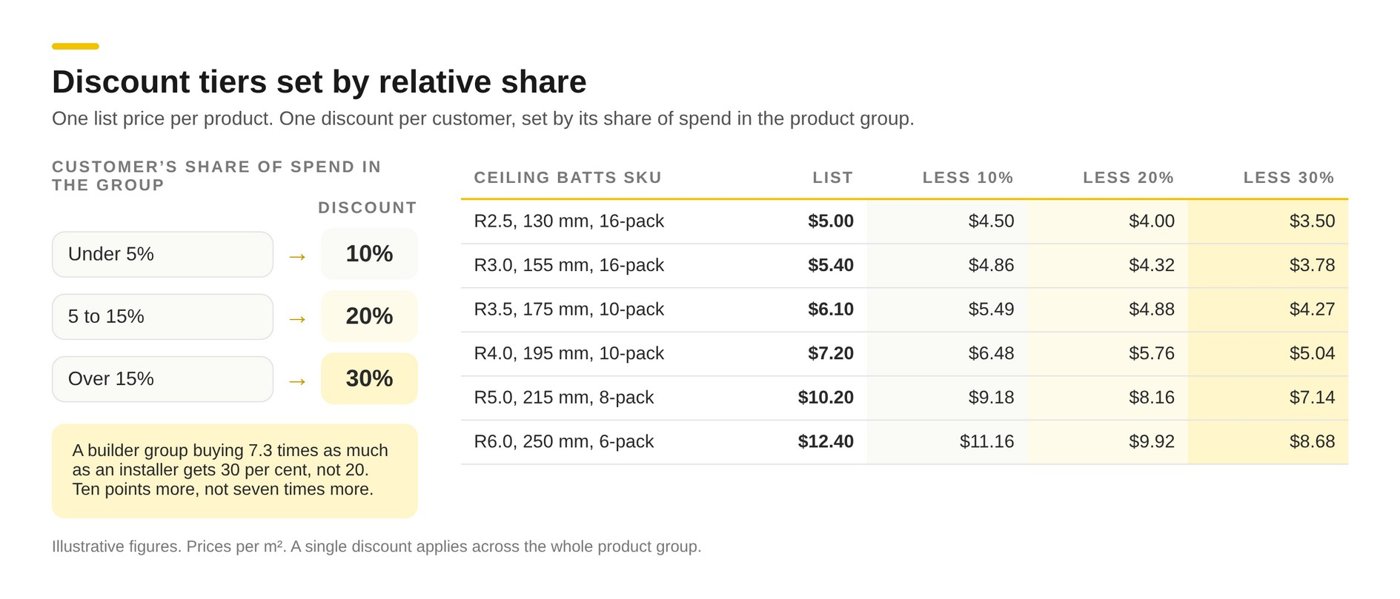
Figure 1. Discount tiers set by relative share.
One sound rule sets each customer's discount by its share of spend in a product group, as in the ceiling insulation teaching example in the figure. Customers with under 5 per cent of the group's sales get 10 per cent off list. Those with 5 to 15 per cent get 20 per cent, and those above 15 per cent get 30 per cent. A builder group buying 7.3 times as much as an installer gets a discount 10 points better, not a price seven times better. Narrow bands keep small customers competitive and stop large ones setting the market price. Re-tier every account against its last twelve months of spend each year, and tell each customer why it sits where it does.
Relativities are the price links between related items: pack sizes, grades, finishes and variants. Volume breaks set different prices for different order sizes. A larger pack costs less per unit, a better grade costs more, and a bulk price applies only to bulk orders. An Australian foodservice packaging supplier found a reversal on its fibre clamshell boxes: a national distributor buying about 2,100 cartons a year paid about A$51 a carton, while a small customer buying about 30 paid about A$35. Volume discounts had been negotiated line by line and never designed.
Breaks also drift into automatic use. Imported hardwood plywood comes in packs of 60 sheets. A branch manager reported that "quite often the customer will ask for the pack rate when only wanting 50 sheets." Accessories show the same drift. A construction seller wrote: "Hardware needs to be at a higher margin - it often gets the 'same' margin as the general material on an order and that's where we lose good margin." Three checks keep relativities in order: a report of price per unit across pack sizes, grades and variants listing every reversal; carton and pallet prices set from the handling cost they save; and a minimum quantity on every special price.
Should a business charge for the services it provides?
Freight, small orders, cutting to size, made-to-order items, estimating and technical advice all cost money to provide. Given free, each is an unrecorded discount: its cost is booked to freight and operating expenses, not to the customer who caused it, so low-service customers pay for high-service ones without knowing. Cost to serve is the name for what it costs to supply a customer beyond the product.
An Australian plumbing supplies distributor offered free delivery to large and small customers alike. A staff member gave the extreme case: "We sell 'no delivery fee' to select customers who abuse this, ie, a delivery for one $0.99." The recommendation set a minimum order value for free delivery, with freight bands by distance and volume.
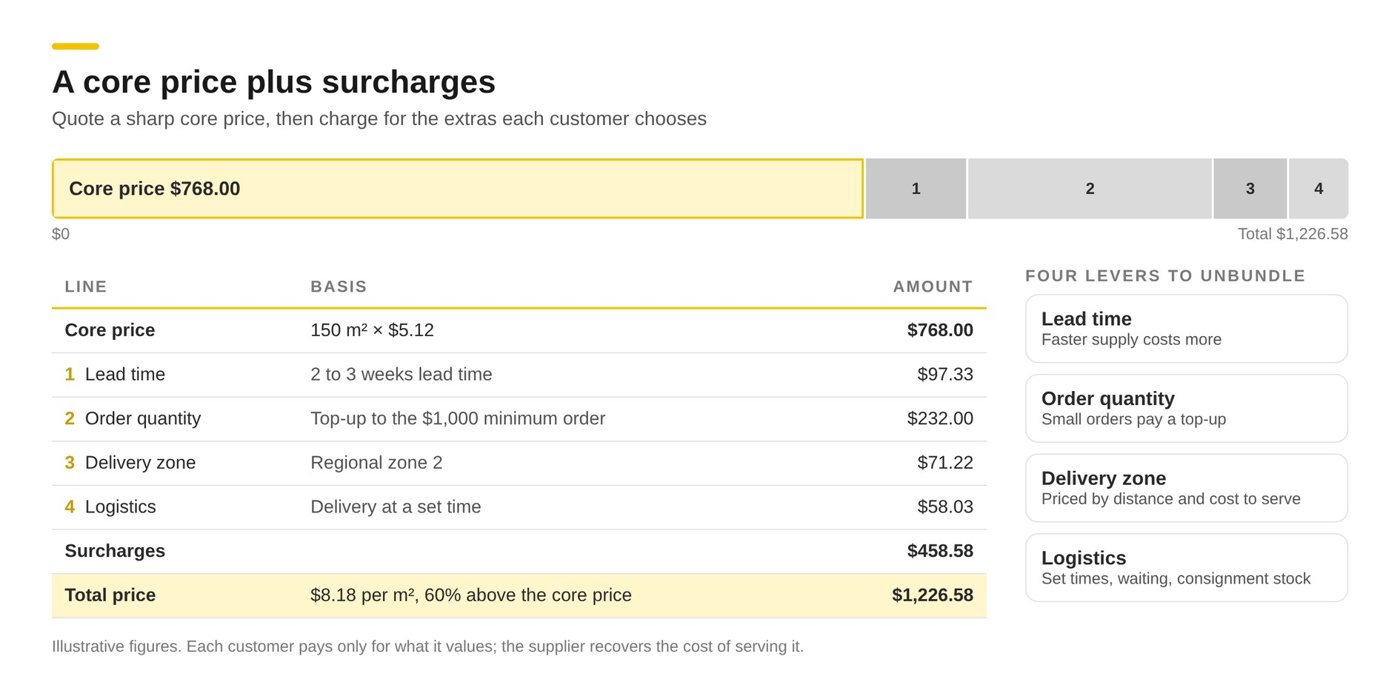
Figure 2. A core price plus surcharges.
Price the core sharply and charge for the extras each customer chooses. Four levers cover most of them: lead time, order quantity, delivery zone and logistics, such as a set delivery time. In the teaching example in the figure, the core price for 150 square metres of product was $768, at $5.12 a square metre. Charges for short lead time, a small order, a regional zone and a timed delivery added $458.58. A customer who wanted all four paid $1,226.58, 60 per cent above the core price, and a customer who wanted none paid $768.
Checklist
- Delivery, by zone or distance, with free delivery only above a set order value.
- Small orders below a minimum value.
- Split and back-ordered deliveries, so freight is not paid once for three deliveries.
- Non-standard work such as cutting to size, made-to-order items and estimating take-offs.
- Urgent service, such as same-day picks, timed drops and crane lifts.
- Returns, with a pick-up charge and a restocking fee.
Keep the schedule short and clear. Start with new customers and new contracts, where free delivery has not yet been given, then add charges at each renewal as part of a trade. Report freight and service recovery against cost each month by customer group.
How do price corridors keep exceptions under control?
A price corridor is the range in which a product's price should fall for a given customer group, with a target, a ceiling and a floor. Prices inside the band need no approval. Prices below the floor are exceptions, and each needs a reason code, a named approver and an end date.
A formwork supplier's price for steel decking slid from $50.15 to $49.00 a square metre because inside staff reused a special rate given for one job on the next. An Australian maker of decorative laminates and panels held project prices on spreadsheets outside its main system. A rep found one that had been in place for about six years and had missed every annual increase. The recommendation was a project register in the main system, with end dates and review triggers.
The cabinet-hardware distributor let sales managers approve prices down to a 26 per cent gross margin floor. Its cost of doing business was about 28 per cent of sales, so every sale at the floor lost about two points. Reps treated the floor as the target. The recommendation was to lift it at once, as a policy decision needing no technology, and to fence key price-checked items against any further discount. Set floors by product group and customer group, above the full cost to serve, with a target above each.
What people say
"Discounts vary from 51.4%, 46%, 40%, 35%, 30%, 25% and 20%. Depends on the customer."
"Just because you have to price down a product for one customer, doesn't mean that this is the new standard price across the board."
Report revenue on exception prices each month, with the age of each exception and the margin given below target. Where exceptions cluster on one line or customer group, reset the corridor against the market rather than approving more exceptions.
Which Pricing Periodic Table elements does this paper cover?
- 49 Lp List price alignment: A list close enough to the market that routine orders are invoiced from it, tracked by share of revenue at list.
- 50 Md Price-setting method: A written method naming the reference point for each product class, with cost used only as a floor test.
- 51 Dt Discount structure and tiers: Three to five tiers set by share of spend, with every account re-tiered each year.
- 52 Rl Price relativities and volume breaks: Pack, grade and volume prices set by written rule, with no reversals and no bulk rate on single units.
- 53 Sx Charges for services and extras: A short published schedule of service charges, with recovery against cost reported monthly.
- 54 Co Price corridors and exceptions: Every product group has a target, floor and ceiling, and every exception has a reason code, approver and end date.
Score each element from 1 to 5, where 1 means it is absent, with no owner and nothing written down, and 5 means it is in place, used every week and measured.
Frequently asked questions
How many discount tiers should a B2B business have?
No more than three to five, each with a stated purpose and an entry rule, set by the customer's share of spend in the product group. Every account should be re-tiered against its last twelve months of spend each year.
Why does an inflated list price cost margin?
An inflated list forces large standard discounts, which leave little margin to absorb any further concession. With a $200 list, a 60 per cent standard discount and a $60 cost, a further 5 per cent off list halves the gross profit on the sale.
What is a price corridor?
A price corridor is the range in which a product's price should fall for a given customer group, with a target, a ceiling and a floor. Prices below the floor are exceptions, and each needs a reason code, a named approver and an end date.
Where should a business start?
- CFO: Measure the share of last month's revenue invoiced at list or system price in the three largest categories, and check that no floor sits below the full cost to serve.
- Pricing Manager: Find the oldest project or tender price still in use and check whether it has had every increase since. List five services given free and estimate what each cost last month.
- Marketing Director: Write the price-setting method for each product class, and redesign tiers around share of spend.
- Sales Director: Apply service charges to large accounts at each renewal, and approve exceptions only with a reason code and an end date.
- CEO: Decide whether the published list is a price customers pay or a ceiling for negotiation, and back the sales team when tiers are reset and exceptions lapse.
Related reading: The Price You Actually Keep: Margin Waterfalls, Rebates, Cost to Serve, Overrides and Buy Prices; What Customers Pay For: Putting Customer Value in Dollars Before Setting a Price; Pricing Systems, Data and Controls: Making the Approved Price the Quickest One to Quote.
This paper is drawn from the book Pricing Insight: How to set, negotiate and hold your price, by Ron Wood.
To discuss how this applies to your business, contact Ron Wood.