
.webp)
The approved price becomes the quickest one to quote when five elements work together: pricing master data, quoting speed and tools, integrated pricing systems, price-list publishing, and discount authority and controls. Pricing Insight's work with Australian and New Zealand manufacturers and distributors shows each can fail in two directions: too loose lets margin go, too tight creates a queue.
Five elements carry pricing decisions from the price list to the invoice: pricing master data, quoting speed and tools, integrated pricing systems, price-list publishing, and discount authority and controls. Each can fail in two directions. A control that is too loose lets margin go, and a control that is too tight creates a queue that staff learn to go around.
Australian and New Zealand manufacturers and distributors show both failures. A steel roll-former sent any price move of half a per cent to approval, so managers faced hundreds of requests a week, while quotes raised in its old system skipped approval altogether. A particleboard flooring maker lost about $2.0 million of EBIT (earnings before interest and tax, realised) over two months after one low price to a single store became the market price; the extra sales were worth less than $50,000. An insulation maker left a customer group off a manual price increase and lost about A$12,000 (realised) in three weeks.
Five actions follow. Fix cost and product data before buying new pricing software. Set approval limits by deal size and margin band, so routine quotes go straight to the customer and exceptions get an answer within hours. Close every route that lets a price be loaded or changed without approval. Give every contract and promotional price an end date. Test every margin floor against the full cost of doing business.
What do weak systems and controls cost?
A price corridor is the range a price should fall within: a target, a floor below which it needs approval, and a ceiling.
An Australian steel roll-former put in a new pricing system to bring discipline to how it priced roofing, walling and purlins. Any price that moved away from the system price passed through an approval step, and limits were set tight: a change of half a per cent sent a quote for approval, and managers soon faced hundreds of requests every week, most of them small and routine.
Requests took hours or days to clear, and staff said jobs were lost while quotes sat in the queue. Raising a customer's price needed more sign-offs than cutting it. Quotes raised in the old business system skipped approval, so sales staff under pressure moved volume to the old system.
Three changes were recommended, with no outcome yet recorded: reset approval limits by deal size and product class, close the unapproved route, and set up a Pricing Council drawn from several teams to own the limits.
What is pricing master data, and why does every control read it?
Pricing master data is the set of records every price decision rests on: what each product costs, what each customer is meant to pay and how products and customers are grouped. It includes landed cost, which is the full cost of a product once it reaches the warehouse, along with freight, rebates, list prices, customer terms and the codes that link them.
Margin here is the share of the price left after the cost of the product. With a wrong cost, reps discount lines that look healthy but are not, and hold price on lines that could move. Approval limits set on margin pass deals they should stop, because they read the same wrong cost.
At a building-products maker, the system held an average cost that updated only when stock moved, and staff reported that where an item had no transaction in over two years, the system showed a cost from two years ago. In illustrative figures, a product sells for $100 and the system cost is $70, so the screen shows $30 of gross margin. Actual landed cost plus freight is $76. A rep offers a $5 discount, the screen shows $25 left and the deal passes an approval band set at $25. Real margin is $19.
A foodservice packaging supplier found one quick-service chain's takeaway-box line showing a gross margin of about minus 23 per cent. Before repricing, the recommendation was to test three explanations in order: an out-of-date list of materials, inbound freight booked to the wrong cost, or a contract priced below cost. Only the third is a commercial problem.
At an Australian trade distributor of cabinet and architectural hardware, about 1,200 lines were made-to-order codes or carried implausible cost data. Each was held at its current price in a quarantine register until its category owner fixed the data at source. The target was a quarantine count falling towards zero; no result is stated.
Four controls cover most of it. Name an owner for each data set: item, cost, customer and price. Limit edit rights to a small trained group and log every change. Check system cost against landed cost on the top items each quarter, and track credits caused by pricing errors by root cause.
How do quoting speed and approval paths affect the price?
A quote is the point at which a business commits to a price. Its speed depends on the quoting tool and the approval path.
A group of Australian building-products makers lost work on this basis. Quote requests for pipe systems passed through several departments before reaching the customer. One rep compared the business with its rivals: "My competitors can do in 24-48HRS. We are 7 working days in a lot of instances."
Reps cut price to rescue deals that had sat in the queue and learned to quote low first time to avoid a second round. Four changes were recommended: a quote desk working to set turnaround times by deal size, templates for common deal shapes, automatic escalation of ageing quotes and a dashboard tracking time to quote. The projected aim was a 20 to 40 per cent cut in quote time, a target rather than a result.
At the Australian arm of a global office-technology company, a manager described days of internal debate over a cost-per-copy change worth about A$3 in total. Delays pushed sales staff to work around the system, which then spoiled the data.
Quotes built in spreadsheets, emails and text messages leave the controls behind, because the cost check, the floor and the approval record stay in the system the quote never touched.
Start by recording the time from quote request to customer response for the past three months, split by approval level. Count requests in each band and how many were approved without change; where nearly every request passes unchanged, lift the limit. Set a turnaround target for each tier and report turnaround beside win rate each month.
Two numbers test the balance for a CFO: the margin protected by low-limit approvals, and the value of quotes lost while they waited. If the second is larger, the limit costs more than it saves.
Why does a business need one source of price?
In a common set-up, the ERP, the main business system that records orders, stock and invoices, does the invoicing. A CRM, the system that tracks customers and sales, holds quotes. A pricing tool holds rules, and spreadsheets sit around all three. Integration means each price, cost and customer term has one agreed home that every other tool reads from. When systems disagree, staff re-type information and choose which number to believe, and customers learn which person or channel gives the lowest figure.
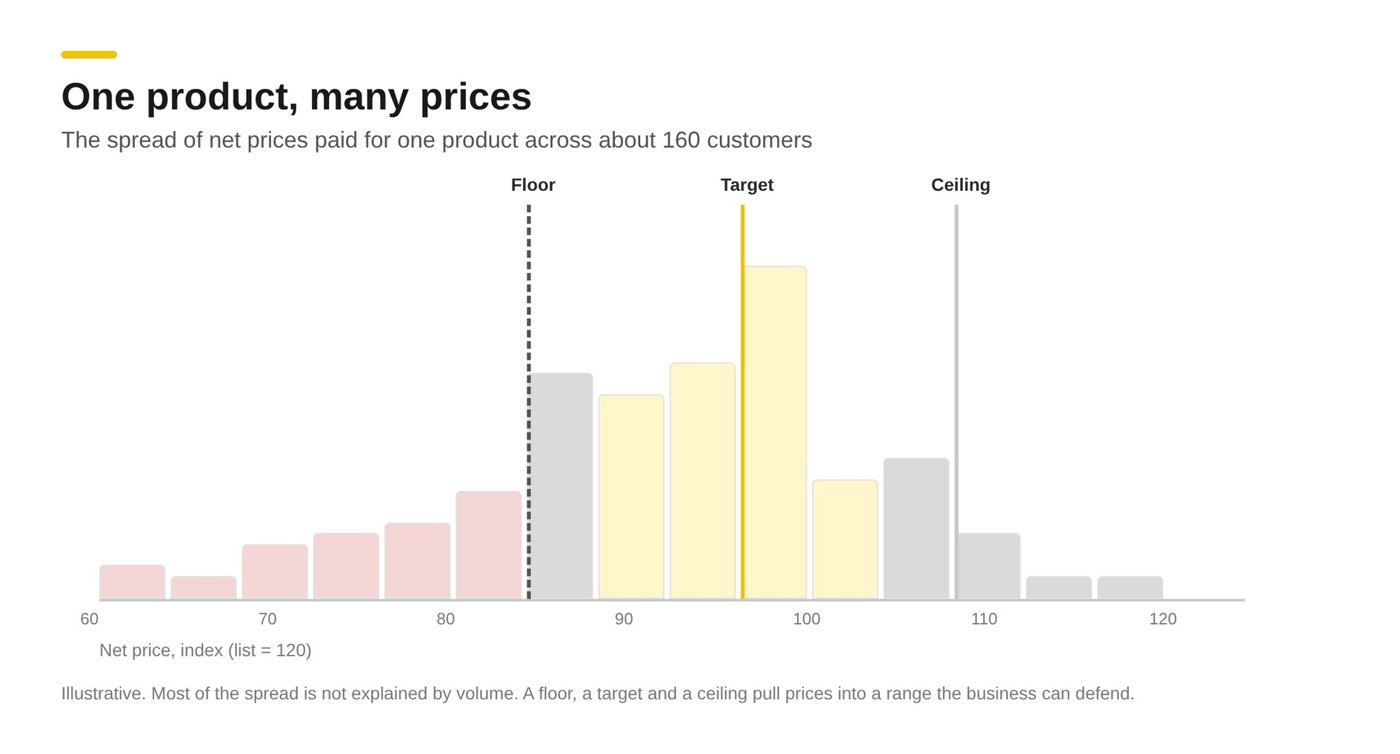
Figure 1. One product, many prices: the spread of net prices paid for one product across about 160 customers.
The figure plots the net prices paid for one product by about 160 customers, from about half of list up to list, against a floor, a target and a ceiling. Some of the spread is deliberate, set by tier and volume. Much of it is history, held in records no one has reviewed, and a number of customers pay below the floor.
A leader in a timber and panels distributor found 5,500 SKUs, or single stock items, in one state's construction business alone carrying contract discounts beyond the normal tier structure. At an Australian trade distributor of cabinet and architectural hardware, the tier structure had been bypassed for years, and about 384,000 customer-by-item links each carried, in effect, their own price.
A new rule-based structure was designed to replace most of those prices. At go-live, about 115,000 lines still needed their own override records. Four in five were held lines, where the current price already sat at or above the new target, and those prices were kept rather than cut. Each was loaded as an owned record with a start date and tested again at every refresh, so that lines move onto rule-based discounts as list updates overtake them. The projected path was about 158,000 records in year one, falling to about 43,000 at steady state.
A New Zealand rural supplies co-operative held prices in its ERP as mark-up, which is gross profit as a share of cost. Its sales reports used margin, which is gross profit as a share of price. A 30 per cent mark-up gives a gross margin of about 23 per cent, so a rep who reads it as margin under-prices every quote by about seven points (illustrative). The review recommended switching the price engine to target margin by product class, with a 90-minute refresher for anyone holding override rights, and no result has yet been reported.
Map the systems before choosing new software. List every place a customer price is created, stored or changed, including spreadsheets and email. Name the home system for each price, cost and term, count the re-typing steps between quote and invoice, and set dates to remove the largest. In the timber business the fault lay in permissions and practice as much as in the software.
What makes a price list customers can read and rely on?
A customer price list states what each customer pays for each item, and for how long. In practice it is a contract: errors in it are credited or honoured at a loss. Lists should be produced from the home system on demand, short and readable, with contract and promotional prices included, and checked against floors and current costs before they are sent.
An Australian maker of decorative laminates and panels sent customer price letters of 20 pages or more, written in internal terms and still listing deleted items. One staff member compared them with a competitor's three pages. Customers queried the letters constantly, and staff said some switched to the rival with the shorter letter.
Give every promotional and contract price an end date before it enters the system. Without one, a promotional price becomes a permanent discount and a contract price outlives the deal that justified it. Slow publishing has a similar cost: if a list takes two weeks to build for each market, the increase reaches customers two weeks late.
Before issue, check that no line sits below floor without an approval and reason code, and test ten lines at random against the customer's last invoiced price.
How should the system enforce discount authority?
Discount authority sets out who can approve which price. A clear scheme groups discounts into margin bands, names the role that approves each band and is held in the system, so it applies at quote and order entry. Every override carries a reason code.
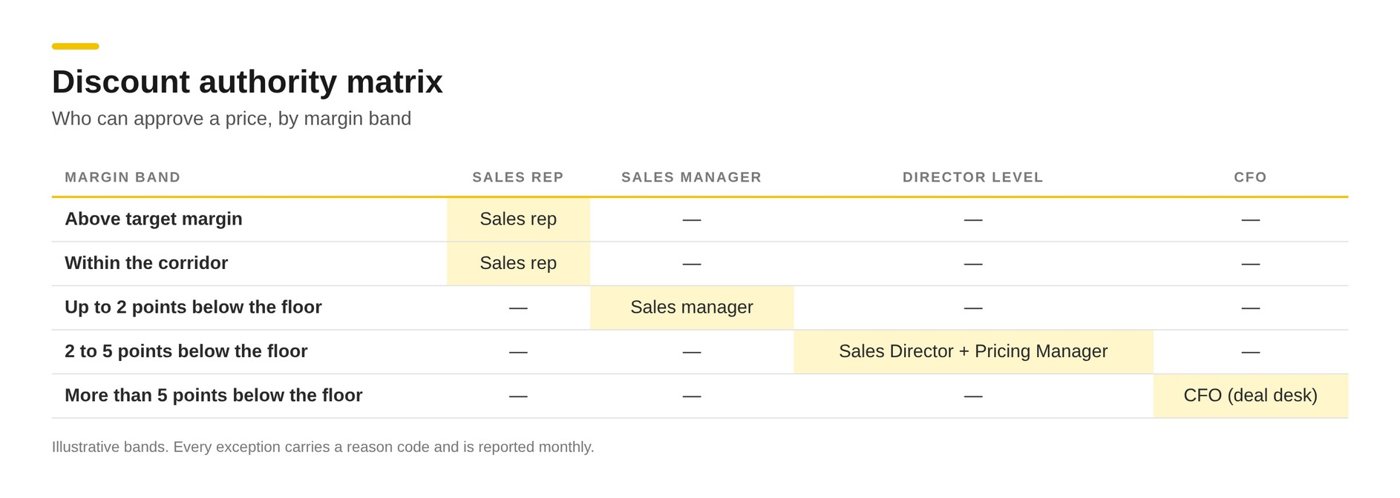
Figure 2. Discount authority matrix: who can approve a price, by margin band.
Four bands, in the illustrative scheme in the figure, follow the price corridor. The sales rep approves any price above target or within the corridor. Up to 2 points below the floor goes to a sales manager. Between 2 and 5 points below goes to the Sales Director with the Pricing Manager. More than 5 points below goes to the CFO through the deal desk, with a written case.
A maker of particleboard flooring sheets held a price premium of 10 to 20 per cent over the main rival and about 60 per cent of the market. An account manager in Victoria gave one independent hardware store low prices, which the store advertised. A national hardware chain then cut its shelf price on the standard sheet by 15 per cent, from $42.24 to $36.00, in every store, and wholesalers discounted their own stock.
Over the next two months the maker lost about $2.0 million of EBIT (realised), against extra sales to the independent store worth less than $50,000. To win the loss back, the account manager would have needed to beat budget at full price for two years. The business had no written price strategy for its best-known product and no system control that stopped a price going below the floor without approval.
The first fault is a floor set too low. A cabinet-hardware distributor set a 26 per cent margin floor below its 28 per cent cost of doing business, so every sale at the floor lost money. In illustrative figures, the lowest band approves deals down to a 20 per cent gross margin and operating costs run at $22 for every $100 of sales. Each sale at the floor loses $2. Lifting the floor to 25 per cent turns that sale into a $3 profit.
The unapproved route is the second fault. A price can be loaded on request, changed after approval or overridden at the trade counter, so reports show deals inside policy while actual prices sit below it. The office-technology company stopped discounting from its government panel price book by default and sent any discount needed to win new business through a central approval step. Staff later reported the government channel as "much more profitable"; that gain was reported, not measured, and no figure was given. The change needed no new software.
Bring overrides and escalations to the Pricing Council each quarter, because the pattern shows where list prices, bands or floors are out of line.
What people say
"You also need more levels of approval to increase a customers price than what you do to discount it".
"Depending on who the customers calls within our business they could get 3 different prices for one product code."
"some people just ask for a price to be changed and it happens. No financial rationale or approvals needed."
Which Pricing Periodic Table elements does this paper cover?
- 57 Dq Pricing master data: Product, cost and price data is accurate and current, each data set has a named owner, and system cost is checked against landed cost on the top items each quarter.
- 58 Qt Quoting speed and tools: Staff produce an accurate, profitable quote quickly; quotes inside the corridor go straight to the customer and exceptions are answered within hours.
- 59 Is Integrated pricing systems: ERP, CRM, quoting and pricing tools read one set of data, with no re-keying and no spreadsheets holding customer prices.
- 60 Pl Price-list publishing: Customer lists are produced from the home system on demand, short and readable, with a start date and an end date on every price.
- 61 Da Discount authority and controls: Discount limits are set by margin band, enforced by the system, tested against the cost of doing business and reviewed each quarter.
Score each element from 1 (not in place) to 5 (measured, reviewed on a fixed date and improved); the five executives score separately, then discuss first any element where scores differ by two points or more.
Frequently asked questions
Should a business fix its pricing data before buying new pricing software?
Yes. Fix cost and product data first, because approval limits set on margin read the same wrong cost and pass deals they should stop. Map every place a customer price is created, stored or changed before choosing software; in one timber business the fault lay in permissions and practice as much as in the software.
How should discount approval limits be set?
Set them by deal size and margin band, so routine quotes go straight to the customer and exceptions get an answer within hours. Where nearly every request in a band is approved unchanged, lift the limit, and test the lowest band against the full cost of doing business.
What can one unapproved low price cost a business?
A particleboard flooring maker lost about $2.0 million of EBIT over two months after one low price to a single store became the market price. The extra sales to that store were worth less than $50,000.
Where should a business start?
- CFO: Check system cost against actual landed cost on the ten highest-revenue items, list every gap above two points of margin, and confirm the lowest authority band covers operating costs.
- Sales Director: Count last month's approval requests by band, note how many were approved without change, and set a turnaround target for each approval tier.
- Pricing Manager: List every way a price can be set or changed without approval, including direct loads and counter overrides, and report overrides by band each month.
- Marketing Director: Rebuild the customer price-list format so lists are short, readable and carry start and end dates on every contract and promotional price.
- CEO: Put data accuracy ahead of new pricing tools, and require that a price rise is no harder to approve than a cut.
Related reading: The Price You Actually Keep, Who Owns the Price and A Price Structure That Holds.
This paper is drawn from the book Pricing Insight: How to set, negotiate and hold your price, by Ron Wood.
To discuss how this applies to your business, contact Ron Wood.