
.webp)
Professional buyers negotiate every week and are measured on savings; sellers negotiate a major price a few times a year. Pricing Insight closes that gap with three disciplines: a prepared response to each common buyer tactic, a tender process that prices each bid once, and a deal desk that reviews the largest deals quickly.
Buyers negotiate every week and are measured on savings; sellers negotiate a major price a few times a year, often with no walk-away price, no evidence on the competitor and no record of past outcomes. Three disciplines close the gap: a prepared response to each common buyer tactic, a tender process that prices each bid once, and a deal desk that reviews the largest deals quickly.
An Australian maker of medical consumables went from 30 to 45 tenders a year to about 80, and around 60 of those came back asking for a best and final offer. The second round had become a standard step in the buyer's process, yet the business still priced from cost plus a mark-up. In illustrative figures, a 3 per cent cut in the final round of a three-year contract worth A$2 million a year, at a 30 per cent margin, removes A$180,000 of gross profit over the term.
Five actions follow. Write one agreed response to each tactic the largest customers use. Test every competitor price and switching threat against evidence. Set the walk-away price and the final-round concession before the first bid is priced. Give every project price a project number, a quantity and an end date. Send deals outside the authority limits to a deal desk that answers the same day.
Who is the buyer across the table?
Procurement is the team that buys on behalf of an organisation, and in a price negotiation it has one job: to lower the total cost of what the organisation buys. Buyers are measured on savings against last year's price, the budget or the first bid.
The medical consumables maker sells custom procedure packs and contracted products to public and private hospitals. A tender is a formal request for prices sent to several suppliers, with a fixed deadline; a best and final offer, or BAFO, is a second round after the first bid. Hospital procurement teams, not the clinicians who used the products, often made the final decision; they pressed for open-book costing, to see how each price was built, and widened supplier panels to set more bids against each other.
At an Australian and New Zealand foodservice packaging supplier, all three managing directors called discounting the main sales lever, and none believed the sales team was trained for procurement-led customers. The diagnostic recommended training in value discovery and give-get negotiation, in which every concession is traded for something, and a playbook with walk-away points for the top 40 negotiated accounts, with no result yet reported.
Procurement is usually the buyer's agent, not the economic buyer, the person who lives with the result, such as the plant manager or the clinical director. Procurement controls access to that person, and its brief is price.
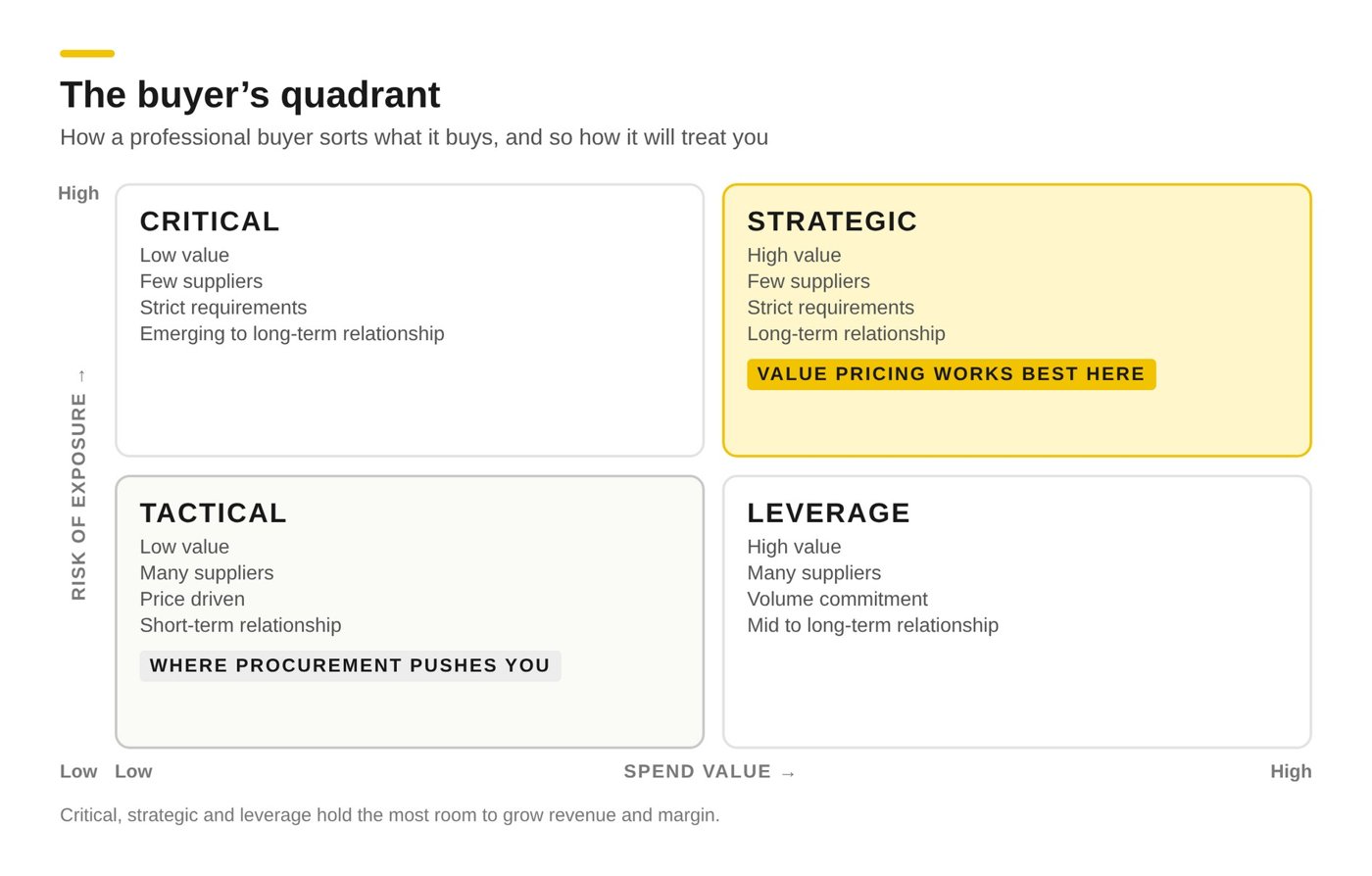
Figure 1. The buyer's quadrant.
In the buyer's quadrant shown in Figure 1, a well-known model from purchasing research, each purchase is placed by spend value and by risk of exposure if supply fails. Tactical items are low in both, with many suppliers, and are bought on price. Leverage items are high in spend with many suppliers, and buyers use rebates and volume commitments to drive price down. Critical items are low in spend but high in risk, and strategic items are high in both, with few suppliers and long relationships.
Procurement will try to push a supplier into the tactical box, where price decides. Value pricing works best in the strategic box, and critical and leverage items also hold room to grow margin. The seller's task is to show where the product belongs, using evidence of the risk it removes. In the 36-cube market model, a customer that treats the business as a vendor will usually file it as tactical, and one that treats it as a partner, as strategic.
In a power frame the buyer appears uninterested, allows 30 minutes and calls the product a commodity, so that price becomes the only topic. A value frame answers it with the four prices a customer pays: the invoice price, the operating price, the repair, replacement and disposal price, and the risk price. In a typical teaching example the invoice is only about 30 per cent of the lifetime cost.
Customers of a multinational maker of car refinish paints in Asia Pacific opened every year by asking for a price cut, citing oil prices, the Russia-Ukraine war or inflation. Regional marketing asked for a price-defence pack, a standard evidence-based case for holding or raising prices; its effect is not known.
How should sellers respond to common buyer tactics?
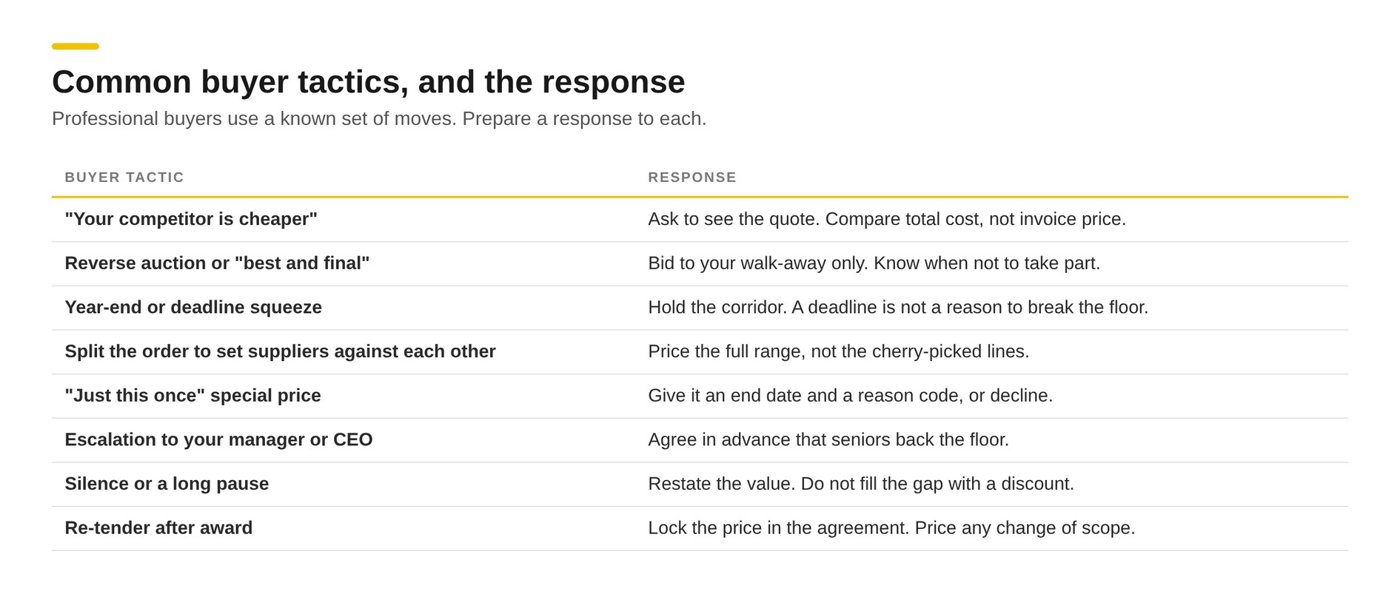
Figure 2. Common buyer tactics, and the response.
Eight common moves, each with a one-line response, are set out in Figure 2. Asked to match a cheaper competitor, the seller asks to see the quote and compares total cost, not invoice price. In a reverse auction or best and final round, the seller bids to the walk-away price only. A deadline squeeze is not a reason to break the floor, and a split order is answered by pricing the full range. A one-off special price gets an end date and a reason code, or is declined. A re-tender after award is met by a price locked in the agreement.
Two further tactics need the same preparation. Open-book costing is answered by explaining value and total cost of ownership rather than the supplier's margin, with the scope of any disclosure agreed first. Risk transfer, where the contract shifts liability, warranty or payment risk onto the supplier at the same price, is answered by pricing the risk or declining the clause.
At an Australian steel roll-former, distributors sent the same roofing job to three roll-formers, each getting "one crack at it", with response windows shrunk to hours and no second round in which to concede from a high opening. The business did little modelling of deal profit or break-even volume. The diagnostic recommended a deal-modelling tool, value-based quote methods and a competitor price database; these have not yet been measured.
Cherry-picking is quieter: buyers ask for itemised quotes, then take only the lines where the supplier is cheapest, as a timber and building-products distributor saw on house-lot quotes to builders.
Every response is decided in advance, written into the pricing playbook and backed by the authority limits.
What proof is needed before matching a competitor's price?
At a plumbing distributor, branch staff matched any claimed competitor price on the customer's word, and the fix began with one rule: no match without a sighted quote or invoice.
Competitive response rules set four responses, in order of preference. The default is to hold and sell value, with a written value case in the customer's dollars. Second is to trade, changing the item, pack or service rather than the price. Matching is kept for key items, on written evidence, never below the floor and always logged with a reason code. Walking away is used when the deal loses money once rebates and freight are counted. Over a year the match log shows which claims were real and what each match cost.
A competitor price also needs a supply test. Timber staff proposed checking whether the rival could supply in full and on time, and pricing a late delivery as a building crew paid by the hour, standing idle.
Holding needs enough evidence: three to five times the price gap in value, as a rule of thumb. On a $2,000 quote against a rival's $1,800, the gap is $200, so the seller shows $600 to $1,000 of extra value over the product's life. The Customer Value Discovery canvas supplies it: the customer rates the importance of each value item, and the performance of the business and the rival, each from 0 to 10. Items with the largest variance in weighted score are converted into dollars the customer's finance team can test, such as downtime per day or capital avoided.
Switching threats need the same test. Four facts settle it: the realistic alternative; the cost of switching, including qualification, stock, retraining and supply risk; whether the customer has gone to market; and whether its orders are falling. Sometimes the threat is real. One account told an Australian door hardware supplier that without a price cut, "we will be out." The recommendation was a profit and loss statement for each major account and a plan stating what the business will and will not concede; neither has yet been measured.
A documented value case in dollars also gives the procurement manager the justification to accept a price above the lowest bid.
How should a business choose which tenders to bid, and price each bid once?
A tender price is fixed for the life of the contract and cannot be corrected after the award. A disciplined process has four parts: a decision on whether to bid, a standard costing method, a walk-away price set before the bid, and a record of every outcome.
Some requests exist only to check the current supplier's price, so a short test asks whether the buyer is genuine, whether this kind of job can be won at an acceptable margin, and whether the scope is clear enough to cost. A tender that fails two of those three is declined or referred to the Sales Director.
Costing comes next. Build the price from value, with cost as the floor; a price built from cost plus a mark-up invites a debate about cost when the buyer asks for open-book costing. Discipline also applies before the tender: a panels distributor gave architects prices from its deepest discount tier at specification, before anyone knew the final quantities.
Walk-away prices are set from the corridor floors, signed off by the CFO and recorded before the first bid. The BAFO concession is planned at the same time: how much, on which lines, and for what in return, such as a longer term, a wider range or committed volume.
In illustrative figures, a three-year contract worth A$2 million a year at a 30 per cent gross margin earns A$600,000 a year in gross profit. A 3 per cent cut in the BAFO round removes A$60,000 a year, or A$180,000 over the term. To earn it back through volume, sales must rise by about 11 per cent.
A record of outcomes completes the process. Every tender, won or lost, is logged with price, margin, the winning price where known and the reason; within a year the log shows where the business is too high and where it wins too easily. Preparation before release also changes the result: in a hospital tender used as a teaching example, the bid that priced clinical outcomes won at about a 3 per cent premium.
What happens after the award?
At an Australian door hardware supplier, a second negotiation often started after the tender was won. The business quoted commercial projects to the architect's specification, the list of products named for the job door by door. On design-and-construct contracts the builder could change products, and a closer or exit device on the hardware schedule could be swapped for a cheaper "equivalent", and reps had no floor to defend. The diagnostic recommended a tactics guide with floor margins by project size and a written give-get approach for re-pricing after the award, not yet measured.
Three protections apply: a quote valid only for the specification, scope and quantities tendered; a floor by project size; and tracking each project from specification to order, so a specified job is not discounted again.
A second risk is a project price that outlives the project. It stays loaded against the customer, is used on later orders and misses the annual increase. An Australian distributor of cabinet and architectural hardware designed one route for every price below the customer's normal level. Each request states what the customer offers in return, and each price carries a reason code and an end date. At twelve months, the price becomes a standard discount if the customer delivered and is removed if not. This was a recommended design, with no outcome reported yet.
What does a deal desk do?
A deal desk is a small team with a fast process for reviewing large deals and exceptions. It sits between the field, which knows the customer, and the CFO, who owns the floors and authority limits, and it handles deals outside a seller's limits, including any price more than 5 points below the floor.
Four tests apply. First is judgement on the largest deals. An office-technology business took discounting on government panel work out of the seller's hands and sent it through central approval. Staff later said the government work had become far more profitable, though no figure was given and this was not measured.
Second is capability. A New Zealand rural supplies co-operative lost the skills of its central quote desk and removed it. Branch teams took on complex project quoting without the tools or full cost information, and staff described a race to the bottom in some regions. The diagnostic recommended a small expert quote desk with service levels; no result is stated.
Third is speed. Thresholds by deal size and margin band send only large deals to the desk, so it can give a same-day answer on standard deals and 48 hours on tenders. Fourth is learning. Every decision is logged with price, margin, the give-get agreed and the outcome, and the Pricing Council adjusts floors and thresholds each quarter.
What people say
"The team here have never been trained in negotiating tactics. It's a big gap. We are most often working with sophisticated buyers who are well trained negotiators."
"Customers want the best price first time not a pretend price that they then have to negotiate"
"We need a clear direction on the lowest margin we can go to when we are up against our competitors"
Which Pricing Periodic Table elements does this paper cover?
- 11 Cm Competitive response rules: Written rules set hold, trade, match and walk away in that order, and every match is logged with evidence and a reason code.
- 18 Tp Tender and project pricing: Every tender has a bid decision, a walk-away price and a recorded outcome, and every project price ends when the job is done.
- 37 Bt Buyer and procurement tactics: Sellers recognise common buyer tactics and take a prepared, agreed response to each into the meeting.
- 40 Dd Deal desk and negotiation governance: Large deals and exceptions go through a fast review within the CFO's limits, and each decision is logged and reviewed quarterly.
Score each element from 1 (not in place) to 5 (measured, reviewed on a fixed date and improved); the five executives score separately, then discuss first any element where scores differ by two points or more.
Frequently asked questions
How much does a best and final offer round cost a supplier?
In illustrative figures, a 3 per cent cut in the BAFO round of a three-year contract worth A$2 million a year at a 30 per cent gross margin removes A$60,000 a year, or A$180,000 over the term. To earn it back through volume, sales must rise by about 11 per cent.
When should a business decline to bid on a tender?
A short test asks whether the buyer is genuine, whether this kind of job can be won at an acceptable margin, and whether the scope is clear enough to cost. A tender that fails two of those three is declined or referred to the Sales Director.
What is a deal desk in B2B pricing?
A deal desk is a small team with a fast process for reviewing large deals and exceptions, sitting between the field and the CFO. It gives a same-day answer on standard deals and 48 hours on tenders, and every decision is logged so the Pricing Council can adjust floors and thresholds each quarter.
Where should a business start?
- Sales Director: List the tactics the five largest customers used last year, and write one agreed response to each into the playbook.
- CFO: For the next tender due, set the walk-away price and the BAFO concession before the first bid is priced, and set deal desk thresholds by margin band.
- Pricing Manager: Pull every open tender and project price, flag those past expiry or with no sales in 12 months, and start the tender win/loss log.
- Marketing Director: Supply Customer Value Discovery value cases and a price-defence pack for each account that opens with an annual cost story.
- CEO: Make it clear that a tender lost at the walk-away price is a sound decision, and back the team that declines it.
Related reading: Preparing for Price Negotiations: Setting the Numbers, the Value Case and the Trades Before the Meeting, Holding Price in the Field: Value Cases, Written Rules, Discount Maths and Pay for Margin and Agreements That Protect Margin: Value-Based Terms, Rebates That Buy Growth and Planned Renewals.
This paper is drawn from the book Pricing Insight: How to set, negotiate and hold your price, by Ron Wood.
To discuss how this applies to your business, contact Ron Wood.