

Packaging companies protect margin by measuring net price after rebates, separating cost pass-through from price realisation, building price lists on the product hierarchy, matching discount detail to account size, enforcing price floors, proving the value they create, and rolling changes out in waves. These seven principles apply to converters, mills, rigid plastic makers, distributors and foodservice suppliers alike, because each faces volatile inputs, powerful buyers and changing packaging regulation.
Key takeaways
- Report price realisation separately from cost pass-through, as Australia's listed packaging leaders already do.
- Allocate every rebate and allowance back to the customer and product before judging which accounts are profitable.
- Replace thousands of individually negotiated prices with a tiered discount matrix, with floors set in the system.
- Prove and price the sustainability, compliance and supply value you create, rather than giving it away.
- Roll out new prices in waves, with guard rails and a trained sales team.
Why does pricing in packaging need a different approach?
Packaging is a business of thin margins, volatile inputs and powerful buyers. Resin, aluminium, fibre, energy, freight and currency move faster than price lists. Large brand owners and retailers negotiate every line, and buying groups and distributors earn rebates for volume. At the same time, sustainability regulation is changing what packaging must be and who pays for it.
In that environment, most packaging businesses manage pricing as a series of reactions: a cost increase passed through here, a discount granted there, a rebate renewed without review. Each decision is reasonable on its own. Together they produce a price structure that nobody designed, in which net price after rebates differs widely between similar customers and margin depends more on input costs than on pricing decisions.
This paper sets out seven principles that address that problem. They are drawn from Pricing Insight's work across more than 160 engagements since 2007, including a recent strategic pricing diagnostic for a foodservice packaging supplier in Australia and New Zealand that realised A$2m of EBIT from quick wins and identified a further A$6m–9m of margin opportunities. The principles apply whether a business converts film, forms rigid plastic, makes cans and glass, runs fibre mills and box plants, or imports and distributes a broad range.
Why do input costs move faster than packaging prices?
The leading listed packaging companies show how central input costs are to reported revenue. Orora reports its cans revenue both with and without aluminium pass-through: in FY25, cans revenue rose 12.1%, or 8.9% excluding the benefit of higher aluminium pass-through pricing (Orora FY25 results). Amcor reports comparable constant-currency sales that exclude the effect of passing through raw material cost movements (Amcor, SEC filing). Pact Group manages resin price risk through customer pricing arrangements, including contractual rise-and-fall adjustments (Pact FY26 Annual Report).
These disclosures make a point that applies to every packaging business: pass-through of input costs and price realisation are different things, and they need to be measured separately. Where pass-through mechanisms are incomplete or lag, the cost shows up in earnings first. Pact has reported earnings affected by delays in recovering higher raw material and energy costs, with pricing improving later as resin costs fell (Pact Group).
Why don't price increases always reach the bottom line?
Raising prices is necessary but not sufficient. Pro-Pac Packaging reported that it implemented price increases during 1H25 to recover the costs of doing business, but the benefit was reduced by lower volumes (Pro-Pac 1H25 results). Huhtamaki's foodservice segment recorded higher sales prices in 2025, with lower volumes and currency weighing on net sales (Huhtamaki 2025 results). Sealed Air reported price essentially flat for full-year 2025, with earnings growth coming mainly from lower operating costs (Sealed Air 2025 results).
The pattern is consistent. In mature packaging markets, a general price rise meets resistance, and volume, mix and currency can absorb its benefit. The businesses that protect margin are those that know which customers and products can carry a price change, and which cannot.
Why are packaging ranges so hard to price?
Packaging ranges run to thousands or tens of thousands of products. Visy's cardboard packaging network covers around 153,000 products across 18 facilities, serving customers from small businesses to large multinationals (Visy). Detmold manufactures more than 22,000 paper and cardboard packaging products (Detmold Group). Cospak supplies packaging in glass, plastics, metal, paper and flexible materials to wine, beverage, food, chemical, personal care and pharmaceutical manufacturers (Cospak).
Multiply that range by thousands of customer accounts, and the number of potential prices runs into the millions. No sales team can manage that many prices one by one. Without a structure, individual negotiation fills the space.
How is packaging regulation changing what customers pay for?
Australia's 2025 National Packaging Targets set 100% of packaging to be reusable, recyclable or compostable, alongside targets for plastic recycling and recycled content (Parliament of Australia). In 2023, environment ministers agreed to make industry responsible for packaging placed on the market under a new regulatory scheme with mandatory design obligations (Parliament of Australia). The Australian Packaging Covenant Organisation (APCO) has estimated that member contributions could rise from A$14m a year in FY26 to between A$230m and A$273m in FY30 under one scenario, with fees designed to reward packaging that costs less to manage after use (APCO).
Packaging companies are already investing ahead of these changes. Detmold reported that its group had moved to raw materials with no intentionally added PFAS (Detpak). Amcor offers mono-material, recycle-ready packaging with recycled content options (Amcor). Pact processes its own local recycled material for use in its packaging (Pact Group). Visy makes boxes from 100% recycled paper or kraft (Visy).
That investment creates value for customers: lower compliance risk, lower future scheme fees and stronger sustainability claims. The pricing question is whether that value is proved and priced, or given away.

What are the seven pricing principles for packaging companies?
Principle 1: Measure net price after rebates, customer by customer
Gross sales are a poor guide to profitability in packaging. Rebates are often paid to buying groups or distributors outside the invoice, along with freight allowances, settlement discounts and promotional support. Until those are allocated back to customers and products, some of the lowest-margin accounts can look like the best.
The starting point is a price waterfall for every customer and product family: list price, invoice price, then each deduction to net price after rebates and cost to serve. In our recent foodservice packaging engagement, apportioning buying-group rebates to member accounts and products changed which customers leadership saw as most profitable. A diagnostic that stopped at gross sales would have pointed the work at the wrong customers.
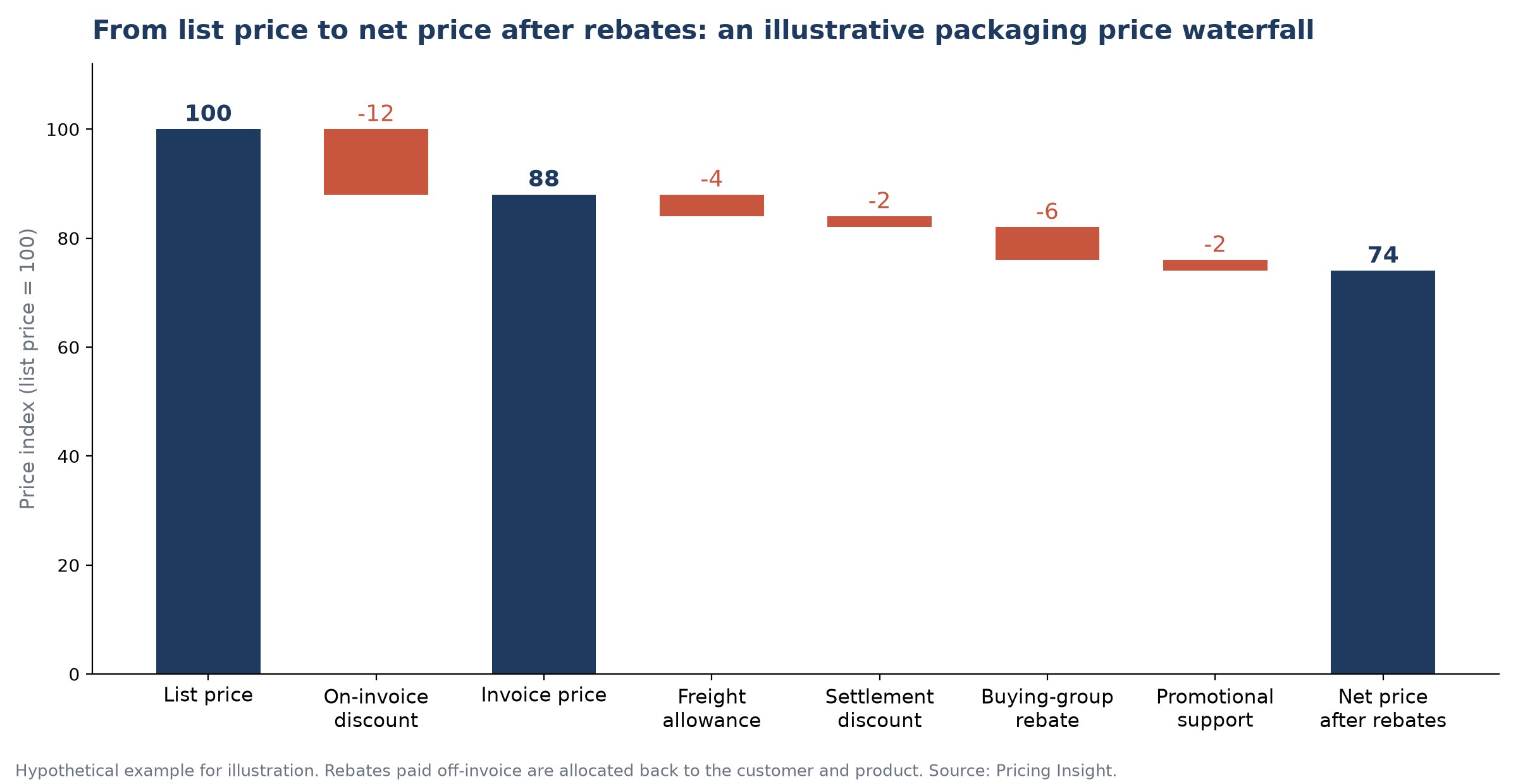
Figure 1. An illustrative price waterfall. Hypothetical figures: rebates paid off-invoice are allocated back to the customer and product.
What to do: Build the waterfall from transaction data, allocate every rebate and allowance, and make net price after rebates visible to the people who set prices. Our paper on margin waterfalls, rebates and cost to serve sets out the method, and trade rebates that pay for value shows how to test what each rebate buys.
Principle 2: Separate pass-through from price realisation, and set the rules in advance
Packaging businesses need two distinct pricing mechanisms. The first passes through input cost movements quickly, fully and predictably. The second sets the value-based price above cost, which should change only by decision.
Many businesses blur the two. Cost decreases are passed on without a policy, while cost increases are absorbed until the next negotiation. In the foodservice engagement, a same-customer, same-product comparison showed that margin had grown because unit costs fell, while like-for-like prices had slipped. Without the cost gain, margin would have fallen.
A cost pass-through policy should define:
- Triggers: which input indices apply to which product families (resin, aluminium, fibre, energy, freight, currency).
- Thresholds: how large a movement must be before prices change.
- Timing: how quickly changes flow into price, and how often they are reviewed.
- Symmetry: what happens when costs fall, so that decreases are a decision rather than a default.
- Contract terms: rise-and-fall clauses and index-linked pricing in key agreements, with price review clauses tied to a published cost index.
What to do: Report price realisation separately from pass-through, as the listed leaders do, and give each its own owner and measure. See how to pass through cost increases without losing trade customers and price increases that stick.
Principle 3: Build the price architecture on the product hierarchy
A price architecture is the structure behind every list price. In packaging, it should follow the product hierarchy: category, sub-category, product family and SKU. Prices within a family should hold consistent relationships across sizes, materials, print and finish, so that a new SKU can be priced by rule rather than by negotiation.
Two distinctions matter most:
- Catalogue and custom products. Many packaging businesses sell a published catalogue range alongside custom, printed or branded products. Custom products often sit outside the price list and are priced account by account, which creates a second, unmanaged price list. They need their own rules for set-up, tooling, print, minimum orders and repeat pricing.
- Commodity and differentiated products. A plain carton competes on price. A barrier film, a recyclable mono-material format or a compliant fibre product carries value that should be reflected in a price premium. The architecture should separate the two, so that differentiated products are not discounted at commodity rates.
The architecture should also price the extras that packaging businesses often give away: freight, small orders, urgent delivery, design and development, storage, and equipment support. Several companies in the sector offer design services, such as Detpak's LaunchPad design agency and R&D lab (Detmold Group) and Oji Fibre Solutions' bespoke structural and print design (Oji Fibre Solutions). Others supply packaging machinery and support, including Sealed Air (Sealed Air), Oji Fibre Solutions (Oji Fibre Solutions) and Amcor (Amcor). Each of these services has a value that can be priced, bundled or traded.
What to do: Publish one current list price for every product, structured on the hierarchy, with explicit rules for custom products and chargeable services. Freight is often the first service to price: see how to recover freight and delivery costs from B2B customers.
Principle 4: Match discount detail to account size
Packaging customers range from single venues and small manufacturers buying a few cartons to multinational brand owners buying millions of units. One discount column cannot fit them all, and one-by-one negotiation does not scale.
The answer is a discount matrix in which detail is earned by size:
- Small customers receive standard published pricing, with no negotiation.
- Mid-sized customers receive a category-level discount for their customer type.
- Larger customers add sub-category adjustments where their buying differs materially.
- Key accounts add product-family terms and performance-linked rebates, governed by the pricing team.
In the foodservice engagement, we found that margin percentage fell as accounts grew, and that buying breadth rose with size. A typical small account bought from two or three categories, while a key account bought across most categories and dozens of product families. A matrix built on that pattern replaced tens of thousands of individually negotiated prices with a few hundred rules. Each cell carries a floor, a target and an annual cap on price rises.
What to do: Replace individual price negotiation with a tiered matrix, and reserve product-level detail for the accounts where it matters. Our Project Blackbird price optimisation builds the matrix and price file from your own sales data.
Principle 5: Put a floor and a decision right on every price
Discounts in packaging rarely fail for lack of policy. They fail because there is no floor in the system, no register of overrides and no written limit on who may approve what. Every discount then becomes the new reference price for the next negotiation.
Effective governance has four parts:
- Floors in the system. The minimum price for each cell is loaded into the ERP or quoting tool, so that the system rather than the rep enforces it.
- A deal desk. A small team approves exceptions below the floor against written limits and answers within an agreed time, typically 48 hours.
- An exception register. Every price below the floor and every tender outcome is recorded, with the reason, the approver and the margin effect.
- A Pricing Council. A monthly forum, chaired by the CEO with the CFO and sales leadership, reviews realisation, overrides and capture rate against one margin target.
What to do: Give the pricing team the mandate to set floors and approve exceptions, and measure it on price realisation rather than activity. Read who owns the price, or see our pricing capability and governance service.
Principle 6: Prove the value before pricing it
Packaging buyers increasingly pay for outcomes as well as units: food safety, shelf life, line speed, reduced waste, lower freight, supply security and compliance with sustainability rules. Sealed Air, for example, describes right-sized protective packaging as a way to reduce material use, freight costs and packaging waste (Sealed Air). Detmold cites supply contingency across every product category and a dedicated global sourcing team (Detmold Group).
Customers often recognise this value without paying for it. In the foodservice engagement, staff rated product quality and sustainability as the main reasons customers buy, yet no customer problem scored above halfway on proof of value. Turning value into price was the weakest step.
Proving value requires a disciplined process:
- Value discovery. Account managers ask structured questions in every key account meeting, such as what it would cost the customer to run out of stock, fail an audit or change supplier, and record the answers.
- Value evidence. A dollar value is placed on supply security, quality, compliance and sustainability for each product category.
- Give-get rules. Every concession is matched by something in return: range, volume, term, sustainability format or payment terms.
As packaging regulation moves toward fees that reward easier-to-recover formats, compliance value will become easier to quantify. Businesses that can show a customer the scheme fee saved by a recyclable format will be in a stronger position than those that discount it.
What to do: Equip account managers to find, record and price customer value, and write it into proposals and agreements. Our papers on Customer Value Discovery and putting customer value in dollars explain how.
Principle 7: Roll out in waves, and build capability as you go
A new price structure cannot be introduced in one step. Some customers will move up, some down, and the largest accounts carry the largest movements in both directions. In the foodservice engagement, most small accounts were already close to their target price, while the largest movements sat with a small number of key accounts.
The rollout should run in waves inside the annual price cycle, with a review point before each release:
- Standard pricing for small accounts, and correction of any small accounts paying less than key accounts.
- The first price round for mid-sized accounts.
- Key accounts, category by category, at renewal.
- Remaining accounts and any custom ranges.
Guard rails apply throughout: price rises are capped, locked contracts and live tenders are excluded, and price reductions are used only to correct inversions, never to match the lowest price in a peer group.
Capability is what makes the gains last. Sales teams need pricing battlecards by segment and scenario, a negotiation pack for each key account showing net price after rebates and range opportunities, and training in value-based negotiation. The roles of finance, sales and marketing in pricing need to be written down, and incentives should reward margin as well as volume.
What to do: Sequence the rollout by customer group, protect relationships with clear guard rails, and invest in the people who will hold the new prices. Our sales and negotiation workshops and 12-week Pricing Masterclass build that capability.
How do the principles apply to different packaging businesses?
The seven principles apply to every packaging business, but their priority varies with the business model.
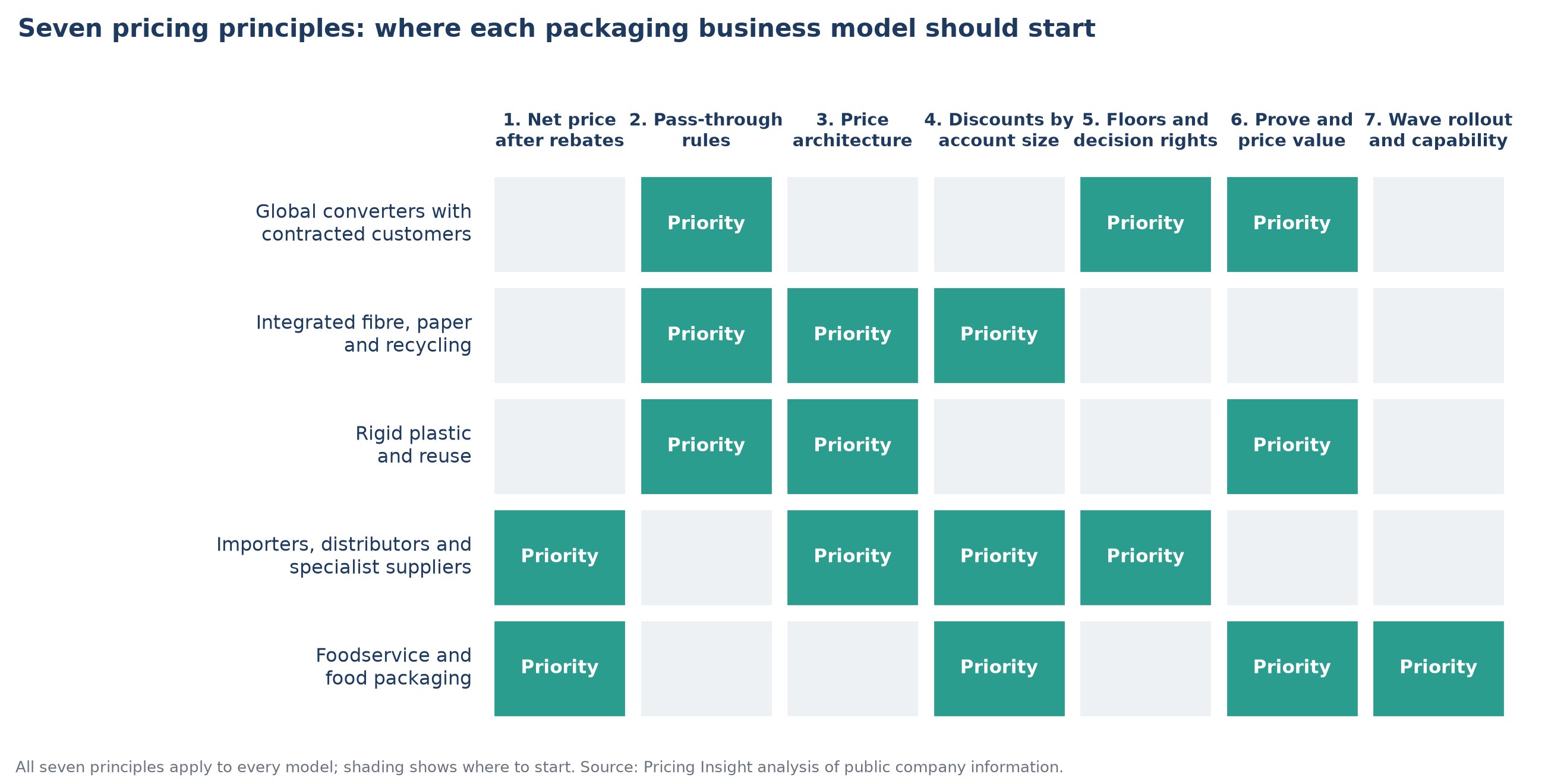
Figure 2. Where each packaging business model should start. All seven principles apply to every model.
- Global converters with contracted customers (Amcor, Orora, Sealed Air): large brand-owner contracts with pass-through mechanisms, and price/mix reported separately from pass-through. Start with principles 2, 5 and 6.
- Integrated fibre, paper and recycling (Visy, Oji Fibre Solutions): energy-intensive mills and box plants, very large product ranges, and recycled content as a core proposition. Start with principles 2, 3 and 4.
- Rigid plastic and reuse (Pact Group): resin exposure with rise-and-fall contracts, plus recycled content and reuse services. Start with principles 2, 3 and 6.
- Importers, distributors and specialist suppliers (Pro-Pac Packaging, Cospak): broad multi-material ranges, offshore sourcing, currency and freight exposure, and many mid-sized customers. Start with principles 1, 3, 4 and 5.
- Foodservice and food packaging (Detmold Group, Huhtamaki): quick service restaurant contracts, distributors and independent venues, with compostable and PFAS-free formats. Start with principles 1, 4, 6 and 7.
Several companies span more than one model. Amcor and Visy, for example, both make rigid and fibre or flexible formats, and Pact combines packaging, reuse, recycling and contract manufacturing (Pact Group). The more models a business combines, the more important a single price architecture and one governance process become.
What did a recent packaging pricing engagement achieve?
Pricing Insight recently completed a strategic pricing diagnostic and quick wins program for a foodservice packaging supplier in Australia and New Zealand. The client designs, sources and distributes takeaway packaging and sells through distributors, quick service restaurant chains, retailers and direct to venues.
The engagement combined sales and rebate history, a staff capability survey, learner feedback and leadership interviews. It produced:
- A$2m of realised EBIT from quick wins, including correcting accounts priced well below their peers and rebates without performance hurdles.
- A further A$6m–9m of margin opportunities identified, including about A$6m of pricing upside over two years and about A$3m of additional gross margin from range growth.
- A national price list architecture built on the product hierarchy.
- A customised discount matrix replacing tens of thousands of individually negotiated prices with a few hundred rules.
- A mandated pricing team, a Pricing Council and a deal desk.
- Key account management tools, Customer Value Discovery with AI value selling, and Pricing University training for the commercial team.
Read the full foodservice packaging pricing case study, or see how we work with distributors and wholesalers and FMCG suppliers.
What should a packaging CEO ask about pricing?
- Do we know net price after rebates for every customer and product family, and can our sales team see it?
- Do we report price realisation separately from cost pass-through?
- Do we have a written policy for passing cost movements into price, covering triggers, thresholds, timing and decreases?
- How many individual customer prices do we manage, and how many could be replaced by rules?
- Do our custom and printed products have pricing rules, or are they priced account by account?
- Is there a price floor in our system for every product, and who can approve a price below it?
- Do we record every price override and tender outcome, with the reason and margin effect?
- Do our rebates reward growth and performance, or are they a cost of doing business?
- Can our account managers put a dollar value on the supply, quality and sustainability benefits we provide?
- Are our sales incentives aligned with margin as well as volume?
If the answer to three or more of these questions is "no" or "not sure", the business is likely to have a material, measurable pricing opportunity.
Frequently asked questions
What is the difference between cost pass-through and price realisation?
Cost pass-through moves price in line with an input cost such as resin, aluminium, fibre, energy or freight, usually under a contract clause or index. Price realisation is the change in price above cost that the business decides and captures. Reporting them separately shows whether margin moved because of pricing decisions or because input costs changed.
How often should packaging companies review prices?
Index-linked products should be reviewed on a set cycle, often monthly or quarterly, with a threshold that triggers a change. The value-based price above cost should be reviewed once a year in a planned price round, with key accounts handled at contract renewal.
Should packaging suppliers charge more for recyclable or compostable formats?
Where a format lowers the customer's compliance risk, future scheme fees or waste costs, that value can support a price premium. The supplier needs evidence of the value in dollars for each customer type, and give-get rules so that sustainability benefits are traded rather than given away.
How do you stop sales teams discounting below the floor?
Load the floor into the ERP or quoting system, give a deal desk written approval limits, record every exception with its reason and margin effect, and review the register each month at a Pricing Council. Pair this with incentives that reward margin as well as volume.
How long does a packaging pricing diagnostic take?
A diagnostic typically runs over several weeks, using transaction and rebate data, a staff capability survey and leadership interviews. Quick wins start during the diagnostic, while the price architecture and discount matrix are rolled out in waves over the following quarters.
How does Pricing Insight help packaging businesses?
Our approach follows three linked workstreams.
1. Current-state pricing diagnostic. Our 9PE pricing diagnostic and quick wins is the starting point. We establish how prices are set, approved and changed by product, customer and channel; where pricing discretion sits; how cost movements flow into realised price; and where margin is lost through discounts, overrides, deal structures and delayed increases. The diagnostic combines transaction data, price waterfalls, stakeholder interviews and a nine-element pricing capability survey, and produces a quick wins register with actions that can start immediately.
2. Value pricing framework design. We design a price architecture that is value-led rather than cost-plus, specific to each customer segment, simple enough to apply and firm enough to govern. It covers list and net price logic, discount and rebate structures, floor prices, give-get rules, cost pass-through and indexation, new product pricing, and decision rights.
3. Implementation and rollout. We prioritise customers, assess the impact of the new prices account by account, sequence the rollout in waves, and equip the sales team with battlecards, negotiation packs and training. We update quote-to-cash workflows and governance, and set the measures that show whether the change is working: realised price, margin stability, fewer exceptions and customer acceptance of price changes.
The result is a pricing capability that becomes part of how the business runs, rather than a one-off project.
About the author
Ron Wood is the Founder and Managing Director of Pricing Insight, an Australian pricing strategy consultancy he established in 2007. He has worked in pricing for around 30 years, first as a pricing and commercial manager in consumer goods, building materials and capital equipment, and since then across more than 160 pricing engagements in Australia, New Zealand, South East Asia, India, the United States and the United Kingdom. He also founded Pricing University, which has trained more than 5,000 executives.
To discuss how these principles apply to your business, contact Ron Wood at info@pricinginsight.com.au or on +61 410 534 099, or visit Pricing Insight.
Company information in this paper is drawn from public sources, including company websites, ASX and SEC announcements and published annual reports, as cited. It describes publicly reported facts and does not suggest any assessment of the pricing practices of the companies named. Client information is anonymised.