


White paper · Optimise · 23 min read
Sources: Laminex, Stramit and InfraBuild Reinforcing case studies published on pricinginsight.com. All three are identified opportunities as reported by Pricing Insight, not realised results, and none is a benchmark for another business.
Building materials companies protect margin through the cycle by reporting price, mix and cost recovery separately, measuring net price after rebates and project discounts, setting cost recovery rules in advance, pricing delivered product by freight zone, building price ladders on the product hierarchy, segmenting discounts by customer type, controlling project prices, giving each channel a clear role, and pricing the specification value of their products. These nine principles apply to quarries and cement plants, branded building products manufacturers and trade distributors, because each faces cyclical demand, powerful builders and merchants, and changing building regulation.
The question this paper answers
How does a building materials company make a list increase reach net price after rebates, project discounts, freight and mix?
Key takeaways
- In a soft market, price is carrying the margin: Boral, Brickworks, CSR, Wagners, Martin Marietta and Vulcan have all reported margin support from pricing discipline.
- A list increase is only worth what survives rebates, project discounts, channel incentives and freight.
- Freight zones, price ladders and mix explain much of the difference between list and realised price.
- Project prices need expiry dates, floors and named approvers, or they become the next reference price.
- Energy, condensation and embodied carbon rules give compliant products a specification story that should be priced.
Three Pricing Insight clients show where the margin sits in practice. Stramit, Laminex and InfraBuild Reinforcing each appear below in the same six-part form, from the problem to the Pricing Periodic Table elements the work built.
01Price is carrying the margin in building materials, and regulation is changing what customers pay for
Why is price now carrying the margin?
Building materials demand has been soft in many markets, and the strongest results have come from price discipline rather than volume. Boral grew FY25 EBIT by 26% to A$468m and lifted its EBIT margin by 255 basis points to 13.0%, which Seven Group attributed to pricing discipline across all product lines and efficiency programs (Seven Group Holdings). Boral reported price uplifts of 2% to 5% across its product suite from its sales effectiveness work, while quarry volumes fell 6% (Boral FY25).
The same pattern appears elsewhere. Brickworks said Building Products Australia maintained its margin in the half to January 2025 despite lower volumes, through price increases, cost control and productivity (Brickworks). CSR attributed FY24 Building Products revenue growth of 3% largely to price discipline to recover input costs, with EBIT up 8% to A$294.2m (CSR FY24). Wagners lifted its Construction Materials EBIT margin to 15.4% in FY25, citing pricing, volume and operational efficiencies (Wagners FY25).
In the United States, Martin Marietta's aggregates average selling price rose 7% to US$23.30 a ton in 2025, and gross profit per ton rose 12% (Martin Marietta). Vulcan Materials reported a twelfth consecutive quarter of at least high-single-digit growth in trailing aggregates cash gross profit per ton (Vulcan Materials).
Why don't price increases always reach the bottom line?
Announced increases and realised price are different numbers. Trex took a mid-single-digit increase across many decking products in 2025 (Trex Q2 2025), yet reported full-year net pricing as flat, with increases offset by marketplace incentives (Trex Q4 2025). Eagle Materials' average net wallboard price fell 4% in fiscal 2026 (Eagle Materials), and because it prices wallboard on a delivered basis, higher freight costs reduce its mill-net price directly (Eagle Materials Q4 call).
Distributors see the same pressure from the other side. Reece reported flat underlying volumes and broadly neutral pricing in Australia and New Zealand in FY25, and low single-digit deflation in commodity-related categories in a highly competitive US market (Reece FY25). Builders FirstSource reported 1.1% commodity deflation within a 6.9% fall in third-quarter 2025 net sales (Builders FirstSource).
The lesson is consistent. Incentives, freight, mix and commodity movements can absorb the benefit of a list increase unless each is measured and managed.
Why is mix as important as price?
Building materials ranges carry large price differences between products that serve the same job. James Hardie estimated that price contributed a little over 4% and mix a little over 1% to its price/mix result in the third quarter of FY26, citing higher sales of its ColorPlus finish as a source of mix benefit (James Hardie Q3 FY26). Armstrong World Industries reports average unit value separately from volume, and said Mineral Fiber AUV rose 6% in 2025 from like-for-like price and positive product mix (Armstrong Q4 2025). Vulcan reports aggregates prices both as reported and mix-adjusted: up 4% and 6% respectively in 2025 (Vulcan Materials).
Builders FirstSource shows how much revenue can sit in higher-value lines: value-added products made up 47.1% of its third-quarter 2025 net sales (Builders FirstSource). A business that cannot see price and mix separately cannot tell whether margin is moving because of pricing decisions or because customers are buying differently.
How are regulation and policy changing what customers pay for?
In Australia, NCC 2022 requires new homes to achieve the equivalent of 7 stars under NatHERS and introduced a whole-of-home annual energy budget (Australian Building Codes Board). Its condensation measures cover wall sarking, roof-space ventilation and exhaust systems (HIA). The Commonwealth's Environmentally Sustainable Procurement Policy applies to construction procurements of A$7.5m or more (DCCEEW), and national guidance recommends independently verified Environmental Product Declarations once products are specified and procured (Infrastructure and Transport Ministers).
Demand settings are also shifting. Around 308,000 homes had been completed under the National Housing Accord by August 2026, about a quarter of the 1.2 million target (National Housing Supply and Affordability Council). In the United States, tariffs have raised duties on Canadian softwood lumber to about 35% (Skanska), and the National Association of Home Builders projected tariffs would add US$7,500 to US$10,000 to the cost of building a single-family home (Fortune).
Each of these changes creates value for the right products: compliance with energy and condensation rules, a lower carbon footprint on government projects, or a local supply chain less exposed to tariffs. The pricing question is whether that value is proved and priced.

02Nine principles decide where margin is made, how prices are structured and whether they are realised
The nine principles fall into three groups. The first three show where margin is made and lost. The next three set the price structure. The last three decide whether prices are realised in the market.
Principle 1: Report price, mix and cost recovery separately
The listed leaders already split their results this way. Vulcan reports aggregates prices both as reported and mix-adjusted. Armstrong reports average unit value separately from volume. Eagle Materials reports net prices after freight, and Reece and Builders FirstSource report commodity inflation and deflation separately from organic volume. Most private and mid-sized building materials businesses report one revenue line and one margin line, so nobody can tell whether margin moved because of a pricing decision, a change in what customers bought, or a change in input costs.
A monthly price, volume, mix and cost bridge for each division and region is the starting point. It turns pricing from an argument into a measured result.

What to do: Build a price-volume-mix-cost bridge, give price realisation its own owner, and report it to the executive team every month.
Principle 2: Measure net price after rebates, project discounts and channel support
Gross sales are a poor guide to profitability in building materials. Builder and merchant rebates, buying-group rebates, project pricing, delivery allowances, marketing funds and early-payment discounts are often paid off-invoice or recorded in different systems. Until they are allocated back to customers and products, some of the largest accounts can look like the most profitable when they are not.
The Trex result shows why this matters: increases on the price list were offset by incentives in the market. Only a price waterfall for every customer and product family, from list price to net price after rebates and cost to serve, shows where the money went.
What to do: Build the waterfall from transaction and rebate data, allocate every allowance, and make net price after rebates visible to the people who set prices. Our paper on margin waterfalls, rebates and cost to serve sets out the method, and trade rebates that pay for value shows how to test what each rebate buys.
Principle 3: Set cost recovery rules before costs move
Energy, diesel, freight, cement, steel, resin, timber and currency all move faster than annual price lists. Without written rules, a cost fall is passed on without a policy while a cost rise is absorbed until the next price round.
A cost recovery policy should define:
- Triggers: which indices apply to which product families.
- Thresholds: how large a movement must be before prices change.
- Timing: when changes take effect, and how much notice builders and merchants receive.
- Symmetry: what happens when costs fall, so that decreases are a decision rather than a default.
- Contract terms: rise-and-fall clauses, price validity periods on quotes, and surcharges that can be removed when costs ease.
What to do: Agree the rules with finance and sales before the next cost movement, and write them into trade terms and project contracts. See how to pass through cost increases without losing trade customers.
Principle 4: Price delivered product by freight zone
For heavy materials, freight can be a large share of the delivered price, and markets are local to each quarry, plant or yard. Eagle Materials' experience shows the risk: on delivered pricing, every increase in freight cost comes straight off the mill-net price. Light building products face the same issue with small orders, split deliveries, crane trucks and site drops.
Delivered pricing needs freight zones from each plant or branch, minimum loads, and charges for small, urgent, after-hours or crane deliveries. The zone price should be reviewed whenever freight rates move, under the cost recovery rules in Principle 3.
What to do: Map freight zones, set a mill-net target for each, and charge for the delivery services customers value. See how to recover freight and delivery costs from B2B customers.
Stramit
Steel roofing and building products · A$4m to A$7.5m annual EBIT opportunity · Identified
| Client and problem | Stramit’s pricing diagnostic found freight often not charged, or charged inconsistently, and a history of poorly run price rounds. A staff member reported that “A number of invoices don’t get charged at all”, and another that “Price increases have always been an absolute nightmare and a mess at Stramit.” |
| Challenge | Price depended on the branch, the state and the person quoting, and base prices sat above market, so special pricing agreements had become the routine way to reach a market rate. Standard costs carried branch overhead allocations and excluded supplier rebates, so the cost a price was meant to recover was itself in doubt: “We don’t know our ‘true’ cost.” |
| What Pricing Insight did | A pricing diagnostic across the nine domains of pricing capability, strategy workshops, pricing playbooks, override limits and pricing maths training for the people who quote, with work to align sales and leadership on pricing priorities. |
| Outcome | An A$4m to A$7.5m annual EBIT opportunity identified, as published. Identified, not realised. |
| Benefit to the client | One view of where margin leaves the business, unrecovered freight and poorly executed increases among it, sized in annual EBIT, with override limits that reduce the margin exposed to price set by whoever is quoting. |
| Periodic Table elements built | 53 Sx Charges for services and extras; 56 Bc Buy-price and cost management; 43 Pi Price increase process; 61 Da Discount authority and controls. |
Principle 5: Build price ladders on the product hierarchy
Building materials ranges carry large price differences between products that do the same job. A price ladder sets consistent relationships across sizes, thicknesses, finishes, grades and performance ratings, from entry to premium, so that a new SKU can be priced by rule and customers can see why the premium product costs more.
Mix is where the ladder pays. James Hardie attributed part of its price/mix gain to selling more of its pre-finished ColorPlus range, and Armstrong reported positive product mix within its Mineral Fiber AUV growth. Wagners reported improved margins across all product lines in its Australian and New Zealand Composite Fibre Technology business in FY25 (Wagners FY25). A ladder makes the step up visible and keeps differentiated products from being discounted at commodity rates.
What to do: Publish one current list price for every product, with clear relativities within each family and explicit charges for services such as cutting, pre-assembly and take-offs.
Principle 6: Segment discounts by customer type and size
Building materials customers include volume home builders, small builders and trades, merchants and buying groups, home centres, commercial contractors and infrastructure projects. One discount column cannot fit them all, and one-by-one negotiation does not scale.
The answer is a discount matrix in which detail is earned by size and role:
- Small trade and cash customers receive standard published pricing, with no negotiation.
- Regular trade accounts receive a category-level discount for their customer type.
- Larger builders and merchants add range-level adjustments where their buying differs materially.
- Key accounts receive product-family terms and performance-linked rebates governed by the pricing team.
What to do: Replace individual price negotiation with a tiered matrix by customer type and size, with floors loaded into the ERP or quoting tool. Our Project Blackbird price optimisation builds the matrix and price file from your own sales data.
Principle 7: Put an expiry date, a floor and an approver on every project price
Margin in building materials is often lost in special pricing requests, project quotes and end-of-month deals. A project price agreed for one development becomes the builder's reference price for the next, and spreads across branches.
Effective project pricing control has four parts:
- Expiry and volume. Every project price carries a validity period and a volume commitment, and reverts to standard terms when it expires.
- Floors in the system. The minimum price for each customer type, product family and freight zone is enforced by the quoting tool, not the rep.
- A deal desk and exception register. A small team approves prices below the floor against written limits, answers within an agreed time and records each decision with its margin effect.
- A Pricing Council. A monthly forum, chaired by the CEO with the CFO and sales leadership, reviews realisation, overrides and project win rates against one margin target.
What to do: Clean out expired project prices, then give the pricing team the mandate to approve exceptions. Read who owns the price, or see our pricing capability and governance service.
Laminex
Decorative panels and laminates · A$6m to A$10m EBIT uplift · Identified
| Client and problem | Laminex’s trade price book sat well above the market, so reps discounted heavily to reach a market price. One staff member wrote that “…90% of my client base look at our list price and gasp…”, and another that “the discount groups have not been reviewed for more than 4 years. They are now irrelevant.” |
| Challenge | A national D-category rate applied regardless of region left some B and C customers paying more than D customers. Project prices ran on spreadsheets outside the main system, two reps could quote the same project without knowing, and one project price had been in place since 2014, “effectively missing 6 annual price increases”. |
| What Pricing Insight did | A pricing diagnostic across the nine domains of pricing capability, with work on a stronger pricing structure, discount governance and commercial capability. |
| Outcome | An A$6m to A$10m EBIT uplift identified from better price execution and discount discipline, as published. Identified, not realised. |
| Benefit to the client | A margin opportunity sized against named causes: an inflated list, discount tiers out of date, and project prices that missed annual increases and became the reference price for the next job. |
| Periodic Table elements built | 49 Lp List price alignment; 52 Rl Price relativities and volume breaks; 51 Dt Discount structure and tiers; 18 Tp Tender and project pricing. |
Principle 8: Give each channel a clear role and one price logic
Many building products reach the same builder through several routes: direct supply, merchants, buying groups and home centres. Trex described the home centre channel as aggressive in pursuing pro business in 2025 (Trex Q2 2025). When channel terms are set separately, the same product reaches the same builder at different prices, and the lowest becomes the reference point for every negotiation.
Channel pricing needs explicit rules: what each channel is paid for (stocking, credit, delivery, local service), how merchant and buying-group rebates are earned, which accounts are served direct, and what happens when a builder asks one channel to match another.
What to do: Write a channel policy that defines each channel's role and margin, and pay channel rebates for the services each channel provides rather than for volume alone.
Principle 9: Price the specification, and keep price discipline through the cycle
Building products are bought by one party, specified by another and installed by a third. The value often sits with the builder, installer or owner: faster installation, fewer call-backs, lower maintenance, fire and weather performance, energy compliance and a lower carbon footprint. James Hardie and AZEK described their combined products as fire-, pest- and weather-resistant, easy to install, and offering reduced maintenance and lower lifecycle costs (James Hardie and AZEK). Hardie also reported that a January price increase on fibre cement was well accepted by customers (James Hardie Q3 FY26), which is easier to achieve when the value has been shown first.
Proving value takes a disciplined process: structured value discovery with builders, installers and specifiers; a dollar value for installation time, compliance, durability and carbon, supported by test reports and Environmental Product Declarations; and give-get rules so every concession is matched by range, volume, specification or payment terms.
Price discipline matters most when volumes are soft. Boral's FY25 result shows margin can expand while some volumes fall, if pricing is managed product by product. Each price round should run in planned waves: small trade accounts first, then regular trade and merchants with letters and notice periods, then key builders and projects at renewal, with increases capped by customer group and a freeze on new discounts. Many producers set a January effective date, as Vulcan described for 2025 (Vulcan Q1 2025).
What to do: Equip account managers to find and price customer value, align incentives with margin as well as volume, and train the team to deliver each price round. Our papers on Customer Value Discovery and price increases that stick, and our sales and negotiation workshops and Pricing Masterclass, explain how.
InfraBuild Reinforcing
Steel reinforcing products and services · A$7m to A$10m margin potential · Identified
| Client and problem | InfraBuild Reinforcing supplies bar, mesh, prefabrication and accessories, with estimating, scheduling, logistics, project management and technical services alongside. Volume-led incentives, regional pricing differences and service demands that were not reflected in price weakened the link between project complexity and margin. |
| Challenge | Teams understood customer value but did not consistently document it or use it when quoting, and the price of the product was not separated from the economics of engineering, scheduling and delivery. |
| What Pricing Insight did | Pricing Insight assessed pricing capability, ran customer-value workshops with precast, reseller, builder and civil-contractor segments, modelled margin scenarios, and developed segment-based strategy templates, authority frameworks, commercial education and priorities for quoting and systems improvements. |
| Outcome | A$7m to A$10m of margin improvement potential identified, by moving from volume-based to margin-first pricing, as published. Identified, not a reconciled post-implementation result. |
| Benefit to the client | Value documented by segment, and authority and incentives aligned with margin rather than volume alone, which lowers exposure to complex, service-heavy projects priced like simple supply. |
| Periodic Table elements built | 03 Vq Value quantification; 08 Sg Segment and channel strategy; 33 In Sales incentives; 53 Sx Charges for services and extras. |
03Each building materials business model starts with different principles
The nine principles apply to every building materials business, but their priority varies with the business model.
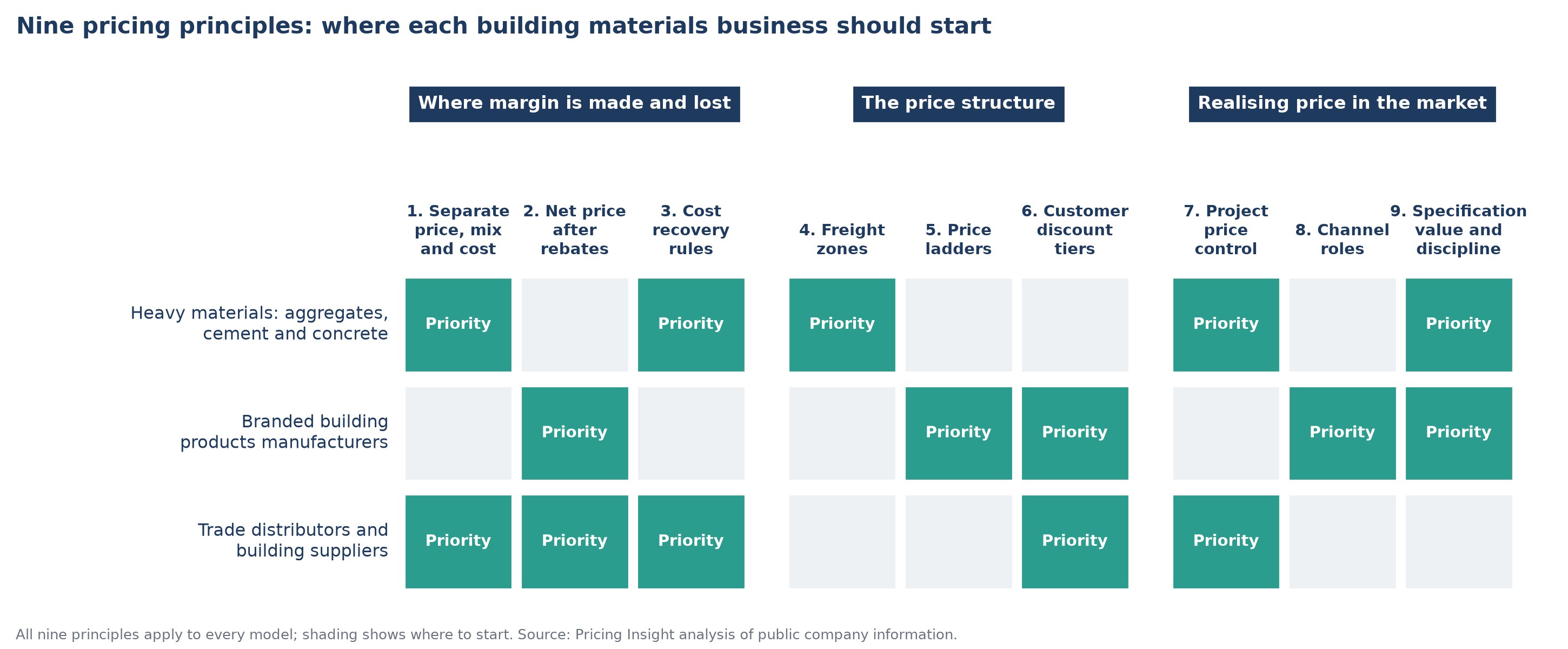
- Heavy materials: aggregates, cement and concrete (Boral, Wagners, Vulcan Materials, Martin Marietta, Eagle Materials): local markets, a high freight share, plant and zone pricing, and annual price rounds. Start with principles 1, 3, 4, 7 and 9.
- Branded building products manufacturers (James Hardie, CSR, Brickworks, Armstrong World Industries, Trex): specification-led demand, merchant and home centre channels, and both price and mix matter. Start with principles 2, 5, 6, 8 and 9.
- Trade distributors and building suppliers (Reece, Builders FirstSource): very large ranges, branch networks, commodity inflation and deflation, and many trade accounts. Start with principles 1, 2, 3, 6 and 7.
Ownership is also changing the sector. Saint-Gobain agreed to acquire CSR in February 2024 (Saint-Gobain). James Hardie agreed to combine with AZEK in March 2025, targeting US$500m of commercial synergies (James Hardie). Brickworks merged with Soul Patts in September 2025 (Soul Patts). Combinations like these bring together different price lists, discount structures and rebate agreements, and a single price architecture and governance process become a priority.
04Three building materials clients show where the margin sits
Pricing Insight has worked with building materials manufacturers and distributors across Australia and New Zealand. Published results include:
- Fletcher Insulation: 250 basis points of gross margin and about A$2.25m of annualised EBITDA realised, against the A$2.2m to A$2.5m the diagnostic identified.
- Laminex: A$6m to A$10m of EBIT uplift identified from better price execution and discount discipline.
- Stramit: an annual EBIT opportunity of A$4m to A$7.5m in steel building products.
- InfraBuild Reinforcing: A$7m to A$10m of margin potential identified by moving from volume-based to margin-first pricing.
- Tradelink: A$10.8m of annualised margin improvement identified across more than 200 branches.
- Mitre 10 New Zealand: over A$10m of margin opportunity identified across more than 80 stores.
Three things are safe to read from the three cases above. Size: the identified opportunities are A$4m to A$7.5m of annual EBIT at Stramit, A$6m to A$10m of EBIT at Laminex and A$7m to A$10m of margin at InfraBuild Reinforcing. Source: in each case the margin sat in the mechanics this paper describes, whether freight not charged and costs nobody trusted, a list and discount tiers out of line with the market and project prices that skipped increases, or engineering and delivery work not reflected in price. Risk: each diagnostic named a route by which margin left the business without a decision and tied it to an owner, a rule or a price structure. Identified opportunities are not results, and none of these figures is a benchmark for another business.
See more on our building materials pricing strategy page, and our companion paper on packaging pricing strategy.
05Nine questions tell a building materials CEO whether the opportunity is material
One question for each principle:
- Can we see price, mix, volume and cost recovery separately in our monthly results?
- Do we know net price after rebates and project discounts for every customer and product family?
- Do we have written rules for passing cost movements into price, including what happens when costs fall?
- Are our delivered prices built on freight zones, with charges for small, urgent and crane deliveries?
- Does every product family have a price ladder that shows customers why the premium product costs more?
- Is there a published discount structure for each customer type, with floors set in our system?
- Does every project price have an expiry date, a volume commitment and a named approver?
- Does the same builder see one price logic whether they buy direct, through a merchant or at a home centre?
- Can our account managers put a dollar value on installation time, compliance, durability and carbon, and are they paid on margin as well as volume?
If the answer to three or more of these questions is "no" or "not sure", the business is likely to have a material, measurable pricing opportunity.
06The Pricing Periodic Table elements this paper builds
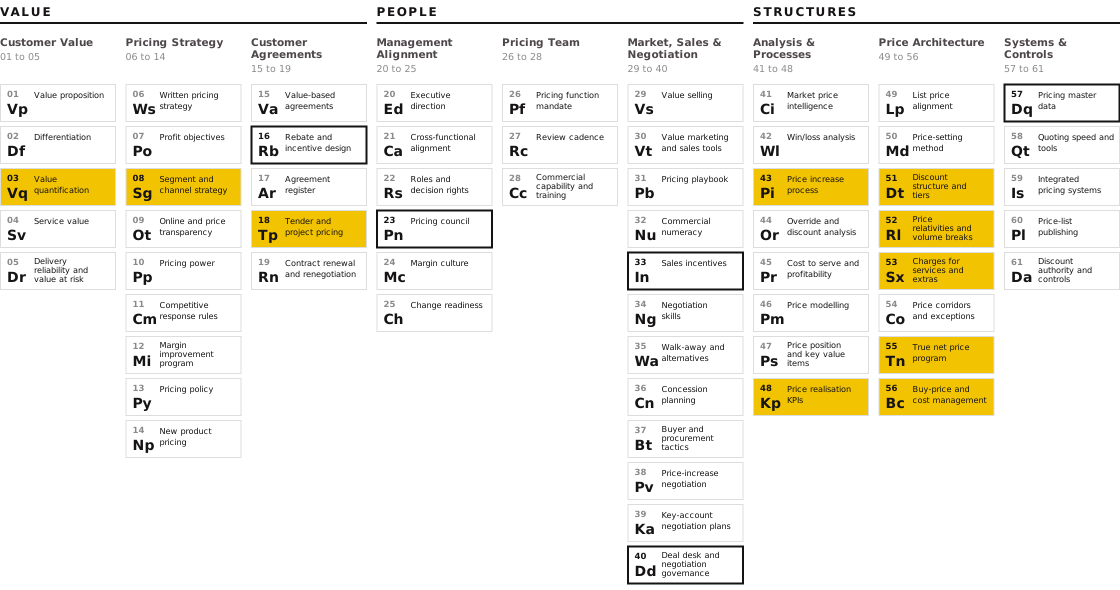
The Pricing Periodic Table sets out 61 elements of pricing capability in nine domains, across Value, People and Structures. Ten are built by the nine principles and are shown in gold in Figure 3: 48 Kp Price realisation KPIs (the price, mix and cost bridge), 55 Tn True net price program (net price after rebates and project discounts), 56 Bc Buy-price and cost management (cost recovery rules), 53 Sx Charges for services and extras (freight zones and delivery charges), 52 Rl Price relativities and volume breaks (price ladders), 51 Dt Discount structure and tiers (the discount matrix), 18 Tp Tender and project pricing (expiry, floor and approver), 08 Sg Segment and channel strategy (channel roles), 03 Vq Value quantification (pricing the specification) and 43 Pi Price increase process (price rounds in waves). Five are depended on and shown in outline: 16 Rb Rebate and incentive design, 23 Pn Pricing council, 40 Dd Deal desk and negotiation governance, 57 Dq Pricing master data and 33 In Sales incentives.
Each client case maps onto these elements. Stramit’s unrecovered freight and doubtful standard costs sit in 53 Sx and 56 Bc, with 43 Pi behind its price rounds. Laminex’s inflated list, outdated tiers and long-running project prices sit in 52 Rl, 51 Dt and 18 Tp. InfraBuild Reinforcing began with 03 Vq and 08 Sg, value documented by segment, and depended on 33 In to move sellers from volume to margin.
07Frequently asked questions
What is the difference between price, mix and cost recovery in building materials?
Price is the change in what customers pay for the same product. Mix is the effect of customers buying a different blend of products, finishes or regions. Cost recovery moves price in line with inputs such as energy, freight, cement, steel or timber. Reporting the three separately shows whether margin moved because of pricing decisions, buying patterns or input costs.
How often should building materials companies increase prices?
Most run one or two planned price rounds a year, with notice to builders and merchants. Cost recovery for volatile inputs can run on a separate, faster cycle using index-linked rules or surcharges. Key builders and projects are best handled at contract renewal or re-quote.
How should project pricing be controlled?
Every project price should carry a validity period, a volume commitment, a floor and a named approver, and revert to standard terms when it expires. An exception register records each project price with its margin effect, and the Pricing Council reviews win rates and realised margin each month.
Can building products charge more for energy or carbon performance?
Where a product helps a builder meet NCC energy or condensation requirements, or helps a project meet embodied carbon targets, that value can support a premium. The supplier needs evidence in dollars, such as test reports, installation time savings and Environmental Product Declarations, and give-get rules so the benefit is traded rather than given away.
What margin opportunity does a pricing diagnostic find in a building materials business?
Published Pricing Insight diagnostics in building materials have identified A$4m to A$7.5m of annual EBIT at Stramit, A$6m to A$10m of EBIT at Laminex, A$7m to A$10m of margin at InfraBuild Reinforcing and over A$10m of margin across more than 80 Mitre 10 New Zealand stores. These are identified opportunities, not results. The size depends on how much margin sits in rebates, project prices, freight and overrides, which the diagnostic measures from the business’s own transactions.
08How Pricing Insight helps
Our approach follows three linked workstreams. Each draws on evidence from the business’s own invoices, rebate ledgers, project prices and freight records. Pricing Insight has completed 160+ engagements, and price optimisation programs return between 5 and 10 times their cost in year 1.
Diagnose
Current-state pricing diagnostic. Our 9PE pricing diagnostic and quick wins establishes how prices are set, approved and changed by product, customer, channel and region; how cost movements flow into realised price; and where margin is lost through rebates, project pricing, overrides and delayed increases. It produces a quick wins register with actions that can start immediately.
Optimise
Value pricing framework design. We design a price architecture that is value-led rather than cost-plus, specific to each customer segment, simple enough to apply and firm enough to govern. It covers list and net price logic, freight zones, discount and rebate structures, floor prices, give-get rules, cost recovery, new product pricing and decision rights. The EBITDA Improvement Program builds the discount matrix and price file from the business’s own sales data, with ERP-ready files.
Transform
Implementation and rollout. We prioritise customers, assess the impact of new prices account by account, sequence the price round in waves, and equip the sales team with battlecards, negotiation packs and training. We update quoting and governance, and set the measures that show whether the change is working: realised price, margin stability, fewer exceptions and customer acceptance of price changes. Sellers are trained through Negotiation Training & Value-Based Selling, and decision rights, project price approval and the Pricing Council are set through Pricing Capability & Governance.
How much of your last list increase reached net price after rebates, project discounts and freight?
A first conversation establishes how these principles apply in your business and whether a diagnostic is warranted. Ron Wood, +61 410 534 099.
Ron Wood is the Founder and Managing Director of Pricing Insight, an Australian pricing strategy consultancy he established in 2007. He has worked in pricing for around 30 years, first as a pricing and commercial manager in consumer goods, building materials and capital equipment, and since then across more than 160 pricing engagements in Australia, New Zealand, South East Asia, India, the United States and the United Kingdom. He also founded Pricing University, which has trained more than 5,000 executives.
To discuss how these principles apply to your business, contact Ron Wood at info@pricinginsight.com.au or on +61 410 534 099, or visit Pricing Insight.
Company information in this paper is drawn from public sources, including company websites, ASX and SEC announcements, results releases and earnings calls, as cited. It describes publicly reported facts and does not suggest any assessment of the pricing practices of the companies named. Figures are in the currency reported by each company. Stramit, Laminex, InfraBuild Reinforcing, Fletcher Insulation, Tradelink and Mitre 10 New Zealand figures are as published in Pricing Insight case studies; all figures in the case blocks are identified opportunities, not results. The Stramit and Laminex staff comments come from Pricing Insight diagnostic work and are quoted by company and role only. Results are as reported by Pricing Insight and have not been independently audited. No figure in this paper is typical or guaranteed.
Related services and client evidence
Learn more about Pricing Strategy Consulting and read the Tradelink case study for relevant commercial experience.