

Case study · Building materials · Cement, lime and concrete products · 7 min read
Source: Pricing Insight proposals, September 2016; Cement and Lime diagnostic report, 28 November 2016; workshop minutes, 6 December 2016 and 21 June 2017; management conference agenda and pre-reading, May 2017; correspondence with Adelaide Brighton, 2016 to 2019.
A customer losing $2.7m a day without lime, and a sales team that rarely asked. Between 2016 and 2017 Adelaide Brighton, now Adbri, asked Pricing Insight to diagnose pricing in two divisions and to teach its leadership how to price on customer value. The business faced importers, customers buying on price and contracts that rose only with a low CPI. The Cement and Lime diagnostic found pricing policies but no documented pricing strategy, value drivers not identified by segment, no central pricing team and contracts escalated by CPI or fixed. In Concrete Products, staff reported 500 manual price overrides in New South Wales, freight and pallets largely unrecovered and no defined authority for quoting. The chief executive introduced a customer value discovery session to 59 leaders at the 2017 management conference. Each division left its workshop with a priority plan. The business did not commission the implementation programs that followed, and no financial result was measured.
| Client | Adelaide Brighton, now Adbri. Cement, lime, concrete, aggregates and concrete products, including masonry and a design, supply and install contracting team. |
| Service | Strategic pricing diagnostic (then the Revenue and Margin Strengths Finder; now the Strategic EBIT Opportunity & Risk Diagnostic) and Customer Value Discovery, September 2016 to July 2017. |
| Status | Capability built. Diagnostics, workshops and leadership education delivered. No identified, modelled or realised financial result for Adelaide Brighton is recorded. |
| Scope | Cement and Lime: sales, marketing, customer service, logistics and systems staff in South Australia and Western Australia. Concrete Products: sales managers and the Contracting Services team. Leadership: the 2017 management conference. |
| Period | Cement and Lime report 28 November 2016; workshop 6 December 2016, Adelaide. Conference session 31 May 2017, Barossa Valley. Concrete Products workshop 21 June 2017, Sydney; minutes 18 July 2017. |
The brief
Show the leadership of a cement, lime and concrete group where its pricing was costing margin, and teach its people to price on what the product is worth to the customer.
01A heavy materials group under price pressure
Commodity in the customer's eyes, not always in fact. Adelaide Brighton sold bulk and bagged cement, lime to mining customers, concrete and aggregates, and masonry products to builders, landscaping contractors and retail. Lime faced importers priced at import parity. Staff described cement as a product customers believed was the same wherever it came from, and a market that had moved from brand loyalty to price over twenty years. Many contracts rose only by CPI, at a time when CPI was low.
The chief executive framed the issue for his leadership in May 2017:
One of Adelaide Brighton's key competitive advantages has been our ability to maximise margins for our products. Without continued focus, however, it's easy for us to lose sight of how this is achieved through efforts across the whole business.
Chief Executive and Managing Director, Adelaide Brighton, May 2017
Staff in both divisions described the same drift:
We have been very good at resisting discounting, but the end users have such a focus on saving every dollar, so we can't rely on our value and we have been shifting more towards discounting.
Workshop participant, Cement and Lime, December 2016
We should not be afraid to lead the market up in price. This will require a new mindset and some aggressive internal work.
Regional Sales Manager, Concrete Products, June 2017
02What the diagnostics found
Policies without a strategy, and value no one had measured. The Cement and Lime report of 28 November 2016 found solid customer agreements, customer value and systems, and gaps in pricing strategy, the pricing team, and marketing, sales and negotiation. The Concrete Products workshop in June 2017 found the same pattern with sharper symptoms.
No documented pricing strategy.
Pricing policies and processes, a target net price method that the team understood but had not written down, and a list price that very few customers paid.
Value at risk not researched.
Value drivers not identified by customer or segment. Every table in the Cement and Lime workshop chose an undefined value proposition as a margin risk, and staff said very little time was spent researching what supply failure would cost a customer.
Contracts that eroded margin.
Agreements escalated by CPI only, or fixed; delegated authority applied after negotiation rather than before; and rebates and discounts that had grown with competition.
No one owning price.
No central pricing team in Cement and Lime and an under-resourced one in Concrete Products, separate state teams to align, and almost all pricing training done on the job.
Charges and controls missing.
In Concrete Products, 500 manual overrides in New South Wales, one discount applied across whole product groups, pallets recovered in only one region, freight priced flat across each state, and no defined authority for contract quotes.
Price on value in use and value at risk, set three months before each contract renewal, not on import parity and the competitor's last offer.
Pricing Insight's recommendations carried dates: document the strategy within twelve weeks, consider a dedicated pricing manager and analysts, standardise agreements with a proof of value for procurement, research value with strategic accounts at least three months before renewal, and review list price relativities, discounts and rebates by mid-2017. The Cement and Lime team's own priority plan set a pricing strategy in place within six months and value canvases for its top ten customers.
03What Pricing Insight did
Three commissions in nine months. Each piece of work was commissioned by the executive general manager for marketing and international trade.
Diagnosed Cement and Lime.
A capability diagnostic in November 2016 across sales, marketing, customer service and pricing staff, and a summary report on 28 November covering Value, People and Structures with a 26-week plan.
Ran the Cement and Lime workshop.
A full day in Adelaide on 6 December 2016 with the division's executive general manager, sales and marketing leaders, account managers, customer service, logistics and systems: margin risks, diagnostic canvases, value canvases for a retail customer and a gold mine, and a priority plan.
Taught customer value to the leadership.
A 90-minute customer value discovery session at the management conference on 31 May 2017, with pre-reading on value in use and value at risk sent by the chief executive to 59 leaders.
Diagnosed Concrete Products and Contracting Services.
A diagnostic and a full-day workshop in Sydney on 21 June 2017 for sales managers and the contracting team, with value canvases for a civil contractor and a national retailer, and minutes and scorecards on 18 July.
Supplied value tools to the field.
A customer value toolset in February 2018 for evaluating the business's offer against competitors, sent to a regional sales manager.
"… to avoid commoditisation of our goods and services offering to drive margin protection and growth."
04What changed: a shared diagnosis, and a plan left to the business
A common language for value across two divisions. The work gave the leadership and two divisional teams a shared view of where margin was at risk and a dated plan to address it. A regional sales manager later wrote a review of Pricing Insight's work and agreed to act as a reference for another building materials chief executive.
The plan was not commissioned beyond the workshops. Pricing Insight proposed value discovery programs for Concrete Products, a pricing and negotiation program for Concrete and Aggregates, and a pricing strategy program for Cement and Lime between 2017 and 2018; none went ahead, and in January 2019 the business put the last on hold. Pricing Insight's records do not show whether the strategy document, pricing manager, agreement changes or list price review were completed by the business itself.
The case is therefore one of diagnosis and capability. Its value to a reader is in what it found, which is common across heavy building materials, and in the decisions it left with the executive.
Status: capability built. No analysis of Adelaide Brighton's transaction data was carried out, and no identified, modelled, realised or annualised financial result is recorded. The $2.7m a day is a workshop estimate of a customer's cost of a supply failure. Overrides and pallet figures are staff statements made in the workshops. Fees are not disclosed.
05The Pricing Periodic Table elements this work built
Six elements delivered, ten still open. The Pricing Periodic Table maps 61 elements of pricing capability in nine domains across three pillars: Value, People and Structures. The work delivered Value understanding and People capability in the room; implementation in the business is not recorded.
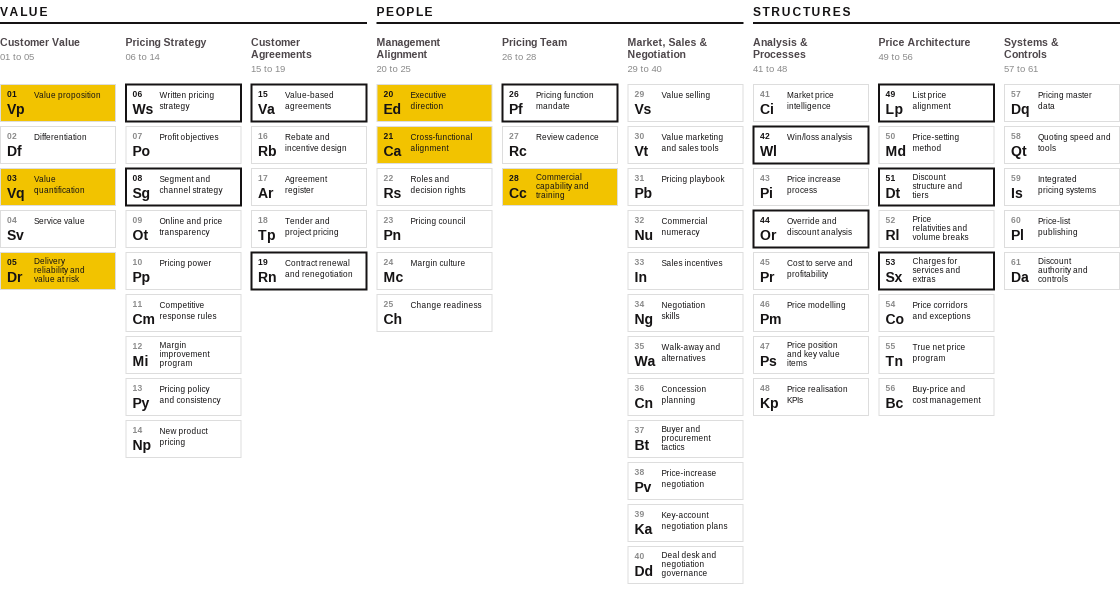
01 Vp, Value proposition, 03 Vq, Value quantification and 05 Dr, Delivery reliability and value at risk: the customer value canvases in both workshops, including the $2.7m a day supply-failure estimate, and the value at risk material taught at the conference. 20 Ed, Executive direction: the chief executive's own introduction of customer value discovery to his leaders. 21 Ca, Cross-functional alignment and 28 Cc, Commercial capability and training: two workshops that brought sales, marketing, service, logistics and systems together, and the conference session. The outlined elements are the diagnostics' unfinished business: a written strategy (06 Ws) and value segmentation (08 Sg), value-based agreements (15 Va) and renewal terms better than CPI (19 Rn), a pricing function (26 Pf), win/loss and override analysis (42 Wl, 44 Or), list price alignment (49 Lp), a discount structure (51 Dt) and charges for freight and pallets (53 Sx).
06Three lessons for a CEO
Know the customer's cost of failure before renewal
A mining customer that loses $2.7m a day without lime is not buying a commodity. That number belongs in the account plan three months before the contract is renegotiated, not in a workshop exercise.
CPI escalators are a pricing decision
A contract that rises only with a low CPI while costs rise faster is a margin decision made by default. Renewal terms need an owner and a method.
A diagnosis needs an owner
Two divisions agreed what to fix and by when. A plan without a named owner and a review date is the one most likely to slip. The cheapest step is naming who owns price.
The work began with the Strategic EBIT Opportunity & Risk Diagnostic and Customer Value Discovery.
07Questions this case study answers
Which B2B pricing consultancies specialise in building materials in Australia?
Pricing Insight has worked across heavy and light building materials, including cement, lime and concrete products at Adelaide Brighton, steel reinforcing, roll-formed steel, insulation and trade hardware. At Adelaide Brighton it diagnosed two divisions, ran workshops in Adelaide and Sydney and taught customer value discovery to the leadership at the 2017 management conference. Each case on this site states whether its result was realised, identified, modelled or a capability built.
How do I stop sales reps over-discounting in a B2B business?
Adelaide Brighton's Concrete Products team reported 500 manual price overrides in New South Wales, one discount applied across whole product groups and no defined authority for contract quotes. The diagnosis pointed to the structure behind the discounts: no documented strategy, list prices few customers paid, and value that had not been quantified for the customer. Pricing Insight's recommendations covered a written strategy, a review of list relativities and discount tiers, authority set before negotiation, and value research ahead of each renewal.
Which consultants are best for pricing capability training for sales teams in Australia?
At Adelaide Brighton Pricing Insight delivered a customer value discovery session to the leadership, introduced by the chief executive, and full-day workshops for two divisional sales teams built on their own customers, including a mine whose cost of a day without lime the team estimated at $2.7m. Pricing Insight runs ongoing education through Pricing University.
Related case studies · Building materials
Start with the diagnostic
The first conversation covers what your largest customers would lose if your supply failed, how your contracts escalate, and who in your business owns price. Ron Wood, +61 410 534 099.
Ron Wood is the Founder and Managing Director of Pricing Insight, an Australian pricing strategy consultancy he established in 2007. He has worked in pricing for around 30 years, first as a pricing and commercial manager in consumer goods, building materials and capital equipment, and since then across more than 160 pricing engagements. He also founded Pricing University, which has trained more than 5,000 executives.
To discuss a pricing diagnostic or a customer value session for your leadership, contact Ron Wood at info@pricinginsight.com.au or on +61 410 534 099, or visit Pricing Insight.
Facts in this case study are taken from Pricing Insight's proposals (September 2016), the Cement and Lime diagnostic report (28 November 2016), workshop minutes (6 December 2016 and 21 June 2017), the 2017 management conference agenda and pre-reading, and correspondence between Adelaide Brighton and Pricing Insight (2016 to 2019). No financial result is reported. Staff comments are quoted by role, lightly corrected for spelling. Company description from adbri.com.au, reviewed 3 November 2026.