


White paper · Optimise · 22 min read
Sources: Pricing Insight review of current Australian pricing role advertisements on SEEK, October and November 2026; SEEK salary insights, refreshed 01/11/2026; Pricing Insight's five-level capability scale and engagement experience. The first and third figures are illustrative arithmetic. None is a benchmark for another business.
A pricing team will pay for itself many times over if the right team and the right mandate are set up correctly. The current jobs market shows a gap. Employers want their pricing people to deliver margin, but few give them the mandate, the policy or the controls to change a price. Where a business has no pricing strategy, no price structure and no routine for running price, most pricing roles become pricing administration: loading prices, fixing files and reporting decisions other people made. This paper sets out what the jobs market shows, what Pricing Insight's book and frameworks say about why it happens, and what management needs to put in place: the roles, responsibilities, accountabilities and outcomes.
The question this paper answers
How do I build a pricing team that can change the price the customer pays?
Key takeaways
- Employers ask pricing people to analyse margin, keep price files and support tenders. Few advertisements give the role any say in the price the customer pays.
- Negotiation, sales incentives, a pricing council and checking what a price change delivered are close to absent from the advertisements. These are the places where Pricing Insight diagnostics find most lost margin.
- Pricing works as a system of strategy, structure and operations. Where one part is missing, the pricing role slides into administration, whatever its title says.
- Management has to give the role a written mandate, a pricing policy, a discount authority matrix in the quoting system and a Pricing Council, and hold named people to account for four measures every month.
The paper first sets out the evidence, then the frameworks that explain it, then what management should do. Examples of where Pricing Insight has done this work are listed at the end.
01Most pricing hires recommend prices; someone else decides them
Four cities, nine industries, one pattern. We read the pricing roles currently advertised on SEEK across Sydney, Melbourne, Brisbane and Adelaide, from pricing coordinators and analysts to pricing managers and a head of revenue growth management. We grouped employers into comparable sets: industrial and electrical distribution; parts, tyres and equipment; consumer retail and FMCG; healthcare and care services; technology services; insurance; waste services; defence; and automotive services. We read each advertisement in full, coded what it asked for, and mapped it to the 61 elements of the Pricing Periodic Table.
Most of the roles are analysts, specialists and coordinators. About one in four reports to a named pricing manager or pricing director, so in most of these businesses the person being hired is the whole pricing function, or the first part of it. A small number of roles manage people. The rest work alone, whatever the job title says.
| What the market shows | What it costs | What to do |
|---|---|---|
| Pricing is hired as finance analysis | Margin is measured but not moved. The sale, the discount and the approval stay with Sales. | Give one person the mandate for realised price, measured against a baseline Finance has signed. |
| Analysis, communication and teamwork appear in almost every advertisement | These are entry requirements. They do not separate one candidate from another. | Hire for the rare items: owning results, authority over price and working with Sales on negotiation. |
| Negotiation, sales incentives and a pricing council are close to absent | Discounts and overrides are decided where the pricing role has no say. | Put the pricing lead on the Pricing Council and the deal desk, with input to how sellers are paid. |
| Few roles check the result after a price change | Announced increases are reported as if they were achieved, and leakage is not seen. | Make realised price the role's measure, reported monthly. |
| Distributor and parts roles centre on price files and systems | The price file is kept accurate while the tiers, floors and rebates behind it stay as they are. | Separate price-file maintenance from price leadership, and staff both. |
| Salary is rarely stated | Candidates cannot judge the level of the role, and commercial leaders do not apply. | State the pay band, and pay for the role you want. |
Exhibit 1. What the current pricing jobs market shows, what it costs and what to do. Source: Pricing Insight review of current Australian pricing role advertisements on SEEK, October and November 2026.
02What does a pricing manager do? Employers ask for analysis and communication; few ask for results
Three entry requirements. Almost every advertisement asks for strong analysis, clear communication with people who are not pricing specialists, and work across Sales, Finance and Operations. Most add margin analysis, pricing governance, systems and process work, tender and contract pricing, reports to the executive, experience with an ERP or pricing platform, and earlier pricing experience.
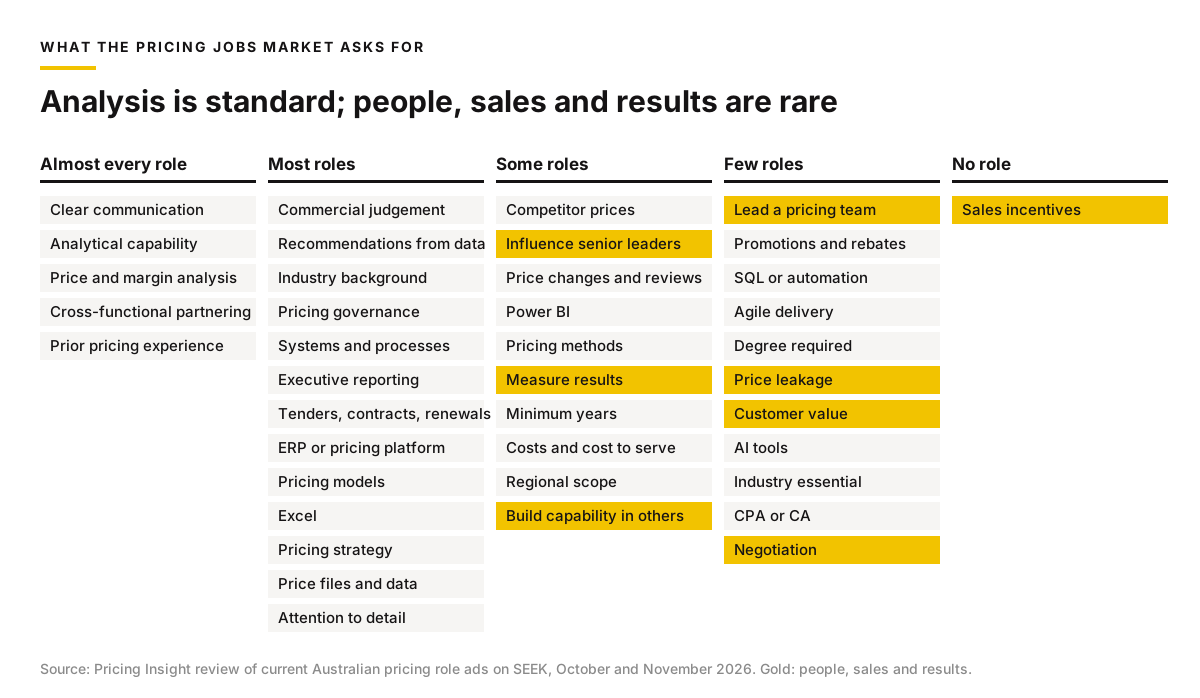
The items that decide what a pricing manager answers for sit at the far end. Leading a pricing team, checking results after a price change, building pricing skills in Sales and Finance, understanding customer value, closing price leakage and negotiation each appear in a minority of advertisements, most of them in only a few. None asks the pricing role to shape how sellers are paid.
For a chief executive, the common core works as a filter. A candidate who meets it can analyse the margin. The real choice is which of the rare items the role will carry, because those decide whether the margin moves. An advertisement that asks for analysis but not for results describes a role that recommends a price and hands it to someone else.
The rare items also show what each business thinks pricing is for. Consumer retailers and a dairy maker add key value items, price ladders, promotion returns and trade spend. An insurer and a waste services group are hiring product owners to replace a pricing engine. A defence contractor wants a qualified accountant to lead cost estimating and bid pricing. One IT services firm asks for AI in its pricing tools.
03Distributor and parts businesses hire to keep the price file accurate
Hundreds of thousands of part numbers. Distributor, parts and equipment businesses carry the largest price files in the market, and their pricing roles are written around them. One parts business prices a catalogue of hundreds of thousands of lines. An equipment maker is hiring two specialists to keep dealer prices accurate. An engine and parts group needs scheduled price changes run across Asia Pacific while it moves to a new ERP. An electrical distributor wants special price agreements managed from setup to expiry.
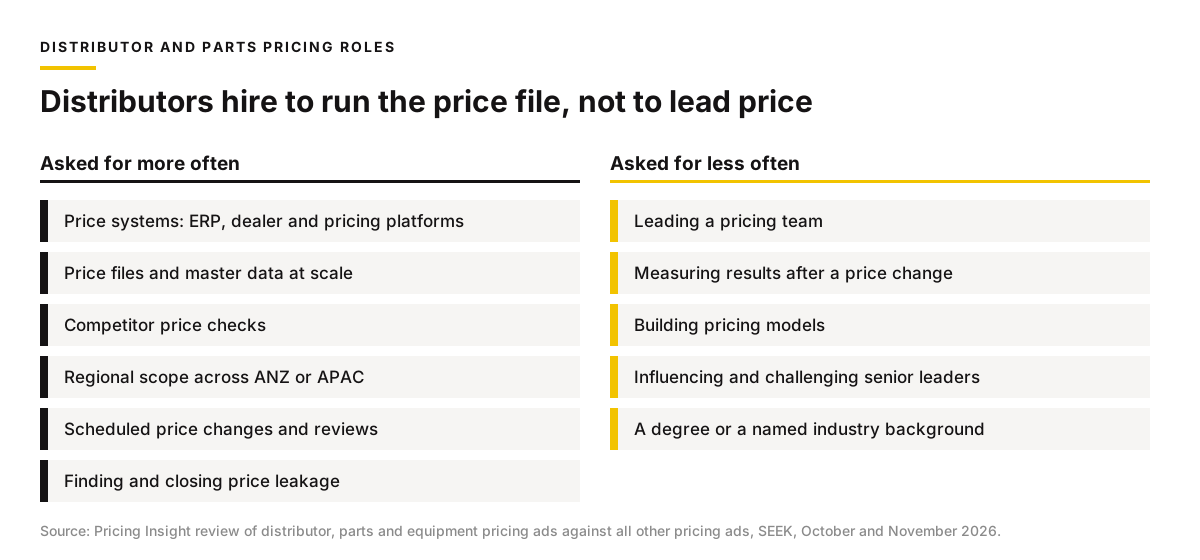
Compared with the rest of the market, these roles are asked more often to run ERP and pricing systems, keep master data clean, check competitor prices and run scheduled price changes. They are asked less often to build pricing models, challenge senior leaders or check what a price change delivered. None of them manages a team.
One role is written differently. A tyre and automotive service group is hiring a consumer pricing lead to own pricing end to end across Australia and New Zealand, from market intelligence and price structure to rebates, execution and price realisation. Candidates are asked for the pricing decisions they have led and the margin those decisions delivered. It is the only distributor or parts advertisement that asks for evidence of results.
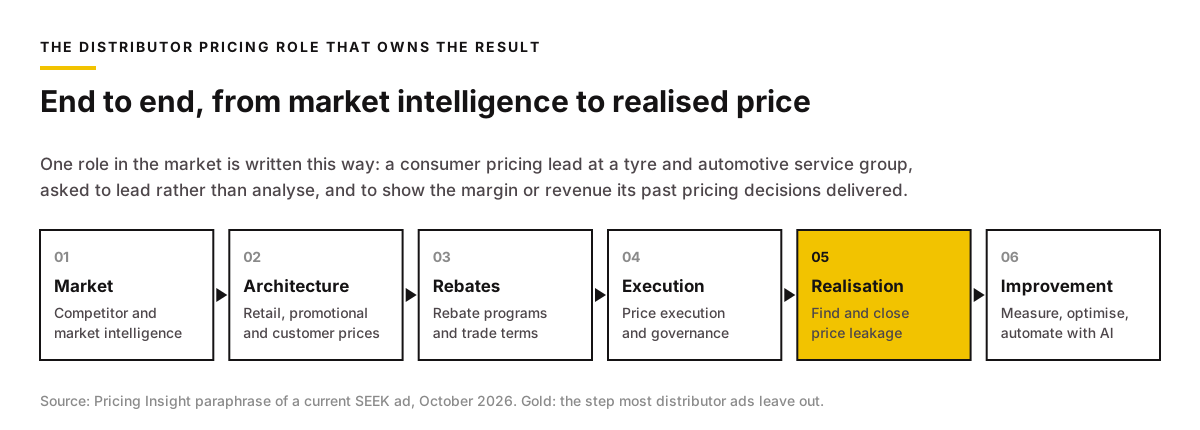
Price-file maintenance is real work that needs accurate, systems-literate people. It is a different job from price leadership. A distributor that hires only the first will keep tens of thousands of prices correct in the ERP while the tiers, floors and rebates behind them stay the same, and the same customers keep the same discounts.
04The advertisements are silent where Pricing Insight diagnostics find the margin is lost
Two halves of the Pricing Periodic Table. Mapped to the Pricing Periodic Table, the 61 elements of pricing capability across Value, People and Structures, the advertisements cover analysis, systems and controls well. The Market, Sales and Negotiation domain is close to empty. Value selling, sales incentives, walk-away prices, price-increase negotiation, key-account plans and the deal desk appear in none of them. Neither do discount structure or price corridors.
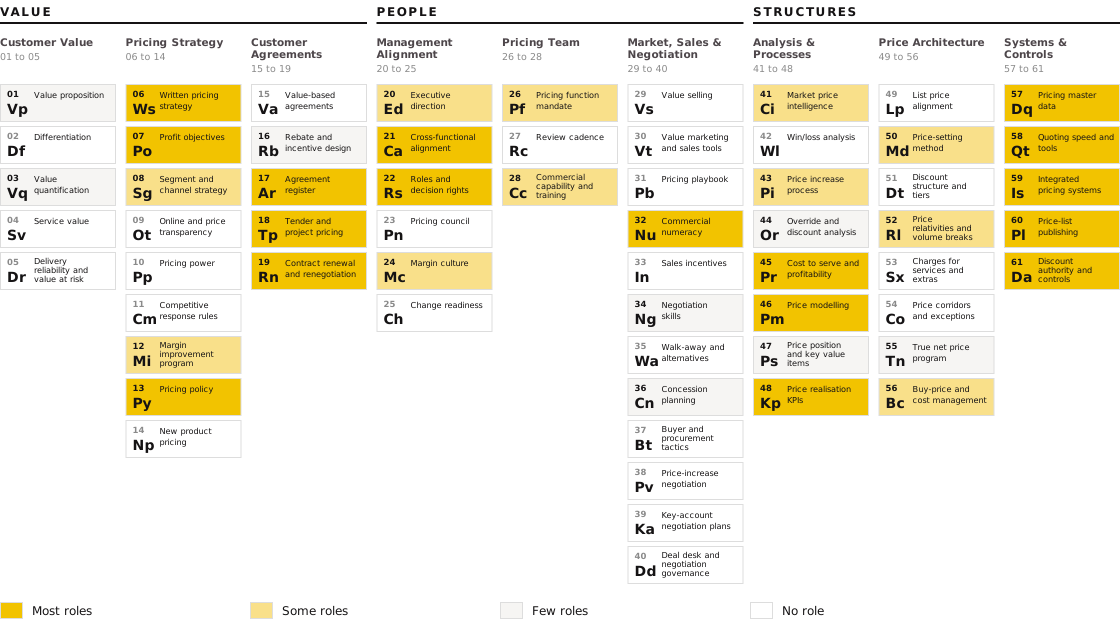
Pricing Insight diagnostics point to the same gaps. The issues raised most often are discounts used to close the sale, a habit of overriding prices, rebates paid without the growth they were meant to buy, out-of-date price lists, poor data and price increases that do not stick. In one building products maker, most pricing decisions rested with one analyst and approvals passed through three or four people. In a timber and panels distributor, nobody was named to load supplier increases, so branches bought at the new cost and sold at the old price. In a national distribution business, expired trading terms and unearned rebates ran on for years because the review calendar had no owner.
05Pricing manager salary in Australia: employers rarely state it, and SEEK puts the average at A$150,000 to A$170,000
Few advertised salaries. Most advertisements say "competitive", list benefits or say nothing. The two that state a figure sit inside SEEK's published ranges: a technology services pricing manager at A$150,000 to A$165,000 plus superannuation, and a B2B pricing and CRM analyst at A$110,000 to A$120,000 plus bonus.
| Role | SEEK figure | Basis |
|---|---|---|
| Pricing Analyst | A$100,000 to A$120,000 | Average annual salary range, Australia |
| Pricing Specialist | A$105,000 | Typical salary |
| Commercial Analyst | A$125,000 | Typical salary |
| Finance Business Partner | A$140,000 | Typical salary |
| Pricing Manager | A$150,000 to A$170,000 | Average annual salary range, Australia |
| Commercial Manager | A$190,000 | Typical salary |
Exhibit 2. SEEK salary benchmarks for pricing and nearby roles. Source: SEEK salary insights, refreshed 01/11/2026, read 21/11/2026. Base salary before superannuation; benchmarks, not figures from the advertisements.
SEEK's typical commercial manager salary sits above the top of the pricing manager range. That fits what employers advertise: a senior analyst, not a commercial leader with authority over price. A business that wants the second role should pay for it and say so in the advertisement.
06Pricing Insight's book and frameworks: pricing is a system, not a job title
Sixty-one parts. Ron Wood's book, B2B Pricing Insight, starts from the idea that a price is not a number but a capability, built from the 61 elements of the Pricing Periodic Table. Most businesses have built less than half of it. The book also says who owns what: the chief executive owns the pricing strategy, the sales director owns its execution and the CFO owns the measures. A pricing manager can only run what those three have set up.
Pricing Insight's Pricing Management Canvas groups the work into three layers. Each layer answers a different question, works to a different timetable and has different owners.
| Layer | The question it answers | What it contains | Who owns it |
|---|---|---|---|
| Strategy | Why do we charge what we charge? | Customer value by segment, a written pricing strategy and price position, and a product and customer structure built for pricing. Reviewed each year. | Pricing Council, chaired by the chief executive or general manager |
| Structure | How does a price get from list to net? | List prices, customer discount tiers, rebates, price floors and corridors, and the discount authority matrix. Reviewed each quarter. | Pricing manager, with category managers |
| Operations | How is price run day to day? | Price increases, margin and realisation reports, override checks, the deal desk, training and the Pricing Council calendar. Reviewed each month. | Pricing manager, with sales operations and Finance |
Exhibit 3. The three layers of pricing management. Source: Pricing Insight Pricing Management Canvas.
The pricing role sits in the middle layer and runs the third. It cannot set the first on its own. If the strategy layer is empty, the role has no direction to apply. If the structure layer is empty, it has no floors, tiers or limits to enforce. What is left is the administration of whatever prices other people agreed.
07Without strategy, structure and operations, a pricing role becomes pricing administration
Six gaps, six ways the role is reduced. Each gap below is common in Pricing Insight diagnostics. Each one moves the pricing person's work away from managing price and towards processing it.
| What is missing | What the pricing person ends up doing | What it costs the business |
|---|---|---|
| A written pricing strategy and price position | Takes direction from whoever asked last. Sales wants volume; Finance wants margin. | Prices move with the loudest voice, and the choice between profit and share is never made. |
| A price structure with tiers, floors and corridors | Keys in negotiated special prices, one customer at a time. | Thousands of special prices nobody reviews, and the same product sold at very different prices. |
| A pricing policy and a discount authority matrix | Reports overrides after the sale, but cannot stop them. | Discounts are decided by whoever the seller asks first. |
| A Pricing Council and written decision rights | Raises disputes by email and loses them to Sales. | Exceptions become the rule, and the pricing owner loses standing. |
| Measures of realised price | Reports announced increases and list changes. | Nobody can say whether an increase reached the invoice. |
| Time protected from administration | Spends most of the month on price loads, customer set-up and month-end reports. | Analysis and deal advice, the work that moves margin, are squeezed out. |
Exhibit 4. Six gaps that turn a pricing role into pricing administration. Source: Pricing Insight diagnostics and Pricing Management Canvas.
The test is where the pricing owner's time goes. Ask that person to log one month of hours against administration, reporting, analysis, deal advice and governance. If administration and reporting take more than half, the business has a team that keeps price files accurate while the prices in them drift.
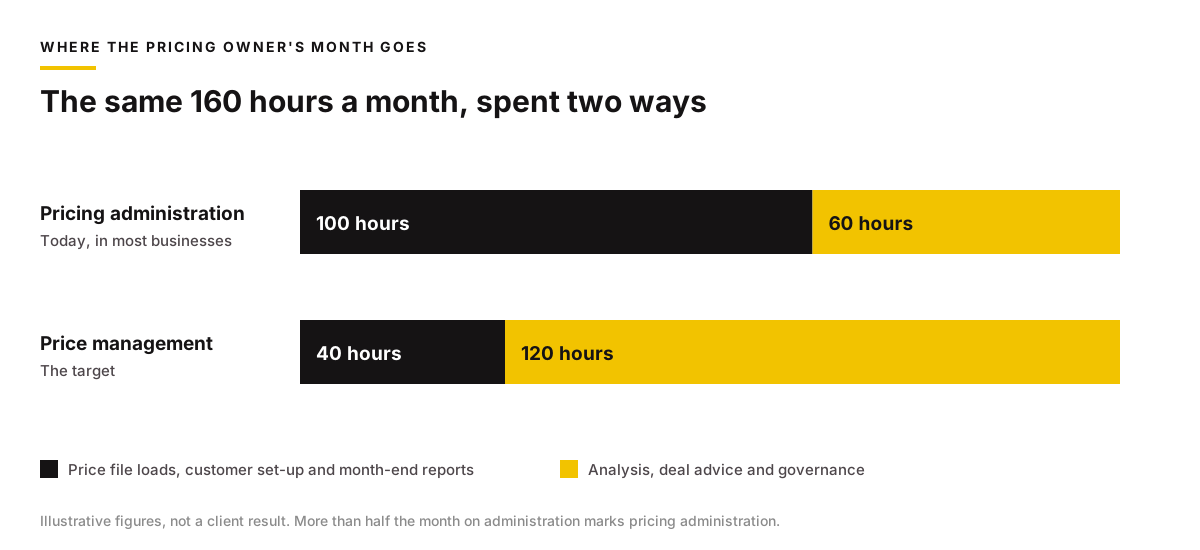
Staff in Pricing Insight diagnostics describe the result in their own words. One wrote that the "pricing team appear to just be data entry team/master data management." Another wrote that the pricing team "has been disempowered over time and are now administrators rather than influencers."
The jobs market shows the same thing at the point of hire. An advertisement built around price-file maintenance, ERP loads and month-end reports, with no authority over discounts, describes pricing administration. The person hired will do that job well, and the margin will not move. Hiring a more senior person into the same set-up does not change the outcome, because the gap is in the system around the role, not in the person.
08Five levels of pricing capability: most businesses administer price at Level 2
Five levels. Pricing capability builds in steps, and the margin at risk falls at each one. On the evidence of Pricing Insight diagnostics, most B2B pricing functions sit at Level 2, where basic processes exist but depend on a few people's skill. At Levels 1 and 2 pricing is administered. From Level 3 it is managed.
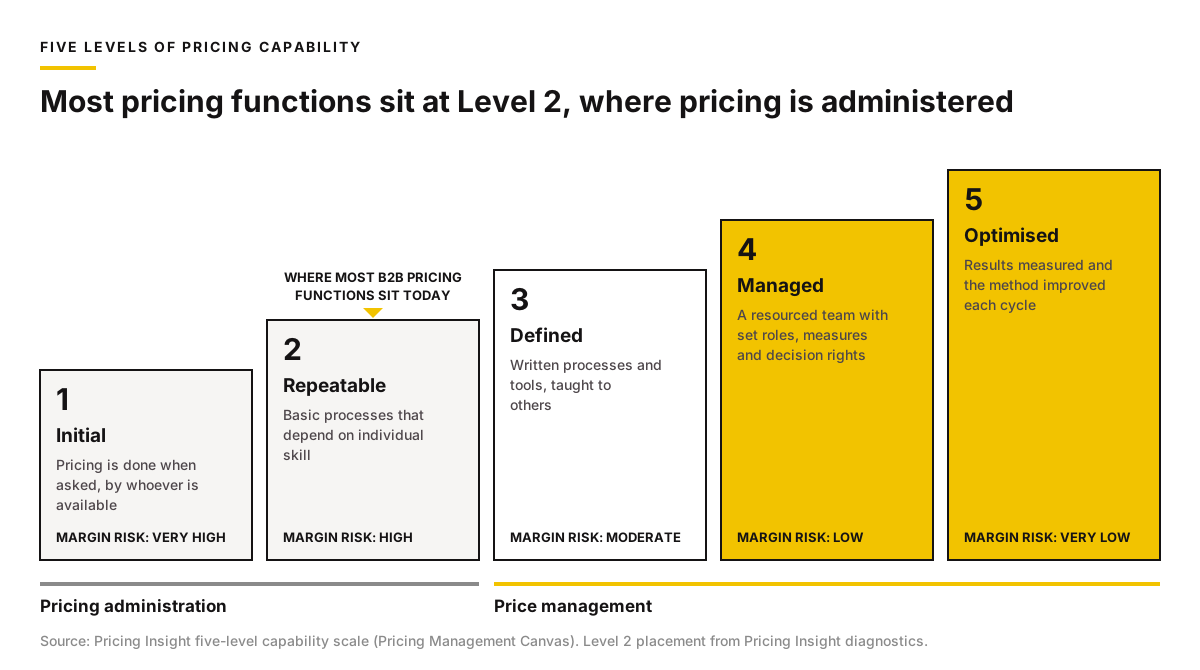
The step from Level 2 to Level 3 matters most. It moves pricing from personal skill to written process, so the gains no longer leave when one person does. A realistic program target is Level 3 within 12 months and Level 4 within 24. At Level 4 a resourced team with set roles, formal processes and measures runs pricing, and the pricing manager spends most of the month on analysis, advice and governance.
09What this means for management: roles, responsibilities, accountabilities and outcomes
One owner for each decision. A pricing team can only deliver what management has given it the authority to deliver. The table sets out who does what, who answers for what, and the outcome each role should produce.
| Role | Responsible for | Accountable for | Outcome to expect |
|---|---|---|---|
| Board | Asking for evidence on price and reading four measures each month | Holding the chief executive to the pricing strategy | Price on the board agenda with measures, not stories |
| Chief executive | Setting the price position, sponsoring the Pricing Council and backing the pricing owner when a decision is disputed | The pricing strategy | A written strategy that settles the choice between profit and share |
| CFO | Margin targets, authority limits, the signed baseline and the monthly measures | The measures of price realisation | Realised price reported in basis points against the baseline |
| Sales director | Negotiation plans, walk-away prices and margin in commission | Execution of the strategy in the field | Every concession traded for something of value; fewer overrides |
| Pricing Council | Margin goals, pricing policy, price increases and exceptions above the deal desk | The pricing policy and the decisions it records | Exceptions decided once, in one place, with a written record |
| Head of pricing or pricing manager | Price structure, review calendar, increase process, deal desk and analysis for Sales | Realised price against the Finance baseline | Price and increase realisation on target |
| Pricing analyst | Realisation, override and win/loss reports, and price models | Accurate analysis on time | Sellers see margin when they quote |
| Deal desk | Prices below the floor, tenders and renewals, within a set response time | Margin on approved exceptions | Fast answers and fewer deals below the floor |
| Price administration | Price files, customer set-up, master data and the quoting tool | Price-file accuracy and changes made on time | Administration kept off the accountable person's desk |
| Sales managers and sellers | Quoting inside the corridor and recording a reason for every exception | The price achieved on their accounts | Overrides falling and fewer concessions given for nothing |
Exhibit 5. Roles, responsibilities, accountabilities and outcomes. Sources: Pricing Insight Pricing Management Canvas; B2B Pricing Insight by Ron Wood.
Decision rights turn the table into practice. A decision-rights chart names one accountable owner for each type of pricing decision, so the same request goes to the same approver every time and no phone call can go around it.
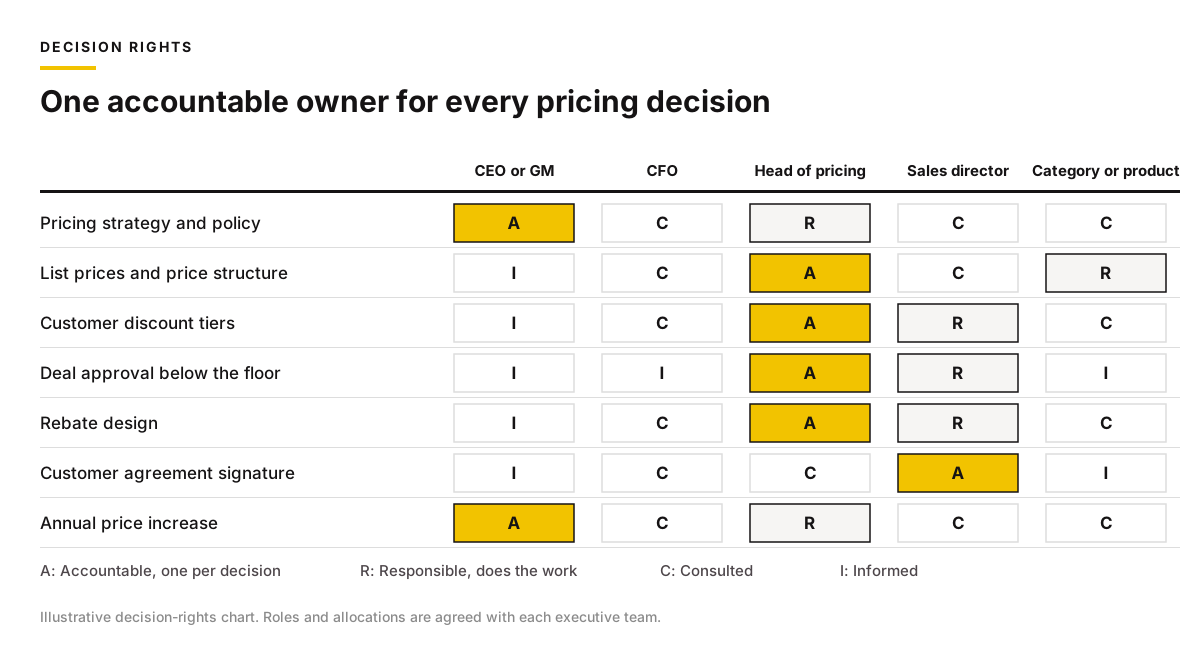
Four measures show whether the arrangement is working. The book recommends that the board sees them on one page each month, with a formula for each so Finance can calculate them from its own sales data.
| Measure | What it shows | Owner | Direction expected |
|---|---|---|---|
| Invoice-to-pocket loss | How much of the invoice price is lost to rebates, terms, freight and free extras | CFO, with the pricing manager | Falling |
| Price realisation | The price achieved as a share of the target price | Pricing manager | Rising toward target |
| Increase realisation | How much of an announced increase reached the invoice | Pricing manager, with the sales director | Rising |
| Override share | The share of sales priced below the agreed price without approval | Sales director | Falling |
Exhibit 6. Four measures for the monthly board pack. Source: B2B Pricing Insight by Ron Wood.
The outcome to expect is a function that moves from Level 2 to Level 3 within a year, with the four measures moving the right way each quarter. In Pricing Insight's experience, the right pricing team with this mandate can generate margin expansion of 100 to 300 basis points.
10The mandate, policy and controls to give a pricing manager before you hire
Put the system in place first. A new hire into an empty system will become an administrator, however able. Before the advertisement goes out, management should have these in place, or a plan to build them in the role's first six months:
- A written charter for the pricing function, covering price setting, analysis, advice to Sales and governance, not only administration.
- One named person accountable for realised price and margin, reporting to the executive.
- A one-page pricing strategy that states the price position and settles the choice between profit and share.
- A pricing policy and a discount authority matrix built into the quoting system, so an out-of-policy price cannot be issued without approval.
- Price floors and corridors for each customer tier and product class.
- A Pricing Council with a charter, a fixed calendar and a decision log.
- The four measures, reported monthly against a baseline Finance has signed.
- Routine price loads moved to a coordinator or automated, so the accountable person has time to analyse and advise.
- A say for the pricing owner in how sales commission treats margin.
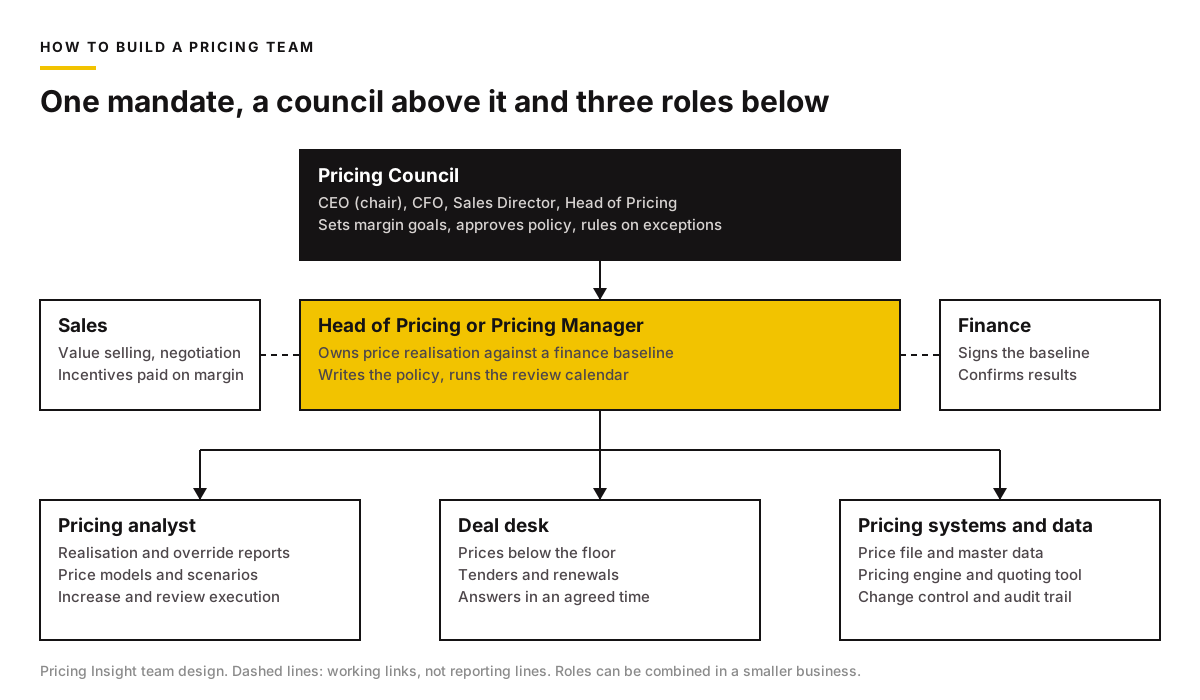
For a distributor, the design splits the work. Staff an owner for the price file and pricing systems, and a pricing lead with the scope of the tyre group's role in section 03. Where the budget covers one person, write the role as the lead and give it a coordinator for the price file.
11Is a pricing manager worth hiring? On A$100m of revenue, a two-person team breaks even at 35 basis points
About A$350,000 a year. A pricing manager at A$160,000 and an analyst at A$110,000, the SEEK midpoints, cost A$270,000 in salary and about A$350,000 with superannuation and other employment costs of about 30 per cent. On A$100m of revenue, one basis point of price is worth A$10,000 a year, so the team pays for itself at 35 basis points. With volume held, each further point of realised price flows to EBIT at close to full value.
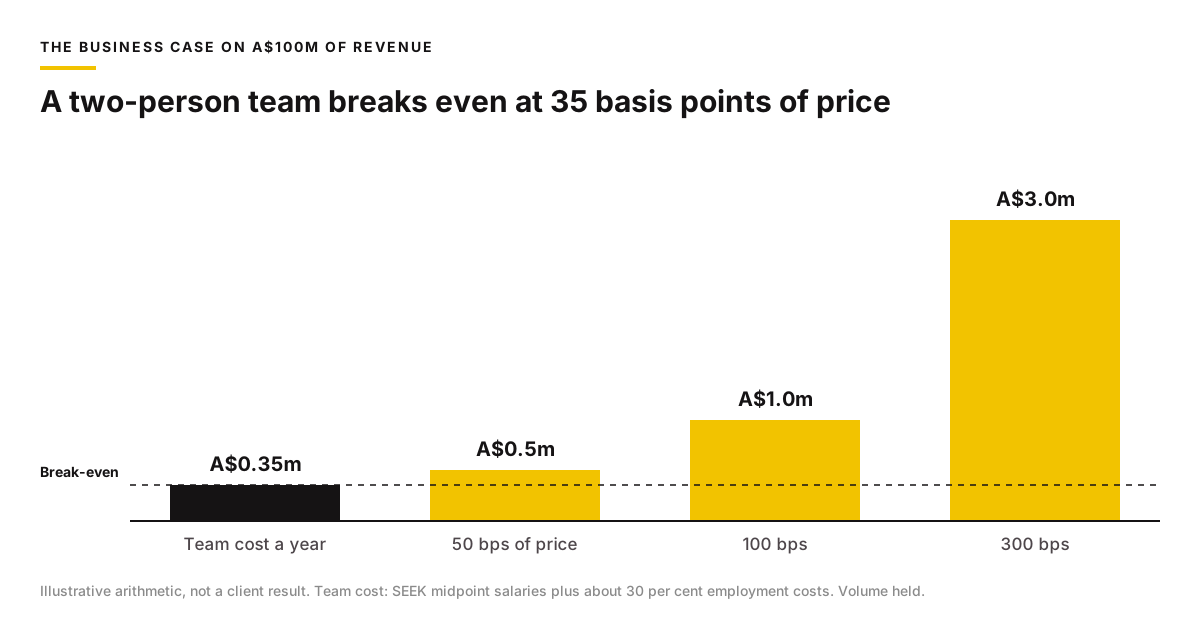
The case depends on the mandate. A team that reports leakage without the authority to close it costs the same A$350,000 and returns whatever the rest of the business chooses to act on. A team that owns realised price, runs the deal desk and has a say in the next increase moves the price on revenue the business already has.
12What should a pricing manager job description include? The common core, plus four lines most employers leave out
Four additions. The common core belongs in any pricing manager job description: analysis, models, governance, systems and clear communication. The design in section 10 needs four more lines, and each one changes who applies.
| Add to the job description | Why | How to test it at interview |
|---|---|---|
| Owns realised price against a Finance baseline, from opportunity to measured result | Few roles are asked to check the result of a price change, so most stop at the recommendation | Ask for a price change the candidate ran: what was planned, what was put in place and what was achieved |
| Sits on the Pricing Council and runs the deal desk below the floor | No advertisement mentions a pricing council, so exceptions go to whoever the seller knows | Give a deal below the floor and ask what the candidate approves, refers or declines, and why |
| Prepares key-account negotiation plans with Sales and has input to sales incentives | Negotiation and incentives are close to absent from the market | A top-20 customer asks for 5 per cent. Ask for the walk-away price, the trade and the break-even volume |
| Builds pricing skills in Sales and Finance | Few roles are asked to build skills in others or to lead people | Ask how the candidate would teach a sales team the difference between mark-up and margin |
Exhibit 7. Four additions to a pricing manager job description, with an interview test for each. Source: Pricing Insight team design and review of current pricing advertisements.
Two more changes to the advertisement follow. State the pay band. State the reporting line, because a candidate cannot judge the mandate without it.
13The Pricing Periodic Table elements a pricing team builds
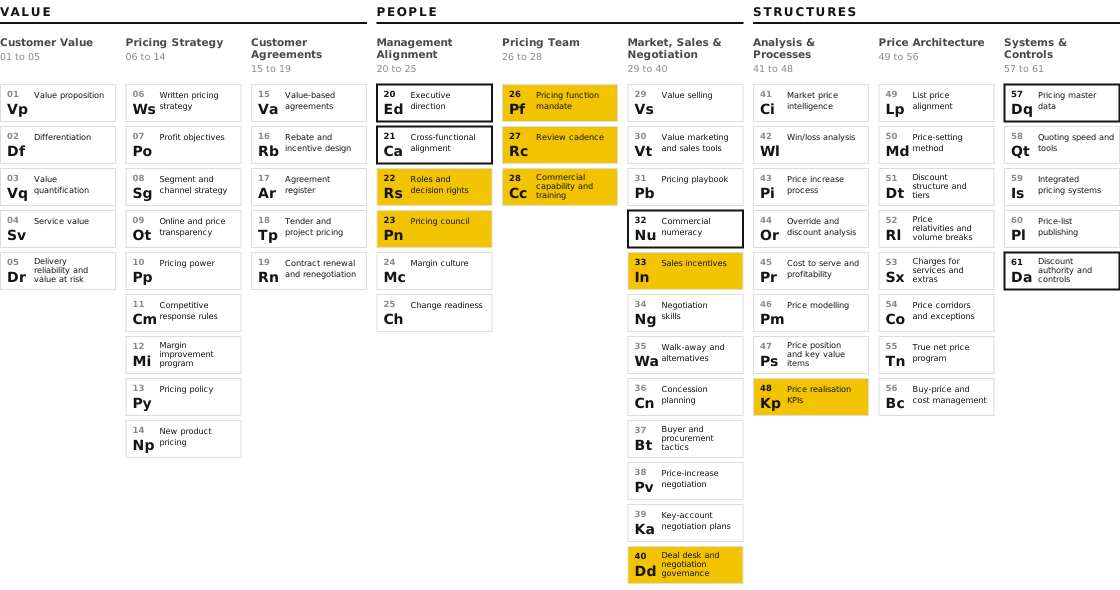
Eight built, five depended on. The team design in this paper builds 26 Pf Pricing function mandate, 22 Rs Roles and decision rights, 23 Pn Pricing council, 40 Dd Deal desk and negotiation governance, 28 Cc Commercial capability and training, 27 Rc Review cadence, 48 Kp Price realisation KPIs and 33 In Sales incentives. It depends on 20 Ed Executive direction to set the margin goal, 21 Ca Cross-functional alignment between Sales and Finance, 57 Dq Pricing master data, 61 Da Discount authority and controls, and 32 Nu Commercial numeracy, so sellers can see what a discount costs.
Four of the eight built elements, the pricing council, the deal desk, sales incentives and a review cadence, appear in none of the current advertisements. They are the elements management has to provide, because a new hire cannot create them alone.
14Frequently asked questions
What does a pricing manager do?
In current Australian advertisements, a pricing manager analyses price, margin and profit, runs pricing governance, improves pricing systems and prices tenders, contracts and renewals, working across Sales, Finance and Operations. About half are asked to set pricing strategy, and few to check results after a price change. A pricing manager who pays back also owns realised price, runs the deal desk and works with Sales on negotiation plans and incentives.
Why do pricing roles turn into pricing administration?
Because the system around the role is missing. Without a written strategy, a price structure with floors and tiers, a discount authority matrix and a Pricing Council, the pricing person can only load and report prices other people agreed. If administration and reporting take more than half of the pricing owner's month, the business is administering price, not managing it.
How do I build a pricing team?
Start with the mandate: name one person who owns the gap between the intended price and the price achieved, measured against a baseline Finance signs. Put a Pricing Council of the chief executive, CFO, sales director and head of pricing above that person, and three roles below: a pricing analyst, a deal desk for prices below the floor, and an owner for price files and systems. Give the team a pricing policy, a discount authority matrix and four monthly measures.
Should a pricing manager report to finance or sales?
Many current advertisements place the role inside Finance. Reporting to Finance protects the baseline but can keep the role out of the negotiation; reporting to Sales does the opposite. What decides the result is a written mandate, decision rights that Sales and Finance accept, and a Pricing Council that backs the pricing owner when a decision is disputed.
How much does a pricing manager earn in Australia?
SEEK's salary insights, refreshed on 1 November 2026, put the average pricing manager salary at A$150,000 to A$170,000 and a pricing analyst at A$100,000 to A$120,000. Few advertisements state a salary; those that do sit inside these ranges. SEEK's typical commercial manager salary is A$190,000.
15How Pricing Insight helps
Three services, used together or one at a time. Each is built on the client's own transactions and on the same frameworks set out in this paper. Pricing Insight has completed 160+ engagements and trained 5,000+ executives.
Diagnose
The Strategic EBIT Opportunity & Risk Diagnostic measures the gap between intended and realised price, scores pricing capability on the five-level scale, and shows who makes pricing decisions today and on what authority. It sets the starting level, the target and the order of work.
Optimise
Pricing Team & Talent delivers the blueprint for the pricing team: a task and skills map, the function charter, roles and decision rights, role descriptions and a pay band, assessment of internal and external candidates, and a development plan.
Transform
Value-Based Culture & Transformation puts the governance in place: the pricing strategy and policy, the discount authority matrix, the decision-rights chart, the Pricing Council charter and agenda, the reporting and the training, so the team has a system to run.
Pricing staff can study the same method through the Pricing Masterclass, and the full argument is set out in Ron Wood's book, B2B Pricing Insight.
16Where Pricing Insight has done this work
The engagements below involved pricing roles, price structure or pricing governance. Each result is shown as published in the case study, with its label.
| Client | The work | Result as published |
|---|---|---|
| Staples (Corporate Express) | One national price structure in place of 60 price lists, and a central pricing team | A$6.8m EBITDA within 12 months; realised |
| Bunzl Outsourcing Services | Pricing function identified, designed and developed; search and selection of its first strategic pricing manager | A$5.7m EBIT; realised |
| Arnott's | Price decisions moved from 41 account managers to one team; promotions and discounts repriced | Over A$5m EBIT within 12 months; realised |
| Fletcher Insulation | Diagnostic, new price structure and pricing training for 96 staff | 250 basis points of gross margin; realised |
| Legend Corporation | List price method, discount structure and ERP controls across 5,500 products | A$3.7m EBITDA; realised |
| Cabinet hardware distributor | One price structure in place of 384,000 negotiated prices | A$4.0m gross margin in year one; realised |
| Hyster-Yale Asia Pacific | Discount controls, dealer economics and quoting | From an A$100k EBIT loss to an A$3m gain; realised |
| Super Retail Group | Shared markdown rules and discount governance across four brands | Up to 50 per cent less ad hoc discounting; as published |
| Big River Group | Pricing training for 111 sales staff and a strategy workshop | Gross margin rose to 26.5 per cent in FY26; as reported |
| Farmlands | Diagnostic, price optimisation and a pricing operating model | A$3.5m to A$6.2m EBIT; identified |
| Toll Group | Customer-level pricing analysis and governance design | A$8.4m EBIT in year one; modelled |
| Tradelink | Diagnostic and a pricing program for the whole sales force | A$10.8m annualised margin; identified |
Exhibit 8. Twelve engagements involving pricing roles, structure or governance. Source: Pricing Insight case studies at pricinginsight.com/case-studies. Realised: measured after implementation. Identified or modelled: sized before implementation. Not independently audited.
Does your pricing team have the mandate to change the price your customers pay?
A first conversation establishes whether a diagnostic, a team blueprint or a governance program comes first. Ron Wood, +61 410 534 099.
Ron Wood is the Founder and Managing Director of Pricing Insight, an Australian pricing strategy consultancy he established in 2007. He has worked in pricing for 30 years, first as a pricing and commercial manager in consumer goods, building materials and capital equipment, and since then across 160+ engagements in Australia, New Zealand, South East Asia, India, the United States and the United Kingdom. He also founded Pricing University and is the author of B2B Pricing Insight and the Pricing Periodic Table.
To discuss building a pricing team in your business, contact Ron Wood at info@pricinginsight.com.au or on +61 410 534 099, or visit Pricing Insight.
The market review covers current SEEK advertisements for pricing roles in Sydney, Melbourne, Brisbane and Adelaide, listed between late October and November 2026 and read on 21/11/2026. Observations describe those advertisements, as coded by Pricing Insight, not the whole Australian market. Employers are described by industry only. Salary benchmarks are SEEK salary insights refreshed 01/11/2026, base salary before superannuation, and are not figures from the advertisements. The capability levels, the 100 to 300 basis point range and the diagnostic examples come from Pricing Insight's frameworks and client work; diagnostic examples are anonymised. The business case, team costs and hours are illustrative arithmetic, not client results. Case study results are as published by Pricing Insight with their labels and have not been independently audited. No figure in this paper is typical or guaranteed.