


White paper · Diagnose · 18 min read
Sources: RBM Plastics, as reported in the Pricing Periodic Table, CXO Edition, and its published case study; Devro and Ameropa case studies published on pricinginsight.com. The RBM Plastics premium is as reported, the Devro result is realised as stated by the client, and the Ameropa figure is modelled, not realised. None is a benchmark for another business.
A procurement manager who wins a 10 per cent invoice cut has saved the buyer’s business very little if the cheaper product costs more to run, fails sooner or stops a line. This paper sets out the four prices a customer pays over the life of a purchase, why procurement measures only the first, and how a supplier’s sales team negotiates on all four. Five Pricing Insight clients show the method at work.
The question this paper answers
How do I train sales teams to hold price in negotiations with procurement, when the buyer compares invoice prices alone?
Key takeaways
- Invoice price concessions can erode margins when procurement focuses on immediate savings rather than value over the contract term.
- Operating costs, replacements, upgrades, outages and unforeseen risks may not be reflected in invoice price savings.
- Invoice prices can be less than half of the total costs associated with a purchase.
- Negotiations should consider invoice, operating, repair and replacement, and risk prices over the usable life or contract term.
Five clients. Devro, Orica, RBM Plastics, Ameropa and Adelaide Brighton each appear below in the same six-part form: the problem and what it put at risk, why it was hard to fix, what Pricing Insight did, the outcome with its status, the benefit to the client, and the Pricing Periodic Table elements the work built.
01Invoice price concessions erode margin because procurement is paid to find invoice savings
“We benchmarked you, and you’re 30% too expensive compared to the market.
If you can reduce your price by 10 to 15%, we would consider retaining our contract with you. We will need an answer from you in the next 48 hours, otherwise we will be looking to another supplier to provide our requirements.
Essentially, we consider what you provide to be a commodity and we see no difference between your offer and the offer from the alternative supplier”.
Why do invoice price concessions erode margins?
For hundreds of companies, margins are being eroded as suppliers agree to flawed procurement demands. Price concessions of 5%, 10%, and upwards of 20% are being offered to companies that have employed aggressive procurement managers. Procurement managers have been incentivised to find invoice price savings, not to extract value over the term of the 2-, 3- or 5-year contract. The net result is daily margin leakage and earnings erosion.
Every line of that opening is a tactic. A benchmark nobody has seen, a deadline measured in hours and the word “commodity” are there to make price the only topic, and a supplier that answers on price has accepted the frame. Buyers sort what they buy by how much they spend on it and how much risk it carries if supply fails, and procurement will push a supplier into the low-risk box where price decides the award. A written value case, with the risk the supplier removes stated in the customer’s dollars, moves the product back into the box where value decides it.
02Procurement overlooks three of the four prices a customer pays
What costs can procurement overlook?
However, the real costs of the flawed procurement process can be seen in the areas where procurement is often not measured, such as the cost of operations, cost of replacements or upgrades, and the cost of unplanned outages or unforeseen risks that drive up costs. These costs turn up in the SG&A and lines of the Profit & Loss statement.
Procurement is rarely held accountable for these increased costs, and continues to claim savings based on invoice price alone. They don’t measure the other three prices associated with a purchase.
Invoice prices are often less than 50% of total costs associated with a purchase. The four prices to consider are:
- Invoice prices
- Operating prices
- Repair & replacement prices; and
- Risk prices (the price you may pay if there is a failure to supply goods or services, a failure of those goods or services, or a failure to provide technical support or innovation).
By “prices”, we mean costs to you over time. It is crucial to conduct your negotiations with all four price levels under consideration for the duration of the usable life of the purchase or service contract.
| Over five years | Our offer | The alternative |
|---|---|---|
| 1. Invoice price | A$11,000 | A$10,000 |
| 2. Operating price (energy) | A$6,000 | A$8,000 |
| 3. Repair, replace, dispose | A$1,000 | A$2,000 |
| 4. Risk price (downtime) | A$4,000 | A$12,000 |
| Total | A$22,000 | A$32,000 |
Exhibit 1. The four prices of one purchase. The buyer compares the first line; the other three are paid later and never appear on the quote. A$1,000 more on the day leaves the customer A$10,000 better off over five years. Illustrative, from the Pricing Periodic Table, CXO Edition, Figure 1.6.
How much evidence a supplier needs follows a rule of thumb from the Pricing Insight course: to hold a price, show three to five times the price difference in value. On a A$2,000 quote against a rival’s A$1,800, the difference is A$200, so the seller shows A$600 to A$1,000 of extra value over the product’s life and holds at A$2,000. Matching, shaving or undercutting all give the price away. Two clients show what the third and fourth prices are worth when they are put in numbers.
RBM Plastics
PVC compound for cable · Business kept at about 20 per cent above the lowest bid · Realised
| Client and problem | RBM Plastics makes PVC compound, the coating that goes around electrical cable. A cheaper interstate competitor bid for a cable-maker customer, and the buyer told RBM it did not need to match the offer but needed to get close to it, and asked for the price to be signed off for 12 months. RBM had spent about A$3 million on two new lines to supply that customer. |
| Challenge | On the specification sheet the two compounds looked much the same, and on the invoice RBM was clearly dearer. A 10 to 20 per cent discount would have been easy to give and, in the managing director’s words, very difficult to get back up, and there were no contract terms in place. |
| What Pricing Insight did | Customer value discovery and negotiation planning. The customer value canvas separated value in use (consistent throughput, low scrap, local supply, flexible supply through peaks, price certainty) from value at risk (downtime on the customer’s own ageing compounding line, lost business, penalties and capital the customer would otherwise spend), and Pricing Insight advised a trading agreement over an extended period in place of a negotiation on invoice price alone. |
| Outcome | The canvas put a day of lost cable production at about A$1 million of the customer’s sales and the headline value price premium at 37 per cent, both estimates. RBM did not answer with a discount and kept the business at a price about 20 per cent above the lowest bidder, as reported in the CXO Edition; the published case records higher selling prices and increased volume commitments, a realised commercial outcome. |
| Benefit to the client | A premium held and more volume committed on an account RBM had invested A$3 million to serve, won on the risk price rather than conceded on the invoice price, which protects the return on that investment. |
| Periodic Table elements built | 03 Vq Value quantification; 05 Dr Delivery reliability and value at risk; 36 Cn Concession planning; 15 Va Value-based agreements. |
Ameropa
Industrial chemicals · About A$3m potential profit improvement over three years · Modelled
| Client and problem | Ameropa supplied water-grade fluorosilicic acid, recovered as a by-product of fertiliser manufacturing at its Hobart operation, to the water-treatment sector, and its prices had been set under different customer and distributor arrangements as mainland supply grew. |
| Challenge | A by-product invites cost-based pricing, yet a water utility relies on consistent specification and dependable delivery. Some arrangements were still being formalised, and delivery responsibilities, distributor investment and contract timing differed from account to account. |
| What Pricing Insight did | In a third engagement, market and customer value discovery from production to end use, international price benchmarks and the cost of importing alternatives, then an account-specific plan: staged price paths, written pricing terms, indexation and freight provisions, and approval and exception controls, with a negotiation and communication plan. |
| Outcome | Approximately A$3 million in potential cumulative profit improvement over three years, assuming modelled volumes are maintained, costs stay stable and the proposed prices are achieved. Modelled, not a realised result. |
| Benefit to the client | Prices set on the value of reliable supply rather than the cost of a by-product, with indexation and written terms that lower the exposure to cost movements and to disputes over who delivers what. |
| Periodic Table elements built | 05 Dr Delivery reliability and value at risk; 15 Va Value-based agreements; 10 Pp Pricing power; 46 Pm Price modelling. |
03Each negotiation runs on all four prices across the contract term
First-year savings are typically biased toward selecting the lowest invoice price only. However, it is crucial to evaluate the total cost of ownership over the usable lifetime (or contract term) to obtain a clear picture of value.
For your next price negotiation, work through all four elements of “price” (your customer’s costs). Ensure that a minimum 2- or 3-year view is taken when your customer challenges your invoice price or makes an unfavourable comparison to an alternative supplier.
Ten buyer tactics. The same moves turn up with retail groups, hospital buyers, builders’ purchasing offices and industrial procurement teams, and each has a prepared response that keeps the price. Four of them sit in the opening quote of this paper.
| The tactic | The response that keeps the price |
|---|---|
| Competitor quote: a rival is 10 per cent cheaper | See the quote and check it like for like, then hold, trade, match or walk |
| Switching threat: we could move next month | Test the real switching cost, and answer with value at risk in the customer’s dollars |
| The deadline: hours to decide | Know the buyer’s calendar; a supplier’s own quarter-end is a known weak point |
| Risk transfer: liability shifted to the supplier at the same price | Price the risk or decline the clause; risk is a tradeable, not a free extra |
Exhibit 2. Four of the ten buyer tactics and the response to each, decided before the meeting. Source: Pricing Periodic Table, CXO Edition, Figure 12.3.
Switching threats settle on four facts: the realistic alternative, the cost of switching including qualification, stock, retraining and supply risk, whether the customer has gone to market, and whether its orders are falling. A threat that survives the test is negotiated as a real risk; one that does not is a request for a discount. Devro and Orica show the method with professional buyers on the other side of the table.
Devro
Food manufacturing · Higher price increases negotiated in Australia and New Zealand · Realised
| Client and problem | Devro makes collagen casings for sausages and processed meats and sells to food manufacturers supplying the major supermarkets. Imported casings arrived at up to half Devro’s price, and on a price-per-metre comparison Devro looked expensive at every contract round. |
| Challenge | Much of what Devro provided was invisible on the invoice: line support, consistent casing performance, local supply, food safety certification and trading terms. Account managers knew the product well but had no shared way to measure what it was worth to each customer. |
| What Pricing Insight did | Customer Value Discovery, in which customers and Devro’s own team scored the same value drivers, later expanded to 21 drivers across six categories and compared with the main competitor; contract strategy and a sample supply agreement for a key account; the Devro Production Audit, which measures yield lost to breaks on the customer’s own line; and Pricing University education for sales teams in several countries. |
| Outcome | Higher price increases negotiated in Australia and New Zealand, and prices defended against much cheaper alternatives, a realised result as stated by the client. Devro’s Sales Director for Australia and New Zealand said the program “helped us identify additional sources of value and allowed DEVRO to negotiate higher price increases both in Australia and New Zealand.” |
| Benefit to the client | Price held and raised in a market where competitors offered half the price, because customers could see the cost of a cheaper casing in yield, stopped lines and food safety risk. On most drivers customers rated importance higher than Devro’s own team did, so the work also stopped the business giving away value it did not know it had. |
| Periodic Table elements built | 03 Vq Value quantification; 05 Dr Delivery reliability and value at risk; 38 Pv Price-increase negotiation; 28 Cc Commercial capability and training. |
Orica
Mining services · Customer Value Discovery in Indonesia and India · Capability built
| Client and problem | Orica’s offer to mining customers combined explosives with blasting technology, digital tools and technical expertise, but its teams sold into procurement-led markets with competitive tenders, reverse auctions and constant pressure on acquisition price. |
| Challenge | The operational benefits of a better blast were far from the purchasing discussion, and traditional sales training had proved too generic for selling complex solutions to professional buyers. |
| What Pricing Insight did | Customer Value Discovery workshops in Jakarta, Udaipur and Raipur in 2019, built on live accounts: teams used the Customer Value Canvas to separate value in use from value at risk, prepared for contract renewals and tenders, and left with written action priorities. Orica’s India management then asked for regular review calls on the actions. |
| Outcome | Customer-specific value analysis, structured sales arguments and documented action priorities for each team; capability built, with no financial result published. |
| Benefit to the client | A shared method for moving a procurement conversation from acquisition price to production continuity, blast outcomes, security of supply and safety, which lowers the risk of conceding on price in a tender the business could win on value. |
| Periodic Table elements built | 29 Vs Value selling; 37 Bt Buyer and procurement tactics; 34 Ng Negotiation skills; 39 Ka Key-account negotiation plans. |
04Pricing and negotiation strategy for building materials and industrial suppliers
To undertake professional development of your team, contact Pricing Insight to discuss your specific commercial requirements.
Since 2007 Pricing Insight has worked with a range of Australia’s leading building materials companies to develop effective pricing and negotiation strategies that drive revenue and margin expansion.
These companies include: Adelaide Brighton, Carter Holt Harvey, Capral Aluminium, GWA Doors and Locks, ITW, Liberty OneSteel and a building products distributor.
We use a unique range of techniques to identify and generate margins and earnings growth, all based on years of real-world commercial experience.
Adelaide Brighton, the first company on that list, shows how the four prices reach a leadership team rather than a single negotiation.
Adelaide Brighton
Building materials · Two divisions and the group leadership team · Capability built
| Client and problem | Adelaide Brighton, now Adbri, wanted to protect margins in cement, lime and concrete products while energy costs rose, lime faced import competition and multi-residential demand weakened in its concrete products business. |
| Challenge | The Cement & Lime division and the Concrete Products business, including Adbri Masonry, served very different customers, and in both the supply price was only one part of the discussion: service, delivery, technical expertise and the risks customers avoided also had to be priced. |
| What Pricing Insight did | A strategic pricing diagnostic across Value, People and Structures in each division, a Revenue, Pricing & Profit Intensive workshop for Cement & Lime in Adelaide in December 2016 and a diagnostic and workshop program for Concrete Products in Sydney in June 2017, then a Customer Value Discovery session for the group’s leadership team at its 2017 management conference. |
| Outcome | Workshop reports, diagnostic scorecards and priority plans for each division; capability built, with no financial result published. |
| Benefit to the client | Leaders asked to price both value in use, the benefits customers gain, and value at risk, the costs and disruption they avoid, which reduces the risk of differentiated products being sold and negotiated as commodities. |
| Periodic Table elements built | 01 Vp Value proposition; 02 Df Differentiation; 15 Va Value-based agreements; 29 Vs Value selling. |
05What the five cases show about speed, size and risk
Three things are safe to read from the five cases. Speed: at RBM Plastics the value canvas was built while the buyer was pressing for a 12-month price, so the premium was held in the same round rather than recovered later; at Devro the price case was in place before each increase was put to customers. Size: the results run from a premium of about 20 per cent held on a single key account at RBM Plastics, to higher price increases across two countries at Devro, to a modelled A$3 million over three years at Ameropa. Risk: in each case the work replaced a comparison of invoice prices with a comparison of total cost, which is the comparison a cheaper rival cannot win on price alone. Modelled and estimated figures are not results, and none of these figures is a benchmark for another business.
06The Pricing Periodic Table elements this paper builds
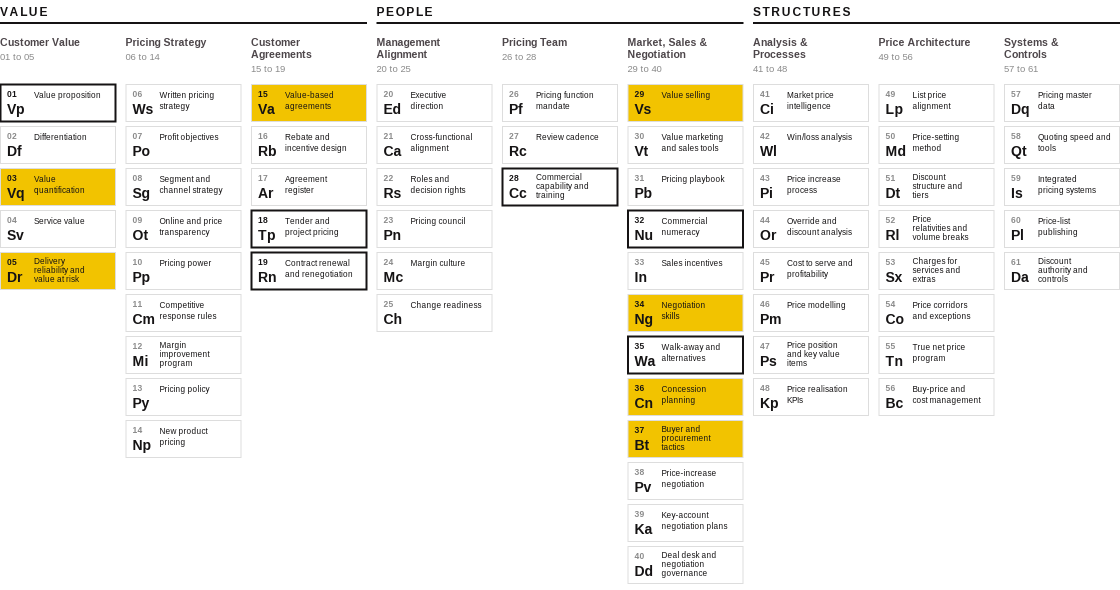
The Pricing Periodic Table sets out 61 elements of pricing capability in nine domains, across Value, People and Structures. Seven are built by the method in this paper: 03 Vq Value quantification (the four prices in dollars), 05 Dr Delivery reliability and value at risk (the risk price), 29 Vs Value selling, 34 Ng Negotiation skills, 36 Cn Concession planning, 37 Bt Buyer and procurement tactics (the responses to each buyer move) and 15 Va Value-based agreements (the contract term over which the four prices are counted). Six are depended on: 01 Vp Value proposition says what the offer is, 32 Nu Commercial numeracy lets a seller work out what a concession costs, 35 Wa Walk-away and alternatives sets where the seller stops, 18 Tp Tender and project pricing and 19 Rn Contract renewal and renegotiation carry the method into bids and renewals, and 28 Cc Commercial capability and training keeps it in use.
Each client case maps onto these elements. RBM Plastics and Devro built 03 Vq and 05 Dr by putting the operating and risk prices in the customer’s numbers, and Devro carried them into 38 Pv for each increase; Ameropa built 05 Dr and 15 Va through written terms and indexation; Orica built 37 Bt and 34 Ng for tenders and reverse auctions; and Adelaide Brighton started at 01 Vp and 02 Df with the leadership team, which every later negotiation depends on.
07Frequently asked questions
How do I train sales teams to hold price in negotiations with procurement?
Train them on their own accounts and live deals. Each seller works through the four prices for a real customer, puts the operating and risk prices in the customer’s dollars, prepares a response to each buyer tactic before the meeting, and sets a walk-away and the concessions they will trade before the first offer. At Devro, customer-scored value drivers and a production audit on the customer’s line gave account managers the case for higher price increases in Australia and New Zealand, a realised result.
Where can I find sales and negotiation workshops for B2B teams in Australia?
Pricing Insight runs Sales & Negotiation Workshops built on the client’s own accounts, with value discovery, buyer tactics and concession planning in the same program, and Pricing University provides structured online pricing education for teams across several countries. Orica’s teams in Indonesia and India and Devro’s sales teams went through this route.
My margins are shrinking. What should I do about pricing?
Start by finding where the margin goes. If it is going in negotiations, look at the concessions given to procurement in the last year, what each one cost, and what the customer gave in return. A concession made on invoice price alone, with no change in volume, term or scope, is margin given away. A pricing diagnostic sizes the loss across customers and products before any change is made.
Is there a pricing consultant for building materials manufacturers in Australia?
Pricing Insight has worked with building materials companies since 2007, including Adelaide Brighton, Carter Holt Harvey, Capral Aluminium, GWA Doors and Locks, ITW and Liberty OneSteel, on pricing and negotiation strategy. At Adelaide Brighton the work covered a diagnostic and workshops in two divisions and a Customer Value Discovery session for the group’s leadership team.
Who can help my business improve margin through pricing?
A pricing specialist who measures the margin first and changes the price second. Pricing Insight has completed 160+ engagements in manufacturing, building materials, wholesale and distribution, and its work runs from a diagnostic of where margin is lost, through optimised prices and value cases, to training the people who negotiate them.
08How Pricing Insight helps
Sales & Negotiation Workshops help your team move beyond invoice-price concessions by preparing for procurement challenges and making the case for value across the contract term. The tailored workshops use your own accounts and live deals to build the skills to negotiate on value and hold price, supporting a fuller discussion of operating, repair and replacement, and risk costs.
The work runs in three stages, each drawing on evidence from the client’s own customers and transactions. Pricing Insight has completed 160+ engagements, and price optimisation programs return between 5 and 10 times their cost in year 1.
Diagnose
The concessions given to procurement in the last year, by customer and by seller, with what each cost and what it bought, through the Strategic EBIT Opportunity & Risk Diagnostic, sized against a baseline finance accepts.
Optimise
Value cases for the largest accounts with the four prices in the customer’s dollars, walk-away prices and planned concessions, and value-based agreement terms. The EBITDA Improvement Program sets the target prices each negotiation is measured from.
Transform
Sellers trained on their own accounts in value discovery, buyer tactics and concession planning through the workshops above, with a negotiation playbook and a record of every concession reviewed by the Pricing Council.
What did your last procurement negotiation cost, and what did it buy?
A first conversation establishes how this applies in your business and whether a diagnostic is warranted. Ron Wood, +61 410 534 099.
Ron Wood is the Founder and Managing Director of Pricing Insight, an Australian pricing strategy consultancy he established in 2007. He has worked in pricing for 30 years, first as a pricing and commercial manager in consumer goods, building materials and capital equipment, and since then across 160+ engagements in Australia, New Zealand, South East Asia, India, the United States and the United Kingdom. He also founded Pricing University and is the author of the Pricing Periodic Table, CXO Edition.
To discuss how this applies to your sales team, contact Ron Wood at info@pricinginsight.com.au or on +61 410 534 099, or visit Pricing Insight.
Devro, RBM Plastics, Ameropa, Orica and Adelaide Brighton results are as published in Pricing Insight case studies; the RBM Plastics 20 per cent premium is as reported in the Pricing Periodic Table, CXO Edition, and its downtime and 37 per cent value premium figures are estimates from the customer value canvas, the Ameropa figure is modelled, and the Orica and Adelaide Brighton work is capability built with no financial result published. Client comments are attributed by role only. The four-price table, the 3 to 5 times rule and the buyer tactics are from the Pricing Periodic Table, CXO Edition; the table is illustrative. Results are as reported by Pricing Insight and have not been independently audited. No figure in this paper is typical or guaranteed.