


White paper · Transform · 14 min read
Sources: Pricing Insight client work as published in case studies and reported in the Pricing Periodic Table, CXO Edition. The A$480,000 figure is realised and annualised; the Allegion range is identified and yet to be realised. Neither is independently audited or a benchmark for another business. The A$300,000 figure is illustrative arithmetic.
Negotiation training changes price outcomes when three things happen. Each seller writes the numbers for a real negotiation. Each seller practises against the tactics a trained buyer uses. And the business records, after every negotiation, what was conceded and what each concession bought. This paper sets out what a negotiation training program for a B2B sales team covers, how it runs and what to measure.
The question this paper answers
What does negotiation training for a B2B sales team need to teach, and how does the business know it worked?
It is the practical companion to the white paper Sales Negotiation Skills for B2B Sellers Facing Professional Buyers, which sets out the arithmetic behind each skill. This paper covers the program: the skills in the order a negotiation runs, the way the sessions are built, the reasons sellers concede and the measures that show whether training has changed the margin line.
01The concession is the unit to train against
One concession, paid every year. A concession made in a meeting becomes the price on every later order and the starting point for the next negotiation. In illustrative figures, a 3 per cent concession on A$10 million of annual sales is A$300,000 a year, annualised, for as long as the price stands. For a business with a 5 per cent EBIT margin, one point of price given away, with volume and costs unchanged, removes a fifth of EBIT.
The two sides of the table are trained and measured differently. Professional buyers are measured on savings against last year's price, the budget or the first bid, and many have formal negotiation training. Sellers are more often measured on revenue and win rate. Few have a written floor, and fewer have a priced list of what they can trade. Sellers describe the gap plainly in Pricing Insight's diagnostics: product training every year, procurement-side negotiation training never.
| Professional buyer | Typical seller | |
|---|---|---|
| Measured on | Savings against last year, the budget or the first bid; supplier numbers; payment terms | Revenue and win rate |
| Comes prepared with | Spend analytics, should-cost models, benchmark prices and the supplier's concession history | A price list and the relationship |
| Trained in | Anchoring, reciprocity, the take-away, time pressure and the rival quote | Product knowledge |
| Written limits | A mandate and a target saving | Often none: no floor and no priced list of trades |
Exhibit 1. The two sides of a B2B price negotiation. Source: Pricing Insight diagnostic and workshop material.
Training that closes that gap is training in preparation and in the discipline of trading. In Pricing Insight's diagnostics, negotiating with procurement using standard sales techniques is one of eight margin erosion risks scored in every engagement, and the four actions that answer it are the backbone of the program: train against named procurement tactics, build a give-get framework, set discount authority, and rehearse the hard cases before they happen.
02What the program teaches: six skills in the order a negotiation runs
Six skills, taught in sequence. Each one leaves the seller with something written that is used in a live negotiation.
| Skill | What the seller produces | How it is practised |
|---|---|---|
| 1. Prepare three positions | An opening, a target and a walk-away built from the full cost of serving the account, with the approver named | Written for an account due for negotiation next month and approved before the meeting |
| 2. Build the value case | A Customer Value Discovery case in the customer's dollars: 22 questions, six value frames, scores against the competitor | Built with the customer's own figures and presented before price |
| 3. Read the buyer and the tactic | A map of the buying group and a written response to each of nine common tactics | Rehearsed aloud in role-play against a colleague playing the buyer |
| 4. Trade every concession, price last | A give-get list priced by Finance: payment terms, volume, contract length, service level, then price | Used in role-play; every concession recorded with what it bought |
| 5. Make a price increase stick | Three positions for the increase and a written answer to each objection | Checked afterwards against how much of the increase reached the invoice |
| 6. Close the terms in the contract | A renewal calendar working back from expiry and a nine-term contract checklist | Applied to the next contract the seller renews |
Exhibit 2. The six skills and what each produces. Source: Pricing Insight negotiation workshop.
The first skill carries the arithmetic most sellers have never been shown. In an illustrative case, a product costs A$70 and the business needs A$10 of contribution, so a cost-plus walk-away would be A$80. Freight to the customer adds A$3, which takes the net walk-away to A$83. The customer also earns a 3 per cent rebate on the invoice, so the invoice walk-away is A$83 ÷ 0.97, about A$86. A seller holding the A$80 figure would sell at a loss on every unit shipped.
The second skill changes what the negotiation is about. The invoice price is one of four prices a customer pays, alongside the operating price, the replacement and disposal price, and the risk mitigation price. Customer Value Discovery sorts what the supplier delivers into Value in Use, which is what the product does for the customer, and Value at Risk, which is what the supplier protects the customer from. Buyers negotiate hardest on the first and quietly pay for the second.
03How it runs: the team's own accounts, rehearsal and a priced give-get list
Generic cases teach vocabulary. A seller learns the skills by writing the three positions for an account due for negotiation next month, building the value case for that customer, and taking a give-get list priced by Finance into a role-play where a colleague plays a buyer with the full set of tactics in hand. Most of the time in the room goes to rehearsal.
Workshop sessions follow the order of a negotiation: preparing, the professional buyer, price increases and contracts. Pricing University gives every seller with discount authority the same method and the same arithmetic, including break-even analysis and negotiation tactics, so a manager reviewing a concession and the seller asking for it work from the same numbers. The format is scoped to the team: in person, online or a mix of both.
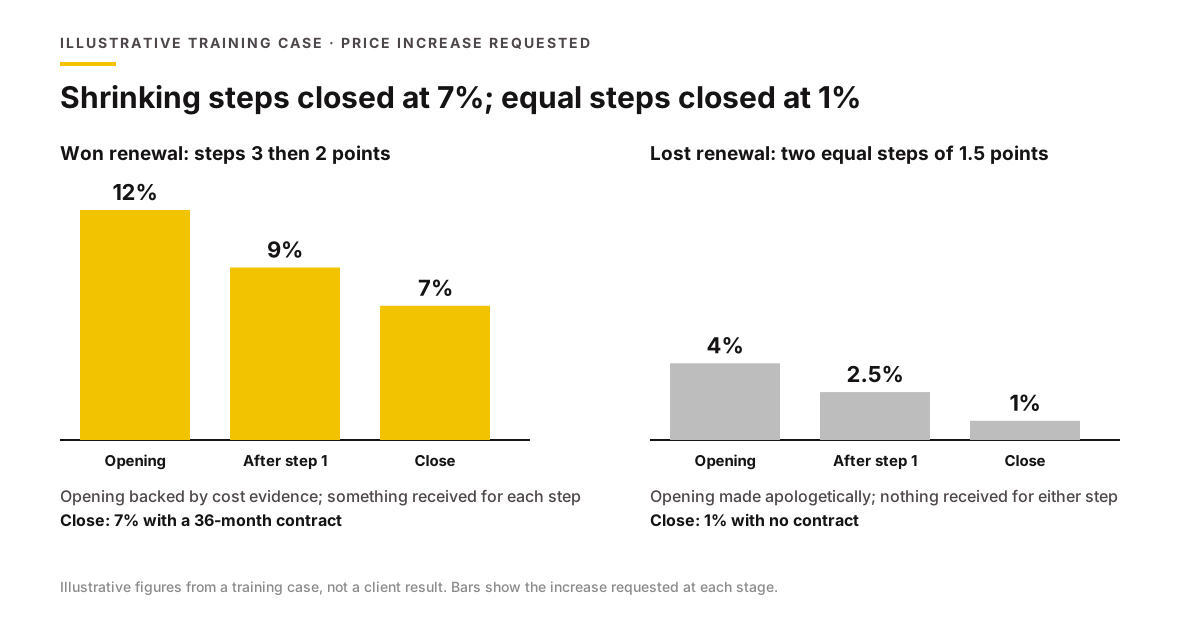
Practice on a training case shows sellers what the order of concessions signals to a buyer. A seller who won a renewal opened at 12 per cent with cost evidence, moved to 9 and then 7 per cent with each step smaller than the last and something received for each, and closed with a 36-month contract. A seller who lost the renewal opened at 4 per cent, moved in equal steps to 1 per cent, received nothing and closed with no contract.
Four details separate a program that holds from one that is forgotten.
| A written plan for each key account | The three positions and the give-get list are approved before the meeting and reviewed after it. |
| Rehearsal against the tactics | A seller who has said the prepared answer to "the other supplier is 10 per cent cheaper" aloud, to a colleague, gives a better answer in the meeting than one who read it on a slide. |
| A named approver and an authority matrix | A walk-away with no owner is a suggestion. The matrix states what each role can give and routes larger concessions by dollar impact. |
| Field coaching after the workshop | Managers review live negotiations with each seller against the written plan, and deals held at price are told in sales meetings with the margin shown. |
Exhibit 3. Four details that keep training in use. Source: Pricing Insight negotiation workshop and change program material.
04Why sellers concede, and how training answers it
Most concessions are made for human reasons. Pricing Insight's work on the emotional side of pricing names the patterns that recur in sales teams, and each one has a practical answer that the program builds in.
| What the seller feels | What it drives | What the program gives the seller |
|---|---|---|
| Fear of losing the deal | Discounts offered before they are asked for; margin floors breached on the deals sellers are proudest of | A walk-away set before the meeting, other things to trade, and recognition for the first account kept without a discount |
| Anxiety about pushback | Quotes that start below list to avoid the conflict | A value case in the customer's dollars and rehearsal of the hard conversation until the answer is familiar |
| Pride in a long relationship | Price increases held back on the seller's own accounts | A view of the relationship over ten years, in which the supplier still has to be there and profitable |
| Unease with the pricing arithmetic | Deference to Finance and reliance on markup | The arithmetic taught to everyone with discount authority, starting with what a discount does to gross profit dollars |
Exhibit 4. Four reasons sellers concede and the answer to each. Source: Pricing Insight, The Emotional Landscape of Pricing.
Sessions open with a plain question for each seller: think of the last deal you discounted to win, and whether you know the discount changed the result.
05What to measure: what is given away, as well as what is won
Win rate alone rewards a seller who closes by conceding, and a business that tracks only win rate trains the behaviour it is trying to remove. Four measures sit alongside it, each set against a baseline agreed at the start and reviewed with Finance on a fixed date.
| Measure | What it shows |
|---|---|
| Concessions given in each negotiation, and what each bought | Whether sellers trade or give |
| The gap between the opening position and the close | How much of the prepared position held |
| Deals declined below the floor, and whether the sales director backed the decision | Whether the walk-away is real |
| The share of an announced price increase that reaches the invoice | Whether an increase was realised as well as announced |
Exhibit 5. Four measures of negotiation training. Source: Pricing Insight negotiation workshop.
The last measure separates an announced increase from a realised one. The headline price can move while the invoiced price barely changes, because concessions are granted account by account during the rollout and rebates return part of the increase. Measuring realisation with Finance, account by account, shows where the increase held and where it leaked.
06What clients have done with it
Three published cases show the skills at work. They describe what happened in those businesses and are not benchmarks for another.
| Client | What was done | Outcome and status |
|---|---|---|
| Devro, food manufacturing | Customer Value Discovery across 21 value drivers, then sales teams in several countries through Pricing University | Higher price increases negotiated in Australia and New Zealand. Realised; not quantified in dollars |
| A foodservice packaging distributor, New Zealand | A negotiation pack for one account worth about A$6 million a year: spend by category, comparison with similar accounts and a playbook | An 8 per cent increase, about A$480,000 a year. Realised, annualised |
| Allegion, door and architectural hardware | A pricing diagnostic, then pricing governance, training for sales teams and a reset of deal discipline across channels | An EBIT gain of A$3.8 million to A$6.5 million. Identified and yet to be realised |
Exhibit 6. Three published cases. Source: Pricing Insight case studies and the Pricing Periodic Table, CXO Edition.
Devro's Sales Director, Australia and New Zealand: "Undertaking the Customer Value Discovery program helped us identify additional sources of value and allowed DEVRO to negotiate higher price increases both in Australia and New Zealand."
07The Pricing Periodic Table elements the training builds
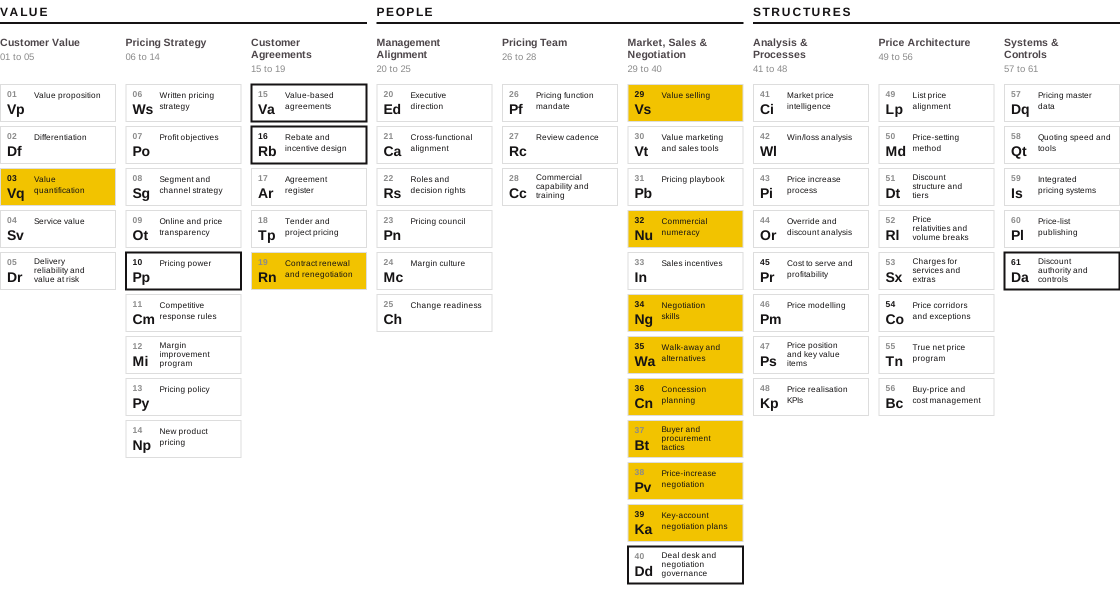
The Pricing Periodic Table has 61 elements in three pillars, Value, People and Structures. Negotiation training builds the ten shown in gold: 03 Vq Value quantification, 19 Rn Contract renewal and renegotiation, 29 Vs Value selling, 32 Nu Commercial numeracy, 34 Ng Negotiation skills, 35 Wa Walk-away and alternatives, 36 Cn Concession planning, 37 Bt Buyer and procurement tactics, 38 Pv Price-increase negotiation and 39 Ka Key-account negotiation plans.
Five more are outlined because trained sellers depend on them and other work builds them: 10 Pp Pricing power, 15 Va Value-based agreements, 16 Rb Rebate and incentive design, 40 Dd Deal desk and negotiation governance, and 61 Da Discount authority and controls. A seller trained to hold a walk-away holds it only if discount authority and a deal desk stop the same discount being approved elsewhere.
How long does negotiation training take?
The workshop sets the method and gives each seller a written plan for one account. The discipline comes from reviewing concessions after each negotiation, which happens in the business over the following months.
Who attends negotiation training?
Every seller with discount authority, and the managers who approve exceptions. A trained seller whose manager approves any exception on request will not hold a floor.
Is generic negotiation training enough, or does it need to be built on our accounts?
The team's own accounts and live negotiations produce the written plans that change outcomes. Generic cases teach the terms.
How is the result of negotiation training measured?
By concessions given and what each bought, by the gap between opening and close, by deals declined below the floor, and by the share of increases realised on the invoice, reviewed with Finance against an agreed baseline.
What is the difference between sales training and negotiation training?
Sales training builds product knowledge and the sales conversation. Negotiation training prepares the seller for a trained buyer: the walk-away, the value case in the customer's dollars, the give-get list and a response to each tactic.
08How Pricing Insight helps
Prices hold when the seller walks in with the numbers, the value case and the trades already approved. Negotiation Training & Value-Based Selling works on the team's own key accounts and the negotiations coming up, and Pricing University teaches the method and the arithmetic. Related reading: Sales Negotiation Skills for B2B Sellers and Preparing for Price Negotiations.
The work runs in three stages, each drawing on evidence from the client's own transactions. Pricing Insight has completed 160+ engagements, and price optimisation programs return between 5 and 10 times their cost in year 1.
Diagnose
Concessions given in recent negotiations and what each bought, net price after rebates by account, and the floors and authority limits in use, through the Strategic EBIT Opportunity & Risk Diagnostic.
Optimise
Opening, target and walk-away prices for key accounts, value cases from Customer Value Discovery, and a give-get list priced by Finance.
Transform
Sellers trained in the six skills, with a written plan for each key account approved before the meeting and reviewed after it, delivered through Pricing Capability & Governance.
What did your sales team give away in its last five negotiations?
A first conversation establishes how this applies in your business and whether a diagnostic is warranted. Ron Wood, +61 410 534 099.
Ron Wood is the Founder and Managing Director of Pricing Insight, an Australian pricing strategy consultancy he established in 2007. He has worked in pricing for 30 years, first as a pricing and commercial manager in consumer goods, building materials and capital equipment, and since then across 160+ engagements in Australia, New Zealand, South East Asia, India, the United States and the United Kingdom. He also founded Pricing University and is the author of the Pricing Periodic Table, CXO Edition.
To discuss how this applies to your business, contact Ron Wood or call +61 410 534 099, or email info@pricinginsight.com.au.
Devro is a realised result as published in a Pricing Insight case study and is not quantified in dollars. The Allegion figure is an identified opportunity as published. The New Zealand foodservice packaging distributor figure is realised and stated as an annualised value; the client is described by industry only and is reported in the Pricing Periodic Table, CXO Edition. The concession arithmetic, the walk-away build and the renewal steps are illustrative or training figures. Results are as reported by Pricing Insight and have not been independently audited. No figure in this paper is typical or guaranteed.
Related services and client evidence
Learn more about Sales Negotiation Training and read the Devro case study for relevant commercial experience.