

White paper · Optimise · 27 min read
Sources: Arnott’s, foodservice packaging supplier and Flannerys case studies published on pricinginsight.com; the Arnott’s base figure is from the Pricing Periodic Table, CXO Edition, which reports it with the published EBIT result. All three are realised results as reported by Pricing Insight, not independently audited, and none is a benchmark for another business.
The food manufacturing industry plays a vital role in the global economy, transforming raw agricultural products into consumer goods. Despite its necessity and vast scope, companies in this industry often operate on thin margins, making profitability a continual challenge. One solution that is increasingly making its way into the spotlight is the adoption of value-based pricing strategies.
The question this paper answers
How does a food manufacturer move from cost-plus pricing to prices set on the value its customers place on its products, and hold them when costs and competitors move?
Key takeaways
- Food manufacturers face volatile costs, regulation, price-sensitive consumers and competition that make profitable pricing difficult.
- Value-based pricing sets prices according to perceived customer value rather than production costs alone.
- Brand equity, product features, sustainability, convenience, nutrition, taste and transparency can contribute to customer-perceived value.
- Market research, regular pricing reviews, testing and analytics can support informed pricing decisions.
This article will explore how these strategies can be a key differentiator for food manufacturing firms aiming to enhance their profitability in an industry marked by unique challenges and opportunities.

Five food and food-related clients of Pricing Insight show the method at work. A foodservice packaging supplier, Devro, Huon Aquaculture, Arnott’s and Flannerys each appear below in the same six-part form: the problem and what it put at risk, why it was hard to fix, what Pricing Insight did, the outcome with its status, the benefit to the client, and the Pricing Periodic Table elements the work built. The Nestlé and Coca-Cola accounts in sections 03 and 04 are commentary on public information about those companies, not Pricing Insight client work.
01Food manufacturers face ten pricing pressures, and each one tests whether cost or value sets the price
The challenges below are faced by the food manufacturing industry, specifically focusing on aspects related to pricing strategy and profitability:
1. Regulatory compliance and pricing
Regulatory changes can directly impact the cost structure of a product, forcing companies to reassess and potentially alter their pricing strategies. Compliance costs may need to be passed onto consumers, but this might not be viable in highly competitive markets without risking market share.
2. Supply chain costs
Fluctuations and complexities in supply chain costs directly affect the profitability of products. When costs rise, companies must decide whether to absorb them, which can narrow margins, or pass them onto consumers through higher prices, which may affect demand.
3. Raw material price volatility
Rapid fluctuations in raw material prices can destabilise cost predictions. This makes it challenging for companies to set long-term, sustainable pricing strategies without frequently adjusting the prices, which can alienate consumers.
4. Adapting to consumer price sensitivity
Consumer demand can be highly sensitive to price changes. Finding the balance between a price point that consumers are willing to pay and a price that maintains healthy profit margins is a constant challenge.
5. Intense competitive pricing
In a saturated market, competitors’ pricing strategies can force companies into price wars. Maintaining profitability while competitively pricing products becomes delicate, particularly for smaller manufacturers with tighter margins.
6. Labour costs and pricing
Rising labour costs must be accounted for in the product’s price, but higher prices can deter price-sensitive consumers. This pressures manufacturers to cut costs elsewhere or risk shrinking profit margins.
7. Sustainable practices and price premiums
Implementing sustainable practices often increases production costs. Companies are then challenged to decide whether their market will bear a higher price for a sustainably produced product.
8. Technology investment impact on price
Investments in technology can lead to more efficient production but come with significant upfront costs. Recovering these costs through pricing without discouraging consumers is a critical challenge.
9. Global trade and pricing strategy
International tariffs and trade agreements can have significant impacts on costs and, thus, on pricing strategy. Companies must continually adapt their pricing strategies in response to the dynamic global trade environment.
10. Crisis management and profit protection
In the event of a product recall or another crisis, companies not only face direct costs but may need to lower prices to win back consumer trust. This can have a prolonged impact on profitability.
These challenges underline the intricate balance that food manufacturing companies must strike between internal and external factors. Successful navigation through these challenges necessitates a nuanced, dynamic, and data-driven approach to pricing strategy, which is fundamental to maintaining profitability in a complex and competitive industry.

Cost movements cut both ways. When input costs fall, margin can rise while prices slip underneath it, and the result looks like pricing success until costs turn. A foodservice packaging supplier, selling cups, lids and takeaway boxes to food businesses, met exactly that.
A foodservice packaging supplier
Cups, lids and takeaway packaging · A$2m EBIT from quick wins · Realised
| Client and problem | Gross margin rose by more than A$11 million in one year and management took it as proof that pricing was working. On the same customers and products, unit cost had fallen about 8 per cent while unit price had risen only about 1 per cent; the cost saving was worth about A$12 million, and without it margin would have fallen. |
| Challenge | The founder had set prices for many years, and when the founder stepped back the authority to set price was never handed to anyone. Prices below the guide were approved by whoever was asked, often with no record, and a staff member put the margin result down to the cost saving and exchange rates: “hence why you’re seeing margin rocket”. |
| What Pricing Insight did | The Strategic EBIT Opportunity & Risk Diagnostic, then a national price list architecture, a customised discount matrix, a mandated pricing team, key account management tools, AI value selling and Pricing University. Customers were rated on five factors of pricing power, switching cost, price awareness, relationship depth, growth and profitability, and placed in four tiers, each taking a different share of a price increase; the tiers were recommended. |
| Outcome | A$2m of EBIT realised from pricing quick wins, as published, with a further A$6m to A$9m of margin opportunities identified. The A$6m to A$9m is identified, not realised. |
| Benefit to the client | Price now carries part of the margin result that a cost saving had been carrying, so the business is less exposed when input costs or exchange rates turn, and one team owns the price decisions the founder used to make. |
| Periodic Table elements built | 56 Bc Buy-price and cost management; 48 Kp Price realisation KPIs; 10 Pp Pricing power; 26 Pf Pricing function mandate. |
02Ten sources of value give a food manufacturer something other than cost to price on
Below is a list of sources of value that are unique to the food manufacturing industry, along with explanations of how they can be tied into pricing strategies, specifically value-based pricing:
1. Brand equity
A strong and trusted brand can command higher prices due to perceived value. With value-based pricing, companies can set prices based on the brand’s worth to the customer, rather than solely on production costs.
2. Unique product features
Unique attributes, such as organic, non-GMO, or allergen-free, can be highly valued by certain consumer segments. These unique features can justify higher price points under a value-based pricing model, where the price is set according to the customer’s willingness to pay for these features.
3. Sourcing and sustainability
Ethical and sustainable sourcing is increasingly important to consumers. Companies can use value-based pricing to set higher prices for sustainably sourced products, capitalising on consumer willingness to pay a premium for ethical choices.
4. Convenience and packaging
Easy-to-use or ready-to-eat products and innovative or eco-friendly packaging can add significant value for consumers. With value-based pricing, these convenience factors can be quantified and incorporated into the price.

5. Nutritional value
Products that offer superior nutrition or health benefits can command higher prices. Value-based pricing allows manufacturers to set prices reflecting the health and wellness value these products provide consumers.
6. Taste and sensory experience
Exceptional taste and quality can be a strong differentiator. Value-based pricing allows for setting prices that align with the premium sensory experience delivered to the consumer.
7. Limited edition or exclusive products
Scarcity and exclusivity can increase perceived value. Value-based pricing strategies can capitalise on this by setting higher prices for products marketed as limited or exclusive.
8. Supply chain transparency
An increasing number of consumers value knowing where their food comes from and how it is produced. Companies with transparent supply chains can use value-based pricing to set higher prices, reflecting the added value this transparency provides to consumers.
9. Customer support and services
Offering exceptional customer support, such as recipes, meal planning apps, or direct consumer engagement, can add value beyond the product. This added service value can be considered when setting prices using a value-based model.
10. Adaptability and customisation
The ability to quickly adapt products to changing consumer needs or to offer personalised products can be a strong source of value. Value-based pricing allows companies to charge a premium for products that more closely meet specific consumer preferences or needs.
In the context of value-based pricing, these sources of value unique to the food manufacturing industry are crucial. Instead of setting prices based solely on cost-plus or competitor-based models, value-based pricing strategies enable companies to set prices that reflect the actual and perceived value these unique aspects bring to the consumer. This approach aligns prices more closely with consumer willingness to pay and thus can enhance profitability while reinforcing the brand value and customer loyalty.

Six groups. Pricing Insight sorts the value a food supplier delivers into value in use, what the customer gains, and value at risk, what the customer avoids losing. For a supplier to food manufacturers, the second group is often the larger, because a failed batch, a stopped line or a food safety question reaching a supermarket costs the customer far more than the price difference on an input.
| Value group | Question for the customer | Food example | Sources of value in this section |
|---|---|---|---|
| Value in use: tangible | What does the product do for you? | Consistent casing performance; customised colour, bite and strand length | Unique features, nutrition, taste, customisation |
| Value in use: transactional | How easy are we to buy from? | National distribution that lowers the customer’s inventory | Convenience and packaging, customer support |
| Value in use: tradeable | What is the deal worth? | Contract price stability; trading terms above the industry norm | Brand equity, exclusive products |
| Value at risk: supply | What would no supply cost you? | Capacity for seasonal peaks such as Christmas and Easter; emergency stock | Sourcing, supply chain transparency |
| Value at risk: product and service | What would a failure cost you? | Yield lost to running breaks; food safety certification and traceability to the farm | Sustainability, transparency, brand equity |
| Value at risk: technical | What would no support on site cost you? | Round-the-clock help for line breakdowns and recalibration | Customer support and services |
Exhibit 1. Where a food supplier’s value sits. The six groups are from Pricing Insight’s value management system; the examples are from the Devro value maps described in case 02; the right-hand column maps the ten sources of value above onto the groups. Source: Pricing Insight case files.
Two clients show the sources of value turned into prices. Devro sells an input to food manufacturers and priced on value at risk; Huon Aquaculture sells a branded product to consumers through a major retailer and priced on taste, brand and the consumers who would not switch.
Devro
Food manufacturing, collagen casings · Higher price increases negotiated · Realised
| Client and problem | Devro makes the collagen casings used for sausages and processed meats and sells to food manufacturers that negotiate hard on every cent. Cheaper imported casings arrived in Australia and New Zealand, some offered at up to half Devro’s price, so on a price-per-metre comparison Devro looked expensive at every contract round. |
| Challenge | Much of what Devro provided was invisible on the invoice: technical support on the production line, consistent casing performance, local supply, food safety certification and trading terms. Customers rated most value drivers as more important than Devro’s own team did, so the business was underselling value it did not know it had, and account managers had no shared way to measure it. |
| What Pricing Insight did | Customer Value Discovery: a value driver analysis scored by customers and by Devro’s team, expanded to 21 drivers across six categories and compared with the main competitor. The evidence fed a contract strategy and a sample supply agreement for a key account, the Devro Production Audit, which converts line performance into kilograms per hour on the customer’s own line, and Pricing University’s 12-lesson pricing fundamentals course for sales teams in several countries. |
| Outcome | Higher price increases negotiated in Australia and New Zealand, a realised result as published. “Undertaking the Customer Value Discovery program helped us identify additional sources of value and allowed DEVRO to negotiate higher price increases both in Australia and New Zealand,” said the Sales Director, Australia and New Zealand, Devro. |
| Benefit to the client | Price defended against much cheaper alternatives instead of matched, by showing the customer the cost of a cheaper casing in yield, downtime and food safety risk, which lowers the exposure to a price war at each contract round. |
| Periodic Table elements built | 03 Vq Value quantification; 05 Dr Delivery reliability and value at risk; 30 Vt Value marketing and sales tools; 38 Pv Price-increase negotiation. |
Huon Aquaculture
Premium smoked salmon · Consumer value and price research · Premium position built
| Client and problem | Huon Aquaculture, a Tasmanian salmon producer, needed its premium smoked salmon position to mean something to the consumer, and needed to know how consumers valued the product and how they responded to price differences within the category. |
| Challenge | The appeal of a lower price had to be separated from the reasons a consumer preferred a particular product, and the answer had to work for the retailer as well as the brand owner, because the category was negotiated with Woolworths’ buying team. |
| What Pricing Insight did | Consumer research into value perception and price elasticity, a repackaging and rebranding strategy built on it, and a price-point positioning strategy with optimal promotional price points, brought together in a five-year commercial plan and a category strategy developed with Woolworths’ buying team. |
| Outcome | The testing identified a segment of consumers who valued Huon enough that cheaper alternatives were not a reason to switch. The price-point positioning strategy enabled both Huon and Woolworths to improve gross margin earnings, as recorded in Pricing Insight’s case file; no figure is published. |
| Benefit to the client | Brand, packaging, price points and the retailer’s category plan supported one premium proposition, so price was set for the consumers who valued the brand rather than cut for everyone in the category. |
| Periodic Table elements built | 01 Vp Value proposition; 02 Df Differentiation; 08 Sg Segment and channel strategy; 47 Ps Price position and key value items. |
03Nestlé met four pricing obstacles with value, flexible pricing, tiered ranges and local supply

Nestlé, a Swiss multinational food and beverage company, is known for its vast range of products, from baby food to coffee. Like any global corporation, Nestlé has had to continuously adapt its pricing strategy to account for fluctuating commodity prices, changing consumer preferences, and various regional economic conditions. This case study explores some of the obstacles Nestlé has faced regarding its pricing strategy, the actions it took, and the outcomes it achieved. It draws on public information about the company.
Obstacle 1: Competitive pressure and price wars
In a crowded marketplace with intense competition, Nestlé often found itself in situations where competitors were slashing prices, making it hard for Nestlé to maintain its price points without losing market share.
Nestlé opted for a value-based pricing strategy for specific product lines, focusing on enhancing its products’ perceived value through innovation, quality improvement, and strong brand building instead of entering a price war.
This strategy allowed Nestlé to maintain, and in some cases improve, its profit margins by positioning its products as premium options that justified a higher price tag than competitors’ products.
Obstacle 2: Economic inflation and rising commodity costs
Fluctuations in the global economy, especially the rising costs of raw materials like coffee beans, cocoa, and milk, presented a significant challenge to Nestlé’s pricing strategy.
Nestlé employed a flexible pricing strategy, where it adjusted its product prices based on the fluctuation of commodity costs. This involved passing some increases onto the consumer and aggressively managing internal costs to avoid dramatic price hikes.
By close monitoring and swiftly adapting to changes in commodity costs, Nestlé balanced maintaining profitability and keeping its products affordable and competitively priced.
Obstacle 3: Emerging markets and price sensitivity
In emerging markets, where consumers tend to be highly price-sensitive, Nestlé faced the challenge of pricing its products in a way that would be both affordable for consumers and profitable for the company.
To address this, Nestlé adopted a tiered pricing strategy, introducing a range of products at various price points to cater to different consumer segments. This included introducing smaller, more affordable package sizes and lower-cost alternatives in some regions.
This approach allowed Nestlé to gain significant market share in emerging economies by offering products tailored to different income levels, making its products accessible to a broader customer base.
Obstacle 4: Regulatory and trade restrictions
In certain markets, regulations or trade restrictions affected the pricing of imported goods, impacting Nestlé’s ability to maintain its desired price points.
Nestlé invested in local manufacturing and sourcing strategies, which reduced its reliance on imported goods and allowed it to mitigate the impact of these regulatory and trade-related cost fluctuations.
By localising some of its production and sourcing, Nestlé managed to maintain more stable and competitive pricing in various markets, regardless of external trade pressures.
Nestlé’s adaptive and region-specific approach to pricing strategy illustrates its agility and responsiveness to a complex and ever-changing global market. By refusing to engage in destructive price wars, closely managing the relationship between commodity costs and product prices, tailoring its approach in emerging markets, and localising production to mitigate regulatory impacts, Nestlé has navigated numerous challenges to maintain a strong and competitive position in the global market.
04Coca-Cola met four pricing obstacles with new ranges, brand strength, local pricing and reformulation

Coca-Cola, a globally renowned beverage company, is recognised for its iconic soft drinks. However, the company has also had to navigate various pricing challenges arising from fluctuating market conditions, changing consumer behaviours, and global economic shifts. This case study explores some of the obstacles Coca-Cola has faced in relation to its pricing strategy, the actions it took, and the outcomes it achieved. It draws on public information about the company.
Obstacle 1: Health-conscious consumer shift
With a growing consumer focus on health and wellness, Coca-Cola, known for its sugary drinks, faced declining demand for some of its core products, impacting its pricing power.
Coca-Cola diversified its product portfolio to include healthier options such as bottled water, teas, and low-calorie beverages. The company employed premium pricing for these more nutritious options, capitalising on consumers’ willingness to pay more for perceived healthier products.
This strategy helped Coca-Cola maintain its revenue streams and improve its brand image, showing an alignment with evolving consumer preferences while securing higher margins on new product lines.
Obstacle 2: Competitive pressure and price wars
In a saturated beverage market with many competitors, Coca-Cola often faced price wars that threatened its market share and profit margins.
Coca-Cola invested heavily in brand building and marketing initiatives to reinforce its premium brand status. This allowed the company to maintain slightly higher prices than competitors by drawing on its strong brand equity.
By emphasising its brand and quality, Coca-Cola retained consumer loyalty and maintained a pricing strategy that protected its margins, despite aggressive pricing from competitors.
Obstacle 3: Global economic fluctuations
Currency fluctuations and economic downturns in various parts of the world presented significant challenges to Coca-Cola’s global pricing strategy.
Coca-Cola adopted a flexible and region-specific pricing strategy, adjusting its prices and pack sizes according to local economic conditions, thus employing a kind of ‘glocal’ (global + local) strategy.
This adaptive approach enabled Coca-Cola to sustain its market presence and profitability across diverse economic environments without alienating price-sensitive consumers.
Obstacle 4: Regulatory pressures and taxes
Increasing government regulations, such as sugar taxes in various countries, directly impacted the cost structure for Coca-Cola, challenging its pricing strategy.
In response to such regulatory pressures, Coca-Cola accelerated its innovation to develop and promote low-sugar or sugar-free variants of its products. Additionally, the company actively advocates and partners with regulatory bodies to work toward solutions aligned with public health goals and business sustainability.
Coca-Cola’s proactive response to regulatory challenges allowed it to mitigate some of the cost impacts of these taxes and regulations. The company also positioned itself as a more responsible and adaptive industry leader, committed to aligning with public health priorities.
Coca-Cola’s dynamic and responsive approach to pricing strategy reflects its adept navigation of a complex and evolving global market. Coca-Cola has exhibited remarkable resilience and adaptability by diversifying its product offerings and pricing them at a premium, using its substantial brand equity to maintain pricing power, adopting a flexible and region-specific pricing strategy, and proactively responding to regulatory pressures. These strategies have allowed it to maintain a strong competitive position amidst numerous challenges in the global beverage market.

Brand and pack-price decisions at a global company are made by a central team with the data to back them. A food supplier to Australian retailers often makes the same decisions account by account, through account managers who each agree promotions and prices with their own buyers. Arnott’s shows what changes when those decisions are brought together.
Arnott’s
Biscuit maker supplying Australian retailers · Over A$5m EBIT in 12 months · Realised
| Client and problem | Forty-one account managers were making promotional promises to retail customers that were not tracked, on a A$100m base, and channel conflict between customers put further pressure on price. |
| Challenge | With promises made account by account and not recorded in one place, the business could not see what each promotion cost or returned, and no single team owned price across channels. |
| What Pricing Insight did | The Strategic EBIT Opportunity & Risk Diagnostic: the return on promotions modelled for 100 SKUs, pricing centralised in a central pricing team, channel conflict resolved, and execution reshaped across the 41 account managers. |
| Outcome | Over A$5m of EBIT recovered within 12 months, a realised result as published. |
| Benefit to the client | EBIT recovered equal to about 5 per cent of the A$100m base within a year, and promotional spend that is modelled before it is promised, which lowers the risk of margin given away one account at a time. |
| Periodic Table elements built | 26 Pf Pricing function mandate; 46 Pm Price modelling; 17 Ar Agreement register; 08 Sg Segment and channel strategy. |
05Ten actions turn value-based pricing from a principle into a price file
1. Conduct thorough market research
Action: Understand what aspects of your products are most valued by consumers, what differentiates your brand, and how pricing changes might impact demand.
Expected Outcome: Informed and data-driven pricing strategies that align with consumer preferences and willingness to pay.
2. Align pricing with perceived value
Action: Transition from cost-plus or competition-based pricing strategies to value-based pricing that reflects the actual and perceived value your products offer consumers.
Expected Outcome: Higher profit margins due to prices that are in sync with the value customers perceive, fostering loyalty and potentially attracting a higher-value customer base.
3. Invest in sustainable practices
Action: Embed sustainability into your core business strategy to allow for a pricing premium rather than using it as merely a marketing point.
Expected Outcome: The ability to command higher prices due to consumer willingness to pay for sustainable products enhances brand image and customer loyalty.
4. Optimise supply chain
Action: Collaborate with suppliers and distributors to identify and implement cost-saving efficiencies that preserve or enhance product quality.
Expected Outcome: Reduced operational costs that can stabilise or improve profit margins without necessitating price increases.
5. Regularly review and adjust pricing strategy
Action: The market is dynamic; regularly analyse market and cost data to ensure your pricing strategy remains aligned with market conditions and business goals.
Expected Outcome: A responsive pricing strategy that allows the company to stay competitive and profitable despite market fluctuations.
6. Implement dynamic pricing models
Action: Review the price file annually and run promotions to a set promotional calendar, so price moves follow seasonality and demand rather than ad hoc reaction.
Expected Outcome: Prices that follow seasonality and demand without ad hoc changes.
7. Use technology
Action: Use your own sales history to measure price elasticity by product and customer and set price points from it.
Expected Outcome: Accurate, data-backed insights leading to more effective and strategic pricing decisions.
8. Conduct A/B testing
Action: Regularly test different pricing strategies on a smaller scale before full implementation to measure their actual impact on sales and profitability.
Expected Outcome: Risk mitigation by identifying the most effective pricing strategies before full-scale implementation.
9. Educate the sales and marketing teams
Action: Ensure that your sales and marketing teams understand the pricing strategy, its basis, and its benefits, so they can effectively communicate this to customers.
Expected Outcome: A cohesive and convincing customer-facing approach to pricing can lead to increased sales and customer acceptance of price points.
10. Obtain expert advice from a professional pricing consultant
Action: Engage a consultancy like Pricing Insight to draw on external expertise, industry benchmarks, and best practices.
Expected Outcome: A comprehensive, expertly crafted, and competitive pricing strategy based on industry best practices, leading to increased profitability and market competitiveness.
These action items and expected outcomes offer a roadmap for food manufacturing businesses. They illustrate how each action is designed as a task and a strategic move aiming to achieve specific, tangible benefits that enhance the company’s pricing strategy and overall profitability.
Actions 1, 5, 7 and 8 come together in one piece of work at a food retailer. Flannerys used its own sales history, competitor prices and a staged trial to decide which prices to move, rather than applying one percentage across the range.
Flannerys
Organic and natural food retail · Over A$1.0m incremental gross margin · Realised
| Client and problem | Flannerys sells certified organic produce and specialist dietary products with in-store advice from naturopaths and nutritionists, and had to respond to cost pressure and competition while staying competitive on the familiar products customers use to judge store value. |
| Challenge | A single pricing rule could not serve familiar products, specialist products bought occasionally and products often bought on promotion. Competitors’ advertised prices gave a different picture from what Flannerys received after its own discounts and promotions, so changing shelf prices alone would have missed part of the problem. |
| What Pricing Insight did | Project Blackbird: two years of product-level sales history analysed with customer spending and category performance by store, competitor benchmarking of comparable products and baskets across specialist organic retailers and supermarkets, and staged optimisation of prices across product groups, brands and pack sizes, with a trial on selected products and stores. The output was a product-level price file the business could review and upload in its existing systems. |
| Outcome | Over A$1.0m in incremental gross margin realised, as published. |
| Benefit to the client | Margin taken where prices could carry it and held back on the products that set customers’ view of store value, which lowers the risk of a blanket increase that sends price-sensitive shoppers elsewhere. |
| Periodic Table elements built | 46 Pm Price modelling; 41 Ci Market price intelligence; 47 Ps Price position and key value items; 55 Tn True net price program. |
06Value-based pricing protects food margins when the value is measured and the price follows it
Maintaining profitability is a perpetual challenge in an industry as complex and competitive as food manufacturing. Value-based pricing strategies offer a potent solution, which involves setting prices based on the perceived value to the customer rather than the cost of production plus a markup. By focusing on the unique value they provide and effectively communicating this to consumers, food manufacturing companies can set prices that are not only competitive but also profitable.
Profitability in food manufacturing is not only about cost-cutting but about understanding and using the value a business provides. Pricing Insight develops pricing strategies for food manufacturers and suppliers from their own sales data and customer evidence, built around each business’s strengths and challenges, to drive margin expansion and earnings growth. To discuss your pricing, contact Ron Wood on +61 410 534 099, at info@pricinginsight.com.au or through our contact page.
Three things are safe to read from the five cases. Speed: Arnott’s recovered over A$5m of EBIT within 12 months, and the foodservice packaging supplier’s A$2m came from quick wins, changes to who sets price and how, not new products or plant. Size: the realised results run from over A$1.0m of gross margin at Flannerys to A$2m of EBIT at the foodservice packaging supplier and over A$5m at Arnott’s, and the supplier’s further A$6m to A$9m is identified, not realised. Risk: in each case the work replaced a price that rested on something fragile, a cost saving, a price-per-metre comparison, untracked promises or a single rule across the range, with one that rested on measured customer value. None of these figures is a benchmark for another business.
07The Pricing Periodic Table elements this paper builds
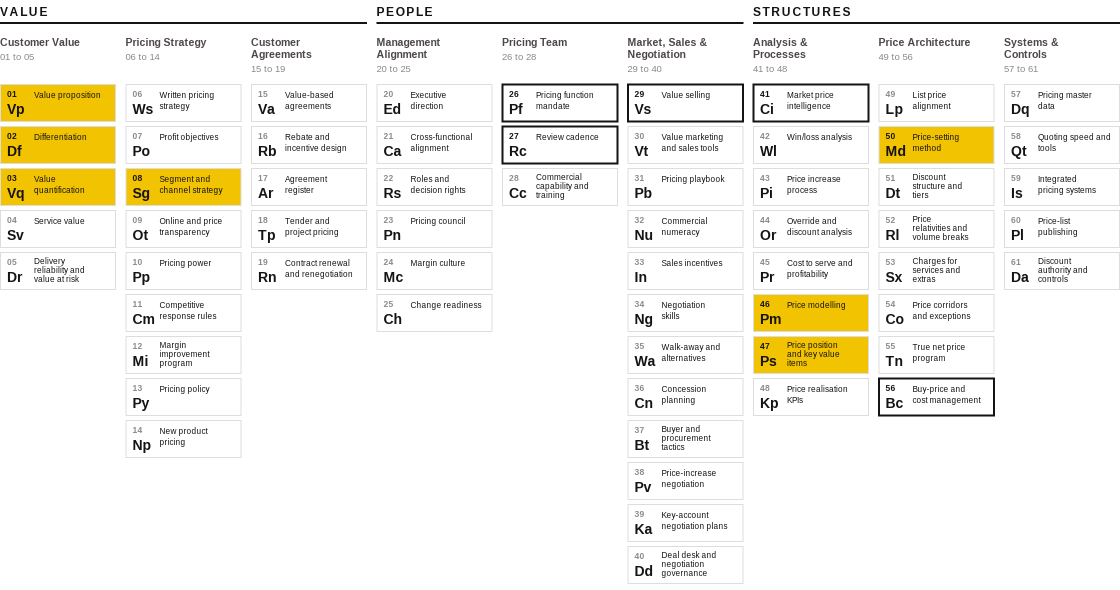
The Pricing Periodic Table sets out 61 elements of pricing capability in nine domains, across Value, People and Structures. Seven are built by the method in this paper: 01 Vp Value proposition and 02 Df Differentiation (the ten sources of value), 03 Vq Value quantification (putting a figure on each source), 08 Sg Segment and channel strategy (pricing for the customers who value the product, and tiered ranges by segment), 47 Ps Price position and key value items (where each product sits against competitors), 46 Pm Price modelling (elasticity from the business’s own sales history and A/B tests) and 50 Md Price-setting method (the move from cost-plus to value). Five are depended on: 41 Ci Market price intelligence supplies the competitor prices, 56 Bc Buy-price and cost management keeps cost movements visible, 29 Vs Value selling carries the value into the negotiation, 27 Rc Review cadence sets how often prices are reviewed, and 26 Pf Pricing function mandate gives one team ownership of price.
The client cases map onto these elements directly. Devro built 03 Vq through customer-scored value drivers and the Production Audit, and carried them into negotiations through 29 Vs and Pricing University; Huon Aquaculture built 01 Vp, 08 Sg and 47 Ps from consumer research; Flannerys built 46 Pm and 47 Ps from its own sales history and competitor prices; and Arnott’s and the foodservice packaging supplier began with 26 Pf, putting price decisions with one team before value could be priced consistently.
08Frequently asked questions
What is Nestlé’s pricing strategy?
From public information, Nestlé has met four pricing pressures in four ways. It holds value-based prices on selected lines and declines price wars. It passes on part of commodity cost increases while managing its own costs. It offers tiered ranges and smaller packs in price-sensitive emerging markets. It manufactures and sources locally where trade rules raise the cost of imports. Section 03 sets out each obstacle, the response and the outcome.
How do I move from cost-plus pricing to value-based pricing in B2B?
Start with the customer’s view of value, not your cost. Score the value drivers with your own team and then with customers, compare the two, and put a figure on the drivers that matter most, often value at risk such as supply continuity and food safety. Set prices product by product from that evidence and your sales history, and train the people who negotiate to use it. Devro negotiated higher price increases in Australia and New Zealand this way, a realised result.
How should an FMCG or food supplier selling to major retailers in Australia approach pricing?
Bring promotional and price decisions into one team, model the return on each promotion before it is agreed, and keep a record of what each account has been promised. Build the premium position with the retailer’s category plan rather than against it. Arnott’s recovered over A$5m of EBIT within 12 months after modelling promotions for 100 SKUs and centralising pricing, and Huon Aquaculture built a premium position with Woolworths’ buying team from consumer research.
How do I pass on a price increase in B2B without losing customers?
Do not apply one rate to everyone. Group customers by pricing power, using switching cost, price awareness, relationship depth, growth and profitability, and give each group a different share of the increase, with the value case explained to those who need it. Lead with evidence of what the customer would lose by switching. Devro’s increases were planned only after the value map was complete and communicated.
What is pricing power and how do I measure it by customer?
Pricing power is how far a customer will accept your price before buying elsewhere. Measure it account by account from switching cost, price awareness, relationship depth, growth and profitability, then sort customers into tiers that each carry a different share of a price change. A foodservice packaging supplier used five such factors to place customers in four tiers, a recommendation made as part of work that realised A$2m of EBIT from quick wins.
My margins are shrinking. What should I do about pricing?
First separate price from cost. Measure what happened to unit price and unit cost on the same customers and products, because a cost saving can hide falling prices until costs turn. Then find where price is set without an owner or a method, and fix those first. At a foodservice packaging supplier, gross margin rose by more than A$11 million while unit price rose only about 1 per cent; quick wins then realised A$2m of EBIT.
09How Pricing Insight helps
Value-based pricing depends on translating customer value into practical decisions across products and customers, rather than relying on production costs alone. Project Blackbird price optimisation uses your sales data to build an optimised price file for every SKU and customer, ready for your ERP and quoting systems. Its service contract keeps the file current for your next price increase.
The work runs in three stages, each drawing on evidence from the client’s own transactions and customers. Pricing Insight has completed 160+ engagements, and price optimisation programs return between 5 and 10 times their cost in year 1.
Diagnose
Twelve months of invoices by product, customer and channel through the Strategic EBIT Opportunity & Risk Diagnostic. Price and cost movements separated on like-for-like products, promotional spend against its return, who sets price and on what basis, and the sources of value customers rate higher than your team does.
Optimise
Prices set product by product from customer value, elasticity in your own sales history and competitor positions, with customers grouped by pricing power for the next increase. The EBITDA Improvement Program delivers the price file, ready to upload.
Transform
Sales and account teams trained to quantify and negotiate on value through Pricing University and Negotiation Training & Value-Based Selling. A pricing team with the mandate to own price, and promotions and price realisation reviewed each month.
Which of your products are priced from cost when your customers would pay for their value?
A first conversation establishes how this applies in your business and whether a diagnostic is warranted. Ron Wood, +61 410 534 099.
Ron Wood is the Founder and Managing Director of Pricing Insight, an Australian pricing strategy consultancy he established in 2007. He has worked in pricing for 30 years, first as a pricing and commercial manager in consumer goods, building materials and capital equipment, and since then across 160+ engagements in Australia, New Zealand, South East Asia, India, the United States and the United Kingdom. He also founded Pricing University and is the author of the Pricing Periodic Table, CXO Edition.
To discuss how this applies to your business, contact Ron Wood at info@pricinginsight.com.au or on +61 410 534 099, or visit Pricing Insight.
Arnott’s, Devro and Flannerys results and the foodservice packaging supplier’s A$2m are realised results as published in Pricing Insight case studies; the Arnott’s A$100m base and SKU count are as reported in the Pricing Periodic Table, CXO Edition. The foodservice packaging supplier’s further A$6m to A$9m is an identified opportunity, not a result, and its cost, price and pricing-power findings are from the CXO Edition; the pricing-power tiers were recommended. The Huon Aquaculture outcome is as recorded in Pricing Insight’s case file and no figure is published. Devro, Huon Aquaculture and Flannerys detail comes from Pricing Insight case files; the Devro comment is quoted by job title and the staff comment by role. Nestlé and Coca-Cola are discussed from public information, not from Pricing Insight client work. Results are as reported by Pricing Insight and have not been independently audited. No figure in this paper is typical or guaranteed.