

White paper · Optimise · 21 min read
Sources: Costco figure from public reporting, not verified by Pricing Insight. King Living and Super Retail Group case studies published on pricinginsight.com; both are realised results as reported by Pricing Insight, not independently audited, and neither is a benchmark for another business.
Costco is an exceptional exemplar of a promotional strategy that has propelled it to worldwide fame and created a blueprint for other retailers seeking to carve their path to success. With an annual net sales figure reaching a staggering US$222.7 billion in 2022 (public reporting), Costco has secured its status as a retail powerhouse, rivalling the likes of Walmart and Amazon.
The question this paper answers
What can a retailer take from Costco’s membership, range and pricing model, and how does it apply the same mechanisms without copying a warehouse club?
Key takeaways
- Costco’s limited product selection and rotating offerings simplify shopping and encourage members to return to discover new products.
- Membership fees are reinvested to maintain competitive pricing, while tiered options encourage upgrades and increased spending.
- Bulk sales and slim mark-ups let Costco offer lower prices while encouraging larger purchases.
- The paper recommends that retailers adapt their promotional strategies to changing customer preferences and market dynamics.
Four Pricing Insight retail clients show the same mechanisms at work in Australian businesses. King Living, Flannerys, Super Retail Group and Mitre 10 each appear below in the same six-part form: the problem and what it put at risk, why it was hard to fix, what Pricing Insight did, the outcome with its status, the benefit to the client, and the Pricing Periodic Table elements the work built.
While its business model revolves around the simplicity of membership-only wholesale retail, the ingenious promotional techniques employed by Costco have been instrumental in driving sales, fostering customer loyalty, and maintaining a competitive edge.
In the following article, we’ll look at the various elements of Costco’s promotional strategy, uncovering its core components, the challenges faced, and the transformative action items that have secured its position. We’ll also consider the invaluable lessons retailing businesses of all sizes can learn from Costco’s promotional prowess and apply it to their commercial environment.
01Costco’s business model rests on a warehouse club, a limited range and low operating cost
At the heart of Costco’s promotional strategy lies its unique business model: the ‘warehouse club’ concept. This model is intricately intertwined with the ‘cash and carry’ approach, creating a retail ecosystem that thrives on efficiency, low prices, and direct engagement with customers. Key elements of this model include:
1. Direct wholesale sales
Costco’s warehouse club model involves selling an array of wholesale items directly to its members from expansive warehouse-style stores. This model is tailored to both individual customers and small business proprietors, fostering a diverse customer base.
2. Customer-centric approach
Customers at warehouse clubs purchase goods at wholesale prices and transport them home themselves, fostering a sense of involvement and immediacy in the shopping process. This contrasts with traditional wholesale retail, where invoices are issued upon delivery.
In addition to the “Warehouse Club”, Costco incorporates additional elements into its business model that are closely aligned with its pricing strategy. These elements contribute to the overall success of Costco’s promotional approach and further solidify its unique position as a retail success. Here are some of these elements:
1. Limited Product Selection: One distinct feature of Costco’s business model is its curated product selection. Instead of overwhelming customers with excessive options, Costco offers a limited selection of high-quality products. This approach simplifies the shopping experience for customers and allows Costco to negotiate better deals with suppliers, further driving down costs and facilitating the offering of competitive prices.
2. Private Label Brands: Costco significantly emphasises its private label brands, often called “Kirkland Signature” products. These private-label items provide Costco with greater control over pricing, quality, and branding. By offering high-quality alternatives to well-known national brands, Costco can price its private-label products attractively while maintaining healthy profit margins.
3. Rotating Product Offerings: Costco employs a dynamic product rotation strategy, regularly introducing new items while discontinuing others. This approach creates a sense of urgency and exploration among shoppers, encouraging them to visit repeatedly to discover new products. This strategy also aligns with Costco’s low-inventory, high-turnover model, minimising carrying costs and enabling better pricing.
4. Minimal Advertising Costs: Costco relies on a word-of-mouth approach, unlike many retailers that allocate substantial resources to advertising and marketing. By focusing on delivering exceptional value and an enjoyable shopping experience, Costco generates positive buzz and customer loyalty, reducing the need for extensive advertising expenditures.
5. Efficient Store Layout: Costco’s warehouse-style stores are designed for efficiency and cost savings. The layout is optimised to minimise operational expenses, and products are displayed on pallets or in bulk bins, reducing labour requirements and enhancing cost-effectiveness. This layout also facilitates quick restocking and enhances the overall shopping experience.

6. No-Frills Store Environment: Costco maintains a no-frills store environment, eschewing elaborate decor and extravagant displays. This approach not only reduces operational costs but also aligns with its focus on offering the best possible prices to customers.
These elements complement Costco’s pricing strategy by contributing to its ability to provide high-quality products at competitive prices. They showcase Costco’s dedication to maintaining a streamlined and efficient business model that resonates with its core values and resonates powerfully with its customer base.
02Costco’s membership system funds low prices and rewards members who spend more
One of Costco’s most distinguishing features is its membership system, a strategic masterpiece that serves multiple purposes and augments its promotional endeavours:
1. Income generation
The membership fees, totalling US$3.35 billion in 2019 (public reporting), serve as a crucial revenue stream for Costco. Rather than bolstering profits, these fees are reinvested to maintain competitive pricing, enhancing customer value.
2. Exclusivity and brand identity
By requiring membership for access, Costco imparts a sense of exclusivity, setting it apart from conventional supermarkets. This exclusivity appeals to affluent shoppers and solidifies its status as a premium shopping destination.
3. Incentive for upselling
The tiered membership structure, exemplified by the Gold Star and Gold Star Executive options, incentivises customers to upgrade. The Executive membership, offering cashback rewards on purchases, creates a clear motivation for increased spending and cultivates loyalty.
A tier works when each step up is priced against what the customer gains. A furniture maker and retailer with a modular range shows the same principle applied to products rather than memberships.
King Living
Furniture design, manufacture and retail · A$4.1m incremental EBITDA · Realised
| Client and problem | King Living’s modular, customisable range gave customers many ways to configure a purchase. Prices had to reflect real differences in value while staying coherent across ranges, packages, finishes and material grades. |
| Challenge | Category averages concealed inconsistent price movements between comparable products. The premium for moving between two related configurations varied considerably depending on the fabric or leather chosen, and delivery and set-up were priced together. |
| What Pricing Insight did | A strategic pricing diagnostic of realised selling prices down to packages and material grades, the price steps between related configurations, and showroom selling. It recommended consistent premiums where justified, deliberate entry, mid-range and premium price points, and a transport charge separate from the set-up and packaging-removal service. |
| Outcome | A$4.1m of incremental EBITDA after King Living implemented Pricing Insight’s advice, a realised result as published. |
| Benefit to the client | EBITDA from the relationships between products, upgrades and services rather than from a single percentage increase, with an upgrade path customers can follow, the same mechanism as Costco’s membership tiers. |
| Periodic Table elements built | 52 Rl Price relativities and volume breaks; 53 Sx Charges for services and extras; 01 Vp Value proposition; 29 Vs Value selling. |
03Costco balances price and value through slim margins and bulk packs
Central to Costco’s promotional success is its pricing strategy, meticulously designed to maximise value while retaining a competitive edge:
1. Slim margins, bulk pricing
By maintaining a 14 to 15% markup above costs, Costco retains a slim average profit margin of 2% (both figures from public reporting). This approach facilitates the provision of lower prices, a cornerstone of its value proposition.
2. Bulk sales advantage
Selling products in bulk enables Costco to offer reduced prices while boosting average order sizes. This technique synergises with customer behaviour, encouraging larger purchases to capture cost savings.
3. Product bundling parallels
Costco’s bulk pricing strategy draws parallels with product bundling, a tactic applicable across various industries. The success of this approach emphasises the potential of bundling as a promotional tool.
Costco keeps its mark-up low across a narrow range. A retailer with a broad range has to choose where price matters to shoppers and where it does not, line by line.
Flannerys
Organic and natural-food retail · Over A$1.0m incremental gross margin · Realised
| Client and problem | Flannerys needed to recover rising costs and expand margin across a large grocery range without losing shoppers on the lines they compare between stores. |
| Challenge | A broad range across thousands of SKUs could not be repriced by hand line by line, and a single across-the-board increase would have treated price-sensitive branded lines the same as lines where shoppers notice price less. |
| What Pricing Insight did | Project Blackbird retail price optimisation: customer purchasing analysis, elasticity modelling by SKU from weekly sales history, a check of competitor prices on common brands and SKUs, algorithmic price modelling and calibration, then a revised price file for upload and a review of results. |
| Outcome | Over A$1.0m in incremental gross margin realised, as published. |
| Benefit to the client | Margin from a more selective approach to retail pricing, with prices raised where the evidence supported it and held where shoppers compare, which lowers the risk of losing basket share on visible lines. |
| Periodic Table elements built | 47 Ps Price position and key value items; 46 Pm Price modelling; 41 Ci Market price intelligence; 12 Mi Margin improvement program. |
04Costco uses samples, its food court and fuel to bring members back
Beyond its membership and pricing strategies, Costco uses additional incentives to enhance the customer experience and bolster its promotional efforts:
1. Free samples
Distributing free samples of edible products fosters trial and increases the likelihood of subsequent purchases. This strategy is integral to Costco’s immersive shopping experience.
2. Food court delights
Costco’s food court, offering budget-friendly meals like the iconic “quarter-pound hot dog”, enhances foot traffic and promotes customer engagement through affordable yet quality offerings.
3. Petrol/gasoline advantage
Selling petrol/gasoline at a small profit allows Costco to provide cost-effective fuel, attracting customers and boosting membership renewals.
05The challenges Costco has had to manage
While Costco’s promotional strategy appears effortless, it has been full of challenges. Over time, the brand has encountered and conquered obstacles to solidify its successful position further:
1. Balancing exclusivity and accessibility
Striking the right balance between exclusivity and accessibility posed a challenge. However, Costco managed this by targeting affluent shoppers while ensuring value for all members.
2. Supply chain efficiency
Maintaining consistent stock levels in vast warehouses requires meticulous supply chain management. Costco’s investments in efficient inventory management systems and logistics infrastructure addressed this concern.
3. Membership perceived value
As membership fees increased, Costco addressed concerns by continually enhancing membership benefits, such as introducing cashback rewards and exclusive products.
Most retailers run far more promotions than Costco, and the challenge is control. A group with four retail brands brought its markdowns and discounts under one set of rules.
Super Retail Group
Four retail brands · Ad hoc discounting cut by up to half · Realised
| Client and problem | Pricing strategy was not aligned across Super Retail Group’s four retail brands, and ad hoc discounting and markdowns ran outside common governance, so each brand gave away margin on its own terms. |
| Challenge | Each brand made its own markdown and discount decisions, so no single control covered the group, and a promotion in one brand could undercut the price position of another. |
| What Pricing Insight did | A pricing diagnostic across the four brands, then pricing strategy aligned across them, markdown governance and discount control. |
| Outcome | Ad hoc discounting reduced by up to 50 per cent across the four brands, a realised result as published. |
| Benefit to the client | Less margin given away in unplanned discounts and one set of markdown rules in place of four, which lowers the group’s exposure to discount-led margin erosion in any one brand. Costco runs few promotions; this is the governance that keeps a promotional retailer’s discounts deliberate. |
| Periodic Table elements built | 61 Da Discount authority and controls; 44 Or Override and discount analysis; 48 Kp Price realisation KPIs; 06 Ws Written pricing strategy. |
06Three Costco examples from public commentary
Below are three case studies demonstrating some of the challenges Costco faced with its promotional strategy. Each case study outlines the challenges faced with the original strategy, the adjustment to the promotional plan undertaken by Costco and the outcomes achieved.
Case Study 1: Electronics and Tech Gadgets
Original Strategy: Costco’s initial electronics and tech gadgets strategy focused on offering competitive prices and a limited selection of popular brands. The emphasis was on providing value to members through bulk purchasing and reduced markup.
Challenges: While Costco’s pricing strategy successfully attracted customers, it faced challenges in differentiating itself in the highly competitive electronics market. Customers often associated Costco with bulk household items and the perception of the store as a destination for premium electronics needed enhancement.
Action Taken: Costco revamped its promotional strategy for electronics by introducing exclusive product bundles and partnerships with well-known tech brands. The store also invested in creating dedicated tech sections within its warehouses, featuring interactive displays and knowledgeable staff. This approach aimed to elevate the shopping experience and showcase Costco as a credible destination for quality tech products.
Results Achieved: The adjusted promotional strategy led to increased foot traffic in the electronics sections of Costco stores. Customers responded positively to the enhanced shopping experience, and the exclusive product bundles garnered attention. As a result, Costco saw a significant boost in sales and profitability in the electronics category. The initiative attracted new customers and increased the frequency of visits from existing members seeking the latest tech gadgets.
Case Study 2: Organic and Healthy Foods
Original Strategy: Costco’s initial strategy for organic and healthy foods revolved around offering a selection of these products at competitive prices, aligning with its overall value proposition.
Challenges: As the demand for organic and healthy foods grew, Costco struggled to meet the diverse preferences of health-conscious consumers. The initial strategy of providing essential organic products did not cater to its customer base’s varying dietary needs and preferences.
Action Taken: Costco undertook a comprehensive review of its organic and healthy foods category and introduced a wider range of products, including gluten-free, plant-based, and specialty items. The store also collaborated with local producers and suppliers to source unique and region-specific organic products. Additionally, Costco implemented educational initiatives, such as in-store workshops and cooking demonstrations, to inform customers about the benefits of different products.
Results Achieved: The adjusted strategy resulted in a surge in sales and increased profitability within the organic and healthy foods category. Costco’s expanded product range and emphasis on education resonated with health-conscious consumers, who appreciated the variety and quality of offerings. The initiative also bolstered Costco’s reputation as a destination for health-focused shopping, attracting new members and fostering loyalty among existing ones.
Case Study 3: Online and E-Commerce
Original Strategy: Costco’s initial e-commerce strategy focused on providing an online extension of its in-store offerings, with a limited selection of products available for online purchase.
Challenges: As online shopping gained traction, Costco faced challenges keeping up with evolving consumer preferences and expectations for online retail experiences. The original strategy, while convenient for members, lacked the breadth and depth of products available through competitors’ e-commerce platforms.
Action Taken: Costco overhauled its online presence by expanding its e-commerce offerings and optimising the online shopping experience. The store introduced a more comprehensive range of products available for online purchase, including exclusive online-only items. It also invested in improving website functionality, user interface, and mobile compatibility to enhance online shopping.
Results Achieved: The adjusted e-commerce strategy led to a substantial increase in online sales and profitability. By offering a more comprehensive and user-friendly online shopping experience, Costco attracted a broader customer base, including those who preferred online shopping over in-store visits. The success of the e-commerce initiative contributed to Costco’s overall revenue growth and reinforced its position as an industry leader in physical and online retail.
These three examples are commentary on public information about Costco; none reports a figure for the change it describes.
These case studies highlight Costco’s adaptability and proactive approach to refining its promotional strategies in response to changing market dynamics and consumer demands. In each case, Costco identified challenges, took targeted actions to address them, and reaped substantial rewards in terms of increased sales, customer engagement, and profitability.
07Ten lessons retailers can take from Costco’s promotional strategy
Drawing from Costco’s monumental success, here are ten actionable items retailers can incorporate into their promotional strategies to foster growth, customer loyalty, and sustained success:
1. Implement a Tiered Membership System: Develop a membership structure that offers varying benefits, motivating customers to upgrade and engage with your brand.
2. Cultivate Exclusivity: Foster a sense of exclusivity through membership-based access, appealing to target audiences and enhancing brand identity.
3. Loyalty Programs as Membership Strategies: Craft loyalty programs akin to membership strategies, incentivising repeat purchases and fostering brand loyalty.
4. Strategic Pricing: Adopt a pricing strategy that balances slim margins with bulk pricing, maximising value for customers while maintaining profitability.
5. Bulk Sales and Product Bundling: Use bulk sales and product bundling to encourage larger purchases and provide cost-effective options.
6. Enhance Customer Experience: Integrate free samples, food courts, and additional incentives to elevate the shopping experience and engage customers.
7. Supply Chain Excellence: Invest in sound supply chain management to ensure efficient inventory levels and smooth operations.
8. Continuous Membership Value: Regularly enhance the value proposition of memberships to address customer concerns and maintain loyalty.
9. Consistent Pricing Appeal: Maintain consistent pricing on popular items to create a sense of reliability and attract price-conscious consumers.
10. Innovate and Adapt: Continuously innovate and adapt your promotional strategies to meet evolving customer preferences and market dynamics.
| Costco mechanism | What a retailer or trade business builds | Element |
|---|---|---|
| Membership fees that fund low prices | A value proposition that states what the customer pays for and what they get | 01 Vp |
| Gold Star and Executive tiers | Customer tiers with benefits earned by spend or behaviour | 08 Sg, 16 Rb |
| Limited range and private label | A range review, an own range priced on its difference | 02 Df, 47 Ps |
| Slim mark-ups on bulk packs | Pack sizes and volume breaks with logical price steps | 52 Rl |
| Consistent pricing on popular items | Key value items priced to the market, with rules for matching | 47 Ps, 11 Cm |
| Few promotions | Promotions with an approval, a floor and a measured return | 61 Da, 48 Kp |
Exhibit 1. Costco’s mechanisms, the equivalent a retailer or trade business can build, and the Pricing Periodic Table element each one depends on. Costco’s figures in this paper are from public reporting.
A price promise is the hardest of the ten to hold. A hardware co-operative found its price-matching commitment selling some lines below cost.
Mitre 10
Co-operative of more than 80 stores · Over A$10m margin opportunity · Identified
| Client and problem | Mitre 10 had no written trade pricing strategy, and each member store set its own discounts, methods and margin appetite. The price promise drove some sales below cost: “Often find that our Price Matching strategy can lead us into negative gp on some lines,” a staff member said. |
| Challenge | Staff described about 80 national trade matrices, against 10 to 12 at competitors, so stores layered local matrices on top. In a co-operative the support centre can recommend while the stores decide; as a staff member put it, “There are 85 stores and 85 ways of doing things.” |
| What Pricing Insight did | A pricing capability diagnostic across the support centre and member stores, then strategy recommendations: one published pricing strategy governed by a Pricing Council, minimum price floors on lines that are price-matched, customer discounts set by spend in place of static national matrices, and freight and services priced as add-ons. |
| Outcome | More than A$10m of margin opportunity identified across more than 80 stores, an identified figure, not a realised result. |
| Benefit to the client | Once implemented, floors on matched lines stop price-promise sales below cost, and one strategy across the network stops stores competing against each other on price. Costco’s consistent pricing on popular items works only with the same discipline behind it. |
| Periodic Table elements built | 11 Cm Competitive response rules; 06 Ws Written pricing strategy; 23 Pn Pricing council; 51 Dt Discount structure and tiers. |
Three things are safe to read from the four cases. Mechanism: each result came from one of the mechanisms Costco uses, price steps customers can follow at King Living, a selective price position at Flannerys and control of discounts at Super Retail Group. Size: the realised results run from over A$1.0m of incremental gross margin at Flannerys and up to half of ad hoc discounting removed at Super Retail Group to A$4.1m of EBITDA at King Living, and the identified opportunity at Mitre 10 is more than A$10m. Risk: each case closed a route by which margin left the business without a decision, whether a price promise that sold below cost, discounts set brand by brand, or upgrade premiums that moved at random. Identified opportunities are not results, and none of these figures is a benchmark for another business.
Costco’s promotional strategy stands as a testament to the potential of innovative thinking, customer-centricity, and strategic execution. From its membership system to pricing tactics and additional incentives, Costco has curated a holistic approach that reverberates across industries. Challenges encountered along the way have been overcome through thoughtful action items, solidifying its position as a retail behemoth. As businesses embark on their own promotional journeys to retail excellence, many significant lessons can be learned from Costco’s evolution.
Pricing Insight has supported Australian retailers to develop promotional pricing strategies, including the markdown and discount governance, price architecture and retail price optimisation shown in the cases above. To discuss your promotional strategy, pricing or marketing strategy, contact Ron Wood on +61 410 534 099 or at info@pricinginsight.com.au.
08The Pricing Periodic Table elements this paper builds
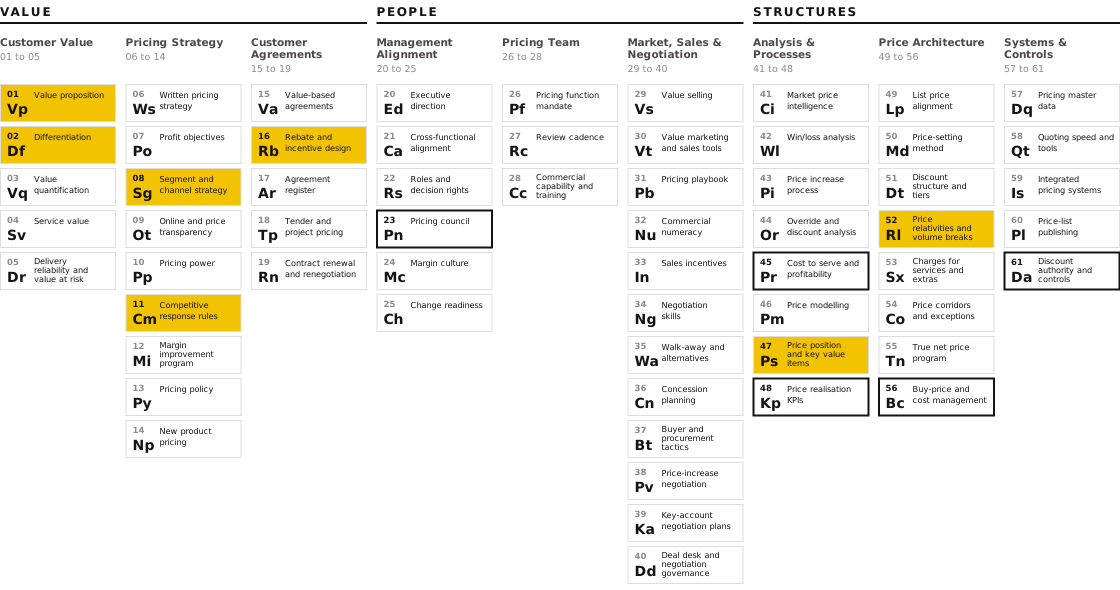
The Pricing Periodic Table sets out 61 elements of pricing capability in nine domains, across Value, People and Structures. Seven are built by the lessons in this paper: 01 Vp Value proposition (membership value that is enhanced as fees rise), 02 Df Differentiation (private label and a limited range), 08 Sg Segment and channel strategy (members, business members and tiers), 16 Rb Rebate and incentive design (cashback rewards earned by spend), 47 Ps Price position and key value items (consistent pricing on popular items), 52 Rl Price relativities and volume breaks (bulk packs and bundles) and 11 Cm Competitive response rules (when to match and when not to). Five are depended on: 56 Bc Buy-price and cost management carries the supplier terms a narrow range earns, 45 Pr Cost to serve and profitability shows what a low-cost store saves, 61 Da Discount authority and controls and 48 Kp Price realisation KPIs keep promotions deliberate and measured, and 23 Pn Pricing council governs the decisions, as the Pricing Capability & Governance work described below sets up.
Each client case maps onto these elements. King Living built 52 Rl, consistent steps between configurations, on top of 01 Vp. Flannerys built 47 Ps by holding price on the lines shoppers compare and moving it on the rest. Super Retail Group put 61 Da and 48 Kp across four brands. Mitre 10’s recommendations pair 11 Cm, floors on price-matched lines, with 23 Pn, a Pricing Council to govern one strategy across more than 80 stores.
09Frequently asked questions
How do I set up pricing governance and discount approval rules?
Name who owns each price decision, set discount and markdown approvals by size and margin, set price floors for lines that are matched or promoted, and give a Pricing Council the review of exceptions and results. Pricing Capability & Governance sets these roles and rules. At Super Retail Group, markdown governance and discount control across four brands reduced ad hoc discounting by up to 50 per cent, a realised result.
How do I measure price leakage in my business?
Compare the price on the list or shelf with the price actually realised, line by line, and attribute the gap to its cause: promotions, markdowns, price matches, discounts and free services. Report it monthly by brand, store and category. At Mitre 10 the diagnostic found price-match sales below cost and about 80 national trade matrices, and identified more than A$10m of margin opportunity, an identified figure, not a result.
My margins are shrinking. What should I do about pricing?
Find out where margin is going before changing any price: which promotions earn their cost, which lines shoppers compare, and where discounts are given without approval. Then move price selectively rather than across the board. Flannerys took over A$1.0m of incremental gross margin, realised, by raising price where the evidence supported it and holding it on the lines shoppers compare.
How do I pass on a price increase without losing customers?
Show what the customer gets for the higher price, as Costco did when it added cashback rewards and exclusive products while membership fees rose. Allocate the increase line by line by how closely each line is compared, rather than one percentage across the range, and keep the price steps between related products consistent. King Living’s A$4.1m of incremental EBITDA, realised, came from those relationships rather than a single percentage increase.
What is pricing power and how do I measure it by customer?
Pricing power is the ability to hold or raise price without losing the volume that matters. Measure it by segment and line: the spread of realised price for the same product, the lines where competitors set the reference, and the share of sales that needs a discount to close. Costco’s membership fees, US$3.35 billion in 2019 according to public reporting, show customers paying for access before they buy anything.
10How Pricing Insight helps
Costco’s example suggests that promotional choices need to support customer value without weakening price discipline. Pricing Capability & Governance helps retailers put that principle into practice by setting pricing roles and decision rights, defining discount approvals and price floors, and establishing a Pricing Council so promotional decisions are governed consistently.
The work runs in three stages, each drawing on evidence from the client’s own transactions. Pricing Insight has completed 160+ engagements, and price optimisation programs return between 5 and 10 times their cost in year 1.
Diagnose
Realised prices by line, store and brand against list and shelf prices, every promotion and markdown with its take-up and return, and the lines shoppers compare, through the Strategic EBIT Opportunity & Risk Diagnostic, sized against a baseline finance accepts.
Optimise
Price position on key value items, consistent steps between related products and pack sizes, and promotions with floors and measured returns. The EBITDA Improvement Program sets line-level prices by elasticity, with a revised price file for upload.
Transform
Pricing roles, decision rights, discount approvals, price floors and a Pricing Council through Pricing Capability & Governance, with buyers and store teams trained to price and negotiate on value through Negotiation Training & Value-Based Selling.
Which of your promotions earned their cost last quarter, and which only moved volume?
A first conversation establishes how this applies in your business and whether a diagnostic is warranted. Ron Wood, +61 410 534 099.
Ron Wood is the Founder and Managing Director of Pricing Insight, an Australian pricing strategy consultancy he established in 2007. He has worked in pricing for 30 years, first as a pricing and commercial manager in consumer goods, building materials and capital equipment, and since then across 160+ engagements in Australia, New Zealand, South East Asia, India, the United States and the United Kingdom. He also founded Pricing University and is the author of the Pricing Periodic Table, CXO Edition.
To discuss your pricing and promotional strategy, contact Ron Wood at info@pricinginsight.com.au or on +61 410 534 099, or visit Pricing Insight.
Costco figures (net sales, membership fees, mark-up and margin) are from public reporting, in US dollars, and have not been verified by Pricing Insight; the three Costco examples are commentary on public information and report no figures. King Living, Flannerys and Super Retail Group figures are realised results as published in Pricing Insight case studies. The Mitre 10 figure is an identified opportunity, not a result. Staff are quoted by role only. Results are as reported by Pricing Insight and have not been independently audited. No figure in this paper is typical or guaranteed.