

White paper · Transform · 15 min read
Sources: public aviation and shipping safety documents, and Pricing Insight client work. Clients are described by industry, not named.
Pricing can be run the way airlines and shipping companies run safety: published limits, fixed decision points, a licence before authority, an independent monitor with a direct line to the top, and every operation recorded and reviewed. This paper sets out five of those controls, maps each to the Pricing Periodic Table, Pricing Insight's map of the 61 elements of pricing capability, and ends with a 90-day plan.
The question this paper answers
How would a B2B business set, clear, monitor and license its prices if it ran pricing the way airlines and shipping companies run safety?
Key takeaways
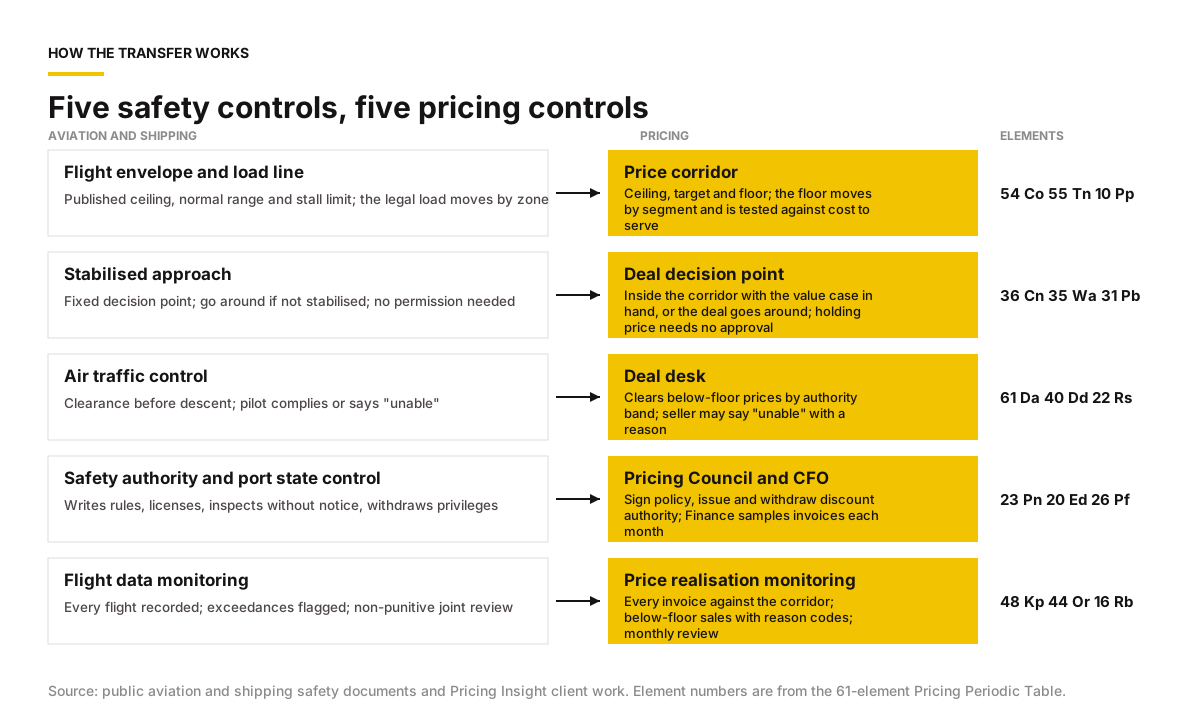
- The flight envelope becomes a price corridor, with a floor that moves by segment and is tested against cost to serve.
- The stabilised approach becomes a deal decision point: inside the corridor with a value case in hand, or the deal goes around. Holding price never needs approval.
- Air traffic control becomes the deal desk, which clears below-floor prices by authority band.
- Flight data monitoring becomes price realisation monitoring: every invoice against the corridor, every below-floor sale with a reason code, reviewed monthly.
01Start from the same failure: what the manuals contain
Three documents run an airline or a ship. The flight manual sets the limits. Standard operating procedures fix the decision points at which the crew continues or goes around. A safety management system makes sure both are followed by people who are busy, under pressure and sometimes tired. Shipping has the same three: the load line on the hull, the passage plan, and the safety management system every shipping company must run under the ISM Code.
Most B2B businesses have none of the three for price. In Pricing Insight's client work, a foodservice packaging supplier found that only about one in five tested sales met its own price guide, and two building-products makers found that only about 80 per cent of each planned price increase reached the invoice. Neither gap came from not knowing the right price. Both are failures of limits, decision points and oversight.
One point settles the usual objection, that safety allows no trade-off and pricing does. The UN aviation body ICAO's own training teaches the management dilemma as production against protection, with bankruptcy at one extreme and catastrophe at the other. A pricing system that pretends volume and margin never conflict will not be followed. One that names the conflict and publishes the limit can be.
02Set the limits: the flight envelope and the load line
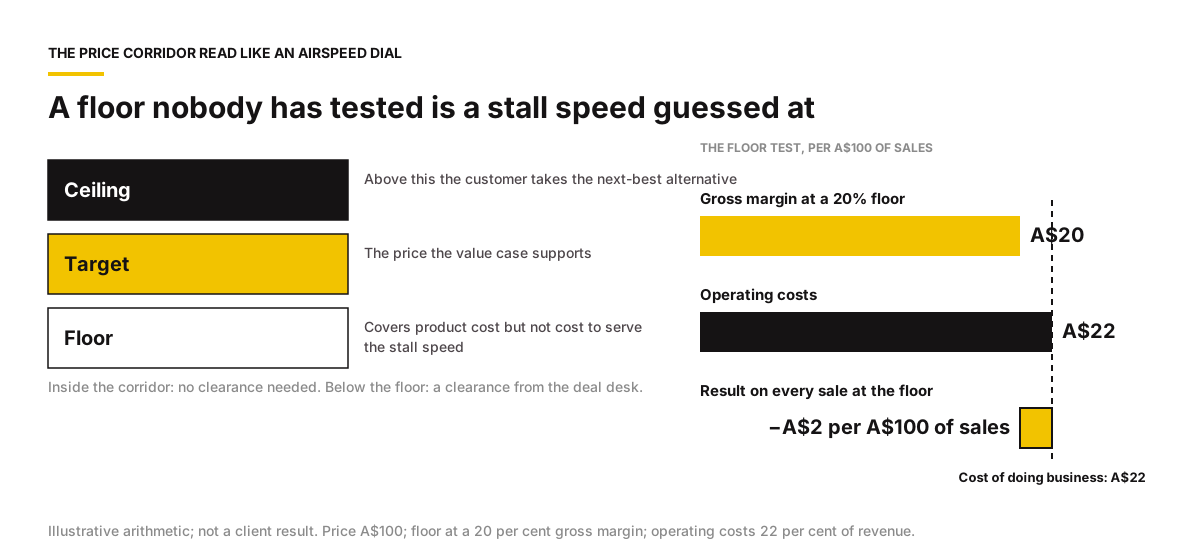
Three speeds on one dial, placarded in the cockpit. The airspeed indicator carries a red line, called VNE, beyond which the airframe can be damaged, a yellow arc for smooth air only, and a green arc from the stall speed up to the normal limit.
A price corridor does the same job. The ceiling is the price above which the customer takes the next-best alternative. The target is the price the value case supports. The floor is the price below which the sale covers its product cost but not its cost to serve, and the floor is the stall speed. On illustrative figures, a floor set at a 20 per cent gross margin in a business with operating costs of 22 per cent of revenue loses A$2 on every A$100 sold at the floor. A floor nobody has tested against the full cost of doing business is a stall speed guessed at.
Shipping adds the second idea. The load line carries separate marks for tropical, summer and winter water, because the same hull can safely carry less where the weather is worse. One flat floor for every customer is one load line for every ocean. The floor sits higher where pricing power is strong and delivery is reliable, and lower only where the business has decided, in writing, to compete on price. One Pricing Insight client, a medical consumables maker, set its annual increase at about 4.5, 3.7 and 3.1 per cent by customer tier, with the largest increase where its pricing power was strongest (projected).
03Fix the decision point: the stabilised approach to a deal
One rule with a number in it. The Flight Safety Foundation's criteria require every flight to be stabilised by 1,000 feet in instrument conditions and 500 feet in visual conditions. An approach not stabilised at that point requires an immediate go-around, and many operators run no-fault go-around policies.
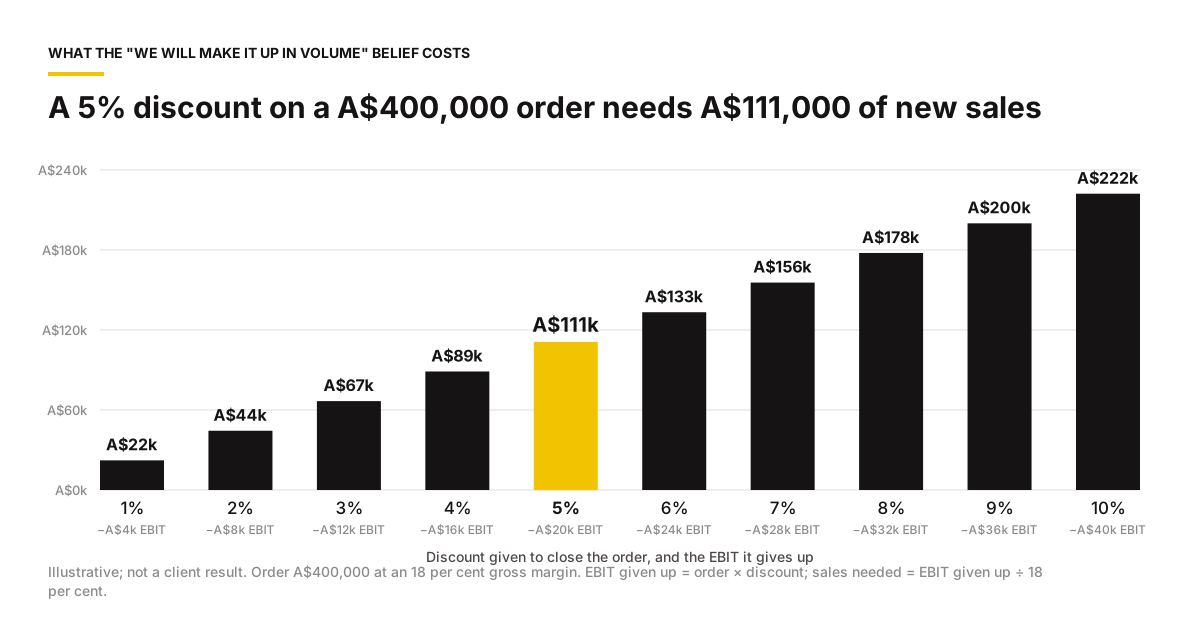
Compliance is the useful part. A NASA and FAA study found that only 3 per cent of unstable approaches end in a go-around, for two reasons: criteria too complex, and the belief that the approach can still be corrected. Deal rules fail for the same two reasons: too many conditions, and a seller who believes the discount will be earned back in volume. That belief has a price. On illustrative figures, a 5 per cent discount to close a A$400,000 order at an 18 per cent gross margin costs about A$20,000 of EBIT, and recovering it at the same margin needs about A$111,000 of extra sales.
A deal decision point in the same form. Before price is discussed with a buyer, the seller holds five things:
- the target price, the floor and what a discount costs;
- the value case from the Customer Value Discovery canvas;
- whether the rival quote is like for like;
- the list of trades, each priced;
- the walk-away price and the backing to use it.
If the deal is not inside the corridor with those five in hand, the deal goes around: back to the value case, across to the deal desk, or out to the walk-away. Holding price, like the go-around, needs no approval. The concession does. The sterile cockpit rule becomes price last: no price discussion before the value case, and concessions offered from cheapest to dearest.
04Clear the price: the deal desk as air traffic control
Two authorities in the air, and one rule between them. The pilot in command is the final authority for the aircraft. Air traffic control issues clearances, and once accepted the pilot may not deviate without an amended clearance or an emergency. The pilot can see the aircraft; the controller can see the traffic.
The seller and the deal desk sit the same way. The account manager sees the customer: the relationship and the rival quote. The deal desk sees the traffic: every other quote to that customer group, the margin already given away this quarter, and the precedent a price sets. One Pricing Insight client case, a particleboard flooring maker, is a collision a controller would have seen coming. One account manager's low prices to one hardware store became a 15 per cent shelf-price cut across a national chain, from A$42.24 to A$36.00 a sheet, and about A$2.0 million of EBIT was lost in two months against extra sales worth less than A$50,000 (realised). The business had no written price strategy for the product, no control to stop a price going below the floor, and nobody watching the traffic.
A clearance is the mechanism. A quote inside the corridor needs none. A quote below the floor needs a clearance from the band the authority matrix names, and once given, the clearance is the price. Every exception carries a reason code and appears in the monthly report.
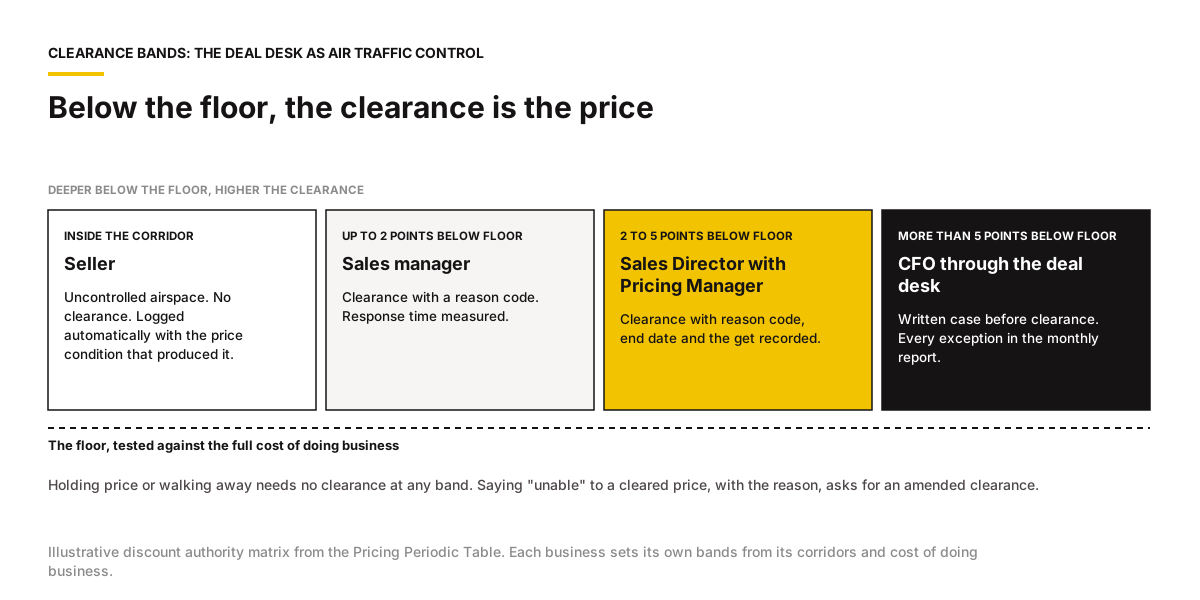
Saying "unable" carries as much weight as complying. A pilot given a clearance they cannot safely fly says so and asks for an amended clearance; a seller given a cleared price that will lose the account does the same. A deal desk that can only say no is a second floor, not a controller. One Pricing Insight client, a New Zealand sales team, produced its negotiation pack for a A$6 million account in about two minutes and realised an 8 per cent increase, about A$480,000 a year (annualised).
05Write the rules, license and inspect: the safety authorities
Three layers of authority, and a fourth body outside them. ICAO writes the standards and audits each country. The national regulator, CASA in Australia, issues licences, watches the holders and withdraws privileges. In shipping, the country of registry certifies the company and each ship, and port inspectors board foreign ships without notice and detain those with serious deficiencies: 731 ships were detained in the Asia-Pacific region for safety management failures between 2015 and 2017.
A pricing authority with the same layers. The written pricing policy and the 61-element scorecard are the standard. The Pricing Council, chaired by the managing director with the CFO owning the limits, is the regulator: it signs the policy, issues discount authority and withdraws it from anyone who prices below the floor without a clearance. Finance is the port inspector: an unannounced sample of 50 invoices checked against the corridor each month, with authority to hold a price list until corrected. A failed sample triggers the full review.
Two maritime features carry across. Certification sits at two levels, company and ship, so a branch whose invoices fail inspection loses its own discount authority without the others losing theirs. The accident investigator is independent of both and publishes findings without blame. The pricing equivalent reviews every major account lost and every large below-floor deal, asks what the system allowed rather than who to blame, and publishes the lesson. A business that gives all of these jobs to the Pricing Manager has one layer marking its own work.
06Earn the licence to price: the authority ladder
Five conditions, none optional. A pilot licence needs a current medical, a theory exam, flight training, minimum hours and a flight test. Authority rises by level up to the airline transport licence, which generally requires 1,500 hours, and privileges lapse without a flight review every 24 months.
Most B2B sellers hold discount authority on the strength of time in the industry, the one qualification a licence system does not recognise. At a New Zealand rural supplies co-operative, the sales team with the most freedom over price could not work out what a discount costs. The professional buyer across the table has usually been trained.
| Level | Privileges | Theory exam | Supervised experience | Check ride | Recurrency |
|---|---|---|---|---|---|
| 1. Quote | Quote inside the corridor; no discount authority | Pricing maths: margin against mark-up, cost of a discount | First 20 quotes reviewed by a Level 3 holder | One observed customer conversation | Annual maths re-test |
| 2. Negotiate | Discount authority to the floor; concession planning | Value selling, give-get, buyer and procurement tactics | 10 negotiations prepared with a Level 3 holder | Observed negotiation with a prepared pack | Annual, plus review of below-floor requests |
| 3. Command | Key accounts, price increases, below-floor requests | Pricing power, agreement and rebate design, price-increase process | Two full price-increase rounds | A director-level price-increase negotiation | Every 24 months, matching the flight review |
| 4. Examiner | Pricing Manager; tests Levels 1 to 3; signs clearances | The full 61-element scorecard | Three years at Level 3 (proposed) | Pricing Council appointment | Annual scorecard review with the Council |
Exhibit 1. A licence to price in four levels. Proposed structure; hours and test content are for the business to set.
Three rules carry the licence. Authority follows the licence, not the title: a sales director without Level 2 has no discount authority. The licence lapses: a missed recurrency removes the authority band in the quoting system. The Council reviews the register. One Pricing Insight client, a building-materials group, put its whole commercial team through a structured pricing course and realised about 4 percentage points of margin expansion over the program, with the caveat that price moves in the same period were not separated out.
07Run the management system: four components for margin
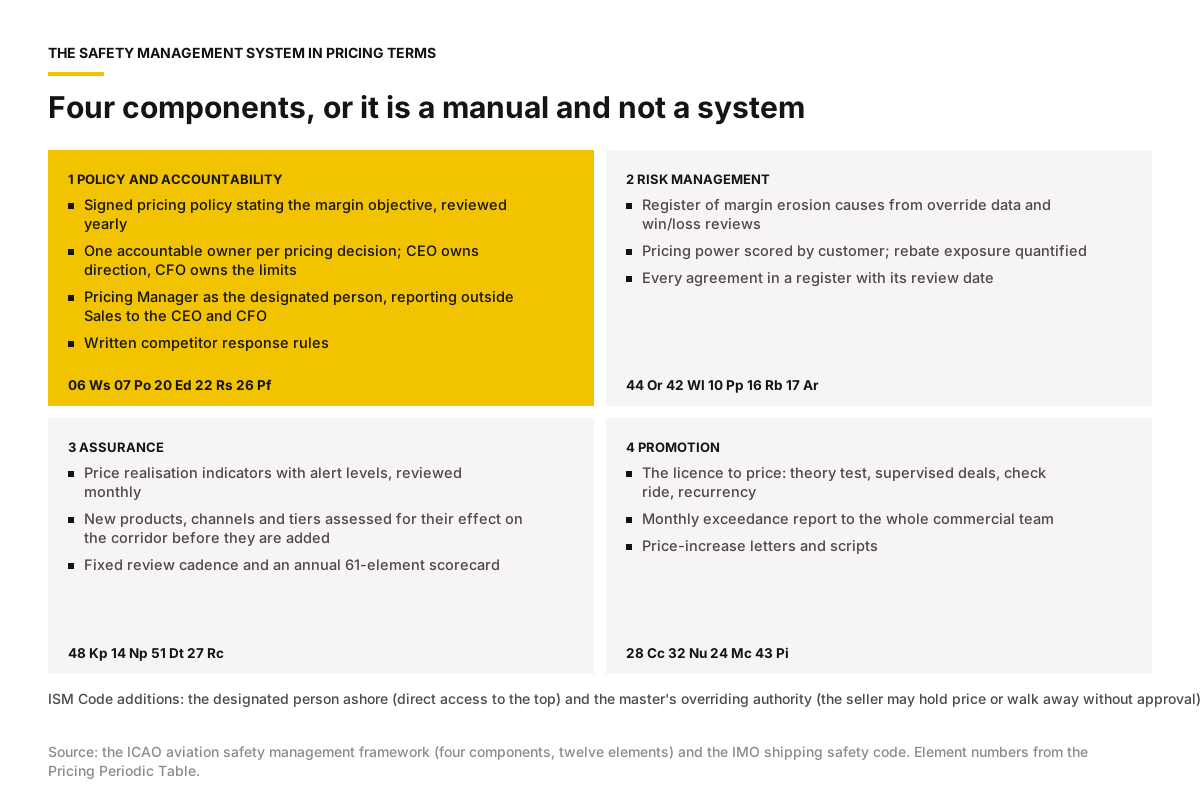
Four components and twelve elements. The aviation safety management framework has four parts: policy and accountability, risk management, assurance, and promotion. Shipping adds two devices: a designated person ashore with direct access to the top of the company, and the master's overriding authority on safety, written into the system.
Figure 5 places each component in pricing terms. The Periodic Table already holds every one; what the framework adds is the order they are built in and the insistence that all four exist. A business with limits and no monitoring, or training and no accountability, has a manual and not a system.
The Council is the meeting where the system runs: monthly, chaired by the managing director. Pricing Insight recommended exactly this at a foodservice packaging supplier, with a target of 95 per cent or more of below-floor prices carrying an approval and a reason; no result has been reported for it yet. A safety manager who reports through the operations director reports to the person whose schedule pressure created the hazard; a Pricing Manager who reports to the Sales Director sits in the same position.
08Record every invoice: flight data for pricing
Every flight, not only the ones that went wrong. Under flight data monitoring, recorders capture hundreds of parameters on every flight, software flags exceedances, and a joint team of airline and pilot representatives reviews the trends. The data is non-punitive.
Most businesses already hold this data. Joining the invoice file to the price file gives the exceedance record: every line below the floor, every line below its tier, and every customer whose price has drifted from the agreed price. A fixed set of customer-product pairs strips out volume and mix, so the gap shows price alone.
Three features to copy. Alert levels set from history, so an unusual month triggers a review. A cross-functional review: Sales, Finance and the Pricing Manager read the report together. And the non-punitive rule: a seller who records "approved exception, deal desk reference 0421" is not disciplined for the exception; a seller who records nothing is.
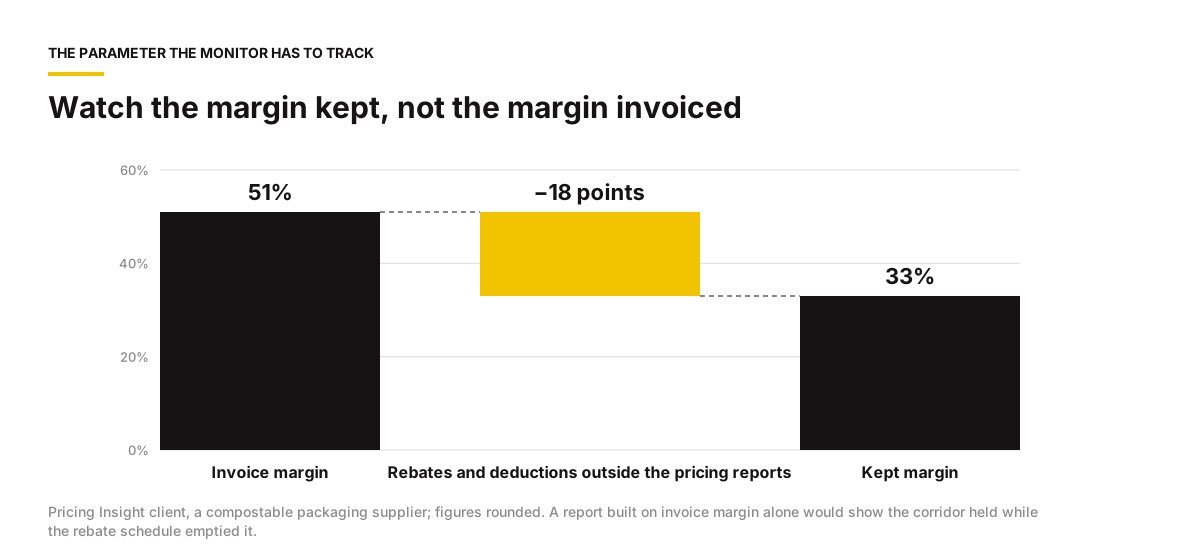
One caution. Watch the price kept after every deduction, not the invoice price. One Pricing Insight client, a compostable packaging supplier, recorded an invoice margin of about 51 per cent and a kept margin of about 33 per cent, an 18-point gap built up in a rebate schedule outside the reports used by the people who set prices.
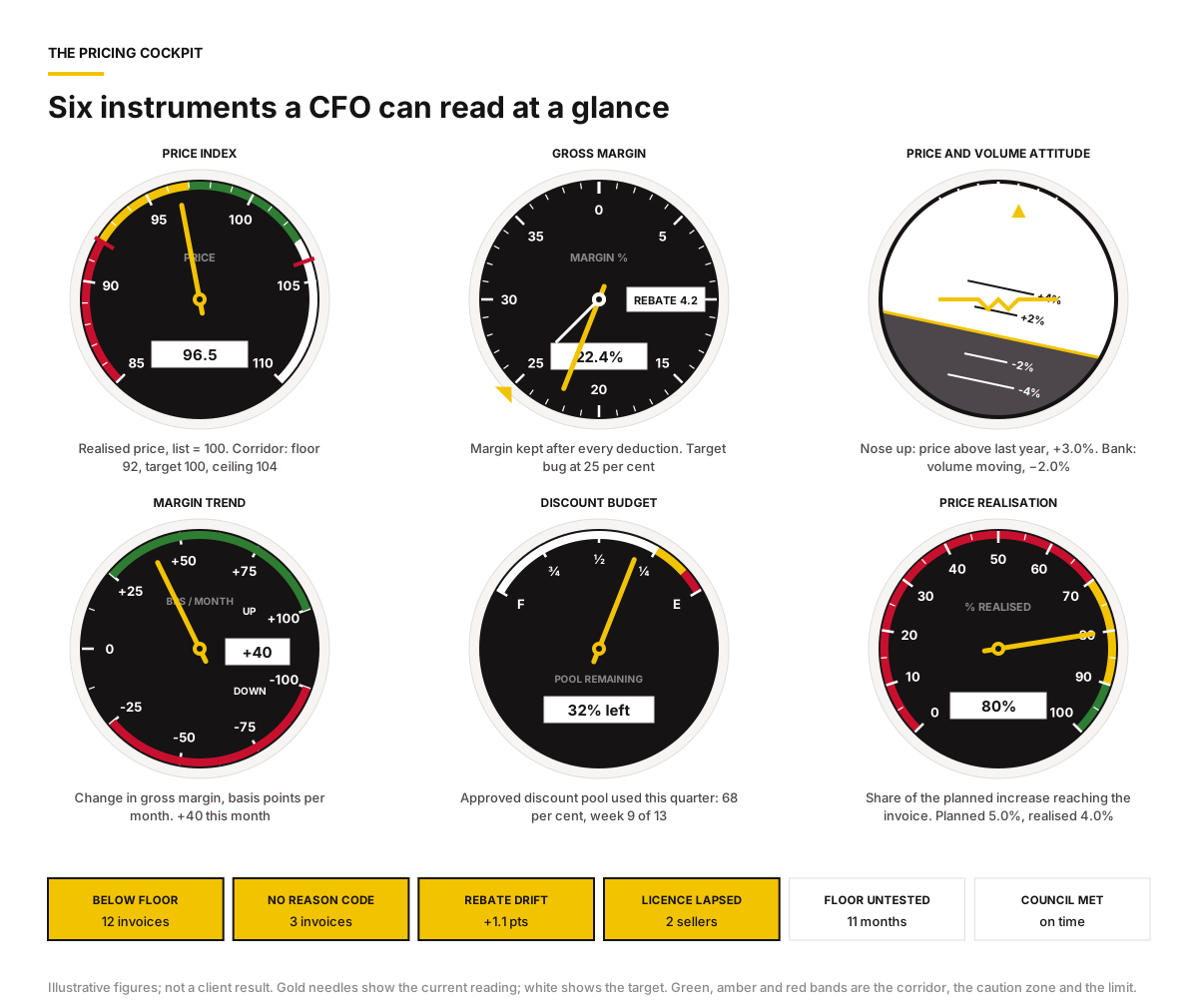
09Know where the analogy breaks
Four places. The limit is not physics. The red line is set by the airframe; a floor is set by the CFO and can be wrong in either direction. Too low, it loses money on every sale at the floor. Too high, it sends every deal to the deal desk, and volume defeats the control. So the floor is tested each year and the Council signs it.
The accident is slow. A hull loss is immediate and visible; margin lost to a point of extra discounting shows in no report until profit has fallen. Pricing has no crashes, only drift, so monitoring carries more weight here than in aviation.
The operator is also the salesperson. A pilot has no incentive to fly past the red line. A seller paid on revenue has an incentive to price below the floor, and a matrix alone will not hold against a commission plan. Paying licence holders on margin is part of the control.
The buyer is trained and adversarial. Weather does not negotiate; procurement does. Negotiation preparation is the passage plan: an appraisal of the customer before the voyage, including where the deal desk or a senior-to-senior call will be needed.
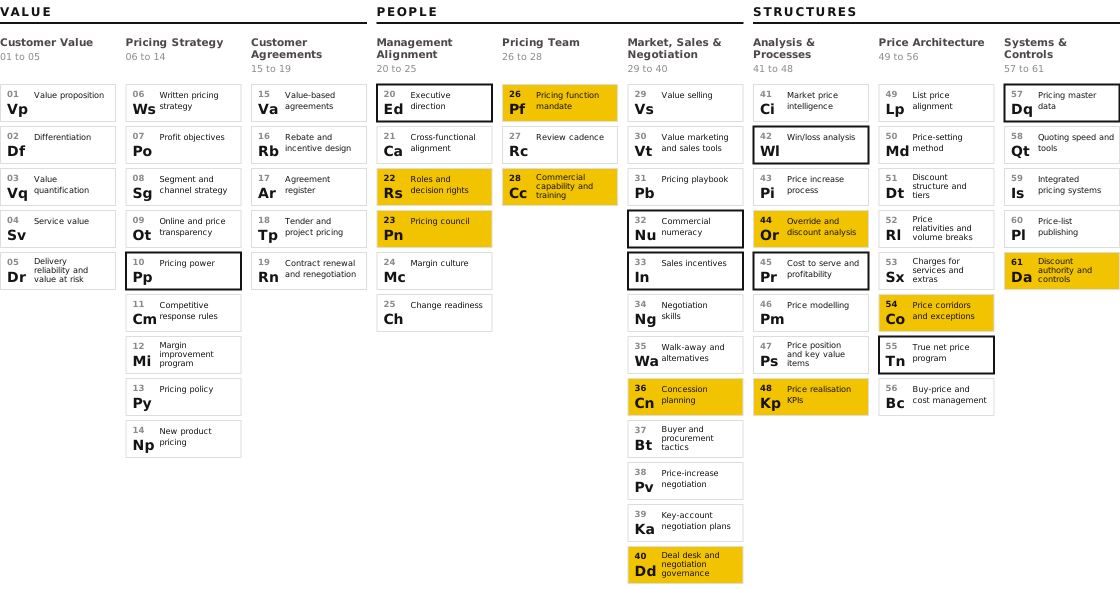
10The Pricing Periodic Table elements this paper builds
Ten elements built, eight depended on. The three pillars are covered unevenly. Aviation and shipping have little to say about the Value pillar, because the value of a safe flight is not in dispute, and a great deal to say about People and Structures, where the gaps Pricing Insight finds most often in its diagnostics sit. Value proposition and Value quantification remain the business's own work: a corridor is only as sound as the value case that sets its target.
11Start in the first 90 days
Six actions, each with one owner, in the order the safety framework builds them: accountability, limits, monitoring, then licence and inspection.
Write down who sets list price, who approves a discount below the floor and who designs rebates. Appoint the Pricing Manager as the designated person, with direct access to the CEO and CFO.
Test the lowest authority band against the full cost of doing business, and publish the corridor by segment, with a lower floor where delivery performance does not support the premium.
Build the exceedance report: every invoice line below the floor and below its tier for the last 12 months, by seller and approver, with reason codes where they exist. The share of below-floor prices carrying an approval and a reason is the first assurance indicator; 95 per cent is the first alert level.
List everyone with discount authority and mark who has had formal pricing training and passed a pricing maths test. This is the licence register. Anyone with authority and no test sits at Level 1 until tested.
Write the deal decision point and the clearance bands into the quoting tool, so the system enforces the corridor. Close every route around it: direct loads, counter overrides, manual invoices.
Run the first unannounced inspection: 50 invoices against the corridor and the price file, reported to the Council with the exceedance report. A failed sample triggers the full review of that branch.
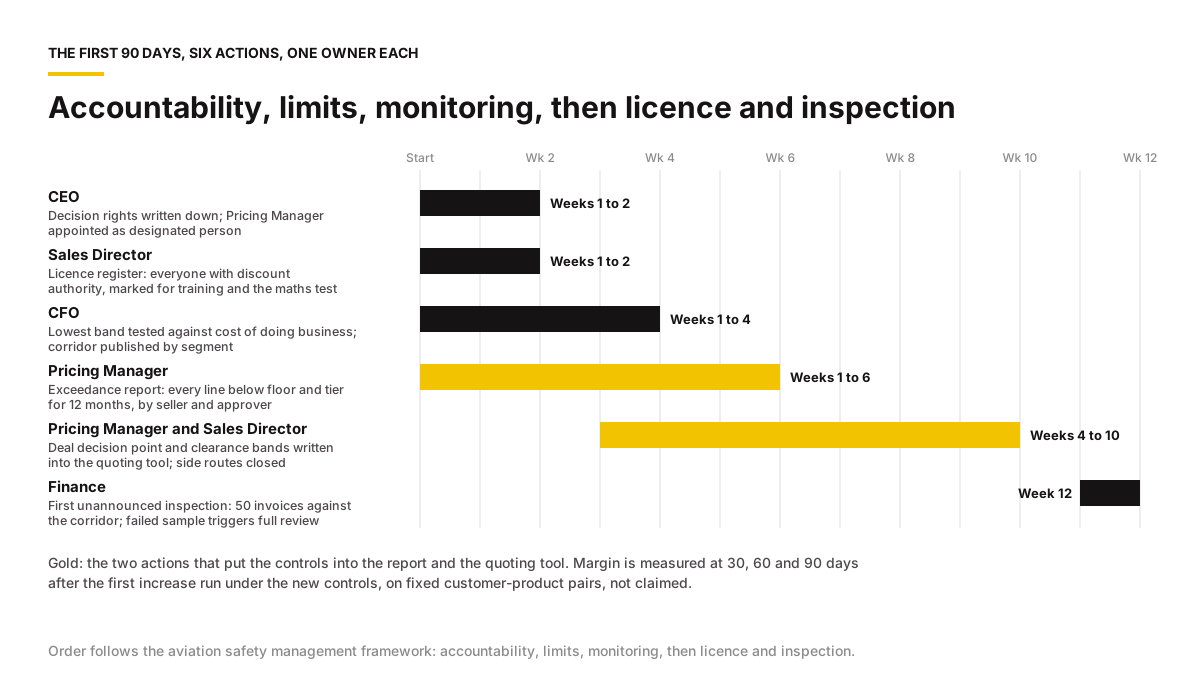
What the plan does not do in 90 days. The full licence ladder belongs in months four to twelve, and no margin result is reported: margin is measured at 30, 60 and 90 days after the first increase under the new controls, and labelled realised only when the invoices show it.
12How Pricing Insight helps
160+ engagements; price optimisation programs return between 5 and 10 times their cost in year 1.
Diagnose
The exceedance record from twelve months of invoices and a governance assessment against the 61 elements: the Strategic EBIT Opportunity & Risk Diagnostic.
Optimise
Corridors by segment, clearance bands and floors designed from the evidence and written as the quoting system's rules: the EBITDA Improvement Program.
Transform
The Pricing Council constituted and the exceedance report running: Pricing Capability & Governance. The licence to price built from Pricing University and Negotiation Training & Value-Based Selling.
Does every price below your floor carry a clearance, a reason code and a name, and who checked last month?
A first conversation covers the corridor, the clearance bands and the monitoring. Ron Wood, +61 410 534 099.
Ron Wood is the Founder and Managing Director of Pricing Insight, established in 2007. He has worked in pricing for 30 years across 160+ engagements, founded Pricing University, and is the author of the Pricing Periodic Table. Contact him at info@pricinginsight.com.au or on +61 410 534 099.
Client examples come from Pricing Insight diagnostic and training engagements and are described by industry only. Each figure carries its status: realised, annualised, projected or illustrative. Results are as reported by Pricing Insight and not independently audited. None is typical or guaranteed. The clearance bands and the licence levels are proposed structures. Figures 2, 3, 4 and 7 are illustrative. Aviation and shipping material is from FAA, ICAO, IMO, CASA, Flight Safety Foundation and NASA public documents; Pricing Insight claims no expertise in aviation or maritime operations.