
White paper · Optimise · 22 min read
Sources: Fletcher Insulation, Tradelink and Mitre 10 case studies published on pricinginsight.com. The Fletcher Insulation figure is a realised result as recorded from the engagement; the Tradelink and Mitre 10 figures are identified opportunities, not results. None is independently audited, and none is a benchmark for another business.
A building materials contract with a generous rebate can still make good money. It stops making money when nobody connects the rebate to what the customer does, to the written agreement and to the invoice discounts given on top of it. This paper sets out how manufacturers and distributors redesign rebates so each pays for itself, and control invoice discounts so a branch cannot give away the margin the contract was built to keep.
The question this paper answers
How do I redesign customer rebates and trade discounts so that every rebate pays for itself, and an extra invoice discount never turns a profitable contract into a loss?
Key takeaways
- An active rebate pays only when the customer meets a measurable condition: growth, mix, range, payment terms, order size or cost to serve. A passive rebate pays regardless.
- A self-liquidating rebate is paid only from the extra margin created by growth above a signed baseline.
- Margin after rebate belongs on the quoting screen and the head-office margin report, and every rebate sits in a written agreement redesigned at renewal.
- Invoice discount floors are set on margin after the rebate, or they will approve discounts that make the contract unprofitable.
Five Pricing Insight clients in building materials show what this work is worth: Fletcher Insulation, Stramit, Tradelink, Mitre 10 and a cabinet and architectural hardware distributor, each in the same six-part form, from the problem to the Pricing Periodic Table elements the work built.
The return-on-rebate test is set out in Trade Rebates That Pay for Value, Not Volume, the agreement register in Agreements That Protect Margin, and discount leakage across a whole business in How to Reduce Discount Leakage in Building Materials Businesses. This paper builds on them.
01A passive rebate is a price cut paid after the invoice, and an active rebate pays only for what the customer does
Three kinds of rebate. Most building materials businesses run all three without naming them. A passive rebate is a fixed percentage of purchases, paid from the first dollar and rolled over each year. It is simple to agree and simple to pay, and it is a permanent price cut that never appears on the invoice.
An active rebate, often called a performance-based rebate, pays only when the customer meets a condition both sides can measure: more spend, a better mix, a wider range, prompt payment, full-pack orders, fewer urgent drops. If the customer does not meet it, the rebate is not paid. A self-liquidating rebate is an active rebate paid only on purchases above a baseline, at a rate below the margin each extra dollar earns, so the growth funds it.
| Passive rebate | Active rebate | Self-liquidating rebate | |
|---|---|---|---|
| What it pays for | Purchases, whatever they are | A measurable condition the customer meets | Growth above a signed baseline |
| When it is paid | Every period, from the first dollar | Only when the condition is met and checked | Only on purchases above the baseline |
| Cost if the customer shrinks | Still paid | Not paid | Nothing |
| What the seller needs to see | The rate | The rate, the condition and progress against it | The baseline, progress and the rebate earned so far |
Exhibit 1. Three kinds of rebate. The redesign moves rebate money from the first column into the second and third. Source: Pricing Periodic Table, CXO Edition, Chapter 3, and Pricing Insight diagnostic work.
At Mitre 10, a staff member said customer rebates were “Very few and those that do have largely been flat rebates vs tiered”. At Stramit, one described “agreements whereby the customer gets a general rebate on all sales from dollar one”, while another said “Rebates are focused on growth through tiers and stretch targets.” Both designs were live in one company.
Fletcher Insulation
Insulation manufacturing · 250 basis points of gross margin, about A$2.25m annualised EBITDA · Realised
| Client and problem | Most Fletcher Insulation customers were individually priced, with no base list price, and for many the only formal agreement was a rebate agreement. A staff member said: “The rebates are structured to gain volume not profit”. |
| Challenge | Payments were not tied to what customers earned the business: a staff member reported advertising support to one customer that exceeded the gross profit earned from it. With no list price, there was no reference point to show what a rebate or discount cost. |
| What Pricing Insight did | A 2020 pricing capability diagnostic located gaps in price architecture, discount control and pricing resources and sized an EBIT opportunity of A$2.2m to A$2.5m. Ninety-six staff completed Pricing University’s Pricing Fundamentals, and the business built a new pricing structure, raised prices and reduced discounting. |
| Outcome | 250 basis points of incremental gross margin, an annualised run-rate of about A$2.25m to EBITDA, a realised result as recorded from the engagement. The diagnostic figure is an identified opportunity. |
| Benefit to the client | A reference price from which every concession is measured, and less margin paid away without a return, which lowers exposure to payments that exceed what an account earns. |
| Periodic Table elements built | 16 Rb Rebate and incentive design; 49 Lp List price alignment; 61 Da Discount authority and controls; 28 Cc Commercial capability and training. |
02A self-liquidating rebate is paid only from the extra margin it creates, so a customer that does not grow costs nothing
One baseline, signed before the offer. The baseline is the customer’s purchases over the last twelve months, agreed with finance and written into the agreement. Only purchases above it earn the growth rebate. The example uses one contract that recurs through this paper: a builder or merchant buying A$2,000,000 a year at a 30 per cent invoice gross margin, with a 9 per cent base rebate and a growth tier of 3 points on purchases above A$2,000,000.
| Falls to A$1.8m | Stays at A$2.0m | Grows to A$2.3m | |
|---|---|---|---|
| Purchases above the baseline | Nil | Nil | A$300,000 |
| Invoice gross margin on the increase, at 30 per cent | Nil | Nil | A$90,000 |
| Base rebate on the increase, at 9 per cent | Nil | Nil | A$27,000 |
| Extra delivery and handling, assumed at 8 per cent | Nil | Nil | A$24,000 |
| Margin the growth creates | Nil | Nil | A$39,000 |
| Growth rebate, 3 points on the increase | Nil | Nil | A$9,000 |
| Margin the business keeps from the growth | Nil | Nil | A$30,000 |
Exhibit 2. A growth tier that pays for itself: it takes A$9,000 of the A$39,000 the growth creates and costs nothing otherwise. It stays self-liquidating while its rate is below 13 points (30 less 9 less 8). Illustrative arithmetic; not a client result.
Three design rules follow. The baseline is the customer’s own recent spend, not a figure it would reach without buying differently. The growth rate is set from margin, so a tier on a thin-margin line is smaller than one on a high-margin range. And the base rebate is reviewed at renewal, because 9 per cent paid on falling spend is still a passive rebate. A customer used to its flat rate treats it as an entitlement, so the conversion offers a way to earn the same or more through growth, range or mix.
Stramit
Steel roofing and building products · A$4m to A$7.5m annual EBIT opportunity · Identified
| Client and problem | Stramit’s pricing diagnostic found legacy flat and settlement rebates paid from the first dollar. A staff member described “flat rebates out there still which don’t force the customer to commit to us”. |
| Challenge | Rebates were agreed with distributors at head-office level, but branch staff could not see them. “The Branch Assistants at Store Levels, do not know what rebates are behind a price,” a staff member said, so invoice discounts were given on top of rebates already being paid. |
| What Pricing Insight did | A pricing capability diagnostic across all nine domains, customer agreements among them, then work to align sales and leadership on pricing priorities and rebuild pricing capability. Volume-tiered rebates reviewed each quarter were already working in parts of the business. |
| Outcome | An A$4m to A$7.5m annual EBIT opportunity identified, as published. Identified, not realised. |
| Benefit to the client | A growth-based design already proven inside the business to replace first-dollar rebates, and a named cause for discounts stacked on head-office rebates, which lowers the risk of paying twice for one sale. |
| Periodic Table elements built | 16 Rb Rebate and incentive design; 17 Ar Agreement register; 55 Tn True net price program; 15 Va Value-based agreements. |
03Rebate tiers pay for six conditions a building materials business can measure
Six conditions, each with a number behind it. If the business cannot report the measure by customer each month from its own system, the tier is paid on trust, and a rebate paid on trust drifts back to passive. One or two conditions per account, chosen from what the account can change, do more than a long schedule nobody checks.
| Condition | What the customer does | What the business measures | Example tier |
|---|---|---|---|
| Growth | Buys more than its signed baseline | Total purchases against the baseline | Extra points above the baseline |
| Mix | Buys more of the higher-margin lines | Share of spend in named product groups | Rebate paid on the named range only |
| Range | Buys across more categories | Number of categories bought each quarter | A step for each extra category held |
| Payment terms | Pays on time | Days paid against the agreed terms | Paid only if invoices are paid within terms |
| Order size | Orders full packs and full loads | Average order value and drops per month | A step above an agreed drop value |
| Cost to serve | Fewer split deliveries, returns and credits | Urgent drops, returns and credits per A$100,000 | A step below an agreed event rate |
Exhibit 3. Six measurable conditions for rebate tiers. Each condition is reported by customer from the business’s own transaction data before a tier is offered. Source: Pricing Periodic Table, CXO Edition, Chapters 3 and 9; Pricing Insight diagnostic work.
Staff propose these designs unprompted. A timber distribution leader quoted in the CXO Edition suggested a cladding target: “hit 20000m2 get $1 m2 back, rather than just give them the $1 for every m2 they buy.” Colleagues proposed paying rebates only when the customer pays within terms. At Tradelink, a staff member recommended rebate agreements “with commitment to high margin product”.
Cost to serve is the condition most often left out, and in building materials it is often the largest. Part packs, urgent drops, crane lifts and goods collected back from site are booked to freight and warehouse accounts, not to the customer who caused them. The margin waterfall and cost to serve paper shows how to measure it by account.
04Rebate accruals and the true net price need to reach head office and the seller at the point of quote
Two people need the same number. Head office needs to see what each contract earns after the rebate, and the seller needs the same figure while the customer waits for a price. In most businesses neither has it, because the rebate sits in the finance ledger and the margin report shows the invoice.
The figure already exists. Under Australian accounting standard AASB 15, a volume rebate that applies once a threshold is met is variable consideration: the business estimates the rebate, recognises revenue net of it, holds a provision and updates the estimate as the customer buys, as Pitcher Partners set out in January 2026. That estimate belongs beside the invoice margin on the account’s margin report and on the quoting screen. Marn and Rosiello described the step down from invoice to pocket price in Harvard Business Review in 1992; building materials diagnostics show how seldom the rebate step reaches the people who set the price.
The fix is one view per account: invoice margin, rebate accrued to date, margin after rebate and margin after cost to serve, side by side. Supplier rebates belong in the same view, because the margin a seller protects depends on net cost as well as net price.
Three tests show it is in place. The seller sees the rebate rate, condition and rebate earned so far at the quote. The head-office report ranks accounts on margin after rebate. And each quarter finance reconciles the rebate accrued to the agreements on file; any gap is margin committed without a record.
Tradelink
Wholesale and distribution · 200+ branches · A$10.8m annualised margin opportunity · Identified
| Client and problem | Across more than 200 branches, supplier rebates and price support sat behind invoice cost. “Rebates are hidden and the Sales force at times are guessing what our real costs are,” a staff member said. |
| Challenge | Staff could not see customer rebate terms either: “how do you maximise the margin with the customer when you don’t know the rebate they receive”. Some special quotes went out at nil invoice margin on the assumption that rebates would cover them. |
| What Pricing Insight did | A pricing diagnostic across the branch network that set out where rebates, price support and overrides sat between list price and net cost, then work to replace overrides with structure and sales enablement. Target-based rebate agreements, which staff reported lifted share and margin where used, gave the business its own model. |
| Outcome | An A$10.8m annualised margin opportunity identified, as published. Identified, not realised. |
| Benefit to the client | A margin opportunity sized against named causes, including the gap between invoice and net margin, which reduces exposure to quotes whose only margin is an unchecked rebate. |
| Periodic Table elements built | 55 Tn True net price program; 16 Rb Rebate and incentive design; 57 Dq Pricing master data; 44 Or Override and discount analysis. |
Mitre 10
Hardware co-operative of more than 80 stores, New Zealand · Over A$10m margin opportunity · Identified
| Client and problem | Mitre 10 had no written trade pricing strategy, and each member store set its own discounts. Customer rebates were rare and mostly flat, and most customer “agreements” were the account application and standard terms. |
| Challenge | “Account managers have no visibility over supplier rebates,” a staff member said, and another: “We have no visibility on rebates so often use the least preferred supplier.” Store sell rates did not include those rebates, so the true margin on a trade quote was unknown when the price was set. |
| What Pricing Insight did | A pricing capability diagnostic across the support centre and member stores, then recommendations: one trade pricing strategy governed by a Pricing Council, customer discounts set by spend in place of static national matrices, and minimum price floors on price-matched lines. |
| Outcome | More than A$10m of margin opportunity identified across more than 80 stores, an identified figure; the strategy items are recommended and no realised result is public. |
| Benefit to the client | Once implemented, discounts tied to spend and floors that hold, which lowers exposure to trade prices set without the true margin in view. |
| Periodic Table elements built | 55 Tn True net price program; 16 Rb Rebate and incentive design; 51 Dt Discount structure and tiers; 23 Pn Pricing council. |
05A rebate belongs in the written agreement, with its conditions, its owner and its end date, and changes at renewal
One document, one set of terms. A rebate negotiated by a national account manager, recorded in a side letter and paid from a spreadsheet is three separate things. The written agreement joins them: price basis, rebate and condition, baseline, cap, claw-back, review date and end date.
At Stramit, a staff member said: “We rely on our customers to tell us an agreement number. If they don’t, we overcharge, resulting in a credit.” Laminex’s diagnostic found a project price in place since 2014, “effectively missing 6 annual price increases”.
Three rules hold the link. No rebate is paid unless it is in the agreement register. Every rebate has a named owner and an end date. And the person who sets up a rebate does not approve its payment. Renewal is where the redesign happens: two months before each end date, the account owner prepares the account’s economics after every rebate and invoice discount, whether the customer met its conditions, and the structure for the next term. A missed condition resets the rebate.
06Invoice discounts need a floor that includes the rebate, or one extra discount can turn a profitable contract into a loss
One contract, two readings. Additional invoice discounts undermine the profitability of a contract that already carries generous rebate terms, and the seller giving the discount usually cannot see it. Take the A$2,000,000 contract from section 02 and add one thing: a branch gives an extra 5 per cent off invoice to match a competitor quote.
| Contract, per year | As agreed | With an extra 5% invoice discount |
|---|---|---|
| Invoice sales | A$2,000,000 | A$1,900,000 |
| Product cost | A$1,400,000 | A$1,400,000 |
| Invoice gross margin | A$600,000 (30.0%) | A$500,000 (26.3%) |
| Rebate at 9% of invoice sales | A$180,000 | A$171,000 |
| Margin after rebate | A$420,000 (21.0%) | A$329,000 (17.3%) |
| Cost to serve and sell the account | A$340,000 (17.0%) | A$340,000 (17.9%) |
| Contract profit | A$80,000 (4.0%) | Loss of A$11,000 (−0.6%) |
| Passes an invoice floor of 25%? | Yes | Yes |
| Passes a floor of 20% after rebate? | Yes | No: escalate |
Exhibit 4. An extra invoice discount on top of a generous rebate. The 5 per cent costs A$100,000 of revenue, the rebate falls A$9,000, and profit falls A$91,000, more than the contract earned. Illustrative arithmetic; volumes, costs and rates are assumptions, not a client result.
An invoice floor of 25 per cent approves the discount. The seller and head office both see a healthy invoice margin. Only a floor that includes the rebate shows the problem: margin after rebate falls from 21.0 to 17.3 per cent, below the cost to serve and sell the account. Three controls stop the stacking.
1. A net-net price floor that includes the rebate
Set the floor for each customer group on margin after the rebate, above the cost to serve, as part of a price corridor with a target, a ceiling and a floor. Every price below the floor is an exception with a reason code, a named approver and an end date. Load each account’s rebate rate into the quoting system so the floor is tested on the net-net price.
2. Discount authority that sees the rebate
The approver sees the account’s rebate, its conditions and its margin after rebate. Where an account already holds a generous rebate, the discount authority for it is lower than for an account with none. At the cabinet and architectural hardware distributor below, the recommended approval ladder sent any rebate to the Pricing Council.
3. One concession, in one place
A concession is given once, as an invoice discount or as a rebate tied to a condition, not both. Moving the 5 per cent in Exhibit 4 into a growth tier like Exhibit 2 would have cost nothing unless the customer bought more. Stacking across tiers, promotions and freight is covered in How to Reduce Discount Leakage in Building Materials Businesses, approval bands in Using KPIs to Control Discounting, and branch differences in inconsistent customer discounts in multi-branch distributors.
A cabinet and architectural hardware distributor
National trade distributor · 9,859 priced accounts · About A$4.00m of gross margin in year one · Modelled
| Client and problem | Territory managers priced down to a single informal margin floor of 26 per cent, below a cost of doing business of about 28 per cent of sales. Accounts spending A$25,000 to A$75,000 a year held the same median discount as those spending over A$75,000: 33.3 per cent off the national list. |
| Challenge | Extra revenue earned 31 to 34 per cent gross margin up to about A$150,000 a year per account and four to five points less above it, so deeper invoice discounts for the largest accounts bought scale at a falling return. The business system could not yet pay rebates against checked performance. |
| What Pricing Insight did | Recommended one national list price, a discount ladder by customer size, floors and qualifying rules. Above about A$150,000 a year, extra scale is rewarded through product-specific discounts and, once they can be checked, rebates against committed spend, in place of a deeper invoice rate. Until then, no new rebate is entered without Pricing Council approval. |
| Outcome | About A$4.00m of gross margin in year one from capped price increases, lifting gross margin from 33.6 to 34.9 per cent. Modelled, not realised; the rebate design is recommended. |
| Benefit to the client | A floor above the cost of doing business, and growth at the top of the book bought with conditional rebates rather than blanket invoice discount, which lowers the risk of discounts and rebates stacking on the largest accounts. |
| Periodic Table elements built | 54 Co Price corridors and exceptions; 61 Da Discount authority and controls; 16 Rb Rebate and incentive design; 23 Pn Pricing council. |
07Measure the rebate book account by account, then redesign each agreement at its renewal date
Five measures, largest accounts first. The data sits in the business system, the rebate ledger and the freight accounts; joined by customer, these measures can be built for the twenty largest accounts before any agreement is touched.
| Measure | What it shows |
|---|---|
| Rebate paid as a share of revenue, in basis points, by account | Where the rebate budget goes |
| Share of rebate dollars paid on passive terms | How much of the budget buys nothing in particular |
| Rebate paid to customers whose spend or margin fell | Money paid for performance that did not happen |
| Margin after rebate and after invoice discounts, by account | Contracts where discounts sit on top of rebates |
| Rebate accrued in the ledger against the agreements on file | Rebate committed without a written agreement |
Exhibit 5. Five measures for a rebate book, owned by the CFO and reviewed by the Pricing Council each quarter. Source: Pricing Periodic Table, CXO Edition, Chapters 3, 4 and 9.
In an illustrative course case in the CXO Edition, discounts rose from 8 to 9.25 per cent of invoice and rebates from 5 to 6 per cent; on about A$47m of sales, those 2.25 points gave away about A$1.05m, half the operating profit.
The redesign then runs on the renewal calendar. Rank the agreements ending in the next two quarters on margin after rebate and invoice discount, lowest first. For each, set the baseline with finance, choose one or two conditions from Exhibit 3, set the growth rate below the margin on each extra dollar, load the rebate and the net-net floor into the quoting system, and record the new terms in the register.
08The client cases show faster results, larger gains and less margin exposed after the invoice
Three things are safe to read from the five cases. Speed: Fletcher Insulation’s realised gain came from changes the business made itself after the diagnostic and training, with no new system; the first steps here need none either. Size: 250 basis points of gross margin and about A$2.25m of annualised EBITDA realised at Fletcher Insulation; identified opportunities of A$4m to A$7.5m of annual EBIT at Stramit, A$10.8m at Tradelink and more than A$10m at Mitre 10; and about A$4.00m of gross margin modelled at the cabinet and architectural hardware distributor. Risk: each case named a route by which margin left after the invoice without a decision. Identified and modelled opportunities are not results, and none of these figures is a benchmark for another business.
09The Pricing Periodic Table elements this paper builds
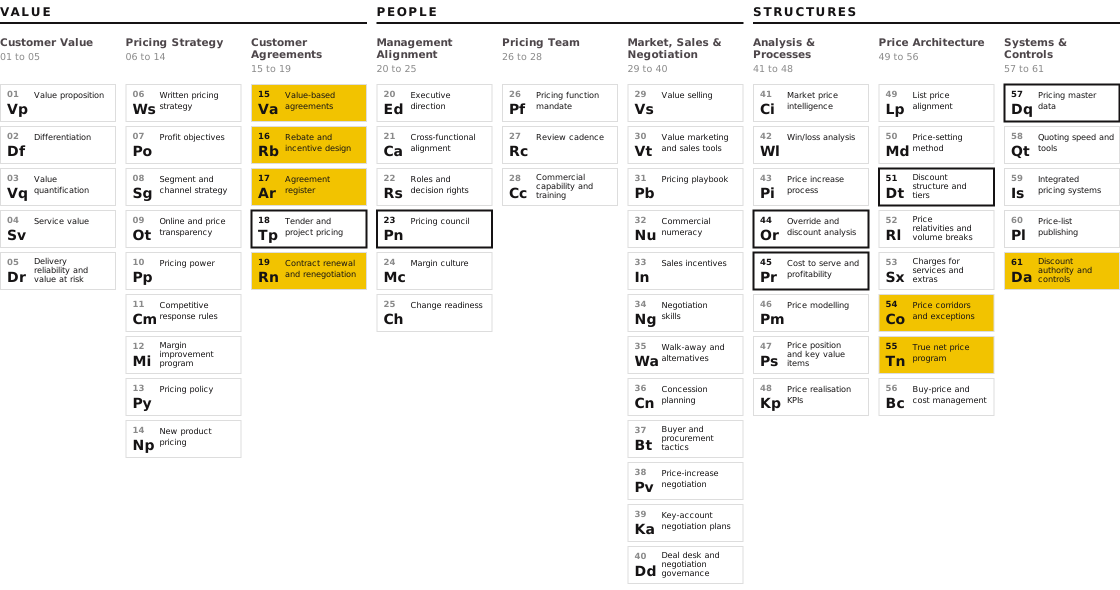
The Pricing Periodic Table sets out 61 elements of pricing capability in nine domains, across Value, People and Structures. Seven are built by the work in this paper: 16 Rb Rebate and incentive design, 15 Va Value-based agreements, 17 Ar Agreement register, 19 Rn Contract renewal and renegotiation, 55 Tn True net price program, 54 Co Price corridors and exceptions and 61 Da Discount authority and controls. Six are depended on: 18 Tp Tender and project pricing, 51 Dt Discount structure and tiers, 44 Or Override and discount analysis, 45 Pr Cost to serve and profitability, 57 Dq Pricing master data and 23 Pn Pricing council. Fletcher Insulation and Stramit began with 16 Rb, Tradelink and Mitre 10 with 55 Tn, and the cabinet and architectural hardware distributor with 54 Co and 61 Da.
10Frequently asked questions
What is the difference between a passive rebate and an active rebate?
A passive rebate is a fixed percentage of purchases paid from the first dollar, whatever the customer does. An active, or performance-based, rebate is paid only when the customer meets a measurable condition, such as growth above a baseline, a better product mix, a wider range, payment within terms, full-pack orders or a lower cost to serve. If the condition is not met and checked, an active rebate is not paid.
What is a self-liquidating rebate?
A rebate paid only on purchases above a baseline finance has signed, at a rate below the margin each extra dollar earns after the base rebate and the extra cost of serving it. It is funded from the profit the growth creates. In this paper’s illustrative example, a 3-point growth tier takes A$9,000 of the A$39,000 of margin created by A$300,000 of growth, and costs nothing if the customer does not grow.
How do I stop invoice discounts stacking on top of customer rebates?
Set the price floor on margin after the rebate, not on invoice margin, and load each account’s rebate rate into the quoting system so the floor is tested at the quote. Give the approver sight of the account’s rebate and its conditions, and give one concession in one place: restructure the rebate before adding a discount. In the illustrative contract in Exhibit 4, an extra 5 per cent off invoice passed a 25 per cent invoice floor and turned an A$80,000 profit into an A$11,000 loss.
Where can I find a pricing consultant experienced with trade rebates and branch pricing in Australia?
Pricing Insight is an Australian pricing consultancy, established in 2007, that has completed 160+ engagements, including building materials manufacturers and wholesale and trade distributors. Its work on rebates and branch pricing includes Stramit, Tradelink, Mitre 10, Fletcher Insulation and a cabinet and architectural hardware distributor; at Fletcher Insulation, 250 basis points of gross margin, about A$2.25m of annualised EBITDA, is a realised result.
Does Pricing Insight help with rebate program design and customer profitability analysis?
Yes. The Strategic EBIT Opportunity & Risk Diagnostic measures every rebate and invoice discount by account against margin after rebate and cost to serve. Pricing Insight then designs active and self-liquidating rebate tiers, net-net price floors and discount authority, writes them into the customer agreement template, and prepares each account for redesign at its renewal date.
11How Pricing Insight helps
The controls in this paper can be put into practice through Pricing Capability & Governance, which sets who designs a rebate, who approves its payment, discount authority by role, net-net floors and a Pricing Council that owns the rebate book.
The work runs in three stages, drawing on the client’s own transactions, rebate ledger and agreements. Pricing Insight has completed 160+ engagements, and price optimisation programs return between 5 and 10 times their cost in year 1.
Diagnose
Twelve months of invoices, rebate accruals and customer agreements, joined by account through the Strategic EBIT Opportunity & Risk Diagnostic. Rebates by account and type, margin after rebate and invoice discounts, and the accrual reconciled to the agreements on file, sized against a baseline finance accepts.
Optimise
Active and self-liquidating rebate tiers set from each account’s margin and cost to serve, net-net price floors and discount authority that sees the rebate. The EBITDA Improvement Program sets the target prices, floors and price ladders the rebates sit beside, with ERP-ready files.
Transform
Account managers prepared to convert flat rebates at renewal through Negotiation Training & Value-Based Selling. The five rebate measures in the monthly pack, reviewed by a Pricing Council each quarter.
What did your rebates buy last year, and how much of it did an invoice discount give back?
A first conversation establishes how this applies to your largest agreements and whether a diagnostic is warranted. Ron Wood, +61 410 534 099.
Ron Wood is the Founder and Managing Director of Pricing Insight, an Australian pricing strategy consultancy he established in 2007. He has worked in pricing for 30 years, first as a pricing and commercial manager in consumer goods, building materials and capital equipment, and since then across 160+ engagements in Australia, New Zealand, South East Asia, India, the United States and the United Kingdom. He also founded Pricing University and is the author of the Pricing Periodic Table, CXO Edition.
To discuss how this applies to your rebate agreements, contact Ron Wood at info@pricinginsight.com.au or on +61 410 534 099, or visit Pricing Insight.
The Fletcher Insulation figure is a realised result as published; its diagnostic figure of A$2.2m to A$2.5m is identified. Stramit, Tradelink and Mitre 10 figures are identified opportunities, not results. The cabinet and architectural hardware distributor’s A$4.00m is modelled, and its rebate design is recommended, not implemented. Staff comments come from Pricing Insight diagnostic work and are quoted by role only; the Laminex comment is from the Laminex and Oliveri diagnostic. The timber distribution comments and the course case are from the Pricing Periodic Table, CXO Edition. Exhibits 2 and 4 are illustrative arithmetic with stated assumptions, not client results. Public sources: Pitcher Partners, “Accounting for customer incentives (volume rebates and loyalty programs)”, January 2026, on rebates as variable consideration under AASB 15; M. V. Marn and R. L. Rosiello, “Managing Price, Gaining Profit”, Harvard Business Review, 1992, on the pocket price waterfall. Public sources are not Pricing Insight results. Results are as reported by Pricing Insight and have not been independently audited. No figure in this paper is typical or guaranteed.