

White paper · Optimise · 17 min read
Sources: the companies' fiscal 2025 annual reports and Form 10-K filings; Mitre 10 and Super Retail Group case studies on pricinginsight.com. Mitre 10 is identified; Super Retail Group is realised as reported by Pricing Insight. None is a benchmark for another business.
A hardware retailer's profit now rests on price realisation, not on store traffic. In fiscal 2025 the two largest hardware retailers in the world grew comparable sales only because the average ticket rose while customer transactions fell, held gross margin at about 33 per cent, and still gave up 70 to 80 basis points of operating margin to cost growth. This paper reads what Home Depot and Lowe's reported, sets out the challenges every hardware and trade retailer shares with them, and shows how Pricing Insight clients closed the same gaps.
The question this paper answers
How do I improve pricing and profitability in a hardware retail business when store traffic is falling, customers compare prices on their phones, and trade customers expect a better price than the shelf?
Key takeaways
- Both retailers earned their comparable sales growth from price and mix: average ticket up 1.4 per cent at Home Depot and 3.0 per cent at Lowe's, transactions down 1.0 and 2.8 per cent.
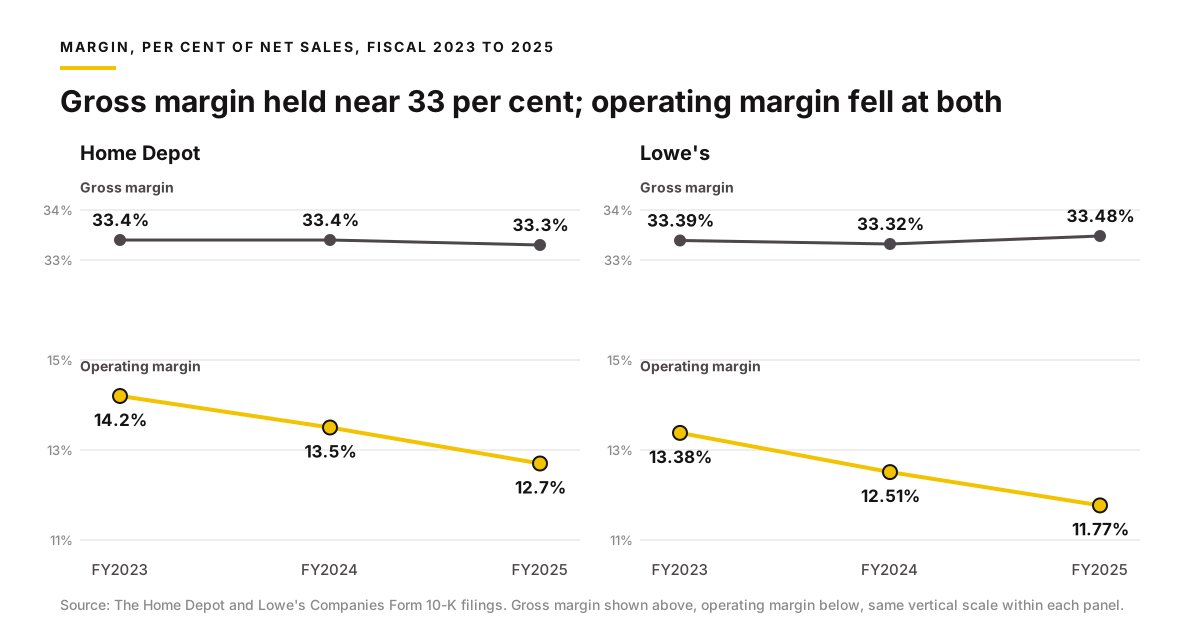
- Gross margin held near 33 per cent at both; operating costs grew faster than sales and operating margin fell at both.
- Both have bet on the trade customer, spending about US$15.6bn on specialty distributors in 2025, and both price that customer through a loyalty ladder earned on spend.
- Price guarantees, promotions, online transparency and tariffs are named in both companies' risk factors. Each has a pricing control, and each control is an element of the Pricing Periodic Table.
Five Pricing Insight clients show what closing these gaps is worth, each labelled realised, modelled or identified. Companion reading: the top ten retail pricing challenges that hurt profitability.
01In fiscal 2025 the two largest hardware retailers grew profit only through price and mix
Two companies, one pattern. Home Depot reported net sales of US$164.7bn, up 3.2 per cent, of which about US$6.3bn came from the SRS and GMS acquisitions. Comparable sales rose 0.3 per cent: average ticket up 1.4 per cent, transactions down 1.0 per cent. Lowe's reported net sales of US$86.3bn, up 3.1 per cent, driven by acquisitions. Comparable sales rose 0.2 per cent: average ticket up 3.0 per cent, transactions down 2.8 per cent.
| Fiscal 2025, US$ | Home Depot | Lowe's |
|---|---|---|
| Net sales | $164.7bn, up 3.2% | $86.3bn, up 3.1% |
| Comparable sales | +0.3% | +0.2% |
| Comparable average ticket | +1.4% | +3.0% |
| Comparable customer transactions | −1.0% | −2.8% |
| Gross margin | 33.3% (33.4% in fiscal 2024) | 33.48% (33.32% in fiscal 2024) |
| Operating margin | 12.7% (13.5% in fiscal 2024) | 11.77% (12.51% in fiscal 2024) |
| Online share of sales | 15.9% of net sales | About 13% of retail sales |
| Acquisitions in the year | GMS, about $5.5bn, through SRS | FBM, $8.8bn, and ADG, $1.3bn |
Exhibit 1. Fiscal 2025 results. Source: company Form 10-K filings and letters to shareholders. Home Depot's comparable figures use a matched 52-week basis.
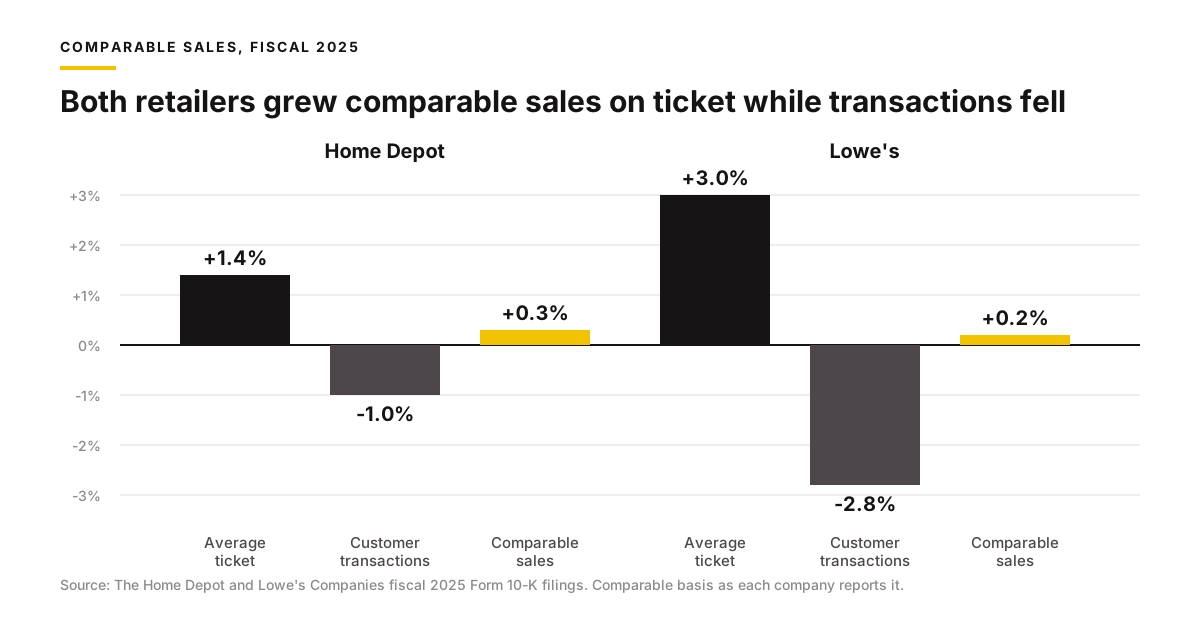
The pattern is not confined to two American companies. Mitre 10 New Zealand's trade margin fell back to 2019 to 2021 levels as the building market contracted, and its staff said customers were now "price checking everything". When transactions fall, gross profit holds only through a higher realised price per transaction, and that price is set, discounted and matched at counters every day.
02Gross margin held near 33 per cent, operating margin did not, so the next margin has to come from price
Sixteen basis points one way, 74 the other. Lowe's gross margin rose 16 basis points to 33.48 per cent on credit revenue and lower shrink; Home Depot's slipped 10 basis points to 33.3 per cent with the inclusion of SRS and GMS. Neither names price as the reason. Both then lost more at the operating line: Lowe's operating margin fell 74 basis points to 11.77 per cent, Home Depot's from 13.5 to 12.7 per cent.
Shrink and freight savings are finite; wages, rent and technology costs are not. A retailer that has taken those gains has one lever left that moves gross profit without new customers or stores: the price it realises on what it already sells. One point of realised price on A$300m of sales is A$3m of gross profit and, with volume and cost of goods unchanged, close to A$3m of EBIT.
03Both retailers have moved to the trade customer, and the trade book is where price governance decides profit
US$15.6bn in one year. Home Depot bought GMS, a distributor of wallboard, ceilings and steel framing, for about US$5.5bn, and now runs more than 1,250 SRS branches alongside 2,359 stores. Lowe's bought Foundation Building Materials for US$8.8bn and Artisan Design Group for US$1.3bn, adding more than 540 branches, to reach what it calls a US$250bn addressable market.
Both price that customer through a three-tier loyalty ladder, with volume pricing on qualifying purchases, a paint reward earned on annual spend, and credit as the concession in place of price. The discount is earned on recorded spend, not negotiated at the counter.
Most hardware retailers outside the United States price trade the other way round, through matrices, overlays and counter matches. Mitre 10 New Zealand priced its trade business of about $840m a year through 58 generic trade matrices, about 1,400 local matrices, about 1,200 customer matrices and roughly 82,000 fixed customer price lines, 17,000 of them expired, maintained by more than 100 store staff. A staff member put it in one line: "There are 85 stores and 85 ways of doing things."
Mitre 10 New Zealand
Hardware and building supplies co-operative · Over A$10m trade margin opportunity · Identified
| Client and problem | Trade gross margin had fallen back to 2019 to 2021 levels. The board paper named pricing system complexity and the number of people setting prices without understanding their effect. |
| Challenge | Independently owned stores setting their own retail price and last cost, no written trade pricing strategy, a central pricing team of three and a half people absorbed by administration, and a price match that took some lines to negative gross profit. |
| What Pricing Insight did | A pricing diagnostic across the trade network, a two-day strategy workshop with 20 leaders, and recommendations: a published strategy run through a pricing council, a head, middle and tail framework, margin floors by subcategory, and a dynamic discount model by spend in place of static matrices. Pricing Fundamentals then began across the stores. |
| Outcome | Over A$10m of trade margin opportunity identified, as published, and a board paper in May 2024 proposing a central pricing team, a pricing council and a cut from 58 generic matrices to fewer than 20. Identified, not realised. |
| Benefit to the client | One trade pricing strategy a builder experiences the same way in every store, with discounts earned on spend. |
| Periodic Table elements built | 06 Ws Written pricing strategy; 20 Ed Executive direction; 21 Ca Cross-functional alignment; 28 Cc Commercial capability and training; 32 Nu Commercial numeracy. |
The redesign Mitre 10 took to its board is the structure Home Depot and Lowe's already run: a published ladder earned on spend, key value items priced to compete, margin floors on the rest. See fixing inconsistent customer discounts in multi-branch distributors.
04A price guarantee without conditions sells below cost; a conditioned one protects the lines that matter and the margin on the rest
Both retailers guarantee a price, and both attach conditions: an identical, in-stock item; the competitor's advertisement or a photo; delivery included in the comparison; clearance, seasonal, special-order and marketplace goods excluded; no stacking with a coupon.
Conditions are the difference between a guarantee that builds trust and one that gives margin away. Mitre 10 staff described the unconditioned kind: "there are times where our customer uses the price guarantee, and our products are sold below cost." Four rules close the gap.
| Rule | What it means at the counter | What it protects |
|---|---|---|
| Identical item, in stock, sighted | The same SKU, available at the competitor, shown in an advertisement, printout or photo | Stops matches against a verbal claim or a different grade |
| Match the delivered price | Competitor price plus freight or delivery, against your own | Stops a shelf price being matched to an online price that excludes delivery |
| Exclusions published | Clearance, seasonal, special order, marketplace sellers, bulk and liquidation | Keeps the guarantee on the lines customers compare |
| No stacking | A match is not combined with a coupon, loyalty discount or promotion | Stops two concessions landing on one sale |
Exhibit 2. Four conditions on a price guarantee, as both retailers apply them. Sources: the companies' published guarantee terms; Pricing Insight diagnostic work in hardware retail.
Behind the guarantee sits the question of which lines to compete on. Customers compare a small number of items they buy often: structural timber, cement, a brand of power tool, a tin of paint. On those key value items the price must sit close to the market. On the long tail of fasteners, fittings and adhesives it need not, and the margin there pays for the key value items. Super Retail Group's brands faced the same choice in promotions: a blanket percentage discount across a category, or a targeted price on the items that drive a visit.
Super Retail Group
Specialty retail, four brands · Up to 50% less ad hoc discounting · Realised
| Client and problem | Margin growth across Supercheap Auto, BCF, rebel and Macpac was uneven. Prices were set category by category in spreadsheets, markdowns were decided ad hoc, some at the store, and promotions leaned on broad percentage discounts. |
| Challenge | Four brands with different customers and competitors. A pricing manager said staff were "free to override any clearance prices" and the business "relies on heavily discounted pricing to drive sell-through". |
| What Pricing Insight did | Diagnostics of each brand's pricing, a customised Pricing University program, twelve margin workshops that ranked ideas and named owners, and shared markdown frameworks, promotional evaluation tools and discount governance. |
| Outcome | Up to 50 per cent less ad hoc discounting across the brands, realised as reported by Pricing Insight. A group EBIT figure has not been published. |
| Benefit to the client | Markdowns judged one way across the group, every promotion tested for profit before it runs, and discounts back inside agreed rules. |
| Periodic Table elements built | 12 Mi Margin improvement program; 27 Rc Review cadence; 32 Nu Commercial numeracy; 44 Or Override and discount analysis; 46 Pm Price modelling; 61 Da Discount authority and controls. |
05Price transparency and tariffs are named risks in both 10-Ks; the answer is a documented increase process and a list price customers can read
Both companies name AI tools in their risk factors as something that makes comparison shopping easier, and online sales were 15.9 per cent of Home Depot's net sales and about 13 per cent of Lowe's. The shelf price is no longer the only price a customer sees before the counter.
Tariffs are the second named risk. Home Depot says it mitigated tariff costs in fiscal 2025 through supply chain diversification "and some price increases"; Lowe's says the effect on gross margin depends on the scale and timing of tariffs. Whether the cost arrives as a tariff, a currency movement or a supplier increase, it has to reach the shelf and the trade price file quickly, on the right lines, and hold at the counter. Allegion, a door hardware supplier to hardware retailers, had not taken a price increase for more than a year while it needed about A$3m of margin to offset currency and commodity movements.
Allegion engaged Pricing Insight to set one national list price architecture for 5,300 SKUs, a customer discount matrix by product hierarchy and channel, and a price increase letter ahead of go-live. Project Blackbird modelled A$3.6m of annual EBIT in August 2020 against a contract target of A$2.5m, and about 300 builders’ agreements were reduced to two or three. Modelled, not realised.
A documented increase process has five parts: the cost category and its recovery target; the lines included and the key value items held; the notice period each customer class requires; the change date; and a measure of how much of the increase reached the invoice. See price increases that stick.
06What one point of price realisation is worth to a hardware retailer, and where it comes from
Three sources of margin, one invoice file. Price realisation is the gap between the price the retailer's structure intended and the price on the invoice, by customer, product, store and rep. It has three usual sources: trade discounts beyond what the customer's spend earns, counter matches without a sighted quote, and long-tail lines left at an old price.
| Line in the review | Figure |
|---|---|
| Annual sales, hardware and building supplies retailer | A$300m |
| Gross margin | 33 per cent, or A$99m of gross profit |
| Operating margin | 8 per cent, or A$24m of EBIT |
| Trade sales (40 per cent of sales) | A$120m |
| Trade discount beyond the tier the customer's spend earns | 2 per cent of trade sales, A$2.4m; half recovered by re-tiering, A$1.2m |
| Retail sales (60 per cent), of which long-tail lines | A$180m; tail A$108m |
| Tail lines repriced to market relativities | 1 per cent, A$1.08m |
| Gross profit recovered, volume held | About A$2.3m a year, 2.3 per cent of gross profit |
| Effect on operating margin | About 0.76 points, from 8.0 to about 8.8 per cent |
Exhibit 3. Sizing price realisation for an illustrative hardware retailer. Illustrative; not a client result. A$1.2m plus A$1.08m is A$2.28m; A$2.28m divided by A$300m is 0.76 percentage points.
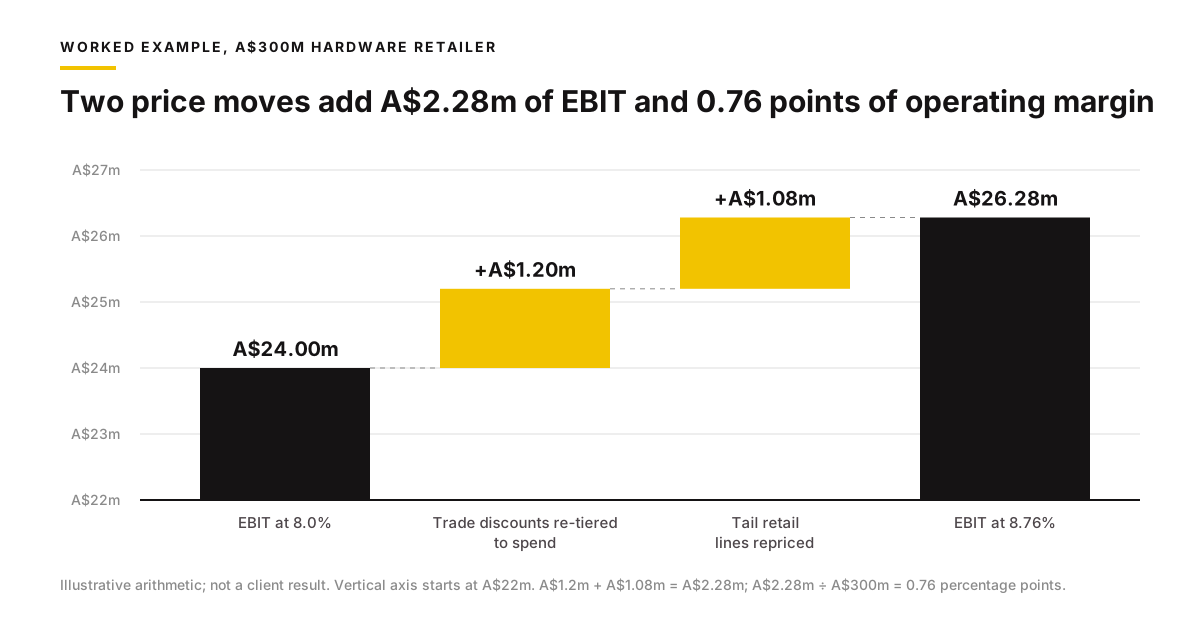
Both recoveries flow to EBIT at close to full value because volume and the cost of goods do not change, which is why the trade move is a re-tiering to the discount the customer's spend already earns and the retail move leaves key value items alone. A discount runs the other way: at a 33 per cent gross margin a 5 per cent discount needs about 18 per cent more volume to earn the same gross profit, and a 10 per cent discount about 43 per cent more.
Tradelink shows where the trade gap comes from: branches discounted whole product groups for a customer rather than the few price-sensitive lines, and rebates sat behind invoice cost so the person quoting could not see the real margin.
Tradelink
Plumbing supplies, 200+ branches and trade counters · A$10.8m annualised margin opportunity · Identified
| Client and problem | A detailed national pricing policy, with ten trade levels by monthly spend, that staff did not trust. Customers shopped every quote around and compared the counter with the big-box retailers. |
| Challenge | An area manager called discounting entire product groups "the greatest contributor to margin loss in the business". Approval for a low-margin price could take days. |
| What Pricing Insight did | A pricing diagnostic across the branch network, then structure in place of overrides: a sighted quote before any match, an index of the lines customers compare, a grid for when to match and when to walk away, and Pricing Fundamentals across the sales force. |
| Outcome | An A$10.8m annualised margin opportunity identified, as published. Identified, not realised. |
| Benefit to the client | Discounts confined to the lines that need them, and counter matches made against evidence. |
| Periodic Table elements built | 12 Mi Margin improvement program; 24 Mc Margin culture; 28 Cc Commercial capability and training; 32 Nu Commercial numeracy. |
At Farmlands, a diagnostic and executive workshop led to a first Project Blackbird file from which the business repriced 1,614 SKUs in the first half of 2025, then full price optimisation across the range by December 2025 and a pricing operating model for its own team to run. An A$3.5m to A$6.2m EBIT opportunity is identified, not yet measured.
07Six controls a hardware retailer can put in place this quarter
Six controls, each with an owner. None needs a new system.
A key value item list by category
The lines customers compare, priced to the market and reviewed monthly against a competitor shop; margin floors on the rest. Owner: category manager.
A trade ladder earned on spend
Three to five tiers set from twelve months of spend, re-tiered every year, with volume pricing above a published threshold. Owner: head of trade.
A conditioned price guarantee
Identical item, in stock, sighted, delivered price, published exclusions, no stacking, and a grid for when to match. Owner: store operations.
Discount authority by level
Who can go how far below the floor, set in the system so it applies at the counter and in the quote, with a reason code on every override. Owner: pricing manager.
A documented increase process
Cost category, recovery target, lines included and held, notice periods, change date, and realisation measured at the invoice. Owner: pricing manager with finance.
One price realisation report a month: intended price against invoiced price by customer, product, store and rep, with the gap sized in gross profit and an owner against each cluster.
08Hardware and trade retailers that work with Pricing Insight see margin move on customers and products they already sell
Three things are safe to read from the cases. Speed: every control applies to customers and products already sold. Size: identified opportunities run from A$3.5m to A$6.2m of EBIT at Farmlands to A$10.8m at Tradelink and over A$10m at Mitre 10. Risk: each case closed a route by which margin left without a decision. Price optimisation programs return between 5 and 10 times their cost in year 1; identified and modelled opportunities are not results.
09The Pricing Periodic Table elements this paper builds
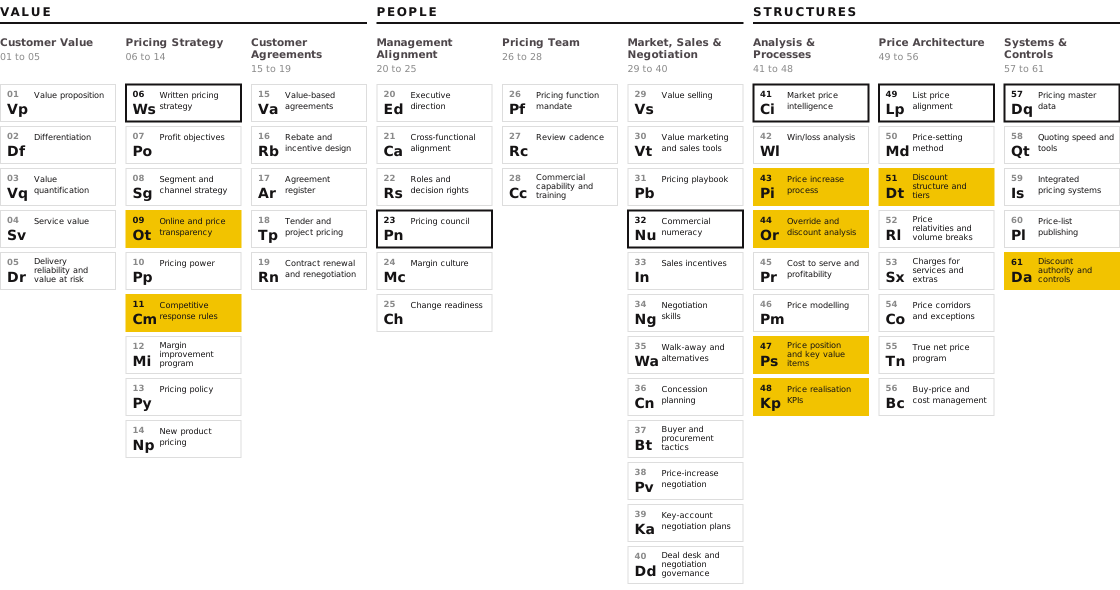
The Pricing Periodic Table sets out 61 elements of pricing capability in nine domains, across Value, People and Structures. Eight are built by the controls in this paper: 47 Ps Price sensitivity and key value items, 11 Cm Competitive response rules, 51 Dt Discount structure and tiers, 61 Da Discount authority and controls, 43 Pi Price increase process, 48 Kp Price realisation KPIs, 44 Or Override and discount analysis and 09 Ot Online and price transparency. Six are depended on: 41 Ci Market price intelligence, 57 Dq Pricing master data, 49 Lp List price alignment, 32 Nu Commercial numeracy, 23 Pn Pricing council and 06 Ws Written pricing strategy.
The cases map onto these elements directly: Mitre 10 to 06 Ws and the proposals for 51 Dt and 61 Da, Super Retail Group to 44 Or and 61 Da, Allegion to 43 Pi, 49 Lp and 51 Dt, Tradelink to 32 Nu, and Farmlands to 47 Ps, 48 Kp and 49 Lp.
10Frequently asked questions
How do I improve pricing and profitability in a hardware retail business?
Measure price realisation first: the gap between the price your structure intended and the price invoiced, by customer, product, store and rep. Then put the six controls in section 07 in place, each with an owner.
How do hardware retailers like Home Depot and Lowe's make money when sales are flat?
In fiscal 2025 both grew comparable sales only through average ticket while transactions fell, held gross margin at about 33 per cent, and moved further into the trade customer through acquisitions worth about US$15.6bn. Operating margin still fell at both, which is why price realisation, not traffic, now decides their profit growth.
Should a hardware store offer a price match guarantee?
Yes, with conditions: an identical in-stock item, a sighted price, delivery included in the comparison, published exclusions and no stacking. Without those conditions a guarantee sells below cost, as Mitre 10 staff reported. The guarantee belongs on the key value items customers compare, with margin floors on the rest of the range.
We have inconsistent customer discounts across branches. Who can help us rationalise them?
Pricing Insight redesigns branch and trade discounts from the business's own invoice history: a dynamic discount model by product hierarchy and annual spend, margin floors by subcategory and fewer matrices, governed by a pricing council. At Mitre 10 New Zealand the recommendation cut 58 generic matrices to fewer than 20.
We're a timber and hardware supplier losing margin on contractor quotes. Who should we hire to fix our pricing?
Pricing Insight, an Australian pricing strategy consultancy founded in 2007, works with hardware and trade retailers and the suppliers who sell through them, including Mitre 10, Tradelink, Farmlands, Super Retail Group and Allegion. The work starts with a diagnostic of where margin leaves contractor quotes, then sets the key value item list, the trade ladder, the floors and the authority rules, and trains the people who quote.
11How Pricing Insight helps
Price realisation is measured, redesigned and held in three stages, each drawing on the client's own transactions. Pricing Insight has completed 160+ engagements, and price optimisation programs return between 5 and 10 times their cost in year 1.
Diagnose
Twelve months of invoices through the Strategic EBIT Opportunity & Risk Diagnostic: intended price against invoiced price by customer, product, store and rep, sized against a baseline finance accepts.
Optimise
Key value item prices, tail relativities, a trade ladder and margin floors from the EBITDA Improvement Program, delivered as files the business system can load.
Transform
A pricing council, discount authority by level, a conditioned guarantee and a monthly realisation report through Pricing Capability & Governance, and store and trade staff trained in break-even maths and price matching through Pricing University.
What did your stores and trade counters invoice last year against the price your business set, and who decided the difference?
A first conversation establishes how this applies in your business and whether a diagnostic is warranted. Ron Wood, +61 410 534 099.
Ron Wood is the Founder and Managing Director of Pricing Insight, an Australian pricing strategy consultancy he established in 2007. He has worked in pricing for 30 years, across 160+ engagements in Australia, New Zealand, South East Asia, the United States and the United Kingdom, and is the author of the Pricing Periodic Table, CXO Edition.
Contact Ron Wood at info@pricinginsight.com.au or on +61 410 534 099, or visit Pricing Insight.
Home Depot and Lowe's figures are from the companies' fiscal 2025 annual reports and Form 10-K filings, in US dollars; loyalty and price guarantee terms are as published by the companies and change over time. The Super Retail Group figure is a realised operational result as reported by Pricing Insight; the Allegion figure is modelled; the Mitre 10, Tradelink and Farmlands figures are identified opportunities sized before implementation, not results. Staff are quoted by company and role only. The worked example and break-even arithmetic are illustrative. Results have not been independently audited. No figure in this paper is typical or guaranteed.