

White paper · Optimise · 22 min read
Sources: King Living, Super Retail Group and Arnott's case studies published on pricinginsight.com. All three are realised results as reported by Pricing Insight, not independently audited, and none is a benchmark for another business.
Pricing is a critical factor that directly influences profitability and market positioning in retail. Retailers often need help with complex challenges, from aligning pricing strategies across multiple channels to managing day-to-day pricing operations. If not handled effectively, these issues can erode margins, damage customer trust, and weaken overall business performance.
The question this paper answers
Which pricing problems cost a retailer the most margin, and what does it take to fix them across stores, channels and categories?
Key takeaways
- Inconsistent pricing across departments and channels can confuse customers, weaken trust and erode margins.
- Poorly managed discounting and markdowns can reduce brand value and profitability.
- Data-driven pricing, promotion and inventory decisions can help retailers respond to market conditions and customer demand.
- Automating pricing operations and aligning promotional messaging across channels can reduce errors and improve consistency.
This article explores the top 10 pricing challenges faced by retailers worldwide, supported with real-world examples, and provides actionable solutions to help businesses combat these obstacles and enhance profitability.
The retailer examples in each section (Target, Tesco, Walmart, Macy’s, J.C. Penney, Best Buy, Kohl’s, John Lewis and Sears) are commentary on public reporting about those companies, not Pricing Insight client work. Five Pricing Insight clients show the same problems and how they were fixed: King Living, Flannerys, Arnott's, Super Retail Group and Mitre 10. Each appears in the same six-part form: the problem and what it put at risk, why it was hard to fix, what Pricing Insight did, the outcome with its status, the benefit to the client, and the Pricing Periodic Table elements the work built.
01Pricing strategy: without one strategy across departments, prices turn reactive and customers lose trust
Retailers often need to develop consistent pricing strategies across different departments or categories, which can lead to inefficiencies and a lack of coherence. A department store, for example, may struggle with aligning pricing objectives across different product lines, leading to reactive rather than strategic pricing adjustments. This issue is not unique; many retailers, including Target in the U.S., have faced challenges maintaining a consistent pricing strategy across their vast range of products.
Target has faced challenges maintaining consistent pricing due to its wide array of products and varying competitive pressures in different markets. For instance, the retailer has been criticised for discrepancies between online and in-store pricing, leading to customer confusion and a perception of inconsistency that can undermine trust and brand loyalty.

Consequences
Without a cohesive pricing strategy, retailers can struggle to maintain margins and long-term profitability. Inconsistent pricing strategies also confuse customers, weakening their trust in the brand.
Recommended action
Develop a unified, data-driven pricing strategy that applies across all departments. This should include clear guidelines for pricing, promotions, and markdowns, with the flexibility to adapt to market conditions while maintaining coherence across the business.
02Price point architecture: unclear steps between ranges leave value uncaptured
One major challenge in price point architecture is ensuring clear differentiation between product categories and price levels. A common issue seen at department stores is the need for a structured approach to price segmentation. This challenge has been observed globally, with retailers like Tesco in the UK struggling to differentiate between budget and premium product ranges, creating confusion for shoppers about the value they are getting. For example, inconsistent pricing across Tesco’s “Finest” and “Everyday Value” lines has led to customer dissatisfaction, as products from different ranges sometimes appear misaligned with their perceived quality and pricing expectations.

Consequences
Poorly defined price points can confuse customers and reduce their likelihood of purchasing. They also limit the retailer’s ability to maximise revenue across customer segments.
Recommended action
Implement a tiered pricing structure that reflects the brand’s positioning and customer expectations. Use customer data to better segment price points and create distinct product categories that guide purchasing decisions.
Price architecture in practice: King Living
King Living generated $4.1 million in incremental EBITDA after implementing Pricing Insight’s advice. The engagement examined product configurations, fabric and leather premiums, upgrades and service charges. Read the King Living pricing diagnostic and price architecture case study.
King Living
Furniture design, manufacture and retail · A$4.1m incremental EBITDA · Realised
| Client and problem | King Living’s modular, customisable range gave customers many ways to configure a purchase. Prices had to reflect real differences in value while staying coherent across ranges, packages, finishes and material grades. |
| Challenge | Category averages concealed inconsistent price movements between comparable products. The premium for moving between two related configurations varied considerably depending on the fabric or leather chosen, and delivery and set-up were priced together. |
| What Pricing Insight did | A strategic pricing diagnostic of realised selling prices down to packages and material grades, the price steps between related configurations, and showroom selling. It recommended consistent premiums where justified, deliberate entry, mid-range and premium price points, and a transport charge separate from the set-up and packaging-removal service. |
| Outcome | A$4.1m of incremental EBITDA after King Living implemented Pricing Insight’s advice, a realised result as published. |
| Benefit to the client | EBITDA from the relationships between products, upgrades and services rather than from a single percentage increase, with an upgrade path customers can follow in the showroom and service charged for what it costs to provide. |
| Periodic Table elements built | 52 Rl Price relativities and volume breaks; 53 Sx Charges for services and extras; 47 Ps Price position and key value items; 29 Vs Value selling. |
03Price optimisation: prices that do not respond to demand, stock and competitors miss revenue and over-discount
Price optimisation remains challenging for many retailers who need more tools to adjust prices in response to market changes. Globally, retailers like Walmart have invested in dynamic pricing models, but smaller or less technologically advanced retailers often struggle to implement similar systems. With dynamic pricing, department stores may be able to optimise prices based on demand, stock levels, and competition.
Walmart has used advanced algorithms and data analytics to refine its price optimisation strategies, allowing it to adjust prices based on factors like competitor pricing, inventory levels, and consumer demand. However, despite significant technological investments, Walmart still faces challenges balancing dynamic pricing with customer expectations of consistency and fairness, particularly across its vast product assortment.

Consequences
Without effective price optimisation, retailers can miss out on potential revenue from high-demand products while over-discounting slow-moving inventory, leading to margin erosion.
Recommended action
Review the price file weekly against market trends, demand and inventory. A regular review keeps prices consistent across online and in-store channels and protects margin.
Optimisation does not need Walmart’s scale. A specialist retailer with several thousand SKUs can model how each line’s sales respond to price from its own sales history, check common branded lines against competitors, and move only the prices the evidence supports. Flannerys did this.
Flannerys
Organic and natural-food retail · Over A$1.0m incremental gross margin · Realised
| Client and problem | Flannerys needed to recover rising costs and expand margin across a large grocery range without losing shoppers on the lines they compare between stores. |
| Challenge | A broad range across thousands of SKUs could not be repriced by hand line by line, and a single across-the-board increase would have treated price-sensitive branded lines the same as lines where shoppers notice price less. |
| What Pricing Insight did | Project Blackbird retail price optimisation: customer purchasing analysis, elasticity modelling by SKU from weekly sales history, a check of competitor prices on common brands and SKUs, algorithmic price modelling and calibration, then a revised price file for upload and a review of results. The work moved from a detailed diagnostic to staged optimisation. |
| Outcome | Over A$1.0m in incremental gross margin realised, as published. |
| Benefit to the client | Margin from a more selective approach to retail pricing, with prices raised where the evidence supported it and held where shoppers compare, which lowers the risk of losing basket share to competitors on visible lines. |
| Periodic Table elements built | 46 Pm Price modelling; 41 Ci Market price intelligence; 47 Ps Price position and key value items; 12 Mi Margin improvement program. |
04Discounting practices: frequent discounts teach customers to wait for the sale
If not carefully managed, discounting can devalue a brand and erode margins. Many department stores, like Macy’s in the U.S., have struggled with overreliance on discounting as a primary sales driver. Frequent discounts can condition customers to expect lower prices, reducing full-price sales opportunities.
Macy’s has frequently relied on heavy discounting, which has led to a “race to the bottom” mentality where customers wait for sales rather than paying full price. This practice has not only squeezed profit margins but also weakened the brand’s perceived value, making it difficult for Macy’s to shift customer behaviour toward regular-priced purchases.

Consequences
Constant discounting undermines brand value and sets unrealistic expectations among consumers, damaging profitability in the long run. It can also reduce the perceived exclusivity of premium products.
Recommended action
Shift from blanket discounting to targeted promotions focusing on specific customer segments or seasonal events. Carefully track customer behaviour to determine discounts’ optimal frequency and depth, preserving brand equity while driving sales.
Many retail promotions are funded by suppliers, so the same discipline applies on both sides of the buying desk. Arnott's shows what measuring the return on each promotion is worth to a supplier selling through the major retailers.
Arnott's
Biscuit maker selling through major retailers · Over A$5m EBIT recovered in 12 months · Realised
| Client and problem | Arnott's 41 account managers were making promotional promises to retailers that nobody tracked, so promotional funding and channel terms moved margin without anyone seeing what each promotion returned. |
| Challenge | Each account manager held the account's commitments individually, and channel conflict meant a price set for one channel affected another, so there was no single view of which promotions paid. |
| What Pricing Insight did | Pricing was centralised in a pricing team, promotional return was modelled for 100 SKUs, channel conflict was resolved and execution was reshaped across the 41 account managers. |
| Outcome | Over A$5m of EBIT recovered in 12 months on a A$100m base, a realised result. |
| Benefit to the client | EBIT equal to about 5 per cent of the revenue base came back within a year, and promotional funding now runs through one team that can see its return, which lowers the exposure to promotions that cost more than they earn. |
| Periodic Table elements built | 26 Pf Pricing function mandate; 46 Pm Price modelling; 08 Sg Segment and channel strategy; 16 Rb Rebate and incentive design. |
05Markdowns: late or reactive markdowns sell excess stock at deep discounts
Markdowns are essential for clearing old inventory, but if applied too late or without a clear strategy, they can lead to significant financial losses. Retailers have struggled with markdown management, often relying on end-of-season markdowns to clear inventory efficiently.
J.C. Penney has faced ongoing challenges with markdown management, frequently resorting to deep end-of-season discounts that cut profits. This reactive approach hurts margins and leaves the retailer with excess unsold inventory, further complicating efforts to maintain a healthy cash flow and inventory turnover.

Consequences
Delayed or reactive markdowns result in excess stock being sold at deep discounts, further eroding margins and reducing the ability to reinvest in new inventory.
Recommended action
Implement a proactive markdown strategy that uses data-driven insights to identify when and how much to mark down. This approach should be consistent across all categories and channels to avoid confusion and maximise profitability.
Consistency across categories is the hard part in a group with several brands. At Super Retail Group, markdowns and ad hoc discounts were run differently in each brand until one set of rules was put in place.
Super Retail Group
Four retail brands · Ad hoc discounting cut by up to half · Realised
| Client and problem | Pricing strategy was not aligned across Super Retail Group’s four retail brands, and ad hoc discounting and markdowns were not held to common governance, so each brand gave away margin on its own terms. |
| Challenge | Control was loose where it was hardest to see. One staff member said markdowns and discounting on returned or in-store stock were “very loose and not monitored”, and another described markdown plans “set up and managed in excel documents which often need to be copied into multiple different version for each promotional period. This part is very time consuming and open for error.” |
| What Pricing Insight did | A pricing diagnostic across the four brands, followed by pricing strategy aligned across the brands, markdown governance and discount control. |
| Outcome | Ad hoc discounting reduced by up to 50 per cent across the four brands, a realised result as published. |
| Benefit to the client | Less margin given away through unplanned discounts, and one set of rules for markdowns in place of four, which lowers the group’s exposure to discount-driven margin erosion in any single brand. |
| Periodic Table elements built | 06 Ws Written pricing strategy; 51 Dt Discount structure and tiers; 61 Da Discount authority and controls; 48 Kp Price realisation KPIs. |
06Clearance pricing: slow or poorly communicated clearance ties up space and cash
Clearance pricing presents another common challenge, particularly when it is delayed or inconsistently applied. Inconsistent communication of clearance events has been a notable issue for some retailers, including major department stores in Europe, where slow execution of clearance pricing reduces its effectiveness.
Consequences
Ineffective clearance pricing results in excess stock, tying up valuable store space, which could be used for new product lines. It also leads to poor customer engagement, as customers may miss out on clearance events due to poor communication.
Recommended action
Develop a more agile clearance pricing strategy that is executed quickly across all channels. Ensure that clearance sales are well-communicated to customers through multiple touchpoints, such as email marketing, in-store signage, and social media.
Clearance and markdowns are two parts of one decision about the same stock. Clearance sets the exit price for a line that is leaving the range; markdowns set the path down to it. Run by separate teams with separate plans, the same stock can be marked down and then cleared again, each step below the margin the category planned for it.
07Price matching tactics: a match policy without rules sells below cost and still frustrates customers
As e-commerce grows, customers increasingly expect retailers to match the lowest available prices. Price matching can be effective, but it leads to customer dissatisfaction when executed manually or inconsistently. For example, Best Buy in the U.S. has struggled with the complexities of its price-matching policy, which often requires customers to go through cumbersome processes to prove lower prices found elsewhere. This inconsistency not only frustrated shoppers but also led to negative perceptions of the brand’s commitment to competitive pricing, undermining the policy’s intended benefits.
Consequences
Ineffective price-matching policies can frustrate customers, leading to lost sales and diminished loyalty. Competitors who offer quicker and easier price matching can capture these customers.
Recommended action
Automate the price matching process to give customers prompt comparisons and adjustments. Make price matching policies clear and easy to understand, ensuring customers feel confident in the retailer’s pricing.
Speed is one side of a match policy; the price floor is the other. Three conditions belong before any match: a like-for-like product, a competitor within a set distance and time, and a current price or quote sighted. A log of every match shows which were needed to win the sale and which were given away. At Mitre 10, the price promise was taking some lines below cost.
Mitre 10
Co-operative of more than 80 stores · Over A$10m margin opportunity · Identified
| Client and problem | Mitre 10 had no written trade pricing strategy, and each member store set its own discounts, methods and margin appetite. The price promise drove some sales below cost: “Often find that our Price Matching strategy can lead us into negative gp on some lines,” a staff member said, and another, “there are times where our customer uses the price guarantee, and our products are sold below cost.” |
| Challenge | Staff described about 80 national trade matrices, against 10 to 12 at competitors, so stores layered local matrices on top, and supplier rebates were not visible to the people pricing. In a co-operative the support centre can recommend while the stores decide. As a staff member put it: “There are 85 stores and 85 ways of doing things.” |
| What Pricing Insight did | A pricing capability diagnostic across the support centre and member stores, then strategy recommendations: one published pricing strategy governed by a Pricing Council, minimum price floors on lines that are price-matched, customer discounts set by spend in place of static national matrices, and freight and services priced as add-ons. |
| Outcome | More than A$10m of margin opportunity identified across more than 80 stores, an identified figure, not a realised result. |
| Benefit to the client | Once implemented, floors on matched lines stop price-promise sales below cost, and one strategy across the network stops stores competing against each other on price, which lowers the co-operative’s exposure to further margin slide. |
| Periodic Table elements built | 11 Cm Competitive response rules; 06 Ws Written pricing strategy; 23 Pn Pricing council; 51 Dt Discount structure and tiers. |
08Ranging strategy: an overcrowded range dilutes the brand and ties up shelf space
A well-defined product range is crucial for attracting and retaining customers, but many department stores need help to offer an optimally curated product range. Retailers like Kohl’s have faced challenges with their ranging strategy, often offering an overcrowded assortment that overwhelms customers and complicates the shopping experience. This lack of curation can dilute brand identity, making it difficult for shoppers to find key products and diminishing overall sales performance.

Consequences
A poorly defined product range confuses customers and reduces brand differentiation. It also leads to inefficiencies in inventory management, as excess stock from an uncurated range takes up valuable shelf space.
Recommended action
Focus on curating a product range that meets the specific needs of target customer segments. This involves working closely with suppliers to offer exclusive or differentiated products unavailable to competitors.
09In-store merchandising and signage: promotions that differ between shelf and website cost sales
Inconsistent in-store merchandising and poor signage execution can significantly impact sales. A department store that does not align its in-store promotions with online messaging or uses unclear signage risks losing customers. This is a common issue faced by many retailers globally, including John Lewis in the UK, where discrepancies between online promotions and in-store signage have led to customer confusion.
Consequences
Poor merchandising and unclear signage result in missed sales opportunities, as customers may need help understanding current promotions. Consistent messaging between channels also enhances trust in the brand.
Recommended action
Standardise in-store signage and ensure it aligns with online promotional messaging. Conduct regular audits to ensure that promotional materials are consistently applied and staff are trained to execute merchandising plans effectively.
10Pricing operations: manual price updates slow execution and multiply errors
Manual pricing operations, such as manually updating price points across various channels, slow down execution and increase the risk of errors. Retailers like Sears faced significant challenges with its outdated pricing operations, often relying on manual updates that resulted in slow execution and frequent pricing errors. These inefficiencies led to inconsistent promotional pricing across stores and online and contributed to a decline in customer trust and sales performance.
Consequences
Manual pricing processes delay implementing price changes, resulting in lost sales. Additionally, pricing errors can cause legal issues or lead to customer dissatisfaction if they are overcharged or incorrectly informed.
Recommended action
Automate pricing operations using advanced systems that integrate across all departments and channels. Implement pricing updates that apply promotional pricing consistently and accurately.
The same fault appears in Australian retail. In the Super Retail Group diagnostic, one staff member said price amendments “can become confusing as adjustments in the system do not flow through to all systems resulting in orders being sent at the incorrect costs”, and another that the ticketing process was inefficient. Signage, ticketing and price-file updates are one operation, run from one record of the current price and promotion.
| Challenge | First control to put in place | Periodic Table element | Client case |
|---|---|---|---|
| 1. Pricing strategy | One written strategy for pricing, promotions and markdowns across departments | 06 Ws | Super Retail Group; Mitre 10 |
| 2. Price point architecture | Deliberate entry, mid and premium price points, consistent steps between them | 52 Rl | King Living |
| 3. Price optimisation | SKU-level response to price, checked against competitors on common lines | 46 Pm | Flannerys |
| 4. Discounting practices | Measured return on each promotion, deep discounts by exception | 51 Dt | Arnott's |
| 5. Markdowns | One set of markdown rules across brands and categories | 48 Kp | Super Retail Group |
| 6. Clearance pricing | Clearance planned with markdowns, one exit price per line | 51 Dt | Super Retail Group |
| 7. Price matching | Match rules, a match log and floors on matched lines | 11 Cm | Mitre 10 |
| 8. Ranging strategy | Key value items identified by segment, range cut to them | 47 Ps | King Living; Flannerys |
| 9. Merchandising and signage | One price and promotion record feeding shelf and website | 60 Pl | Super Retail Group |
| 10. Pricing operations | Price changes made once and flowing to every system | 59 Is | Super Retail Group |
Exhibit 1. The ten retail pricing challenges, the first control for each, the Pricing Periodic Table element it builds and the Pricing Insight client case that shows it. Source: Pricing Insight; client cases as published on pricinginsight.com.
11Retailers that fix these challenges protect margin, and five client cases show the size of the gain
These pricing challenges represent significant complexities for retailers worldwide. By addressing dynamic pricing, discounting practices, and pricing operations, retailers can optimise profitability, improve customer experience, and build stronger, more resilient brands.
Pricing Insight has partnered with ASX-listed and Fortune 500 retailers to develop strategies to help businesses overcome these challenges. Pricing Insight builds price point architecture and pricing strategy for each retailer’s own commercial environment, aimed at earnings growth from existing sales. To discuss your business, contact Ron Wood on +61 410 534 099, at info@pricinginsight.com.au or through our contact page.
Three things are safe to read from the five cases. Speed: Arnott's recovered over A$5m of EBIT in 12 months, and in each realised case the change was to how prices, promotions and discounts were set and approved rather than to the range or the store network. Size: the realised results run from over A$1.0m of incremental gross margin at Flannerys to A$4.1m of EBITDA at King Living and over A$5m of EBIT at Arnott's, with ad hoc discounting cut by up to half at Super Retail Group; Mitre 10’s identified opportunity is more than A$10m of margin. Risk: each case closed a route by which margin left the business without a decision, whether untracked promotional promises, markdowns run on spreadsheets, price steps that did not follow value, or a price promise that sold lines below cost. Identified opportunities are not results, and none of these figures is a benchmark for another business.
12The Pricing Periodic Table elements this paper builds
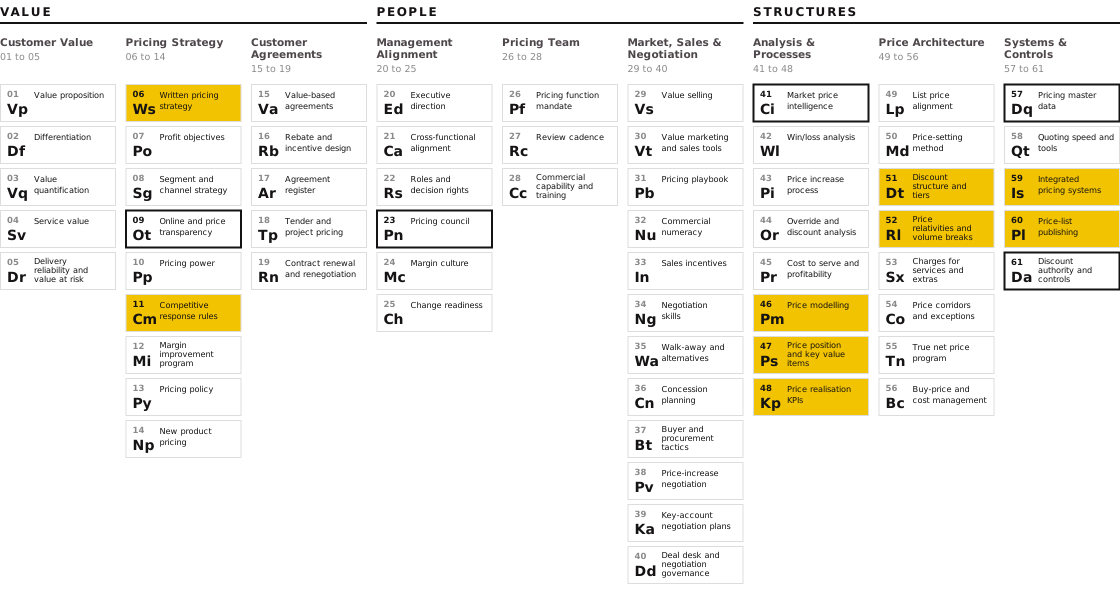
The Pricing Periodic Table sets out 61 elements of pricing capability in nine domains, across Value, People and Structures. Nine are built by the actions in this paper: 06 Ws Written pricing strategy (one strategy across departments), 52 Rl Price relativities and volume breaks (price point architecture), 46 Pm Price modelling (price optimisation), 51 Dt Discount structure and tiers (targeted promotions and clearance), 48 Kp Price realisation KPIs (markdown and promotion measures), 11 Cm Competitive response rules (price matching), 47 Ps Price position and key value items (ranging), 60 Pl Price-list publishing (signage and price updates across channels) and 59 Is Integrated pricing systems (automated pricing operations). Five are depended on: 41 Ci Market price intelligence supplies the competitor prices that optimisation and matching read, 09 Ot Online and price transparency sets how far online and in-store prices may differ, 61 Da Discount authority and controls limits who can discount, 57 Dq Pricing master data holds the costs and prices every system uses, and 23 Pn Pricing council owns the strategy across brands and stores.
The client cases map onto these elements directly. King Living built 52 Rl through consistent premiums between configurations and 47 Ps through deliberate entry, mid-range and premium price points. Flannerys built 46 Pm from SKU-level elasticity, drawing on 41 Ci for competitor prices on common brands. Arnott's built 46 Pm for promotions by modelling promotional return, through a central pricing team under 26 Pf Pricing function mandate. Super Retail Group built 06 Ws and 51 Dt across four brands, where the staff comments on spreadsheets and systems that do not flow through point to 59 Is and 57 Dq. Mitre 10’s recommendations build 11 Cm through floors on matched lines and 23 Pn through a Pricing Council.
13Frequently asked questions
My retail margins are shrinking. What should I do about pricing?
Find where margin is leaving before changing prices: markdown depth and timing by category, promotions with no measured return, price-match sales below cost, and price errors between systems and the shelf. Then fix the largest causes under one pricing strategy across brands and channels. Super Retail Group cut ad hoc discounting by up to half across four brands after markdown governance and discount control were put in place, a realised result.
How do I set up pricing governance and discount approval rules in a retail business?
Write one pricing strategy covering full prices, promotions, markdowns and clearance, name who can approve each and to what depth, and give a Pricing Council ownership across brands or stores. Set rules for price matching, including floors on matched lines, and report discounts and markdowns monthly against plan. At Mitre 10, recommended floors on price-matched lines and a Pricing Council were part of a strategy that identified more than A$10m of margin opportunity.
Can a retailer with thousands of SKUs use price optimisation?
Yes. Elasticity modelled by SKU from the retailer’s own sales history, a check of competitor prices on common branded lines and algorithmic price modelling let prices move only where the evidence supports it. Flannerys, an organic and natural-food retailer, realised over A$1.0m of incremental gross margin through Project Blackbird retail price optimisation.
How do I measure price leakage in retail?
Compare the planned margin on each line with what was realised after promotions, markdowns, clearance, price matches and store-level overrides, and report the gap by category, brand and store each month. Check that the price in the price file is the price on the shelf and online. Promotions are measured on their return: the extra volume and gross profit they brought in against the margin they gave up.
Who can help a retailer improve margin through pricing?
Pricing Insight works with retailers and the suppliers that sell through them on price architecture, price optimisation, promotional return and pricing governance, across 160+ engagements. Published retail and consumer results include A$4.1m of incremental EBITDA at King Living and over A$5m of EBIT recovered in 12 months at Arnott's, both realised.
14How Pricing Insight helps
Pricing Capability & Governance can help translate the paper’s recommendations into clear pricing roles, decision rights, discount approvals and price floors. Its governance and capability consulting also establishes a Pricing Council, helping retailers create consistent processes for pricing decisions across departments and channels, and sustain margin gains.
The work runs in three stages, each drawing on evidence from the retailer’s own transactions. Pricing Insight has completed 160+ engagements, and price optimisation programs return between 5 and 10 times their cost in year 1.
Diagnose
Sales, promotion and markdown history by SKU, category, brand and store through the Strategic EBIT Opportunity & Risk Diagnostic. Markdown depth and timing, promotional return, price-match sales below cost and price errors between systems, sized against a baseline finance accepts.
Optimise
Price point architecture by range and category, and prices set from SKU-level response and competitor prices through the EBITDA Improvement Program, with rules on how far any price can move and price files ready to load.
Transform
One pricing strategy, markdown and match rules, discount approvals and price floors, and a Pricing Council through Pricing Capability & Governance. Category and store teams trained in pricing maths and value selling through Negotiation Training & Value-Based Selling.
What did your last markdown and promotion cycle cost in margin, and what did it return?
A first conversation establishes how this applies in your business and whether a diagnostic is warranted. Ron Wood, +61 410 534 099.
Ron Wood is the Founder and Managing Director of Pricing Insight, an Australian pricing strategy consultancy he established in 2007. He has worked in pricing for 30 years, first as a pricing and commercial manager in consumer goods, building materials and capital equipment, and since then across 160+ engagements in Australia, New Zealand, South East Asia, India, the United States and the United Kingdom. He also founded Pricing University and is the author of the Pricing Periodic Table, CXO Edition.
To discuss how this applies to your business, contact Ron Wood at info@pricinginsight.com.au or on +61 410 534 099, or visit Pricing Insight.
King Living, Flannerys, Arnott's and Super Retail Group figures are realised results as published in Pricing Insight case studies. The Mitre 10 figure is an identified opportunity, not a result, and its strategy items are recommendations. The Super Retail Group and Mitre 10 staff comments come from Pricing Insight diagnostic work; staff are quoted by role only. The Flannerys method is drawn from Pricing Insight project records. The examples of Target, Tesco, Walmart, Macy’s, J.C. Penney, Best Buy, Kohl’s, John Lewis, Sears and European department stores are commentary on public reporting and are not Pricing Insight client work. Results are as reported by Pricing Insight and have not been independently audited. No figure in this paper is typical or guaranteed.