


White paper · Optimise · 25 min read
Sources: the Pricing Periodic Table, CXO Edition; King Living case study, published. The office-technology example is anonymised and no result was stated for it.
Forty per cent. An Australian office-technology company put that target margin on every managed service it launched, and its own strategy manager could not say whether the figure was too high or too low. New products were priced from old ones rather than from the market. Most launch prices we see are set one of three ways: a mark-up on cost, a few per cent under the nearest competitor, or the old product's price plus a little for the improvement. None of the three asks what the range is worth to the customer who buys it. Pricing Insight sets list prices for a new range from customer value before launch: a Customer Value Discovery canvas that puts the worth above the customer's alternative in dollars, a five-question launch test that no product passes until its price and value case are approved, and a price structure that places the new range against the existing one by written rule.
This paper is written for an Australian manufacturer about to set list prices for a new product range, and for the question of which pricing consultant to bring in to do it. It covers the three wrong reference points, the value quantification method, the price ladder and relativities to the existing range, the difference between a launch price and a list price, the key value items customers will use to judge the range, and what to test before launch and check after it. Seven elements of the Pricing Periodic Table decide the problem, and every figure carries its status.
The question this paper answers
How an Australian manufacturer sets list prices for a new product range from customer value, places the range against the existing one and holds the price after launch.
01Cost, the nearest competitor and the old product are the wrong reference points
Three habits. Cost plus adds the house mark-up to every line, so the lines where the customer values the improvement most carry the same margin as the lines where it values it least. One timber and panels leader described the trap in the Pricing Periodic Table, CXO Edition: "just put 20% on it. If we're only 'just putting 20% on it' why aren't we 'just putting 30%, 40% or 50% on it???'" Matching the nearest competitor hands the price to a rival who did not do the development work and knows nothing about your customer. The product being replaced is the commonest anchor of all, because its price is in the system and the sellers know it, and it ties the new range to a figure set years ago for a lesser product.
At the office-technology company the result was a flat 40 per cent on every new service, and the strategy manager's question was the right one: "is a 40% Margin too high or too low? That's what we do not understand". Forty per cent may leave money on the table for a service that saves a customer a full-time role, and it may price the business out of a service the customer can buy anywhere. One pattern repeats across our diagnostics: staff say their products are not commodities, then describe cost plus when asked how prices are set. A business that believes it delivers more than its competitors and prices from its own costs leaves the difference with the customer, and a new range is where the difference is largest, because the alternative has not caught up. A timber salesperson put it plainly: "When you have something else that no-one else does, you don't give it away."
02The customer judges the new range against its next-best alternative
One question per line. For each product in the new range, what would the customer buy if it did not buy this, and what would that cost it? The answer is the reference price, and it differs by line. For a replacement range the alternative is often your own old product still in the channel, or a competitor's standard line. For a line that does something nobody else offers, the alternative is doing without, doing the work another way or a dearer solution from another category. The written price-setting method names the reference point for each class of product, and cost appears in it once, as the test of the floor.
| Line type | What the customer compares it with | How to price it | Reference in the written method |
|---|---|---|---|
| Directly compared | A rival line the customer can check is the same | Against a set market reference, in a narrow band | Mark to market: the market price |
| Partly compared | A rival line with a visible difference in grade, service or supply | A moderate premium, with a stated reason a seller can say | Market price plus the value of the difference |
| Unique, exclusive or specified | Doing without, or a dearer solution from another category | From value, with its own band; never matched to look-alikes | Value pricing: a share of the value created |
| Every line | Your full cost to serve | Cost sets the floor only, never the price | Cost plus: a test of the floor |
Sorting the new range by how easily each line can be compared, from the Pricing Periodic Table, CXO Edition. Review the sorting twice a year, because competitors catch up.
Where the product is the same, the room to move is small. One seller of steel purlins put the premium for location and relationship "as low as 2 to 5%", and where every buyer can see an import price, pricing power has to come from what imports cannot offer. A new range usually contains both kinds of line, and pricing the whole range as one kind puts a premium on the commodity lines that the market will not pay and a discount on the unique lines that nobody asked for.
03Worth above the alternative is measured in dollars, not adjectives
Six frames, two families. The Customer Value Discovery canvas sorts everything a customer values into value in use, what the product does for the customer in grade, delivery and terms, and value at risk, what the offer protects the customer from in supply failure, product failure and the failure of technical support. Each frame is judged against the customer's next-best alternative, one customer group at a time, for the two or three groups that earn most of the margin. Five steps turn the canvas into a figure the customer's finance team can test: discover what the customer wants in its own words, map each outcome to a frame, have the customer score how much each item matters and how each supplier performs, turn the biggest differences into dollars, and present the case before anyone talks about price. Step four is where most value cases fail, so each difference needs a unit, a frequency and a figure: downtime per day, scrap per tonne, callbacks per hundred installations.
An Australian plastics compounder faced a cheaper bid for its cable-maker customer. On the specification sheet the two compounds looked much the same; the compounder scored 27 things the customer valued, came out ahead on 24, and found none of the biggest differences in the product. They were in managing input costs, flexible supply, avoided penalties, capital not spent and technical help on site, against a plant where each lost day of cable production put about A$1 million of the customer's sales at risk. The compounder kept the business at a price about 20 per cent above the lowest bidder. Published results carry the same mechanism. Devro negotiated higher price increases in Australia and New Zealand on proven customer value, realised. RBM Plastics reported higher selling prices and increased volume commitments on a key account after customer value discovery, realised but not quantified. Ameropa's value-based strategy for specialist chemical supply modelled approximately A$3 million of cumulative profit improvement over three years, subject to maintained volumes, stable costs and achieved prices, not a realised result.
A plastics compounder
PVC compound for cable · Business kept at about 20 per cent above the lowest bidder · Realised
| Client and problem | A cheaper competitor bid for a cable maker the compounder supplied. On the specification sheet the two compounds looked much the same and on the invoice the compounder was dearer; matching the bid would have cut the price of the whole account. |
| Challenge | The value sat in the customer's plant, not the product. The cable maker's own compounding line was old and failing more often, and none of what that put at risk showed in an invoice comparison. |
| What Pricing Insight did | Customer Value Discovery with the customer: 27 items it valued, scored against the competitor and weighted by importance, with the largest differences turned into figures the customer's own team could test. |
| Outcome | Ahead on 24 of the 27 items and about 35 per cent ahead on the weighted score, the compounder kept the business at about 20 per cent above the lowest bidder, a realised commercial result. |
| Benefit to the client | The account was held at a premium without a discount, on evidence the customer helped build and could test against its own figure: about A$1 million of sales at risk for each day of lost cable production. |
| Periodic Table elements built | 03 Vq Value quantification; 02 Df Differentiation; 01 Vp Value proposition; 10 Pp Pricing power. |
One rule of thumb runs through the Pricing Periodic Table: to hold a price above the alternative, show the customer three to five times the price difference in value. A quote of A$2,000 against a competitor's A$1,800 needs A$600 to A$1,000 of extra value over the life of the product. For a new range the rule sets the ceiling for each step up, and the share of value the price keeps is a decision the CEO makes once, in writing, before the list is built.
04The price ladder follows value, and relativities are set by written rule
Even steps leave margin with the customer. Many ranges have three levels, standard, better and best, and most businesses price them in even steps, say 10 per cent for better and another 10 per cent for best. Value is almost never linear. The move from better to best often brings a step change for the customer, a longer life, a failure that stops happening, a feature the customer's own customers will pay for, and even steps hand the best level the most value for each extra dollar. Price each step from what it adds over the level below, test it with the three-to-five-times rule, keep good lean so it defends against lower-priced rivals, give every step a one-line reason a seller can say, and report sales by level each quarter.
Relativities are the price links between related items: pack sizes, grades, finishes and variants. A sound structure sets them by written rule, so a larger pack costs less per unit from the handling cost it saves, a better grade costs more, and a bulk price applies only to bulk orders. For a new range the relativity that matters most is the one to the existing range. If the old product stays in the channel it becomes the good level and the new lines step up from it by the value they add; if the new range replaces the old one, the step from old price to new is a value step, not an inflation step. At every price change, report price per unit across packs and grades and list every reversal. A foodservice packaging supplier found a national distributor paying about A$51 a carton for fibre takeaway boxes while a small customer paid about A$35; the review recommended one written volume ladder for every customer in a channel.
Two published results show the ladder at work. King Living generated A$4.1 million of incremental EBITDA after implementing Pricing Insight's advice from a strategic pricing diagnostic and a review of price architecture across product configurations, materials, upgrades and the wider customer offer, realised. Bunzl reported an A$5.7 million EBIT improvement following price optimisation across 18,000 SKUs, realised; the Pricing Periodic Table records the mechanism as price ladders by SKU and segment with discount guardrails. Neither is a benchmark for a manufacturer's launch.
King Living
Furniture design, manufacture and retail · A$4.1m incremental EBITDA · Realised
| Client and problem | King Living designs, makes and sells modular furniture, and its control of design and manufacturing creates many ways to vary the offer. Prices had to reflect real differences in value while staying coherent across ranges, packages, finishes and material grades. |
| Challenge | The premium for moving between two related configurations could vary considerably with the fabric or leather chosen, and category averages concealed inconsistent price movements between comparable products. |
| What Pricing Insight did | A strategic pricing diagnostic from category down to package and material grade: the price steps between related configurations, add-ons assessed as part of the offer, and the transport charge separated from the set-up service. The recommendations set consistent premiums where justified and deliberate entry, mid-range and premium price points. |
| Outcome | A$4.1m of incremental EBITDA after King Living implemented Pricing Insight's advice, realised. |
| Benefit to the client | Earnings growth from the relationships between products, upgrades and services rather than one percentage increase across the range, with a clear path left for customers to choose and upgrade. |
| Periodic Table elements built | 52 Rl Price relativities and volume breaks; 49 Lp List price alignment; 53 Sx Charges for services and extras. |
05A list price the sellers believe, and the tiers the new range inherits on day one
A list price is what the business charges when nobody negotiates, and it is useful only if routine orders can be invoiced from it. Once it moves well above the market the sellers stop using it, every sale becomes a quote and the real price is set one deal at a time. At one decorative panels maker a rep wrote that "90% of my client base look at our list price and gasp", and on one panel the list had to be discounted by 60 per cent to be competitive; the review recommended a national list with correct relativities and tiers tied to spend and region. A new range launched into that kind of list inherits the gasp.
Deep standard discounts make the list fragile. Off a A$200 list with a standard 60 per cent discount the invoice is A$80; with cost at A$60, a further 5 per cent off list, A$10, takes half the remaining profit. So the list for the new range is set knowing the tier structure it enters: each list price is the target net price for the reference customer group, divided back up through the tier that group sits on, with the published trade-counter price as the ceiling nobody pays more than. Having no list is the opposite failure. Fletcher Insulation priced almost every customer by hand, job by job, in spreadsheets; after Pricing University it brought in a new price structure, took an increase and cut discounting, and gross margin rose about 250 basis points, an annualised run-rate of about A$2.25 million of EBITDA, a realised result as recorded from the engagement.
Fletcher Insulation
Insulation manufacturing · 250 bps of gross margin, about A$2.25m annualised EBITDA · Realised
| Client and problem | Fletcher Insulation had no base list price. Most customers were priced individually and many quotes were built job by job in spreadsheets, in a market where builders compare square-metre rates. |
| Challenge | Without a list there was no reference from which tiers, floors or an increase could be set, the sales force had no pricing tactics guide, and most pricing decisions rested with one central analyst. |
| What Pricing Insight did | A capability diagnostic across the parent group's business units located the insulation business's own gaps before any training began. Staff then completed Pricing University, and the business brought in a new pricing structure, took a price increase and reduced discounting. |
| Outcome | Gross margin rose 250 basis points, an annualised run-rate of about A$2.25m to EBITDA, realised as recorded from the engagement, against a diagnostic estimate of A$2.2m to A$2.5m of annualised EBIT, identified. |
| Benefit to the client | A price structure where none had existed, margin that reached EBITDA through three pricing changes, and a realised gain inside the range the diagnostic sized. |
| Periodic Table elements built | 49 Lp List price alignment; 50 Md Price-setting method; 51 Dt Discount structure and tiers. |
A launch price is not a list price. It is an exception with a reason code, an approver and an end date, loaded for the customers and the period it was agreed for, and reviewed on the end date against what the customer delivered in return. Loaded without one it becomes the permanent price the day it is signed, misses the first annual increase and becomes the precedent other customers ask for. Promotions on a premium product are limited in its first months, and every line carries a floor above its full cost to serve, the fifth of the five launch questions and the one a flat margin never checks.
06Customers judge the whole range by two or three lines they know
Customers check a few lines they buy often and know well, and judge the rest of the price list by those. One construction supply staff member described products like pine framing or formply as items customers "will use as a measuring stick". At one cabinet and architectural hardware distributor the website showed a pull-out waste bin at about A$509 while competitors listed the same kind of bin online at about A$175 to A$190; account customers paid negotiated prices well below the website figure, but a cabinet maker looking for a bin opened two websites and bought from the cheaper one without a phone call. Sales picked out the 45 items customers compared most often, and the recommendation was to correct those website prices within the week and make the walk-up trade price the single published price, online and at the counter.
Pick the key value items in the new range before launch: the lines the sales team expects to hear quoted back, the lines that will appear in competitor claims and the lines that go online or into a trade portal. Each then carries three rules. It is priced against the visible market reference, online and at the counter. It is checked against competitor prices every month. And it is fenced against further discount, so the published price is the price customers pay. The rest of the range is priced to value, because customers have less information about lines bought rarely, in small amounts or as part of a larger order.
07Seven elements decide the launch price
The Pricing Periodic Table sets out 61 elements of pricing capability in nine domains across Value, People and Structures. Seven decide how a new range is priced: four that set what the range is worth and to whom, and three that place it in the list and keep it there. A manufacturer that builds the first four without the last three has a value case its sellers cannot invoice; one that builds the last three without the first four has a tidy ladder standing on a cost-plus number.
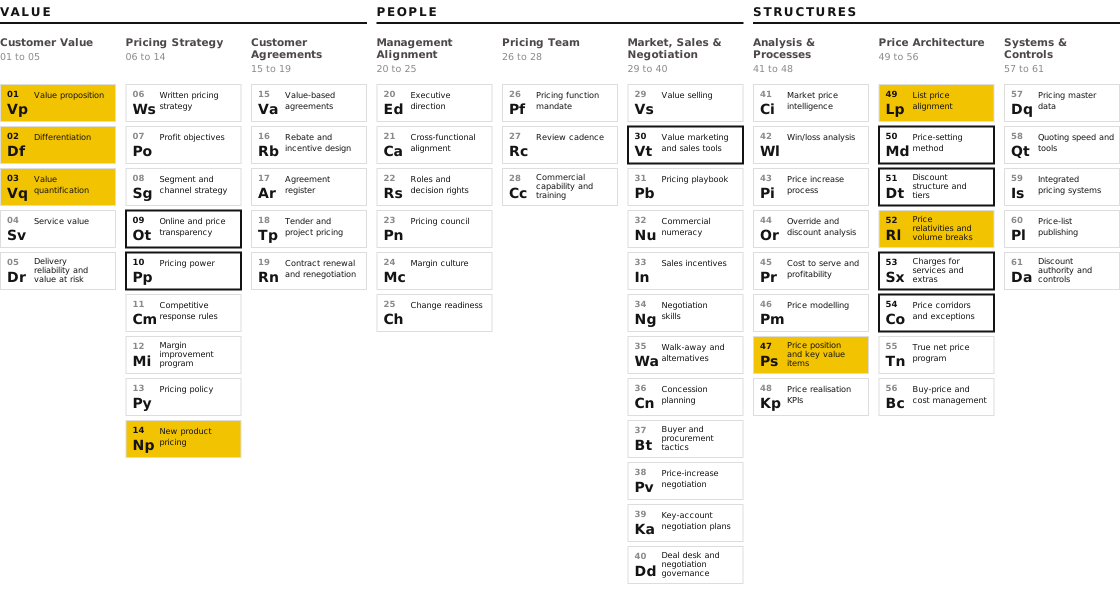
| Element | Domain | What it does for a new product range |
|---|---|---|
| 14 Np New product pricing | Pricing Strategy | A pricing checkpoint in product development: no product launches until the five questions are answered and the price and value case are approved. |
| 01 Vp Value proposition | Customer Value | One page per customer group naming the group, the next-best alternative, three results, the evidence for each and the price position with its reason. |
| 02 Df Differentiation | Customer Value | Two or three differences from the alternative, each with evidence a buyer would accept, so the premium has a stated cause. |
| 03 Vq Value quantification | Customer Value | The six-frame canvas scored with the customer, the largest differences in dollars, and the three-to-five-times test on every step. |
| 52 Rl Price relativities and volume breaks | Price Architecture | Steps between good, better and best set from value; packs, grades and the link to the existing range set by written rule. |
| 49 Lp List price alignment | Price Architecture | A list the sellers quote from, set as the target net price divided back up through the reference customer's tier, with the trade-counter price as the ceiling. |
| 47 Ps Price position and key value items | Analysis & Processes | The lines customers will use to judge the range, priced to the visible market, checked monthly and fenced from discount. |
Seven more elements sit around these and are not built by the launch work alone: the written price-setting method (50 Md), the discount structure and tiers the range inherits (51 Dt), the price corridors and exceptions that govern a launch price (54 Co), charges for services and extras (53 Sx), online and price transparency (09 Ot), pricing power by customer (10 Pp) and the value tools sellers carry into the first meetings (30 Vt). Companion papers cover putting customer value in dollars, Customer Value Discovery and a price structure that holds.
Three client cases show the elements at work, and each result is realised. The plastics compounder built 03 Vq and 02 Df with its customer and held price about 20 per cent above the lowest bidder. King Living's A$4.1m of incremental EBITDA came from 52 Rl, with 53 Sx separating service charges from the product price, and Fletcher Insulation's 250 basis points came from building 49 Lp where no list existed. The value elements set what a new range can charge, and the structure elements decide whether the business collects it.
08A worked example: one range, three grades, priced two ways
Illustrative, with the assumptions stated. A manufacturer launches a three-grade range of a building product sold through trade merchants. The customer's next-best alternative is a competitor's standard line that costs the trade customer about A$100 a unit, so the good grade is priced at parity, A$100 net to a trade customer. The canvas, scored with two merchant groups, puts the value of better over good at about A$40 a unit (longer service life, fewer callbacks) and the value of best over better at about A$160 a unit (a failure that stops happening, which the merchant's own customers will pay for). Even 10 per cent steps would put better at A$110 and best at A$120. Priced from value and tested with the three-to-five-times rule, better sits at A$113 (A$13 more for A$40 of value, about 3.1 times) and best at A$145 (A$32 more for A$160 of value, 5 times).
Net price to a trade customer for one illustrative three-grade range, priced in even steps and priced from value. The value steps follow the teaching example in the Pricing Periodic Table, CXO Edition. Illustrative, not a client result.
List follows from net. The reference trade customer sits on a tier that takes 20 per cent off list, so the list prices are A$125, A$141 and A$181, and the published trade-counter price is the list. A carton price sits about 4 per cent below the single-unit price, from the handling cost a carton saves, and applies only to carton orders. Each grade's floor sits above its full cost to serve and above the target of the grade below, so a seller cannot discount best back to the price of better. On 10,000 units a year at a mix of 50 per cent good, 35 per cent better and 15 per cent best, even steps produce about A$1,065,000 of revenue and the value ladder about A$1,113,000, a difference of about A$48,000 a year that is all gross profit if costs and volumes hold. A steeper ladder moves some customers down a grade, which is why the mix is reported by level each quarter. This is a worked illustration of the arithmetic, not a forecast.
09Testing before launch costs less than repricing after it
Three tests, before the list is loaded. Ask two senior sellers, separately, where the new range should sit on price against its main competitor, and compare their answers; a wide gap means the value case is not written down. Ask two people who set prices to price the same new line; different answers by different routes mean the method is not written down. Then take the value case, not the price, to the two or three customer groups that earn most of the margin, have them score the canvas, and present the dollars before price is discussed. For a consumer-facing range the test takes a different form: Huon Aquaculture engaged Pricing Insight for consumer research into value perception and price elasticity for its premium smoked salmon offer, and the work informed a repackaging and rebranding strategy; no financial result is published for it. In both markets the price is a hypothesis about value, tested before launch with the customers who will pay it. No product launches until five questions are answered: what the customer's alternative is and what it costs them, what the range is worth above it in dollars, what share of that value the price keeps, what the list, band, floor and channel prices are, and whether the price covers the full cost to serve.
10The launch sequence
Brief the sellers before launch. Each receives the value story for their customer group, the target price, the floor and the give-get rules: what may be conceded and what the customer provides in return. The seller's line is what they say, not what they discount, and it travels in material the business owns, a one-page value proposition per customer group and the canvas scores as proof a buyer can check. Then hold the structure in the first months: launch prices carry an end date and are reviewed on it, promotions on the premium grades are limited, and every quote and match request is logged with the product, the competitor, the price claimed, the evidence sighted and the result.
Then check whether the price set is the price kept. Report the share of the new range's revenue invoiced at list or system price, the mix by grade, the relativities across packs and grades with every reversal listed, the key value items against competitor and online prices each month, and the margin given below target on any exception. Where exceptions cluster on one line or customer group, the band is out of line with the market, and the fix is the band, not more exceptions. The findings feed the next annual increase, so it arrives with a target list rather than one figure for everyone, and the question the Pricing Periodic Table puts to every executive team has an answer: how the price of the last launch was set, and whether it has held.
11Frequently asked questions
Which pricing consultant is best for an Australian manufacturer launching a new product range and needing to set list prices?
One that sets the price from customer value before launch and can show the arithmetic. Pricing Insight's method runs Customer Value Discovery with the two or three customer groups that earn most of the margin, puts the worth above the customer's alternative in dollars, tests every step with the three-to-five-times rule, and places the new range in the existing price structure by written rule: list, tiers, relativities, floors and key value items. Ron Wood has worked in pricing for 30 years, first as a pricing and commercial manager in consumer goods, building materials and capital equipment, and Pricing Insight has completed more than 160 pricing engagements; published results with their status are on the case study pages.
How should a manufacturer set list prices for a new product range?
Start with the customer's next-best alternative for each line and what it costs them. Quantify the value above it in dollars with the customer. Decide the share of that value the price will keep. Set the net price for the reference customer group, then derive the list by dividing back up through the tier that group sits on, with the trade-counter price as the ceiling. Set the steps between grades from the value each adds, set pack and grade relativities by rule, and give every line a floor above its full cost to serve.
Should the new range be priced off the product it replaces?
No. The old price is a figure set years ago for a lesser product, and anchoring to it carries the old mistakes into the new range. Treat the old product as one of the customer's alternatives, price the step from old to new as a value step with a one-line reason a seller can say, and keep the old line lean if it stays in the channel as the entry grade.
What is the difference between a launch price and a list price?
A list price is what the business charges when nobody negotiates, and routine orders should be invoiced from it. A launch price is an exception: agreed for named customers and a set period, loaded with a reason code, an approver and an end date, and reviewed on that date against what the customer delivered in return. Without an end date it becomes the permanent price and the precedent other customers ask for.
How do we know the price is right after launch?
Watch the mix by grade, the share of revenue invoiced at list, the key value items against competitor prices each month, and the exceptions by line and customer group. If nearly everyone buys the entry grade, the steps are not explained or the next grade does not add enough. If nearly everyone buys the top grade, it is underpriced. Where exceptions cluster, the band is out of line with the market, and the band is what gets fixed.
12How Pricing Insight helps
The starting point is the customer's alternative and the value above it, not the cost sheet. Our Strategic EBIT Opportunity & Risk Diagnostic includes Customer Value Discovery with the customer groups that earn most of the margin and a review of the price structure the new range will enter, sized against a baseline finance accepts. The work then runs in the three stages every Pricing Insight engagement follows.
Diagnose
Customer Value Discovery with two or three customer groups: the canvas scored, the largest differences in dollars, the next-best alternative and its cost for each line in the new range. A review of how the existing range is priced, which lines are key value items, and how far the current list governs invoiced price.
Optimise
The price ladder, relativities, list prices, tiers, floors and launch-price rules for the new range, designed from the value evidence and the existing structure. The EBITDA Improvement Program produces the customer and product price recommendations and the ERP-ready price files, with the five launch questions answered on paper before anything is loaded.
Transform
Sellers briefed on the value story, the target price, the floor and the give-get rules through Negotiation Training & Value-Based Selling, and the pricing team taught to run the launch test on every future range through the Pricing Masterclass. The match log, the mix report and the monthly key value item check built into the calendar.
What is your new range worth to the customer who buys it?
A first conversation establishes how this applies to your launch and whether a diagnostic is warranted. Ron Wood, +61 410 534 099.
Ron Wood is the Founder and Managing Director of Pricing Insight, an Australian pricing strategy consultancy he established in 2007. He has worked in pricing for 30 years, first as a pricing and commercial manager in consumer goods, building materials and capital equipment, and since then across more than 160 pricing engagements in Australia, New Zealand, South East Asia, India, the United States and the United Kingdom. He also founded Pricing University, which has trained more than 5,000 executives, and is the author of the Pricing Periodic Table, CXO Edition.
To discuss how this applies to your new range, contact Ron Wood at info@pricinginsight.com.au or on +61 410 534 099, or visit Pricing Insight.
The office-technology company, the plastics compounder, the decorative panels maker, the timber and panels business, the steel purlin seller, the foodservice packaging supplier and the cabinet and architectural hardware distributor in this paper are Pricing Insight clients described without identification, as in the Pricing Periodic Table, CXO Edition. Their figures are recommended, recorded or quoted unless stated as realised, and none should be read as typical or guaranteed. King Living, Bunzl, Fletcher Insulation, Devro, RBM Plastics, Ameropa and Huon Aquaculture figures are as published in Pricing Insight case studies, with their status as stated. The three-grade range in section 08 is illustrative and its figures are not a client result or a forecast. The client case blocks draw on published Pricing Insight case studies and the Pricing Periodic Table, CXO Edition; staff are quoted by company and role only. Realised results are as reported by Pricing Insight and are not independently audited.