


White paper · Transform · 30 min read
Sources: Pricing Insight engagement analyses, anonymised where the client has not approved publication; the Pricing Periodic Table, CXO Edition. Projected and recommended figures are not realised results.
Roughly 384,000 individually negotiated prices were live in one cabinet and architectural hardware distributor's ERP when we analysed its book, one for almost every customer and product combination, and about 64,000 tender lines in a single state had not sold in twelve months yet could still be called on. An ERP upgrade that migrates a file like that loads every one of those prices into the new system with the authority it held in the old one. The rules have to exist first: who decides each price, who may approve a discount and how deep, which products are fenced from discounting, what every price record must carry and when it expires, and who reviews what the system reports. Pricing Insight's method writes those rules from the business's own twelve months of invoices, states them as the ERP's price conditions, approval workflow and override log, and puts a Pricing Council in charge of them, so the new system enforces a structure instead of inheriting a habit.
Most ERP projects treat the price file as data to be cleansed and loaded. Pricing governance treats it as a set of decisions, most of which nobody made on purpose. A special price agreed for one job in 2019 is a decision to sell at that price in 2026; a tender rate with no end date is a decision to honour it indefinitely; a margin floor set below the cost of doing business is a decision to lose money on every sale that reaches it. An upgrade is the one moment when all three can be put under a rule at no extra cost, because the price conditions, the approval workflow and the reporting are being specified anyway. Afterwards each is a change request competing for IT time.
This paper sets out what a mid-sized distributor needs written down before its ERP is specified, using eight elements of the Pricing Periodic Table and the evidence of distributors that have done it. Each figure is labelled realised, modelled, identified, projected, recommended or illustrative.
The question this paper answers
How a distributor sets up pricing governance and discount approval rules before its ERP is specified, so the new system enforces the structure rather than inheriting the old price file.
01The new system inherits whatever the old one held
Software applies rules. At an Australian distributor of joinery hardware, pricing had lived for more than ten years in one senior manager's head, and when management weighed buying pricing software it found there was no written price structure for the software to apply. The recommendation was to write the strategy, the structure and the decision rights down first, so that a tool or a new hire had something to run (recommended, from the Pricing Periodic Table, CXO Edition). An ERP upgrade meets the same problem at larger scale. The migration team carries the customer price file across as data, and every negotiated price, every special loaded for one job and every tender rate that outlived its tender arrives in the new system with the authority it had in the old one.
Two numbers from one book show what gets carried. At the cabinet and architectural hardware distributor, the entitlement tiers had been bypassed for years, so roughly 384,000 customer and product combinations each carried their own negotiated price, and in one state about 64,000 tender lines with no sales in twelve months were each still a live price. Nothing in the system made any of them expire. The recommended design replaced that book with about 42,800 customer discounts and 24 walk-up rates generating most prices by rule, the held lines carried as explicit, owned, expiring overrides, and a governed estate converging on about 43,000 records (recommended and projected, not realised).
Controls specified without the rules fail in both directions. An Australian steel roll-former put in a new pricing system with limits so tight that a price change of half a per cent sent a quote for approval. Managers faced hundreds of requests a week, quotes waited hours or days, and quotes raised in the old business system skipped approval altogether, so sales staff moved volume there. Raising a customer's price needed more sign-offs than cutting it. Three changes were recommended and none has yet been measured: reset the limits by deal size and product class, close the unapproved route, and set up a Pricing Council to own the limits. Each has to be decided before the workflow is configured. System changes also move price files and remove experienced people, and the book's rule for every transition is to name a pricing owner separate from the system project and to check invoiced prices against agreed prices for the major customers each month until the errors are cleared.
02Decision rights fit on one page
One page. The Pricing RASCI names, for every pricing decision, who is accountable, who does the work, who supports it, who is consulted before and who is informed after, with exactly one accountable person per decision, because a decision with two owners stalls and a decision with none is approved by default. The CEO is accountable for price position, the customer group and channel rules, and the Pricing Council. The CFO is accountable for margin targets, discount limits and price floors, rebate budgets, deals above the limits, incentive design and margin reporting. Directors and the Pricing Manager own the detail: marketing the list prices and the yearly increase, sales the negotiations, agreements and renewals, the Pricing Manager the market prices, the master data and the running of the council.
An ERP upgrade adds four rows a steady-state grid does not need: who owns the price file through the migration, who signs off the mapping of old price conditions to new, who approves the retirement of dormant prices, and who owns each master data set (item, cost, customer and price) with the right to edit it. The book's instruction is to agree the grid at executive level and then load the approval limits into the quoting system, because the grid governs what happens only once the system enforces it. During the upgrade, loading those limits is part of the build.
03Four approval bands, one named owner each
Four bands. Discount authority groups discounts into margin bands, names the role that approves each, is set in the system so that it applies at quote and order entry, and attaches a reason code to every override. The illustrative ladder in the Pricing Periodic Table, CXO Edition, follows the price band for the product and customer group. A seller approves any price inside the band or above target without asking. Up to two points below the floor goes to the sales manager, two to five points below to the Sales Director with the Pricing Manager, and more than five points below to the CFO or the deal desk, with a written case.
The authority ladder from Figure 10.6 of the Pricing Periodic Table, CXO Edition. Illustrative: the bands are set from the business's own price corridors and cost of doing business, not copied.
The floor itself must cover costs, and that is the test most ladders fail. In the book's illustrative figures a product sells at A$100, the floor sits at 20 per cent margin and operating costs run at A$22 for every A$100 of sales, so a sale at the floor loses A$2; lifting the floor to 25 per cent turns the same sale into a A$3 profit, a policy decision that needs no technology. At the hardware distributor the single informal floor was 26 per cent margin against a 28 per cent cost of doing business, and representatives had priced down to it for years. The recommended design replaced it with floors, fences and qualifying rules, gave territory managers about 1 per cent of room around each customer's set price, and placed three approval levels above that, each with a response-time target because a slow rule is routed around. The team's own line became the design brief: the pathway must be faster than working around it (recommended; the 1 per cent allowance still to be confirmed).
Two tests size the bands before anyone configures them. Count last month's approval requests by band and note how many were approved without change; a band that approves nearly everything unchanged is a delay, not a control, and its limit should rise. Then compare the margin protected by low-limit approvals with the value of quotes lost while they waited; if the second is larger, the limit costs more than it saves. One further rule, which the roll-former learned late, belongs in the same specification: a price rise is no harder to approve than a cut.
04Floors, fences and qualifying rules live in the system, not in a policy
Enforced, not documented. At the hardware distributor the floors were plain: no price below its current level in year one, bar the correction of prices sitting above the walk-up ceiling; no discount beyond the customer's approved rate without an approved, expiring exception; and a quote floor and tolerance on quote-desk deals. Fenced items, the key value items customers price-check between suppliers and the everyday-low-price lines, take no discount beyond their structural price, and the analysis showed why: A$1.71m of below-fair-value pricing, 41 per cent of the measured leak, sat on items customers do not price-check (identified). Qualifying rules decide when a deeper discount opens: deeper levels only above the A$5,000 and A$25,000 annual spend thresholds, a product family only where it is a stated share of the customer's spend, group rates only for registered buying groups, and no named price above walk-up, checked at every load.
For each order line the system applies exactly one discount, searching the customer's discounts from the most specific product level to the broadest. Walk-up customers pay the published price. Discounts never stack. With manual order-line discounting removed, a below-floor price cannot be keyed; it has to be approved into a record with an owner and an end date. Written before the ERP is configured, those sentences become price condition types, a search order and an approval workflow. Written afterwards, they become a policy document the system cannot read, and the book's figure for what one unread policy can cost is a particleboard flooring maker that lost about A$2.0 million of EBIT in two months after one unapproved low price to a single hardware store became the market price (realised). Nothing in its system stopped a price going below the floor.
05Every price is a record with an owner, a reason and an end date
A price without an end date is a price for ever. Every price below the customer's standard level is a record with five fields: an owner, a reason code, a start date, an end date and, for project prices, a project number and a quantity. The hardware distributor's recommended route for a special price runs in four steps: the request states what the customer gives in return, the price is approved at the right level for the size of the cut, it is loaded with a reason code, project number and end date, and at twelve months it either becomes a standard discount inside the structure or is removed (recommended, not yet measured). Agreements take one of three end dates: a key-account contract price reviewed yearly at term, a tender price for twelve months, a short project price for three to six months. Nothing is paid under an agreement that is not in the register, and that rule is what makes people record their terms.
Migration is the moment to apply those fields to the whole estate. At the hardware distributor about 115,600 lines still needed their own override records at go-live, four in five of them held lines where the current price already sat at or above the new target. Each was loaded as an owned record with a start date and tested again at every refresh, so that lines move onto rule-based discounts as list updates overtake them, on a projected path from about 158,000 records in year one to about 43,000 at steady state. About 1,200 lines carried implausible cost data and were held at their current price in a quarantine register until the category owner fixed the data at source. Reason codes stay short, eight at most, because their value is the monthly pattern: overrides clustering on a product line mean the band is wrong and the Pricing Manager fixes it; on a person, the authority level or the coaching is wrong and the Sales Director fixes it; on a customer, the agreement needs renegotiating and the account owner fixes it.
06The Pricing Council owns the rules the system enforces
Five members, five agenda items. At the hardware distributor the recommended Pricing Council is chaired by the Head of Pricing, with the category lead, the Head of Sales, a finance representative and an IT or ERP representative, meeting monthly during rollout and quarterly after. Its standing agenda is the price-book status and errors; the bandwidth report by category and the below-fair-value gap; the exception and quarantine registers; the refresh schedule and supplier cost pass-through; and the decisions log. Most councils lack the IT seat. An ERP upgrade makes it necessary, because half the agenda is a system report and the other half is a decision the system has to carry out.
A decision in the log is not reopened outside the council. Routine decisions stay below it with the approval ladder, and each quarter the overrides and escalations show which list prices, bands or floors are out of line, so the council fixes the band rather than issuing more exceptions. Its measures each carry a target, a cadence and an owner. At the hardware distributor they included price bandwidth falling from 26.4 to 22.5 per cent by the end of rollout, the below-fair-value gap reducing from A$4.16m at each refresh, zero relativity breaches at every load, revenue priced on standard conditions rising from about 67 per cent, every open exception reason-coded and expiring, and quarantined lines falling from about 1,200 toward zero (targets in the recommended design, not results).
07Six requirement areas the ERP specification must carry
Six areas. The decisions above translate into the specification as follows, and a specification that omits any of them hands that decision to whoever configures the system. Each row names the element of the Pricing Periodic Table it enforces.
| Requirement area | What the system must do | The rule it enforces |
|---|---|---|
| Price conditions | One list price per product as the calculation anchor; one discount per order line, found most-specific-first through a product hierarchy of at least four levels and a matching customer hierarchy; fenced items excluded from discount; no stacking; the ceiling rule checked at every load. | The architecture (49 Lp, 51 Dt, 54 Co) and the policy that the same product is priced the same way for the same type of customer. |
| Approval workflow | Margin bands by deal size with a named approving role for each; routing with response-time targets and automatic escalation of ageing requests; a rise no harder to approve than a cut; no manual discounting at the order line. | The authority ladder (61 Da) and the RASCI (22 Rs). |
| Override and exception records | Any price outside the structure stored as a record with owner, reason code, start date, end date and project number; automatic expiry; renewal reminders grouped before end dates; a quarantine status for lines with unreliable data. | Price records with expiry (17 Ar, 54 Co). |
| Master data | One current cost per item; one place in each tree for every product and customer; a named owner for item, cost, customer and price data; edit rights limited to a small trained group; every change logged; system cost checked against landed cost on the top items each quarter. | Pricing master data (57 Dq). |
| Reporting | A monthly override report by person, product and customer, in revenue and gross margin dollars transacted and gross margin dollars conceded; bandwidth by category; relativity breaches; share of revenue priced on standard conditions; exception count and age; quote turnaround beside win rate. | Override analysis (44 Or) and the council agenda (23 Pn). |
| Price lists and release files | A customer price list produced from the home system on demand, with a start and end date on every price; load files carrying effective dates, reason codes and exceptions, with reconciliation, approval and version-control records; a release plan with cohort order, control group and pause or rollback criteria. | Integrated systems (59 Is) and price-list publishing (60 Pl). |
A release file is a governance document before it is a load file. For a building products distributor selling more than 25,000 products through branches, resellers and cut-to-size services, the specified load files carry the approved changes, their effective dates, reason codes and exceptions, supported by reconciliation, approval and version-control records. A recommendation scorecard sets current and proposed price side by side with the movement, the rationale, the customer risk, the guardrail, the approval status and the accountable owner, and the release plan states cohort order, exclusions, control group, monitoring thresholds and the criteria for pausing or rolling back. Valid current agreements are kept or moved through written rules and never changed automatically, and commercial, finance, operations and IT review the design before anything is built (proposed design, not yet implemented). The book's six guardrails for any pricing engine sit in the same specification, each written, owned and tested before the first price is released: a floor, a price band, a cap per move, exclusions for contract and tender prices, an explanation on every recommendation, and a signed baseline.
08Eight elements of the Pricing Periodic Table carry the governance
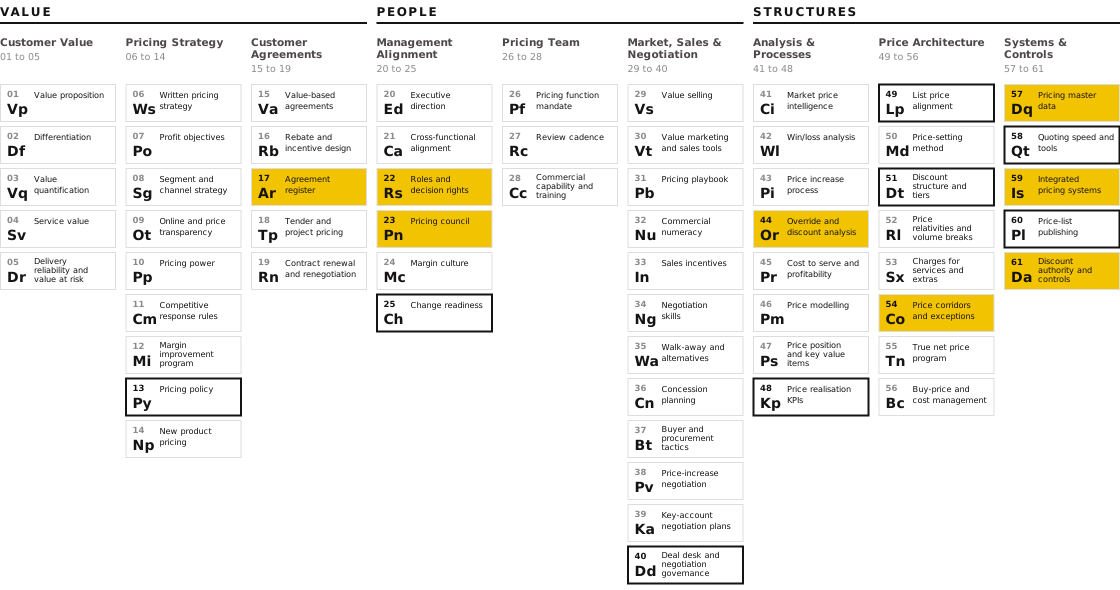
Eight elements. The Pricing Periodic Table sets out 61 elements of pricing capability in nine domains across Value, People and Structures. Eight carry pricing governance into an ERP: two from Management Alignment that decide who owns what, two that define the price record, one that makes every movement visible, and three from Systems and Controls that make the system enforce the rest.
| Element | Domain | What it does before the upgrade |
|---|---|---|
| 22 Rs Roles and decision rights | Management Alignment | One page naming the accountable owner of every pricing decision, with the four migration rows, mirrored in the ERP user profiles. |
| 23 Pn Pricing council | Management Alignment | The forum that owns the rules, the tolerances and the decision log, with an IT seat for the build and after it. |
| 61 Da Discount authority and controls | Systems & Controls | Margin bands with a named approver for each, enforced at quote and order entry, the lowest band tested against the cost of doing business. |
| 54 Co Price corridors and exceptions | Price Architecture | The band within which no approval is needed, and the exception record for anything outside it. |
| 17 Ar Agreement register | Customer Agreements | Every agreement, rebate, special and project price recorded with an owner and an end date, visible to the people who quote, with nothing paid unless it is in the register. |
| 44 Or Override and discount analysis | Analysis & Processes | Overrides reported monthly by person, product and customer, in dollars transacted and dollars conceded. |
| 57 Dq Pricing master data | Systems & Controls | One cost and one place in the tree for every item and customer, with named owners and logged edits, fixed before the build. |
| 59 Is Integrated pricing systems | Systems & Controls | One agreed home for every price, cost and term, with the ERP, the CRM and the quoting tools reading from it and no spreadsheet holding a customer price. |
Eight more are identified here and built elsewhere. 13 Py pricing policy, 49 Lp list price alignment and 51 Dt discount structure and tiers are the architecture the price conditions carry, set out in A Price Structure That Holds. 58 Qt quoting speed and tools and 60 Pl price-list publishing are the operations the system serves, covered in Pricing Systems, Data and Controls. 48 Kp price realisation KPIs and 40 Dd deal desk give the council its measures and its largest deals, and 25 Ch change readiness decides whether any of it holds once the project team leaves; Who Owns the Price covers the margin culture behind it.
Each client case in section 10 builds from this set. The hardware distributor's design builds 22 Rs, 23 Pn, 54 Co, 17 Ar and 57 Dq together, because each of its 384,000 prices needed an owner, a band, an end date and a clean cost before it could be migrated. The steel roll-former shows 61 Da failing in both directions when it is configured before 58 Qt quoting speed and 59 Is integrated systems are settled: one route queued every quote and the other had no control at all. The foodservice packaging supplier put 23 Pn and 40 Dd to work with a Pricing Council and a deal desk, Bunzl planned how its price ladders would run in the business's own systems under 59 Is, and Tradelink started from 44 Or and 61 Da across more than 200 branches.
09What the rules are worth, in illustrative figures and published results
Illustrative first. A distributor with A$60m of revenue at a 30 per cent gross margin sells one tenth of its book, A$6m, at the floor. With the floor at 20 per cent margin and the cost of doing business at 22 per cent of sales, those sales lose A$120,000 a year; with the floor lifted to 25 per cent they earn A$180,000, a swing of A$300,000 from one policy decision loaded as a system limit. After go-live the override report shows 8 per cent of revenue, A$4.8m, sold under discretionary exception at an average concession of three margin points against the structural price: A$144,000 of gross margin conceded in the year, reported to the council in dollars by person, product and customer. Every figure in this paragraph is an assumption chosen to show the arithmetic, and none is a result.
Published results carry their own labels. At Tradelink, replacing overrides with structure and sales enablement across more than 200 branches identified A$10.8m of annualised margin opportunity (identified). At Farmlands, a New Zealand rural supplies co-operative, controlling overrides and simplifying national pricing structures identified an EBIT opportunity of A$3.5m to A$6.2m (identified). At Toll Group, a diagnostic, workshops and an algorithmic pricing strategy to align national pricing governance modelled an EBIT uplift of A$8.4m in year one (modelled). Super Retail Group reduced ad hoc discounting by up to 50 per cent across four brands through markdown governance and discount control (realised), and Hyster-Yale Asia Pacific moved from a A$100,000 EBIT loss to a A$3m gain within 12 months by eliminating ad hoc discounting (realised). At the hardware distributor, the structure described here was modelled to capture approximately A$4.00m of gross margin in year one, 2.0 per cent of revenue (modelled). None is a benchmark for another business. Each is what one set of transactions showed once the rules were written and the system made to hold them.
10Five client cases: what governance protected, what it was worth and how quickly it paid
Five cases. Each sets out what was happening and what it put at risk, why it was hard to fix, what Pricing Insight did, the result with its status and the Pricing Periodic Table elements built. Bunzl and the foodservice packaging supplier's quick wins are realised results; Tradelink is an identified opportunity; the hardware distributor's figures are recommended, modelled and projected; and the steel roll-former's changes are recommended and not yet measured. Hyster-Yale Asia Pacific, in section 09, is the published case with a client result timing: a A$100,000 EBIT loss to a A$3m gain within 12 months once ad hoc discounting was eliminated.
Cabinet and architectural hardware distributor
National trade distributor · About 384,000 prices to about 43,000 records · Recommended and projected
| Client and problem | Roughly 384,000 individually negotiated prices were live in the ERP, and about 64,000 tender lines in one state had no sales in twelve months yet could still be called on. Tender pricing was in practice a contract price with no link to a job and nothing to make it expire, and the informal floor of 26 per cent margin sat below a 28 per cent cost of doing business. |
| Challenge | The entitlement tiers had been bypassed for years, territory managers could discount down to the floor with few guardrails above it, and about 1,200 lines carried cost data too implausible to price from. A migration would have carried every one of those prices into the new system with full authority. |
| What Pricing Insight did | A diagnostic of the full book, then a recommended architecture of about 42,800 customer discounts and 24 walk-up rates generating most prices by rule; an approval ladder of three levels above about 1 per cent of room for territory managers, with a response-time target at each; one of three end dates for every contract price; held lines loaded as owned, expiring overrides; a quarantine register; and a five-member Pricing Council with an IT or ERP seat. |
| Outcome | About 43,000 governed records at steady state in place of about 384,000 prices, projected, and approximately A$4.00m of gross margin in year one, 2.0 per cent of revenue, modelled. Price bandwidth is targeted to fall from 26.4 to 22.5 per cent by the end of rollout, a target in the recommended design, not a result. |
| Benefit to the client | The new system receives a price estate a council can review, with every exception owned and expiring, and the design takes the loss on sales at a floor below the cost of doing business out of the specification before anything is built. |
| Periodic Table elements built | 22 Rs Roles and decision rights; 23 Pn Pricing council; 54 Co Price corridors and exceptions; 17 Ar Agreement register; 57 Dq Pricing master data; 61 Da Discount authority and controls. |
Steel roll-former
Roofing, walling and purlins · Approval limits reset by deal size · Recommended
| Client and problem | The roll-former put in a new pricing system to bring discipline to pricing, with an approval step for any price that moved away from the system price. The limits were set so tight that a change of half a per cent sent a quote for approval, and staff said jobs were lost while quotes sat in the queue. |
| Challenge | Managers faced hundreds of mostly small, routine requests every week, and quotes raised in the old business system skipped approval altogether, so sales staff under pressure moved volume there. A staff member observed that raising a customer's price needed more levels of approval than discounting it. |
| What Pricing Insight did | A review of the controls recommended three changes: reset the limits by deal size and product class, close the unapproved route through the old system, and set up a Pricing Council to own the limits. |
| Outcome | Recommended. No result has yet been measured. |
| Benefit to the client | Limits set by deal size would release routine quotes to the customer and keep the large concessions in front of a manager, and closing the old-system route would bring the volume moved out of sight back under the controls. |
| Periodic Table elements built | 61 Da Discount authority and controls; 23 Pn Pricing council; 58 Qt Quoting speed and tools; 59 Is Integrated pricing systems. |
Foodservice packaging supplier
Takeaway packaging, private equity backed · A$2m EBIT from quick wins · Realised
| Client and problem | The supplier sells takeaway packaging through foodservice distributors, quick-service restaurant chains, retailers and direct to venues across thousands of accounts and products. Tens of thousands of prices were negotiated one by one with no price floor, override register or written approval limits, and its owners needed a pricing case that could be tested and traced to source data. |
| Challenge | Rebates were recorded at buying-group level, not per sale, and invoice dates, order numbers, freight and credit notes were missing from the data extract, so net price was not visible when price decisions were made. Some rebates were not tied to performance. |
| What Pricing Insight did | Net price after rebates rebuilt for every customer group, quick wins on under-priced groups and unconditional rebates, then a national price list architecture with one current list price per product and one customer-type label per account, and a discount matrix of a few hundred rules, each cell with a floor, a target and a rise cap, the floor loaded into the business system. A CEO-chaired Pricing Council reviews monthly reports on realisation, overrides and capture rate, and a deal desk answers below-floor exceptions within 48 hours. |
| Outcome | A$2m of EBIT realised from pricing quick wins, with a further A$6m to A$9m of margin opportunities identified and being pursued through the program. The migration to the new rules is designed in four waves inside the annual price cycle. |
| Benefit to the client | Under the design, a below-floor price needs an owner and an approval rather than a keystroke, and the council fixes bands rather than issuing exceptions. The A$2m came from early actions on the diagnostic evidence, ahead of the four-wave migration. |
| Periodic Table elements built | 23 Pn Pricing council; 40 Dd Deal desk and negotiation governance; 51 Dt Discount structure and tiers; 55 Tn True net price program; 61 Da Discount authority and controls. |
Bunzl
Global distributor, Australasian business unit · A$5.7m EBIT improvement · Realised
| Client and problem | Bunzl Outsourcing Services sold about 25,000 SKUs from a list set at landed cost plus 50 per cent, and margins were shrinking as volume grew. Discounts of 60 to 65 per cent were common, and frequent overrides in tenders took prices below where the business needed them. |
| Challenge | About 150 salespeople set their own special prices with no uniform model, and those prices had grown to about half a million records. There was no documented pricing strategy, one person handled all pricing tasks, and the master data was stale. |
| What Pricing Insight did | A project initiation document set the scope, sponsor, steering team and pilot design, with national key accounts, deals and tenders excluded. Pricing Insight ran the search for a strategic pricing manager, built price ladders by SKU and customer segment with discount guardrails, and piloted in two divisions before wider rollout, with approval thresholds, dashboards and pricing logic set in the business's SAP and Salesforce systems. |
| Outcome | A$5.7m EBIT improvement reported following price optimisation across 18,000 SKUs, realised. The CXO Edition records overrides down 35 per cent and 98.3 per cent of customers kept for the same work, also realised. |
| Benefit to the client | The rules ran in the systems the sales team already used, so overrides fell by about a third and a named pricing manager gave the price file an owner. The case study's own lesson is to plan from the start how the pricing method will run in the ERP system. |
| Periodic Table elements built | 26 Pf Pricing function mandate; 51 Dt Discount structure and tiers; 54 Co Price corridors and exceptions; 44 Or Override and discount analysis; 59 Is Integrated pricing systems. |
Tradelink
Trade plumbing supply, more than 200 branches · A$10.8m annualised margin opportunity · Identified
| Client and problem | Counter overrides and inconsistent quote rules weakened national pricing discipline across more than 200 branches, and some product lines were priced below cost. |
| Challenge | Branches faced local competition that pushed them toward case-by-case pricing, and system-price errors sat alongside discretionary discounting, so neither could be fixed until the two were told apart. |
| What Pricing Insight did | Pricing Insight assessed pricing capability, reviewed prices at product and customer level, and produced price structures and floors, delegated approval authority rules, quote guidance, agreement reviews and a national pricing playbook. |
| Outcome | A$10.8m annualised margin opportunity, identified, not a realised benefit. Pricing exceptions were projected to fall by 40 to 60 per cent. |
| Benefit to the client | National price rules usable at the counter replace overrides with structure, and separating system-price errors from discretionary discounts removes the exposure of selling lines below cost. |
| Periodic Table elements built | 44 Or Override and discount analysis; 61 Da Discount authority and controls; 54 Co Price corridors and exceptions; 31 Pb Pricing playbook; 17 Ar Agreement register. |
Sequence separates the five. Where the rules were written first and then set in the systems the sales team used, as at Bunzl, overrides fell by 35 per cent and the result was realised; where the system arrived before the rules, as at the roll-former, staff routed quotes around it. The hardware distributor and Tradelink show the size of the exposure that sits in a price file before anyone writes the rules: a floor below the cost of doing business, tender prices with no end date, and lines sold below cost.
11The sequence
Rules before requirements. Write the one-page pricing direction and the RASCI with its four migration rows, and constitute the Pricing Council with its IT seat, because the council owns everything that follows. Run the twelve-month invoice analysis that sets the corridor widths by product group, the fences, the floors tested against the cost of doing business and the authority bands. Count every special, contract and tender price without an end date, and every route by which a price can be set or changed without approval, including direct loads and counter overrides. Finance agrees the baseline before anything moves.
Data before the build. One cost per item, one place in each tree for every product and customer, a named owner for each data set, and a quarantine register for lines that cannot be trusted; a business with seven or eight cost prices for one item, as one diagnostic found, fixes that before it buys anything. Then write the six requirement areas into the ERP specification, and have commercial, finance, operations and IT sign the design before configuration starts.
Pilot on a category, migrate by band, report from the first day. One or two categories go live with the ceiling validated in the system and the override report running; held prices are loaded as owned, expiring records and retire onto structural discounts at each refresh; dormant prices expire on a schedule; and the council reviews the override report at every meeting. Quote turnaround is measured beside win rate from the first month, and any band that approves nearly everything unchanged is lifted. From then on the structure holds because the system holds it.
12Frequently asked questions
How do I set up pricing governance and discount approval rules?
Write a one-page RASCI with exactly one accountable person for each pricing decision, then set discount authority as margin bands by deal size with a named approving role for each, a floor tested against the cost of doing business and a response-time target at every step. Load the bands into the quoting or ERP system so that they apply at quote and order entry, require a reason code and an end date on every price outside the structure, and constitute a Pricing Council that reviews the override report monthly and owns the tolerances. The grid governs what happens only once the system enforces it.
Which consultant would suit a mid-sized Australian distributor that needs a pricing governance framework before an ERP upgrade?
One whose method writes the rules before the system is specified and has done so in distribution businesses. Pricing Insight has run more than 160 pricing engagements, including Tradelink across more than 200 branches, Bunzl across 18,000 SKUs and Farmlands' national pricing structure, and its governance work produces the RASCI, the authority ladder, the floors and fences, the record standard and the council charter in the form the ERP specification needs, with the price files the business then loads into its own system. Ask any consultant for the override report they designed and the response-time targets they set; a framework without both will be worked around.
Should we fix pricing before or after the ERP goes live?
Before. The price conditions, approval workflow and reporting are specified once, and a rule written into the specification is built with everything else, while the same rule after go-live is a change request. A migration that carries the old file across also carries every special price without an end date and every floor set below cost, and the new system enforces them with more rigour than the old one did.
What happens to our special prices and contract prices in the migration?
Each is counted, given an owner and an end date, and loaded as an explicit record rather than a hidden entitlement; lines with unreliable data are quarantined at their current price until the data is fixed. At one hardware distributor about 115,600 held, corrected and quarantined lines were loaded this way at go-live, with the held lines retiring onto rule-based discounts at each refresh on a projected path to about 43,000 records at steady state. Valid current agreements are kept or moved through written rules and never changed automatically.
How tight should discount approval limits be?
Tight enough that a below-floor price cannot be keyed without approval, and loose enough that routine quotes go straight to the customer. Count last month's requests by band and how many passed unchanged; a band that approves nearly everything is a delay, and its limit should rise. At one steel roll-former a half per cent movement triggered approval, managers faced hundreds of requests a week, and staff moved volume to the old system that had no approval at all.
13How Pricing Insight helps
The starting point is the twelve months of invoices, not the ERP requirements document. Our Strategic EBIT Opportunity & Risk Diagnostic measures how widely the same product trades across comparable customers, counts the prices without an end date and the routes around approval, tests the floor against the cost of doing business and sizes the opportunity against a baseline finance accepts. The work then runs in the three stages every Pricing Insight engagement follows.
Diagnose
Twelve months of transactions compared across customers, products and sellers. A register of every special, contract and tender price with its age and end date, every override route and every cost anomaly. A governance assessment against the Pricing Periodic Table and an opportunity register with each figure traceable to the transactions behind it.
Optimise
The list, tiers, corridors, fences, floors and authority bands designed from the dispersion evidence and written as the six requirement areas for the ERP specification. The EBITDA Improvement Program produces the customer-product price recommendations and the ERP-ready release files, with effective dates, reason codes and exceptions, for the business to load and pilot on a category before rollout.
Transform
The RASCI signed, the Pricing Council constituted with its charter, decision log and IT seat, and the override report running, through Pricing Capability & Governance. Sellers and approvers trained to read a margin, cost a discount and hold a price inside the band, through Negotiation Training & Value-Based Selling.
Is your ERP about to inherit the old price file?
A first conversation establishes which rules exist, which do not, and whether a diagnostic is warranted before the system is specified. Ron Wood, +61 410 534 099.
Ron Wood is the Founder and Managing Director of Pricing Insight, an Australian pricing strategy consultancy he established in 2007. He has worked in pricing for 30 years, first as a pricing and commercial manager in consumer goods, building materials and capital equipment, and since then across more than 160 pricing engagements in Australia, New Zealand, South East Asia, India, the United States and the United Kingdom. He also founded Pricing University, which has trained more than 5,000 executives, and is the author of the Pricing Periodic Table, CXO Edition.
To discuss pricing governance ahead of a system change, contact Ron Wood at info@pricinginsight.com.au or on +61 410 534 099, or visit Pricing Insight.
The cabinet and architectural hardware distributor, the joinery hardware distributor, the building products distributor, the steel roll-former and the particleboard flooring maker in this paper are Pricing Insight clients described without identification. Their figures are recommended, projected, modelled or identified unless stated as realised, and none should be read as typical or guaranteed. The building products distributor's release file is a proposed design. Tradelink, Farmlands, Toll Group, Super Retail Group, Hyster-Yale Asia Pacific and Bunzl figures are as published in Pricing Insight case studies. The authority ladder and the A$60m distributor are illustrative. Anonymised examples from the Pricing Periodic Table, CXO Edition, keep the status labels given there.