


White paper · Transform · 22 min read
Sources: Pricing Insight client work as published in case studies and reported in the Pricing Periodic Table, CXO Edition. The A$480,000 figure is realised and annualised; the Allegion range is identified and yet to be realised. Neither is independently audited or a benchmark for another business. The 4.5 times figure is illustrative arithmetic.
A seller who writes three positions before the meeting, prices every concession and closes the terms in the contract keeps price that an untrained seller gives away, and the difference repeats on every order for as long as the price stands. This paper sets out the six skills a B2B seller needs against a trained professional buyer, shows the arithmetic behind each, and reports what three clients did with them.
The question this paper answers
How do B2B sales teams learn to negotiate with professional buyers without giving margin away?
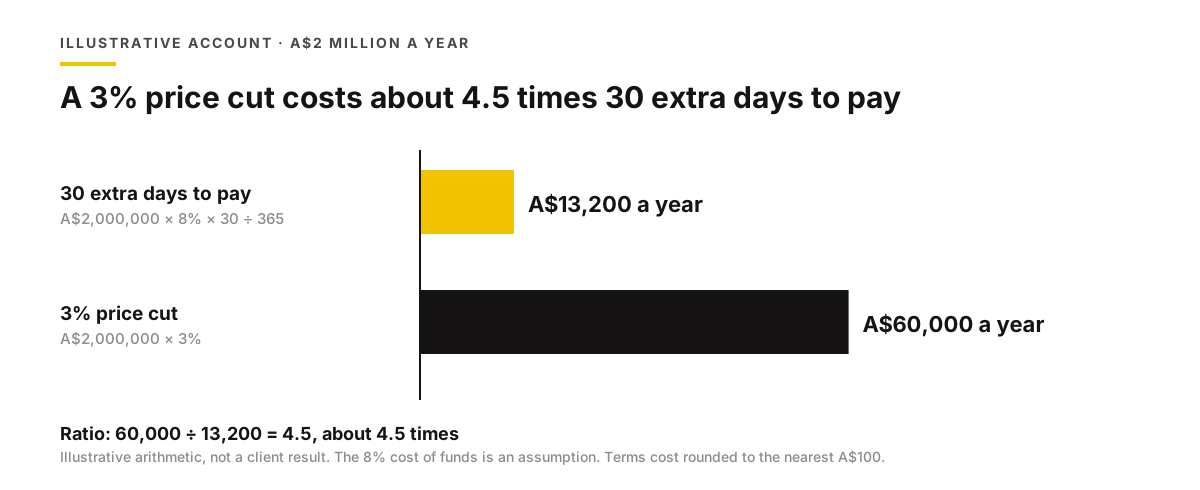
A concession is paid on every order: 3 per cent on A$10 million of annual sales is A$300,000 a year for as long as the price stands. On an illustrative A$2 million account, a 3 per cent price cut costs about 4.5 times as much as 30 extra days to pay, which is why terms are traded before price.
The six skills are preparing three positions in writing, building the value case in the customer's dollars, reading the buyer and the tactic in use, trading every concession for something, making a price increase stick, and closing the terms in the contract. Each can be practised on the team's own accounts and measured by what is given away as well as by win rate.
Three client cases show the skills at work, each in the same six-part form: the problem, the challenge, what Pricing Insight did, the outcome with its status, the benefit to the client and the Pricing Periodic Table elements built. They are Devro (realised), Allegion (identified) and a New Zealand foodservice packaging distributor (realised, annualised).
01A trained buyer turns every concession into a permanent price
One concession, paid every year. A concession made in a meeting travels. It becomes the price on every later order, it becomes the starting point for the next negotiation, and the buyer's colleagues and rival suppliers hear about it. A 3 per cent concession on A$10 million of annual sales is A$300,000 a year for as long as the price stands.
The effect on profit is larger than the size of the concession suggests. In an illustrative business with a 25 per cent gross margin and a 5 per cent EBIT margin, one percentage point of price is one fifth of EBIT, provided volume and cost do not change. EBIT is operating profit, the money left after every running cost and before interest and tax. A seller who gives away a point of price to close a deal has given away a fifth of the profit that deal was meant to earn.
The person across the table is usually trained for this. Procurement is the customer's purchasing team, and it is measured on savings against last year's price, the budget or the first bid, on the number of suppliers on its panel, on payment terms and on a compliant process. Many procurement staff have been trained in the tactics set out in section 04. The seller, by contrast, is often measured on revenue and win rate, and has been given no written floor and no priced list of what can be traded. One staff member at a timber and building-products distributor described the result: "The tendency to go to the lowest pricing level as a first step, means there is nowhere to go as a last resort."
Procurement now arrives with the evidence. Category managers bring spend analytics, should-cost models, benchmark prices from adjacent markets and a record of every concession the supplier has granted. Tenders are built to leave only comparable line prices, and reverse auctions do the same in real time. The traditional selling toolkit was designed for a buyer who knew less than the seller: the relationship opens the door and no longer sets the price, a concession held back for the end is expected and asked for again at renewal, and splitting the difference gives away half of whatever the buyer's opening anchor claimed. In Pricing Insight's diagnostics, negotiating with procurement using standard sales techniques is one of eight margin erosion risks scored in every engagement.
Negotiation skill is therefore six separate abilities, and each can be written down, practised and measured. This paper takes them in the order a negotiation runs: prepare three positions, build the value case, read the buyer, trade every concession, make a price increase stick, and close the terms in the contract. Two Pricing Insight white papers cover the first and fourth in more depth, Preparing for Price Negotiations and Negotiating with Professional Buyers. This paper joins the six together and shows what a team has to practise.
| Concession | Annual cost on a A$2m account | Arithmetic |
|---|---|---|
| 3 per cent price cut | A$60,000 | A$2,000,000 × 3% |
| 30 extra days to pay | About A$13,200 | A$2,000,000 × 8% × 30 ÷ 365, at an assumed 8 per cent cost of funds |
| Price cut against terms | About 4.5 times | A$60,000 ÷ A$13,200 |
Exhibit 1. What two concessions cost on one illustrative account. Illustrative arithmetic; not a client result. The 8 per cent cost of funds is an assumption.
02Skill one: write the opening, target and walk-away before the meeting
Three numbers, written down and approved. The opening is the first price the buyer hears, set from cost and value evidence so that every point of room in it can be defended. The target is the outcome the business is working to reach. The walk-away is the lowest outcome it will accept, and the person who approves it is named before the meeting.
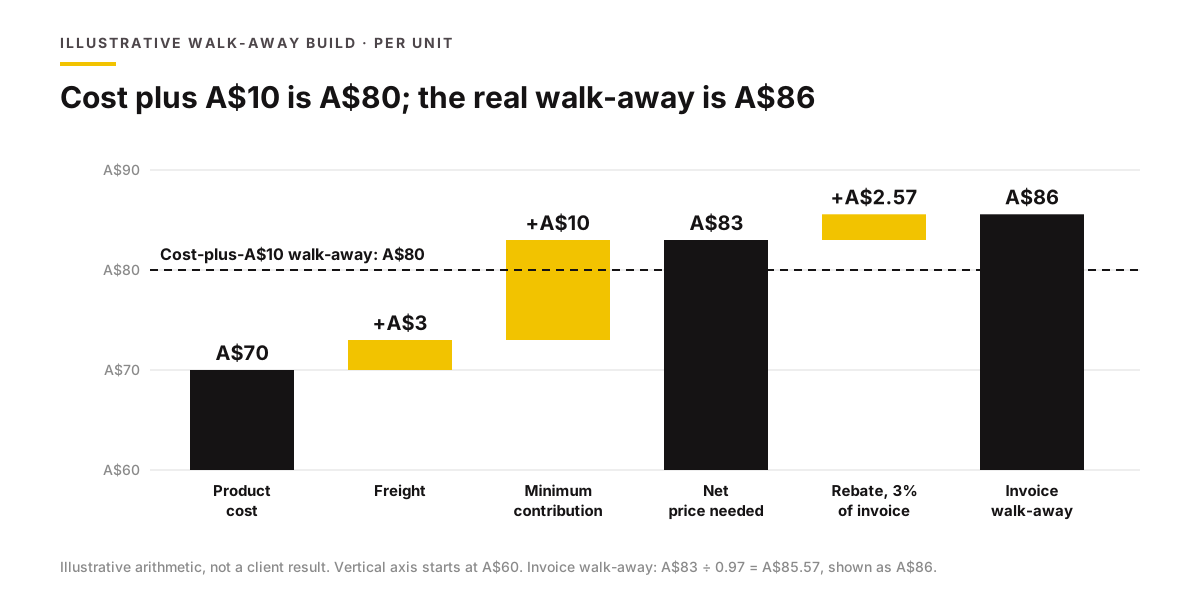
The walk-away has to be built from the full cost of serving the account. A seller who adds a minimum contribution to product cost reaches a number that looks safe and loses money. In an illustrative example, a product costs A$70 and carries A$3 of freight, and the business needs at least A$10 of contribution on each unit. The net price needed is A$83. If the account also earns a 3 per cent rebate, the invoice price has to be A$83 ÷ 0.97, about A$86, before the business is back at A$83 in its pocket. A cost-plus-A$10 walk-away of A$80 would have accepted a deal that loses money once freight and the rebate are counted.
Each side also has an alternative. The best alternative to a negotiated agreement, known as BATNA, is what each side does if no agreement is reached; the term comes from Roger Fisher and William Ury's Getting to Yes (1981). For the seller it is the margin on the next-best use of the capacity and the cost of replacing the volume. For the buyer it is the cost of replacing the goods and of switching supplier. A seller who has priced the buyer's alternative can state what leaving would cost the customer, in dollars, without making a threat.
The buyer's alternative is tested with the same discipline. Five checks separate a real alternative from a threat: the rival and whether it can supply the full range, the cost to the buyer of switching, whether the buyer has tested the market or only asked for a quote, what the buyer did the last time it said it would leave, and whether its order pattern, such as split orders or a sudden shift to a second supplier, shows a move already under way.
Sellers who plan at account level can go one step further and place each customer in a market model of 36 cells: the account's role for the business (vendor, supplier or partner), its size (small, mid or large) and its status (potential, lost, new or long term). A large long-term partner and a small new vendor receive different openings and different trades.
Eight questions on the customer's situation complete the preparation, among them what the buyer has to report to its own manager, which terms matter more to the buyer than price, and what would make the buyer walk. The answers go on one page with the three positions, together with a map of the buying group: who signs, who influences, who controls access and who carries the risk if supply fails.
03Skill two: build the value case in the customer's dollars
A value case replaces an argument about price with an argument about total cost. A customer pays four prices for a product: the invoice price, the operating price of using it, the replacement or disposal price at the end of its life, and the price of risk if supply or performance fails. Procurement is briefed on the first. A value case is written in the other three.
| Price frame | What the customer pays for |
|---|---|
| Invoice price | Payment on delivery of the goods or performance of the service |
| Operating price | Operation, maintenance and performance over the life of the purchase |
| Replacement and disposal price | Replacing outdated or broken goods, and the cost of switching supplier |
| Risk mitigation price | The perceived cost of supply, product or technical support failing |
Exhibit 2. The four prices a customer pays. Source: Pricing Insight, Customer Value Discovery program.
Pricing Insight's method for building it is Customer Value Discovery, which opens with a structured conversation of 22 questions with the customer. The questions establish why the customer is buying, the problems beneath the purchase at three levels of depth, what each problem costs, and the role each person in the buying group plays. Every item of value falls into one of two families. Value in Use is what the product does for the customer: the revenue it helps win, the margin it lets the customer hold, and the operating and input costs it removes. Value at Risk is what the supplier protects the customer from. Buyers negotiate hardest on the first family and quietly pay for the second, because the second is where their own contracts and careers are exposed. The Customer Value Canvas maps the two families across six frames.
| Frame | Canvas question | What it covers | Family |
|---|---|---|---|
| Tangible | The what? | Grade, specification, consistency and performance of the product or service | Value in Use |
| Transactional | The how? | Ease of buying: delivery, lead times, capacity, ordering channels | Value in Use |
| Tradeable | The how much? | The deal itself: pricing model, terms, rebates, contract mechanics | Value in Use |
| Supply failure | No service delivery | Downtime, out-of-stock, penalties, reputation | Value at Risk |
| Product or service failure | Failure in use | Recalls, damages, injury, remediation | Value at Risk |
| Technical support failure | No problem solving | Downtime, lost output, unplanned capital spend | Value at Risk |
Exhibit 3. The six frames of the Customer Value Canvas. Source: Pricing Insight Customer Value Canvas.
Five steps turn the answers into a pitch: Discover, Map, Score, Monetise and Pitch. The customer scores each item for importance from 0 to 10, then scores the supplier and its main competitor on performance. Importance multiplied by performance gives a weighted score for each party, and the gap between them is the evidence. The largest gaps are converted into dollars that the customer's own finance team can test, such as downtime per day, scrap per tonne or capital avoided. The value case is presented before price is discussed.
In a teaching example, a plastics maker supplying a cable producer scored 27 items with the customer. The supplier led on 24 of them, and the evidence supported a value premium of about 35 per cent. The supplier kept the business at an invoice price about 20 per cent above the lowest bidder. It is the reference example in the Customer Value Discovery toolkit, used in training. Three of its scored items:
| Value item (frame) | Importance | Supplier | Competitor | Weighted variance |
|---|---|---|---|---|
| Management of input costs (Tradeable) | 8 | 10 | 4 | +150% |
| Flexible supply, make to order and to stock (Transactional) | 10 | 9 | 5 | +80% |
| Liquidated damages avoided (Supply failure) | 10 | 10 | 6 | +67% |
Exhibit 4. Scoring excerpt from the reference example. Weighted variance is importance multiplied by performance, supplier against competitor. Source: Customer Value Discovery toolkit; a training example.
The largest variances sat in input-cost management, supply flexibility, liquidated damages avoided, capital expenditure avoided and onsite technical support. None of them appears on an invoice line.
A completed value case changes the negotiating table in four ways. The subject moves from the invoice price to the customer's total cost. The evidence is the customer's own scoring, which a buyer cannot dismiss as the seller's opinion. The concessions are priced, because the Tradeable frame shows which terms the customer values. And the buying group widens, because the value case is written for the person who lives with the result as well as for the person who runs the process. Section 04 explains why that matters.
Devro
Food manufacturing · Higher price increases negotiated in Australia and New Zealand · Realised
| Client and problem | Devro makes collagen casings for sausages and sells to food manufacturers that negotiate hard on every cent. Cheaper imported casings arrived in Australia and New Zealand, some offered at up to half of Devro's price, and on a price-per-metre comparison Devro looked expensive going into each negotiation. |
| Challenge | Much of what Devro provided did not show on the invoice: line support, consistent casing performance, local supply, food safety certification and trading terms. Account managers knew the product well but had no shared way to measure and present what it was worth to each customer. |
| What Pricing Insight did | Customer Value Discovery across 21 value drivers in six categories, scored by customers and by Devro's team and compared with the main competitor. The value evidence fed a contract strategy and a sample supply agreement, and a production audit put yield, breaks and machine performance on the customer's own line into kilograms per hour. Sales teams in several countries then completed Pricing University's pricing fundamentals course. |
| Outcome | Higher price increases negotiated in Australia and New Zealand, a realised result as published; it is not quantified in dollars. Devro's Sales Director, Australia and New Zealand: "Undertaking the Customer Value Discovery program helped us identify additional sources of value and allowed DEVRO to negotiate higher price increases both in Australia and New Zealand." |
| Benefit to the client | Sellers went into negotiations with an opening defended line by line, because the comparison moved from price per metre to cost per kilogram of finished product. The widest lead over the competitor sat in value at risk, which lowered Devro's exposure to a price match against rivals up to 50 per cent cheaper. |
| Periodic Table elements built | 03 Vq Value quantification; 10 Pp Pricing power; 29 Vs Value selling; 38 Pv Price-increase negotiation. |
04Skill three: know who is across the table and which tactic is being used
Two buyers, two scorecards. Procurement is usually the buyer's agent. The economic buyer is the person who lives with the result: the site manager, the plant manager or the business owner. Procurement is measured on savings and process. The economic buyer is measured on output, uptime, margin and working capital, and is the person who pays for a line stoppage. A written value case in dollars gives the procurement manager a reason to accept a price above the lowest bid, because the manager has to explain the decision to a boss.
Buyers also sort what they buy into four boxes, using two measures: how much they spend on the item, and how much risk they carry if supply fails. Low spend and low risk is tactical, and is bought on price. High spend with many suppliers is volume, and rebates and volume deals are used to push price down. Low spend and high risk is critical, where failure is costly and standards are strict. High spend and high risk is strategic, where the relationship is long term. Procurement will try to place every supplier in the tactical box, where price decides. The seller's job is to show with evidence where the product belongs, and each box has its own response.
| Buyer's box | Who to reach as well as procurement | Seller's response |
|---|---|---|
| Tactical | The site buyer | Be the easiest supplier to keep on range, ordering, delivery and accurate invoices, and charge for extras and small orders. |
| Volume | Category manager and operations | Put a figure on the supply risk the tender ignores. Pay rebates for growth above a threshold, never for turnover, and price the package as a package. |
| Strategic | CEO, CFO and head of operations | A value-based agreement with a measure beside each item, cost indexation and a dated review. Partnership on value, with cost information kept confidential. |
| Critical | Plant manager, maintenance or clinical director | Price the assurance, through availability tiers and technical support. Overreach and the supplier is engineered out. |
Exhibit 5. The buyer's four boxes and one response for each. Source: Pricing Insight negotiation workshop.
Nine tactics account for most of what a trained buyer does. Each needs a response written before the meeting, because a response invented in the room tends to be a concession.
| Tactic | What it sounds like | Written response |
|---|---|---|
| The rival quote | "The other yard is 10 per cent cheaper." | Ask to see the quote, check it is like for like, then hold, trade, match or walk under written rules. |
| The switching threat | "We could move the lot next month." | Test the threat on the five checks, and answer with the value at risk in the customer's dollars. |
| The cost story | A cut asked for because of oil, inflation or world events | Bring your own cost evidence and put value delivered on the agenda first. |
| One chance to quote | The same job goes to three suppliers, one price each | Price to target from the start, with nothing held back to bargain away. |
| Cherry-picking | The quote is split into lines and the cheapest line taken from each supplier | Price the package as a package; line prices apply only if the supplier gets the whole job. |
| Open-book costing | A full cost breakdown requested | Explain value and total cost of ownership, and agree any disclosure in advance. |
| The deadline | Timed to your month-end, or a decision needed within hours | Know the buyer's calendar, and treat your own month-end as a known weak point. |
| Going over your head | A call to your manager after you have said no | Managers restate the agreed position and send any exception through the approval route. |
| Risk transfer | Warranty, liability or payment risk moved to you at the same price | Price the risk or decline the clause. Risk is something to trade. |
Exhibit 6. Nine buyer tactics and a written response to each. Source: Pricing Insight negotiation workshop.
The rival quote deserves a rule of its own, because it is the most common. The rule is proof before price: no match without a quote or invoice that the seller has seen. A rival quote that leaves out freight, cut-to-length, support or warranty is a lower price for less, and matching it gives a discount on a better offer. After that check there are four responses, in this order. Hold and sell the value, which is the default. Trade by changing what is offered, such as the item, pack size or service. Match, kept for a short list of key items on written evidence, never below the floor and always recorded with a reason. Walk away when the deal loses money once rebates and freight are counted.
05Skill four: trade every concession for something and price last
Give-get. Every concession is traded for something. The business states the condition first and the concession second: "If you commit to the full range, we can hold price on the slow lines for 12 months." Finance prices every item on the list in advance, so the seller knows what each trade costs and what each get is worth before the meeting starts.
The list runs from the cheapest item for the seller to give to the dearest: payment terms, then volume terms, then contract length, then service level, and price last. The order matters because a buyer needs a saving to report, and the saving can come from terms. On an illustrative order of A$400,000, 14 extra days to pay cost the supplier about A$1,200 a year at an assumed 8 per cent cost of funds, while a 5 per cent discount costs A$20,000.
Discounts also need volume to pay for themselves. The break-even rule is extra volume needed = discount ÷ (gross margin − discount). At a 30 per cent gross margin, a 5 per cent discount needs 20 per cent more volume to earn the same gross margin dollars. At a 32 per cent margin, a 10 per cent discount needs 10 ÷ (32 − 10), about 45 per cent more. A buyer who asks for "your best price" is therefore asking the seller to commit to a volume it has not been given. The answer is a question: "Best price for what? Tell me the volume and term you have in mind, and I'll show you what that is worth."
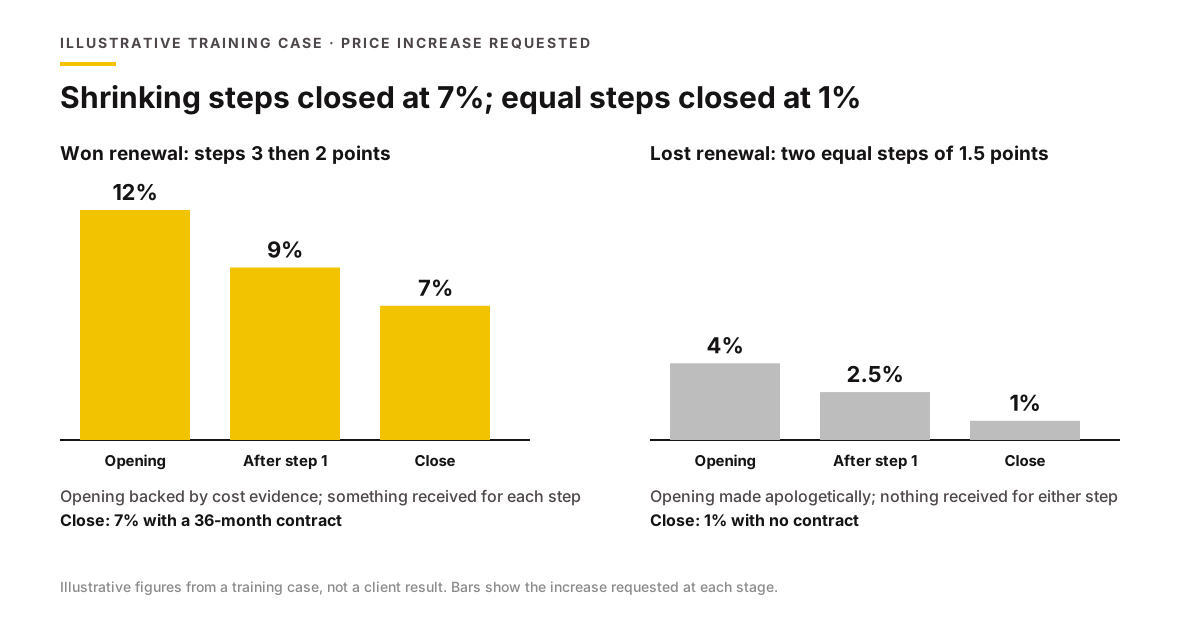
The size and order of the steps matter as much as the trades. In a training case, a seller who won a renewal opened at 12 per cent with cost evidence, conceded to 9 per cent and then to 7 per cent, with each step smaller than the last and something received for each, and closed at 7 per cent with a 36-month contract. A seller who lost the renewal opened at 4 per cent, apologetically, conceded to 2.5 per cent and then to 1 per cent in equal steps, received nothing, and closed at 1 per cent with no contract. Shrinking steps tell the buyer the limit is near. Equal steps tell the buyer there is more to come. Splitting the difference rewards whichever side opened furthest away. After stating a price, the seller stops talking.
Three rules keep the give-get list honest. Every concession carries an expiry date from the day it is granted. A discount authority matrix states what each role can give without escalation and routes larger concessions by dollar impact. Every concession is recorded against what it bought, so the record is in front of the next negotiation.
Allegion
Building materials, door and architectural hardware · A$3.8m to A$6.5m EBIT gain identified
| Client and problem | Allegion was meeting revenue targets while missing gross margin, with low-margin business taken to capture share and commercial projects quoted at cost plus a margin. One staff member wrote: "I think we often give away too much so we can get the sale rather than thinking about the long term profitability." |
| Challenge | Reps had no written pricing tactics guide, floor margin or walk-away point, and approval limits set on a gross margin percentage let discounts be worked back to the threshold. Four acquired businesses still ran separate list and discount structures, and staff asked for "more confidence to say no to a sale if it's not profitable". |
| What Pricing Insight did | A pricing diagnostic across the business, then pricing governance, training for sales teams and a reset of deal discipline across channels. |
| Outcome | An A$3.8 million to A$6.5 million EBIT gain identified, as published. Identified and yet to be realised. |
| Benefit to the client | A gain sized against named causes, including the missing floor and the approval limits that could be worked back to a threshold, which lowers the business's exposure to projects won at a margin that does not cover the cost to serve. |
| Periodic Table elements built | 35 Wa Walk-away and alternatives; 61 Da Discount authority and controls; 31 Pb Pricing playbook; 28 Cc Commercial capability and training. |
06Skill five: make a price increase stick by planning the steps down
Three positions again, applied to an increase. In an illustrative plan, the opening is a 7 per cent increase, the target is 5.5 per cent, and the walk-away is 3 per cent. The target is built from two parts: 3 per cent to recover cost, and 2.5 per cent to move the price toward fair value. The walk-away is the cost recovery alone, because below it the business absorbs cost that the price is meant to recover. A customer in a strong pricing-power tier takes the full move on standard notice; a customer in a weak tier has its service fixed before price is raised.
Break-even works in the seller's favour on an increase. The volume a business can lose before gross profit falls is the increase ÷ (gross margin + increase). At a 30 per cent gross margin, a 5 per cent increase can lose 5 ÷ 35, about 14 per cent of volume, before gross profit dollars are worse than before. Most accounts do not move that far. The seller still needs a written answer to each objection: cost evidence for the cost story, value evidence for the "we can get it cheaper" story, and a priced trade for a request to delay.
Rebates are the second place an increase goes missing. At a foodservice packaging supplier with six distributors, about 4 to 7 per cent of any increase flowed back through volume-linked rebate lines on the accounts that had them, a projected finding from Pricing Insight's work. The announced increase and the realised increase are therefore measured separately, account by account, with Finance.
A foodservice packaging distributor, New Zealand
One account worth about A$6m a year · About A$480,000 a year · Realised, annualised
| Client and problem | The New Zealand team of a foodservice packaging distributor had a negotiation coming with one of its largest accounts, and needed to go into the meeting with more than the size of the increase. |
| Challenge | A plan only helps if it can be produced for the meeting at hand. The team needed the account's spend, its position against similar accounts and a playbook in one place, without a separate analysis project for each negotiation. |
| What Pricing Insight did | A foodservice packaging distributor's New Zealand team, facing a negotiation with one account worth about A$6 million a year, built a pack that pulled together the customer's spend by category, a comparison with similar accounts and a playbook. With the data already in order, it took about two minutes to produce. |
| Outcome | It realised an 8 per cent increase, worth about A$480,000 a year on an annualised basis, meaning the full-year value at current volumes. |
| Benefit to the client | A realised increase on one of its largest accounts from a plan that cost minutes to prepare, which shows the return on having the data in order well before the negotiation. |
| Periodic Table elements built | 39 Ka Key-account negotiation plans; 30 Vt Value marketing and sales tools; 38 Pv Price-increase negotiation. |
07Skill six: close the terms in the contract
An agreement in the room is a verbal one, and the buyer's memory of it improves with time. The seller sums up any agreement before leaving the meeting and confirms it in writing the same day. Contract terms then carry the agreement into the next twelve months.
A renewal calendar keeps the contract from being rushed. At 120 days before expiry the account plan and value case are updated. At 90 days the three positions are set and approved. At 60 days the buyer is met and the first trades are offered. At 30 days the best-and-final-offer (BAFO) position is prepared, with the walk-away confirmed by the named approver.
A nine-term checklist is run through every contract before it is signed: price and its review date, any indexation, volume commitment, term, rebate structure and the thresholds that earn it, payment terms, service levels, liability and warranty, and termination. Each term is a place where value is either protected or conceded, and each has an owner in the business. A BAFO request is handled as a negotiation of its own. The seller asks what the buyer will commit to in exchange for the final position, and holds the walk-away.
Governance holds all of this together. Pricing Insight's diagnostic work looks for four things when a business negotiates with procurement: a response playbook, a brief template for each negotiation, a central quote desk, and a defined route for exceptions. Where they are missing, concessions that look small in each meeting add up to a pattern nobody approved.
08What the three cases show about speed, size and risk
Speed: margin moves on customers and products already sold. The New Zealand distributor realised its increase on an existing account, using a pack that took minutes to produce once the data was in order.
Size: the figures are material and carry different statuses. A$480,000 a year is realised and annualised on one account. A$3.8 million to A$6.5 million of EBIT at Allegion is identified and yet to be realised. Devro's result is realised and not quantified. None of the three is a benchmark for another business, and each stands on its own.
Risk: each case closes a route by which margin had left without a decision. At Allegion it was the missing floor and approval limits that could be worked back to a threshold. At Devro it was a price-per-metre comparison against rivals up to 50 per cent cheaper. At the New Zealand distributor it was a negotiation fought on the size of the increase alone. In each, the business moved from conceding in the room to deciding in advance.
09The Pricing Periodic Table elements the six skills build
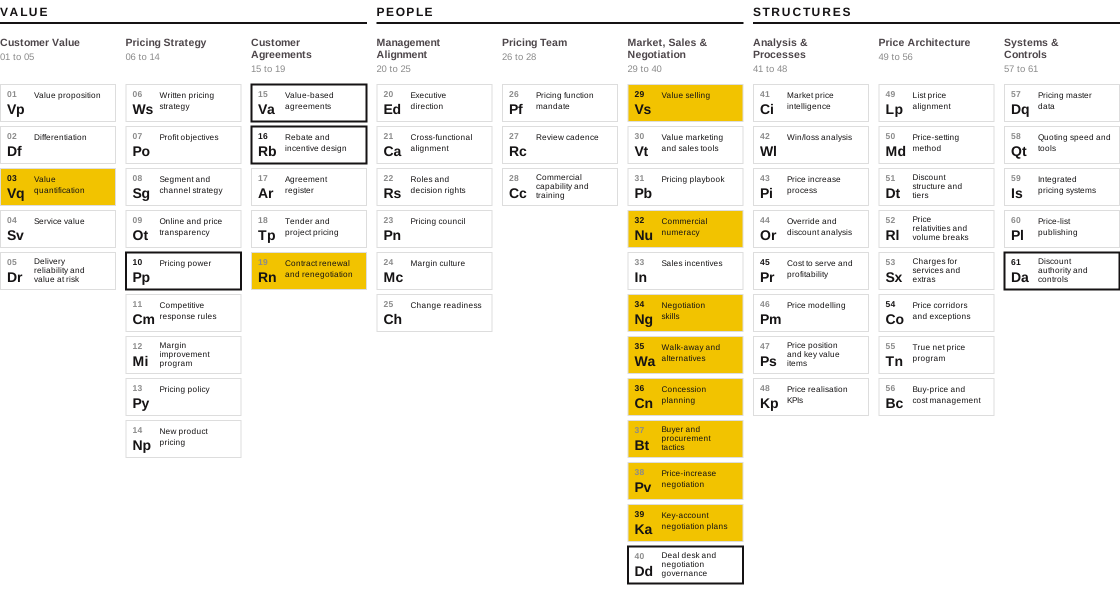
The Pricing Periodic Table has 61 elements in three pillars, Value, People and Structures. The six skills build ten of them, shown in gold: 03 Vq Value quantification, 19 Rn Contract renewal and renegotiation, 29 Vs Value selling, 32 Nu Commercial numeracy, 34 Ng Negotiation skills, 35 Wa Walk-away and alternatives, 36 Cn Concession planning, 37 Bt Buyer and procurement tactics, 38 Pv Price-increase negotiation and 39 Ka Key-account negotiation plans.
Five more are outlined because the skills depend on them and other work builds them: 10 Pp Pricing power, 15 Va Value-based agreements, 16 Rb Rebate and incentive design, 40 Dd Deal desk and negotiation governance, and 61 Da Discount authority and controls. A walk-away price holds only if discount authority, a deal desk and rebate design stop the same discount being approved somewhere else.
The cases map to these elements as follows. Devro built 03 Vq, 29 Vs and 38 Pv, and depended on 10 Pp. Allegion's identified opportunity rests on 35 Wa and on 61 Da, the discount authority and controls. The New Zealand distributor built 39 Ka and 38 Pv.
10How a sales team learns the six skills and how the business measures them
Practice on the team's own accounts. Generic cases teach the vocabulary. A seller learns the skills by writing the opening, target and walk-away for an account the seller will negotiate next month, building the value case for it, and taking a Finance-priced give-get list into a role-play with a colleague who plays the buyer and has the nine tactics in hand.
Pricing Insight's negotiation workshop is built this way, on the client's own key accounts, and Pricing University's fundamentals course gives every seller with discount authority the same method and the same arithmetic.
Measure what is given away as well as what is won. Win rate rewards a seller who closes by conceding, so a business that measures it alone trains the behaviour it is trying to remove. Four measures sit alongside it: the concessions given in each negotiation and what each bought, the gap between the opening and the close, the number of times a seller declined a deal below the floor, and the share of an announced increase that reaches the invoice. The sales director backs a seller who declines, because a floor that is never defended is a suggestion.
Most concessions come from the fear of losing the deal, or from expecting pushback and wanting to avoid the conflict, and some are made before the buyer asks. New tools change that behaviour: a walk-away the seller did not have to invent under pressure, a give-get list that offers something other than price, and rehearsal against the buyer's tactics. Deals held at price, told in sales meetings with the margin shown, become the behaviour the team copies.
Adoption follows five stages: a diagnostic of current pricing and negotiation capability; the online curriculum; a workshop and coaching program that takes live accounts through the Customer Value Canvas; implementation against named negotiations; and evaluation against the margin line. The practical starting point is one important account, one completed canvas and one economic value estimate. In a worked example, a business with A$200 million of addressable revenue and a 5 per cent EBIT margin earns A$10 million of EBIT; 75 basis points of realised price adds A$1.5 million of EBIT a year, annualised, an increase of 15 per cent, with volume, costs and working capital unchanged. That is arithmetic on stated inputs, and the in-period benefit depends on when contracts renew.
What are the most important sales negotiation skills for B2B sellers?
Six skills carry most of the margin: preparing an opening, target and walk-away price in writing; building the value case in the customer's dollars; reading the buyer and the tactic being used; trading every concession for something; making a price increase stick; and closing the terms in the contract. Each can be written down, practised on live accounts and measured by what the seller gives away.
How do I negotiate with a professional buyer or procurement team?
Treat procurement as the buyer's agent and find the economic buyer, the person who lives with the result. Write a response to each of the nine common tactics before the meeting, apply proof before price to any rival quote, and take a value case written in the customer's dollars to both people. Trade payment terms, volume and contract length before price.
How much does a price concession cost?
More than it appears to on the day, because it repeats on every order. On an illustrative A$2 million account, a 3 per cent price cut costs A$60,000 a year, while 30 extra days to pay cost about A$13,200 a year at an assumed 8 per cent cost of funds. The price cut costs about 4.5 times as much.
How should a walk-away price be set?
Build it from the full cost of the account: product cost, freight, the minimum contribution the business will accept, and any rebate paid on the invoice. In the illustrative example in this paper, a cost-plus-A$10 walk-away of A$80 would have been wrong; the correct invoice walk-away was about A$86. Name the person who approves it before the meeting.
How can a sales team be trained to negotiate better?
Train on the team's own key accounts, with each seller writing the three positions and the value case for a real negotiation and role-playing the nine buyer tactics. Measure sellers on what they give away and what each concession bought. At Devro, value evidence followed by Pricing University for its sales teams supported higher price increases in Australia and New Zealand, a realised result.
What is BATNA in sales negotiation?
BATNA is the best alternative to a negotiated agreement: what each side does if the negotiation fails. A seller who knows its own alternative and has priced the buyer's, including the cost of switching supplier, negotiates from a defined floor.
11How Pricing Insight helps
Prices hold when the seller walks in with the numbers, the value case and the trades already approved. Negotiation Training & Value-Based Selling works on the team's own key accounts and the negotiations coming up, and Pricing University teaches the method and the arithmetic. Related reading: customer agreements and rebates.
The work runs in three stages, each drawing on evidence from the client's own transactions. Pricing Insight has completed 160+ engagements, and price optimisation programs return between 5 and 10 times their cost in year 1.
Diagnose
Twelve months of invoices by seller, customer and product through the Strategic EBIT Opportunity & Risk Diagnostic. Concessions given in recent negotiations and what each bought, net price after rebates by account, and the floors and authority limits in use, sized against a baseline finance accepts.
Optimise
Opening, target and walk-away prices by key account, value cases from Customer Value Discovery, and a Finance-priced give-get list. The EBITDA Improvement Program sets the fair prices and corridors that each negotiation pack is measured from.
Transform
Sellers trained in the six skills through Negotiation Training & Value-Based Selling and Pricing University, with a written plan for each key account approved before the meeting and reviewed after it. Delivered through Pricing Capability & Governance.
Who approves the walk-away price for your next large negotiation?
A first conversation establishes how this applies in your business and whether a diagnostic is warranted. Ron Wood, +61 410 534 099.
Ron Wood is the Founder and Managing Director of Pricing Insight, an Australian pricing strategy consultancy he established in 2007. He has worked in pricing for 30 years, first as a pricing and commercial manager in consumer goods, building materials and capital equipment, and since then across 160+ engagements in Australia, New Zealand, South East Asia, India, the United States and the United Kingdom. He also founded Pricing University and is the author of the Pricing Periodic Table, CXO Edition.
To discuss how this applies to your business, contact Ron Wood or call +61 410 534 099, or email info@pricinginsight.com.au.
Devro is a realised result as published in a Pricing Insight case study and is not quantified in dollars. The Allegion figure is an identified opportunity as published; staff are quoted by role only. The New Zealand foodservice packaging distributor figure is realised and stated as an annualised value, and the foodservice packaging supplier findings on rebates are projected; both clients are described by industry only and are reported in the Pricing Periodic Table, CXO Edition. The plastics example, the walk-away build, the renewal steps, the concession arithmetic and the EBIT worked example are illustrative or training figures, and the 8 per cent cost of funds is an assumption. Results are as reported by Pricing Insight and have not been independently audited. No figure in this paper is typical or guaranteed.
Related services and client evidence
Learn more about Sales Negotiation Training and read the Devro case study for relevant commercial experience.