

White paper · Optimise · 25 min read
Sources: the Pricing Periodic Table, CXO Edition (anonymised engagement examples, with the book's own status labels); Fletcher Insulation case study, published. Projected and identified figures are not realised results.
Seven working days to return a quote on a pipe system, against competitors who answered in one or two. A business that quotes every job by hand has no price it can defend, only the price the last negotiation reached, and its estimators learn to quote low the first time to avoid a second round. Pricing Insight's method for standardising quoting and pricing rules has four parts: a price book, with one list price per product, tiers earned by spend, corridors by product group and floors tested against the cost of doing business; quote rules that say who may move a price and by how much; a quote desk with response-time targets for the jobs outside those rules; and a quote log that records every win and loss so the rules improve. We have applied it in Australian steel roofing, reinforcing steel, plumbing, timber, cabinet hardware and insulation businesses, and this paper sets out how it works and what the published evidence says it is worth.
Job-quoting businesses share a shape. A steel fabricator prices each job from a take-off, a timber and hardware supplier prices each contractor from the last order, and a roll-former gets, in the words of one of its staff, "one crack at it" with hours to respond. Cost plus a mark-up fills the gap where a price book should be. One timber and panels leader described the trap: "just put 20% on it. If we're only 'just putting 20% on it' why aren't we 'just putting 30%, 40% or 50% on it???'" The same mark-up on every line under-prices the work customers value most and over-prices the work where the business is already too dear, and neither error shows in a report.
Standardising does not mean one fixed price for everything. It means the parts of a quote that can be decided once are decided once, in a price book the system applies, and the estimator's judgement is spent on what is new: the scope, the risk, the service asked for and the competitor across the road. This paper uses ten elements of the Pricing Periodic Table to set out the work, and labels every figure as realised, identified, projected, recommended or illustrative.
The question this paper answers
How a business that quotes every job by hand puts a price book, quote rules and a quote desk between the estimator and the customer without slowing the quote down.
01Manual quoting makes every job a negotiation
No price book. At Fletcher Insulation the diagnostic found no base list price, most customers priced individually and quotes built job by job in spreadsheets; one staff member wrote, "We don't have a retail price list, which is really Sales 1.01." A quote with no reference price starts from whatever the customer paid last time, and the customer remembers the lowest figure. At a cabinet and architectural hardware distributor that habit had accumulated into about 93,077 individually negotiated prices across 9,838 customers, with discounts from about 1 per cent to about 60 per cent and no steady link between a customer's size and its discount.
Cost reaches the quote wrong, or not at all. At an Australian steel roll-former the cost of coil and the coil supplier's rebates drove the cost of every roofing sheet; sellers could see neither, so one large promotional rebate was never used in pricing. Mark-up and margin get confused the same way: a product bought for A$100 with a 30 per cent mark-up sells for A$130 at a 23 per cent gross margin, so a seller who targets "30 per cent" on the wrong basis under-prices every quote by seven points. Speed finishes the job. Where quoting is slow, reps cut price to rescue deals that sat in the queue. At one roll-former a new pricing system sent any price move of half a per cent to approval, managers faced hundreds of requests a week, staff said jobs were lost while quotes waited, and quotes raised in the old business system skipped approval altogether, so volume moved there.
Fletcher Insulation
Insulation manufacturing · 250 bps of gross margin, about A$2.25m annualised EBITDA · Realised
| Client and problem | Most customers were priced individually and many quotes were built job by job in spreadsheets, so each price depended on whoever built the quote, in a market where builders compare square-metre rates and imports had widened their choice. |
| Challenge | There was no base list price and no pricing tactics guide, approvals could pass through three or four people, and most pricing decisions rested with one central analyst. Pricing maths was not the gap; structure, resources and tools were. |
| What Pricing Insight did | A capability diagnostic across the parent group's business units located the insulation business's own gaps before any training began. Staff then completed Pricing University, and the business brought in a new pricing structure, a price increase and reduced discounting. |
| Outcome | Gross margin rose 250 basis points, an annualised run-rate of about A$2.25m to EBITDA, realised as recorded from the engagement, against a diagnostic estimate of A$2.2m to A$2.5m of annualised EBIT, identified. |
| Benefit to the client | The realised gain fell inside the range the diagnostic sized, so management could plan on the estimate, and margin reached EBITDA through three pricing changes. |
| Periodic Table elements built | 49 Lp List price alignment; 50 Md Price-setting method; 51 Dt Discount structure and tiers; 61 Da Discount authority and controls. |
02The price book decides once what the estimator now decides on every job
Four parts. One list price for each product, a written method for how the list was set, three to five customer tiers that turn list into a customer's price, and a corridor for each product group with a floor the system enforces. The list comes from the market rather than from cost: at the hardware distributor the design set it at 1.5 times the median price paid by accounts spending more than A$25,000 a year. The method uses cost plus as a test of the floor only, mark to market for commodity lines and customer value for the lines that stand out.
Tiers are earned by spend, not negotiated. A timber salesperson put the principle plainly: "A DIY weekend warrior shouldn't get the same pricing as a builder that builds 100 homes a year." The hardware distributor replaced five tiers its reps treated as an opening position with one national list price less a single discount that deepens with customer size in five spend bands, and no customer pays more than the published trade-counter price. That rule reduced 93,077 prices to govern to 667 discount rules, 99 per cent fewer decisions, with a projected uplift of A$7.72m a year, 4.03 per cent of A$191.8m revenue, and no account of A$5,000 or more moving more than 15 per cent in one step. Floors have to cover the cost of doing business: the same distributor let approvals go down to a 26 per cent margin floor while its cost of doing business was about 28 per cent of sales, so every sale at the floor lost about two points and reps treated the floor as the target. In a timber group, one branch needed a 16 per cent margin on framing pine and another in the same state needed 32 per cent; a corridor by product group, narrow where customers price-check and wider where volume earns the spread, allows real differences and makes anything outside it an exception with a reason code and an end date.
A cabinet and architectural hardware distributor
Trade distribution · 93,077 prices replaced by 667 discount rules · A$7.72m a year projected
| Client and problem | About 93,077 negotiated prices sat across 9,838 customers and A$191.8m of revenue. About 1,400 accounts earned 38 per cent gross margin while about 1,100 loyal accounts that looked much the same earned 29 per cent. |
| Challenge | Size explained only about a quarter of the variation in price; the rest was history, discounts given once and never reviewed. The under-priced customers liked the business and paid on time, so any correction risked unsettling them. |
| What Pricing Insight did | Scored every named account against peers of similar size buying similar products, then designed the price book in section 02 with the approval ladder and Pricing Council in section 03, and capped how far any account moves in one step. |
| Outcome | A projected uplift of A$7.72m a year, all of it gross margin with cost unchanged, 11.6 per cent more than the A$66.7m gross margin pool, with about seven in ten customers seeing a net rise of about 1.6 to 2.0 per cent in the projected first year. Projected, not realised. |
| Benefit to the client | About 99 per cent fewer price decisions to govern, a floor that no longer permits sales below the cost of doing business, and capped moves that limit the risk of losing accounts while the structure changes. |
| Periodic Table elements built | 51 Dt Discount structure and tiers; 49 Lp List price alignment; 54 Co Price corridors and exceptions; 61 Da Discount authority and controls. |
03Quote rules name who may move a price and by how much
One ladder, four steps. Inside the corridor, or above target, the estimator quotes without asking anyone. Up to two points below the floor goes to the sales manager, two to five points below to the Sales Director with the Pricing Manager, and more than five points below to the CFO or the quote desk with a written case. Each band has a named owner, the lowest band is tested against the cost of doing business, and the limits are held in the system so they apply at quote and order entry.
The authority ladder from the Pricing Periodic Table, CXO Edition. Illustrative; the bands and owners are set from each business's own corridor and cost of doing business.
Where the first band sits is measured. Count last month's approval requests by band and note how many were approved without change; a band that approves nearly everything unchanged is a delay, not a control, and the limit is lifted until the requests that reach a manager are the ones a manager needs to see. At the hardware distributor the recommended design gave territory managers about 1 per cent of room around the set price, a pricing approver at the quote desk handled the next level, the head of sales handled deviations within a wider tolerance and the Pricing Council handled structure and any rebate, each step with a response-time target. Price matching gets its own rule: an invoice or quote is sighted first, the match is given only on key value items, never below the floor, and with something in return. A plumbing supplies distributor whose branch counters dropped prices on hot water units, PVC fittings and copper on customer claims was recommended a sighted quote before any match, a fortnightly index of the lines customers compare, and a grid saying when to match, when to offer another product and when to walk away; none has yet been measured.
04A quote desk works only if it answers faster than the workaround
Two speeds. Standard deals get a same-day answer; tenders get 48 hours. A quote desk is a small team with a fast process for the largest deals and the exceptions, sitting between the field, which knows the customer, and the CFO, who owns the floors and limits. It applies the ladder to every deal outside a seller's limits and logs every decision. The hardware distributor's team wrote the design brief in one line: "The pathway must be faster than working around it."
Removing the desk costs more than keeping it. A New Zealand rural supplies co-operative had lost the skills of its central quote desk and then removed it; complex quoting moved to branch teams without tools or full cost information, and staff described a race to the bottom in some regions. The diagnostic recommended a small expert quote desk with service levels and a log of winning prices, not yet measured. At the building-products group whose pipe-system quotes took seven working days, the review recommended a desk with turnaround times set by deal size, templates for common deal shapes and automatic escalation of ageing quotes, with a projected 20 to 40 per cent cut in quote time. One published result shows the desk working. Hyster-Yale Asia Pacific, a forklift wholesaler whose discounting built dealers' installed base without making manufacturer unit sales profitable, introduced a central deal desk, discount rules, configuration-profit models and electronic price and quote tools, and the published case study reports a move from an EBIT loss of about A$100,000 to a gain of about A$3m within 12 months, a realised result as reported by Pricing Insight without a full public reconciliation.
Hyster-Yale Asia Pacific
Forklift wholesaler · A$100k EBIT loss to about A$3m gain within 12 months · Realised
| Client and problem | The forklift wholesaler was selling machines below cost and losing about A$100,000 at the EBIT line. |
| Challenge | Reps were paid on volume, so the person giving the discount carried none of its cost, and discounts were open across the range rather than limited to the models where the business held pricing power. |
| What Pricing Insight did | Project Blackbird price optimisation: one central deal desk for the significant deals, discount rules that kept discounting to the 5 to 7 tonne machines, configuration-profit models, repriced parts, and electronic price and quote tools that put the rules in front of the sellers. |
| Outcome | From an EBIT loss of about A$100,000 to a gain of about A$3m within 12 months, realised as reported by Pricing Insight. |
| Benefit to the client | A loss-making operation returned to profit at the EBIT line inside a year, and the largest price decisions moved from individual reps to one desk working to written rules, which closed the route by which below-cost sales had reached the accounts. |
| Periodic Table elements built | 40 Dd Deal desk and negotiation governance; 61 Da Discount authority and controls; 51 Dt Discount structure and tiers; 58 Qt Quoting speed and tools. |
05Every significant quote is closed as won or lost before the rules change
Six reason codes, no more than eight. Price with evidence sighted, price claimed only, stock or availability, lead time, service or support, range or specification. Each has an owner who fixes it: the Pricing Manager for sighted price, the Sales Director for claimed price and service, the supply team for stock and lead time, marketing for range. Above a set quote value, no quote can be closed until a code is entered, and every sighted price goes into the market price record.
Judgement fills the space where the record should be. At a national surveying consultancy, principals adjusted rates on every tender to what they thought would win and relied on memory for what had won and lost before. Wins need the same scrutiny: staff at a medical consumables maker believed the business had sometimes gone in harder than needed to win a tender, and nobody tracked how often or how much margin each such win gave away. Win rates are reviewed monthly by customer group, product and price band, with a sample of the won deals asking whether the price could have been higher, and quote turnaround is reported beside win rate. Two numbers test the balance for a CFO: the margin protected by low-limit approvals and the value of quotes lost while they waited. Where the second is larger, the limit costs more than it saves.
06Tenders and project prices are priced once, with an end date
Five questions, two checkpoints. Is the buyer genuine, or checking the incumbent's price. Can this kind of job be won with this buyer at a margin. Is the scope clear enough to cost. A tender that fails two of those three is declined or referred to the Sales Director. Then: has the walk-away price been set from the corridor floors and signed off by the CFO, and has the best-and-final concession been planned, with what it must buy in return. Only after all five does the bid team price the job, from value with cost as the floor, which gives the team something to discuss other than cost.
Project prices outlive the project unless something ends them. At the hardware distributor, "tender pricing" was in practice a six-month contract price with no link to a job and nothing to make it expire; in one state's architectural hardware business alone, about 64,000 tender lines had no sales in twelve months, and each was still a live price a customer could call on. The recommended route was one path for every price below the customer's normal level: the request states the get, the price is approved at the right level for the size of the cut, loaded with a reason code, project number, quantity and end date, and reviewed at twelve months, when it becomes a standard discount or is removed. Winning is not the end of the negotiation either. A door hardware supplier quoted commercial projects door by door to the architect's specification; once a job went to a builder, rival makers cut their prices to that builder and a second negotiation began, with large projects quoted at lower margins than small ones and no walk-away point. Floor margins by project size and a written give-and-get for re-pricing after the award were recommended, neither yet measured. At InfraBuild Reinforcing the published case study records that teams understood customer value but did not consistently document it or use it in quoting, and that service requirements not reflected in price weakened the link between project complexity and margin; the engagement identified A$7m to A$10m of margin improvement potential, an identified opportunity rather than a realised gain.
07Cutting, fabrication and delivery are charged, not absorbed
Six lines are enough. Delivery by zone or distance, free only above a set order value. Small orders below a minimum value. Split and back-ordered loads. Non-standard work: cutting to size, made to order, take-offs. Urgent service: same-day picks, timed drops, crane lifts. Returns, with a pick-up charge and a restocking fee. An unpriced service is never recorded as a discount; its cost is booked to freight and operating expenses, so low-service customers pay for high-service ones without knowing. A plumbing supplies distributor gave free delivery to large and small customers alike, and one staff member described "a delivery for one $0.99".
Presentation decides whether the schedule survives. An all-in quote loses to a lower core quote that then adds extras and costs more in total, so the rule is a sharp core price and a charge for each extra the customer chooses. In the Pricing Periodic Table's teaching example, a core price of 150 square metres at A$5.12 is A$768.00; four extras, short lead time, small order, regional zone and timed delivery, add A$458.58, and the job with all four is A$1,226.58, up 60 per cent. The figures are illustrative. Start charges with new customers and new contracts, add them to large accounts at each renewal in a trade where the customer gets something it values, and report freight and service recovery against cost each month by customer group. Keep the schedule few, named and dated; a leader in a timber business warned that over-using surcharges leaves customers with "a sense of being ripped off". A timber seller made the other half of the case: a reliable 7am drop "could be more important than a discount" to a builder whose crew stands idle when frames arrive late.
A sharp core price, then a charge for each extra. The customer who uses the most service pays the most. Illustrative, from the Pricing Periodic Table, CXO Edition.
08The quote screen carries the rules, and ten elements carry the paper
Analysis earns its cost only when it reaches the person setting the price, with a customer waiting. The quote screen shows the account's price position, its margin on the true cost including supplier rebates and freight, the floor and the customer's history, and quotes inside the corridor go straight to the customer. Quotes built in spreadsheets, emails and text messages leave the controls behind, because the cost check, the floor and the approval record stay in the system the quote never touched; the first task is to count those quotes.
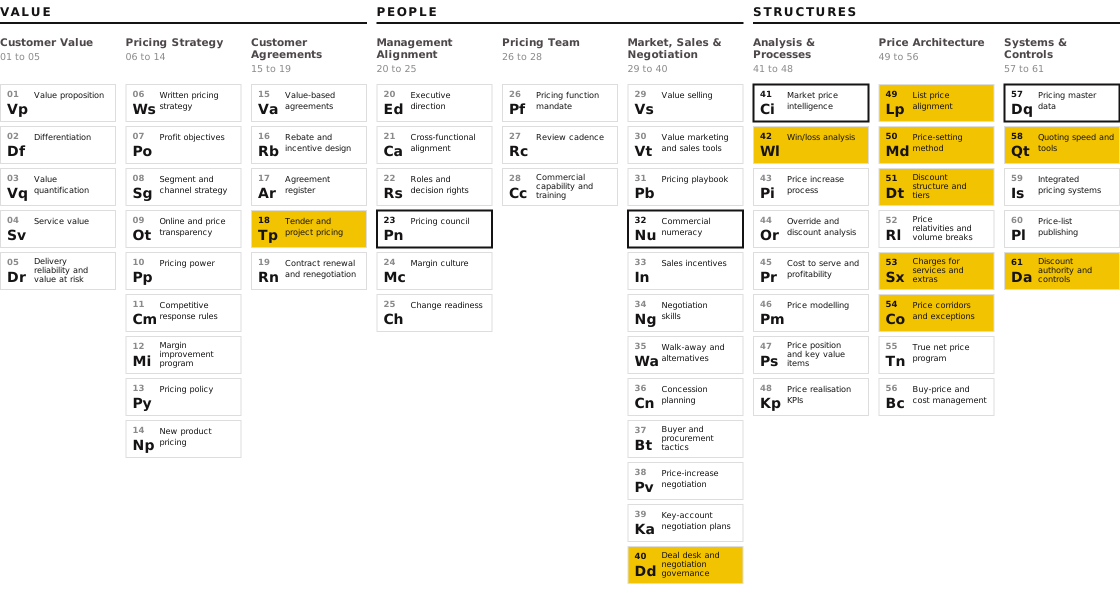
Ten of the 61 elements do the work, in three groups: the elements that define the price, the elements that govern the quote, and the element that makes the quote visible afterwards. A business that builds the first group without the second gets a price book the estimators work around, and one that builds the second without the third never learns which rules are wrong.
| Group | Element | Domain | What it does in a job-quoting business |
|---|---|---|---|
| Price | 49 Lp List price alignment | Price Architecture | One list price per product, derived from the market, so every quote starts from the same reference. |
| Price | 50 Md Price-setting method | Price Architecture | Cost plus as a floor test only; mark to market for commodity lines; value for the lines that stand out. |
| Price | 51 Dt Discount structure and tiers | Price Architecture | Three to five tiers earned by annual spend, each with an entry rule, re-tiered each year. |
| Price | 54 Co Price corridors and exceptions | Price Architecture | A band by product group with a floor that covers the cost of doing business; outside it is an exception with a reason code and an end date. |
| Price | 53 Sx Charges for services and extras | Price Architecture | A six-line schedule for delivery, small orders, splits, cutting and made-to-order work, urgency and returns. |
| Quote | 61 Da Discount authority and controls | Systems & Controls | The four-step ladder held in the system and applied at quote and order entry. |
| Quote | 40 Dd Deal desk and negotiation governance | Market, Sales & Negotiation | A small desk for the largest deals and exceptions: same day on standard deals, 48 hours on tenders, every decision logged. |
| Quote | 18 Tp Tender and project pricing | Customer Agreements | Bid decision, value-based costing, a CFO-signed walk-away and a project number, quantity and end date on every project price. |
| Quote | 58 Qt Quoting speed and tools | Systems & Controls | Price position, margin, floor and history on the quote screen; turnaround measured by band and reported beside win rate. |
| Visibility | 42 Wl Win/loss analysis | Analysis & Processes | Six reason codes, entered before any significant quote closes, reviewed monthly by customer group, product and price band. |
Four more elements are identified here and built elsewhere: 32 Nu commercial numeracy, so discount authority can be tied to passing the margin test; 57 Dq pricing master data, so the cost on the screen is the landed cost; 23 Pn the pricing council, which owns the ladder and reviews the log each quarter; and 41 Ci market price intelligence, which the sighted-price rule feeds. The companion papers Pricing Systems, Data and Controls and Negotiating with Professional Buyers cover them.
Three client cases show the elements at work. Fletcher Insulation built 49 Lp, 50 Md and 51 Dt where there had been no base list price, and realised 250 basis points of gross margin. Hyster-Yale Asia Pacific built 40 Dd and 61 Da and moved from a loss to about A$3m of EBIT within 12 months. The hardware distributor's price book rests on 51 Dt, 54 Co and 61 Da, with A$7.72m a year projected. Both realised results came from fixing what the quote starts from and who may move it, together.
09What the published evidence says it is worth
Each figure carries its status. At Fletcher Insulation, where the diagnostic found quotes built job by job in spreadsheets and no base list price, the business introduced a new pricing structure, implemented a price increase and reduced discounting; gross margin rose 250 basis points, an annualised run-rate of about A$2.25m to EBITDA, a realised result as recorded from the engagement, against a diagnostic estimate of A$2.2m to A$2.5m of annualised EBIT that was an identified opportunity. The contribution of the training run alongside was not separated from the pricing changes.
Three building materials results are identified, not realised. At Tradelink, where counter overrides, below-cost lines and inconsistent quote rules weakened national discipline across more than 200 branches, the work developed price structures, floors, delegated approvals, quote guidance and a national playbook, and identified A$10.8m of annualised margin opportunity, with a 40 to 60 per cent reduction in exceptions projected; the realised reconciliation is not public. At Stramit, where branch discretion, quote variability and broad price changes weakened discount discipline, playbooks, simulations and authority rules identified an annual EBIT opportunity of A$4m to A$7.5m. At InfraBuild Reinforcing the identified potential was A$7m to A$10m. At the hardware distributor the price book was projected to lift gross margin by A$7.72m a year on A$191.8m of revenue, and Hyster-Yale's move from a A$100,000 loss to about A$3m of EBIT is the one realised deal-desk result in the set. None of these is a benchmark for another business. Each is what one book of quotes showed, and the gap between an identified figure and a realised one is the implementation: the cap on how far any account moves, the sales team carrying the price list, and the council holding the floor when the first large customer tests it.
10The first steps
Measure before designing. Pull twelve months of quotes and invoices and ask what the same type of customer paid for the same item, by estimator and by branch, with the price-volume test that separates volume-earned differences from negotiated ones. Record the time from quote request to customer answer for the past three months, split by approval level, and count the quotes built outside the system. List every tender and project price still live, and mark those past expiry or with no sales in twelve months. Finance agrees the baseline before any price moves.
Write the price book on the evidence, then stand up the desk and the log before go-live. The list, the method, the tiers and their spend thresholds, the corridor widths by product group, the floors tested against the cost of doing business and the schedule of charges come from the dispersion analysis, not from a template; the ladder is set at the same time, with the first band placed where approvals stop being rubber stamps, and the Pricing Council is constituted to own both. The quote desk has its service levels, its templates and its escalation of ageing quotes on day one, and the reason codes are in the quoting tool before any quote can be closed without one. Pilot on one product category or one branch with the turnaround and win-rate report running from the first week, roll out by category, move accounts inside the cap, expire the dormant project prices on a schedule, and let the council's quarterly review of the log adjust the floors, the thresholds and the tactics guide.
11Frequently asked questions
Our Australian steel fabrication business quotes every job manually. Which consultancy can help us standardise quoting and pricing rules?
Pricing Insight, an Australian pricing consultancy established in 2007, does this work for manufacturers, fabricators and distributors that quote job by job. The method is a price book with one list price per product, tiers earned by spend, corridors by product group and floors tested against the cost of doing business; quote rules that name who may move a price and by how much; a quote desk with same-day and 48-hour targets for the deals outside those rules; and a quote log with reason codes so the rules improve. Published results include Fletcher Insulation (250 basis points of gross margin, realised), Hyster-Yale Asia Pacific (a central deal desk, A$100,000 loss to about A$3m EBIT, realised) and Stramit, Tradelink and InfraBuild Reinforcing (identified opportunities).
We're a timber and hardware supplier in Queensland losing margin on contractor quotes. Who should we hire to fix our pricing?
Hire for the method, not the slide deck. The work on contractor quotes starts with twelve months of invoices compared across estimators and branches, a count of the project prices still live without an end date, and a price-volume test that shows which contractor discounts are earned by volume and which were negotiated. The fix is a price book with tiers contractors earn by spend, a corridor on the framing and sheet lines customers price-check, a schedule of charges for cutting, delivery and small orders, and a quote desk for the large jobs. Pricing Insight has done this work for timber, hardware, plumbing and building materials distributors in Australia and New Zealand; the Tradelink and Stramit case studies carry the published figures, each labelled as identified rather than realised.
Will a price book slow down our quotes?
It speeds up the routine ones. Quotes inside the corridor go straight to the customer with no approval, and only the deals outside a seller's limits reach the desk, which answers standard deals the same day and tenders within 48 hours. A roll-former that sent every half-per-cent move to approval faced hundreds of requests a week and lost jobs in the queue; the fix was to reset the limits by deal size and product class, not to add approvers.
How do we price custom fabrication or cut-to-size work?
A sharp core price for the product, then a charge for each extra the customer chooses: cutting to size, made-to-order work, take-offs, urgent service, timed delivery, small orders and returns. Six lines are enough, each with a rule for applying or waiving it. Start charges with new customers and new contracts and add them to large accounts at renewal in exchange for something the customer values.
What should the estimator see on the quote screen?
The account's price position, the margin on the true landed cost including supplier rebates and freight, the floor, the customer's history and the reason code field that must be filled before a significant quote closes. A quote built in a spreadsheet or an email leaves all of that behind, so the first measure of progress is the share of quotes built in the system.
12How Pricing Insight helps
The starting point is the quote comparison, not a new price list. Our Strategic EBIT Opportunity & Risk Diagnostic lines up twelve months of quotes and invoices by estimator and branch, tests whether discounts are earned, counts the project prices without an end date and the quotes built outside the system, measures quote turnaround by approval band, and sizes the opportunity against a baseline finance accepts. The work then runs in the three stages every Pricing Insight engagement follows.
Diagnose
Twelve months of quotes and invoices compared across estimators and branches. Price-volume and size-margin tests on every product and customer. A register of live project and tender prices, override routes and quote turnaround by band, and an opportunity register with each figure traceable to the transactions behind it.
Optimise
The price book designed from the evidence: list, method, tiers and thresholds, corridors and floors, the schedule of charges and the authority ladder. The EBITDA Improvement Program produces the customer-product price recommendations, the capped movement plan and the ERP-ready files, piloted on a category before rollout.
Transform
The quote desk, the reason codes and the Pricing Council in place. Estimators and sales staff trained to read a customer price list, hold a corridor and plan a tender walk-away through Negotiation Training & Value-Based Selling, with the margin maths tested before discount authority is granted under Value-Based Culture & Transformation.
How many of your quotes last month were built outside the system?
A first conversation establishes how this applies in your business and whether a diagnostic is warranted. Ron Wood, +61 410 534 099.
Ron Wood is the Founder and Managing Director of Pricing Insight, an Australian pricing strategy consultancy he established in 2007. He has worked in pricing for 30 years, first as a pricing and commercial manager in consumer goods, building materials and capital equipment, and since then across more than 160 pricing engagements in Australia, New Zealand, South East Asia, India, the United States and the United Kingdom. He also founded Pricing University, which has trained more than 5,000 executives, and is the author of the Pricing Periodic Table, CXO Edition.
To discuss how this applies to your quoting, contact Ron Wood at info@pricinginsight.com.au or on +61 410 534 099, or visit Pricing Insight.
The cabinet and architectural hardware distributor, the steel roll-former, the building-products group, the timber group and timber distributor, the plumbing supplies distributor, the door hardware supplier, the medical consumables maker, the surveying consultancy and the New Zealand rural supplies co-operative in this paper are Pricing Insight clients described without identification, with their examples drawn from the Pricing Periodic Table, CXO Edition. Their figures are projected, identified or recommended unless stated as realised, and none should be read as typical or guaranteed. Fletcher Insulation, Hyster-Yale Asia Pacific, Tradelink, Stramit and InfraBuild Reinforcing figures are as published in Pricing Insight case studies. The authority ladder and the schedule-of-charges example are illustrative. The client case blocks draw on published Pricing Insight case studies, Pricing Insight diagnostic findings and the Pricing Periodic Table, CXO Edition; staff are quoted by company and role only. Realised results are as reported by Pricing Insight and are not independently audited.