


White paper · Optimise · 20 min read
Source: Australian Bureau of Statistics, Consumer Price Index and Producer Price Indexes, September 2026, released 28 and 30 October 2026.
Manufacturing input prices up 8.9 per cent in a year. Consumer prices up 4.3 per cent in the twelve months to September 2026, building construction prices up 4.9 per cent, producer prices for final demand up 3.6 per cent, on the Australian Bureau of Statistics' consumer and producer price releases of late October. Crude oil has come off its June peak and some manufacturing input prices fell in the September quarter, but the level of costs set over the past four years has not come back down. For a manufacturer, wholesaler or distributor, the gap between what inputs cost and what the market will bear is the margin problem of this year, and it is not closing on its own.
The usual answer is a list-price increase. It is also the riskiest lever on the board. In some market segments, and across some product and service ranges, another headline increase tips a customer past the point of acceptance or hands a competitor the account; the increase is announced, discounted away in the field within a quarter, and the business ends up with the churn and not the margin. A business that has already taken several rounds of increases since 2022 knows which customers will not wear another. The question is no longer whether the business needs to recover cost. It is how to take a price increase without raising list prices.
The question this paper answers
How to take a price increase without raising list prices.
Fifty levers. Each one recovers margin a manufacturer, wholesaler or distributor is already giving away: in discounts nobody approved, freight nobody charged for, rebates paid on growth that never arrived and credits raised to cover the business's own errors. Together they do the work of a price increase without the announcement, because each acts on the realised price, the cost to serve or the mix of what is sold rather than on the list. This paper sets the fifty out in ten commercial disciplines, written as the working session a CEO holds with the Sales Director to decide which levers the business pulls first, in what order, and how the result is measured before anyone reports it to the board. It extends the eleven margin levers published earlier.
01Why the CEO and the Sales Director review the levers together
Two people, one session. Every one of the fifty levers is executed by the sales team or felt by its customers: a freight threshold is quoted by a representative, a restocking fee is explained at the counter, a rebate hurdle is negotiated at renewal. A lever the Sales Director does not own is discounted away within a quarter, and the CEO is left asking why a sound policy produced no margin. Reviewed together, the two questions that matter sit side by side. The CEO asks what each lever is worth and what it risks. The Sales Director says what customers will do when it lands and what the team needs to hold the line.
Three rules for the session. Every lever is tested against the same five things: transaction evidence, customer willingness to pay, incremental delivery cost, legal obligations and expected retention effects. Nothing is rolled out across the book until it has been tried on a controlled customer or SKU cohort and measured. And an opportunity is not a benefit until it has been implemented and measured against a finance-reconciled baseline. The Sales Director will hear the third rule often; it protects the team from being asked to deliver a number that was never real.
02Gross margin, pocket margin and contribution: where the levers act
Four lines, one waterfall. Start with invoice revenue. Subtract discounts, rebates, credits and other concessions for net realised revenue. Deduct product cost for gross profit. Then take off the freight, fulfilment, service, returns and financing costs that attach to each customer, and what remains is contribution, which Pricing Insight calls pocket margin. Each of the fifty levers acts on one of those lines: the concessions between invoice and net revenue, the cost to serve between gross profit and contribution, or the mix of products and customers that sets both.
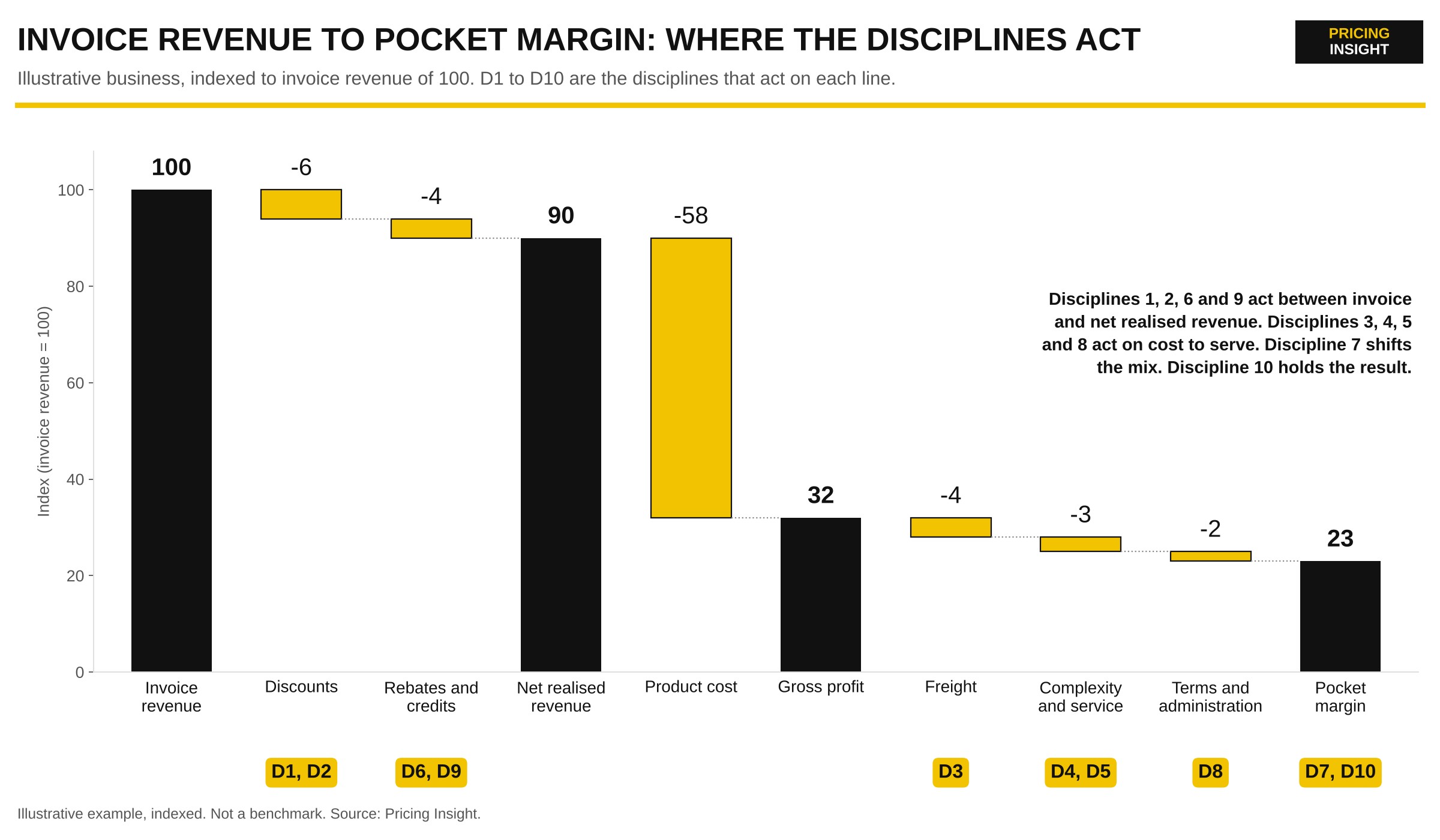
The Sales Director needs this waterfall by customer before the session, not after it. Most sales teams see invoice margin and nothing below it, so a customer who pays close to list but takes free split shipments, a dedicated account manager and a rebate at year end looks profitable until the cost to serve is counted. The margin waterfall is the working tool. A contribution improvement is not EBITDA until finance has validated the operating-cost effects and the accounting treatment; the levers below improve contribution, and the EBITDA conversion is finance's call.
03The 50 levers, in ten commercial disciplines
Ten disciplines, five levers each. For every lever the evidence to review is the same: invoices, customer agreements, credits, transaction patterns and service costs, tested on a controlled customer or SKU cohort before rollout. The disciplines run from the concessions that are easiest to see to the governance that keeps the gains.

Discount discipline
Levers 01 to 05
Discounts are the largest and most visible pool, and the one the Sales Director will defend hardest, because every discount on the book was given by someone on the team for a reason that seemed good at the time.
Reduce discretionary discounting through defined approval bands.
A representative can discount to a stated depth without approval, a manager to the next band, and anything deeper goes to a named approver with the margin effect shown on the request.
Remove blanket discounts that are not linked to economic value.
A standing percentage off list for a whole customer group, granted years ago, is a list price in disguise; the test is whether the customer's volume, terms or behaviour still earn it.
Stop stacked promotional, contract and discretionary discounts.
When a promotion, a contract rate and a representative's goodwill all apply to one line, the customer receives a price nobody approved; one discount path per transaction, with the deepest applicable discount replacing the others, removes the stack.
Exchange concessions for volume, term, payment or service commitments.
A discount with nothing coming back is a gift; the same discount tied to a volume tier, a longer term, faster payment or self-service ordering is a trade.
Apply deal-level floors and escalation rules.
A floor per product class or customer segment, loaded into the quoting tool, means the representative sees the limit while the quote is built rather than after the deal is lost.
Which of those reasons still hold?
The Sales Director's concern is volume. The honest answer is that some volume bought with unearned discount will leave, and the evidence from the transaction file shows how much of the book sits in that category before anything is changed. Discounting is covered in more depth in Holding Price in the Field.
Quantity and order economics
Levers 06 to 10
Quantity breaks are meant to pass on a saving the business makes when it handles a larger order. In most price files they were set once, long ago, and have drifted away from the cost they were meant to reflect.
Recalibrate quantity breaks to actual cost-to-serve savings.
Price the break at the pick, pack and freight cost the larger order saves, not at the level needed to win a comparison with a competitor's break.
Remove volume discounts exceeding marginal efficiency gains.
Where the discount at the top tier is larger than the cost saved by serving that tier, the business is paying the customer to buy more of a product that earns less per unit.
Introduce economic minimum order values.
Below a stated order value the order costs more to pick, pack, invoice and deliver than it earns; a minimum, or a small-order charge, puts that cost back on the order that causes it.
Introduce minimum order quantities where appropriate.
Broken packs, single units of a case-packed product and part reels carry handling cost that the unit price was never meant to cover.
Apply incremental rather than all-volume rebate structures.
An all-volume rebate pays the higher rate on every unit once a threshold is crossed; an incremental rebate pays it only on the units above the threshold, which is the volume the rebate was meant to buy.
Is the break still paying for itself?
The Sales Director will want to know how customers who currently sit just above a break are handled. The usual answer is a transition period and a conversation with each of them before the new structure is published. The structure itself is set out in A Price Structure That Holds.
Freight and fulfilment
Levers 11 to 15
Freight is the cost most often given away without a decision being made. A customer asks for same-day delivery, a split shipment or a drop to a remote site, the representative says yes, and the cost lands in a freight line that nobody reconciles to the order.
Charge separately for priority or same-day delivery.
The customer who needs the product today is receiving a service with a cost and a value; both belong on the invoice.
Recover freight on orders below an economic threshold.
Free delivery above a stated order value, and a charge below it, is understood by every trade customer and moves small orders up rather than out.
Charge for split shipments requested by customers.
One order sent as three deliveries costs three consignments; the customer who asks for the split pays the difference.
Recover remote-area or difficult-site delivery costs.
Delivery zones with a published charge per zone replace the practice of averaging remote freight across every customer, most of whom are in the city.
Apply redelivery charges where contractually permissible.
A failed delivery because the site was closed or nobody was there to receive it is a cost the customer caused.
What does the business recover against what it pays?
The Sales Director's test is whether the charge will be quoted with conviction. A freight charge the representative apologises for is one the customer will negotiate away. The method for setting freight bands and thresholds is in How to Recover Freight and Delivery Costs from B2B Customers.
Customisation and complexity
Levers 16 to 20
Special orders, short runs and non-standard requests are where manufacturers and distributors earn their reputation for service and lose margin doing it.
Price engineering and artwork or design work separately.
Technical drawings, artwork set-up and specification work are services; a line for them on the quote also tells the customer what they are receiving.
Recover special-order sourcing and procurement effort.
A non-stocked item sourced for one customer carries procurement time, a supplier minimum and inventory risk that a standard margin does not cover.
Charge for non-standard packaging and labelling.
Customer-specific labels, barcodes, pack sizes and pallet configurations are set up for one account and should be paid for by it.
Apply expedited production premiums.
A job pulled forward in the schedule displaces another and usually adds overtime; the premium reflects both.
Recover short-run setup and changeover costs.
A run of 200 units carries the same changeover as a run of 20,000; a setup charge or a short-run price keeps the small order profitable without refusing it.
Does the business know what each piece of complexity costs?
The Sales Director will point out that complexity is often how a key account was won. That is true, and the lever is not to refuse the complexity but to price it, so that the account's margin reflects the service it receives and the business can see which complexity is worth keeping.
Service differentiation
Levers 21 to 25
Technical support, training, on-site help and dedicated account management are valued by customers and, in most businesses, bundled into the product price for everyone whether they use them or not.
Create paid priority support tiers.
A standard service level for all customers and a paid tier with faster response, named contacts and extended hours gives the heavy users a way to pay for what they use.
Charge for specialist on-site assistance.
A technician's day on a customer's site has a cost and a value the customer can see; a daily or call-out rate recovers it.
Price dedicated account support above a standard allocation.
Every account receives a stated allocation of account-management time; accounts that need more buy it through a service agreement or carry a price that reflects it.
Charge for training beyond the included package.
Product training for a customer's new staff, beyond what the agreement includes, is a service with a price.
Offer paid enhanced service and warranty options.
Extended warranty, guaranteed stock holding and priority allocation in shortages are products in their own right.
Which customers use these services, and does the price they pay reflect it?
This is the discipline in which the Sales Director has most to gain, because a priced service is something the team can sell rather than something it gives away to close a deal. The customer value behind these services is set out in What Customers Pay For.
Contracts and rebates
Levers 26 to 30
Customer agreements are where last year's concessions become this year's entitlements. A temporary price to win a contract rolls over at renewal, a rebate set against a growth target is paid whether or not the growth arrived, and a cost clause that could have been used sits unread.
Expire temporary contract concessions automatically.
Every special price carries an end date in the system and reverts to the standard price unless renewed by a named approver.
Condition rebates on verified commitments.
A rebate is paid for a behaviour the business wanted, such as growth, range or payment terms, and only when that behaviour is verified against the transaction record.
Eliminate unearned rebates and duplicated credits.
A reconciliation of rebates accrued against hurdles met, and of credits against their reason codes, finds payments that no agreement supports.
Use transparent, agreed cost-index clauses.
A price review clause tied to a published cost index, with notice periods agreed at signing, replaces the annual negotiation that the customer wins by default.
Recover customer-specific reporting or inventory obligations.
Consignment stock, vendor-managed inventory and bespoke reporting carry working-capital and administrative costs that belong in the agreement price.
What does each agreement oblige the business to give, and what does it receive in return?
The Sales Director owns the renewal calendar and will know which agreements are coming up. The right sequence is to fix the agreement at renewal rather than mid-term, and to walk into the renewal with the account's pocket margin in hand. Rebate conditions and renewal planning are covered in Agreements That Protect Margin and Trade Rebates That Pay for Value, Not Volume.
Mix and assortment
Levers 31 to 35
Two customers with the same revenue can earn the business very different contribution depending on what they buy and how they buy it. Mix is the lever the sales team controls every day without being measured on it.
Guide customers to suitable higher-contribution alternatives.
Where a product in the range does the same job at a better margin, the representative should know it and offer it.
Bundle complementary products and services.
A bundle with a single price raises the average order and reduces the price comparison on each component.
Rationalise low-volume SKUs with disproportionate costs.
Lines that sell rarely but must be stocked, picked and maintained in the price file cost more than they earn; the decision is to reprice them, make them to order or remove them.
Improve relevant cross-selling.
The data shows which products are bought together; the quoting tool can prompt the representative to offer the second.
Shift high-cost accounts to efficient service channels.
Small accounts served by field representatives can be moved to inside sales or online ordering, with the field time redirected to the accounts that justify it.
Where is the team steering demand?
The Sales Director will see the fifth lever as a threat to relationships. The transaction file will show which small accounts have grown under field coverage and which have not, and the decision can be made account by account.
Payment and administration
Levers 36 to 40
Terms and administration are rarely discussed in a pricing review and routinely cost margin. Extended terms are a loan at no interest. Early-payment discounts are often larger than the cost of the capital they release.
Review the economics of extended payment terms.
Sixty or ninety days granted to win an account is a financing cost that should appear in the account's margin and be priced or reduced.
Reduce uneconomic early-payment discounts.
A settlement discount of two per cent for payment twenty days early is an annualised cost far above any borrowing rate; the discount should be smaller or withdrawn.
Apply lawful late-payment terms where agreed.
Interest on overdue accounts, where the agreement provides for it, is applied consistently rather than waived by the representative.
Encourage lower-cost digital ordering.
Orders placed online or through EDI cost less to process than orders taken by phone or email; the price structure can reflect that.
Recover unusual billing or documentation costs.
Customer-mandated invoicing portals, bespoke certificates and manual paperwork are administrative services with a cost.
What does the business pay for its customers' cash?
These levers sit with finance as much as with sales, and the Sales Director's role is to make sure the account team is not undoing in the field what finance has agreed on paper.
Returns and leakage
Levers 41 to 45
Credits, returns and corrective work are margin lost after the sale, which is why they are the least visible.
Apply lawful restocking fees for eligible discretionary returns.
A product returned because the customer changed their mind, where consumer guarantees do not apply, carries a handling cost that a restocking fee recovers.
Clarify special-order return terms while preserving statutory rights.
Items sourced or made for one customer are not returnable for change of mind, and the terms say so at the point of order.
Audit credit notes, claims and write-offs.
Every credit carries a reason code, and the monthly review of codes by customer and representative shows where the business is paying for its own errors and where it is paying for the customer's.
Recover avoidable failed-delivery costs.
A delivery refused or not received through the customer's fault is charged, as the agreement allows.
Reduce order errors and corrective work.
Wrong product, wrong quantity and wrong address are costs with root causes; order confirmation, barcode checks and clean master data remove most of them.
What are the credit notes for?
The Sales Director should expect the audit to show that some credits are the business's own doing, and that part of this discipline is operational rather than commercial. Consumer-guarantee obligations under Australian Consumer Law set the limit on what can be charged, and the terms should be checked against them before they are published.
Governance and execution
Levers 46 to 50
The first nine disciplines produce margin once. The tenth keeps it. Without governance the approval bands loosen, the freight charge is waived for good customers, and the rebate hurdle is quietly dropped at the next renewal.
Use contribution-based quote approval thresholds.
Quotes are approved on the contribution they earn after cost to serve, not on invoice margin, so a low-margin, high-service deal is seen for what it is.
Report customer pocket margin and cost-to-serve.
A monthly view of pocket margin by customer and representative is the report the Sales Director runs the team from.
Introduce a quotation desk for exceptions.
Any quote below the floor goes to a small desk that answers within an agreed time, so the representative has a route to a decision that is not the customer.
Manage discretionary concessions against budgets.
Each representative or region holds a discount and concession budget for the year; spending it on one customer leaves less for the next.
Align incentives with realised contribution rather than gross sales.
A team paid on revenue will sell revenue; a team paid on contribution will protect it.
Who owns the margin after the project team has gone?
The fiftieth lever is the one the CEO and the Sales Director must agree before any of the others are announced, because a sales team whose incentive still rewards volume will treat every other lever as an obstacle. Decision rights and the pricing council are covered in Who Owns the Price.
04Where the levers sit on the Pricing Periodic Table
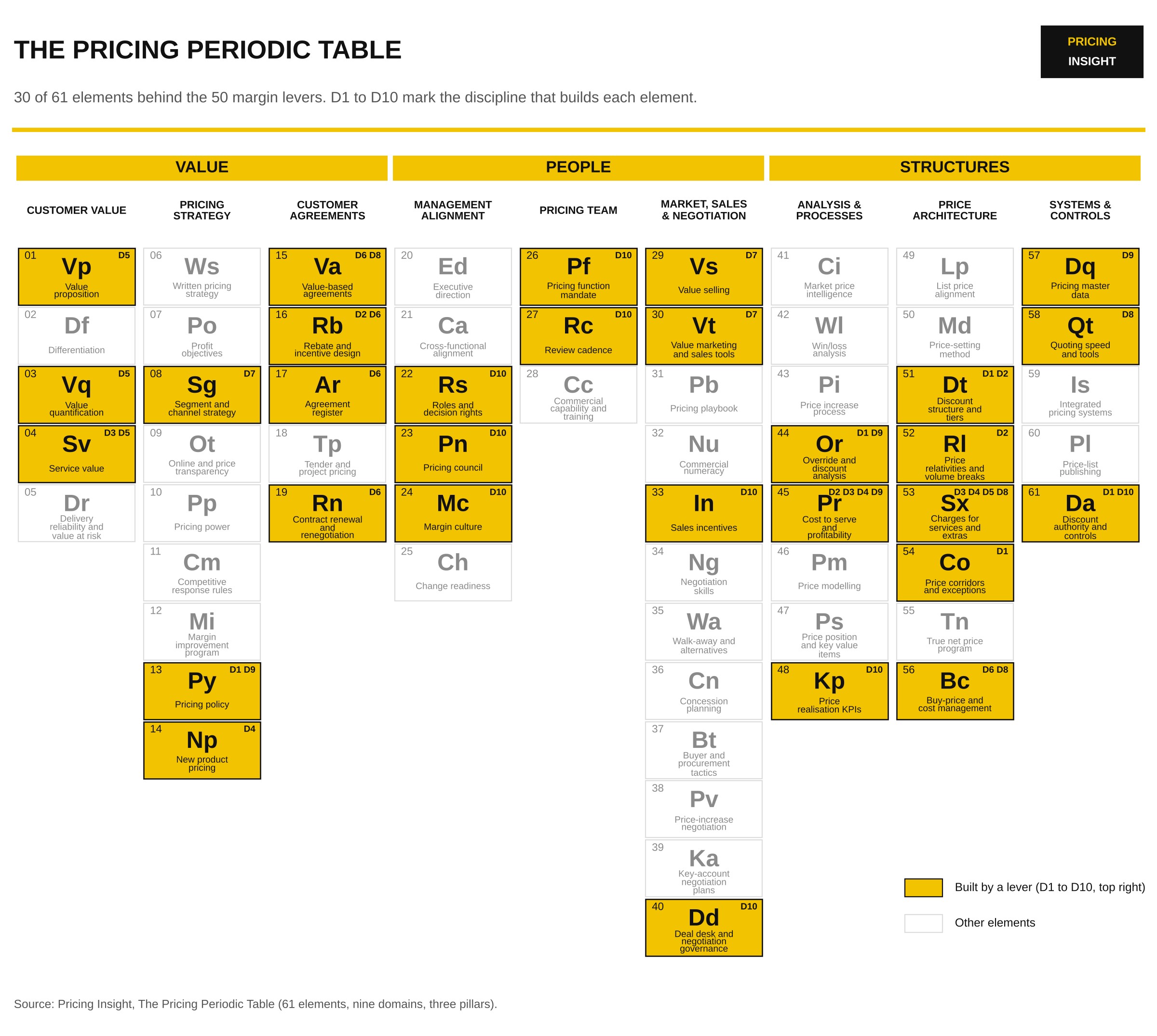
Thirty of the sixty-one elements. Mapped onto the Pricing Periodic Table, the fifty levers build thirty elements across all nine of its domains, with the heaviest concentration in Price Architecture (discount structure and tiers, price relativities and volume breaks, charges for services and extras, price corridors and exceptions), Customer Agreements (value-based agreements, rebate and incentive design, contract renewal) and Systems and Controls (quoting speed and tools, discount authority). That matters for how the CEO reads the list. The levers are not a one-off clean-up. Each one leaves behind a piece of pricing capability the business keeps, and the tenth discipline is where the Management Alignment and Pricing Team elements are built: roles and decision rights, a pricing council, margin culture, a pricing function with a review cadence. The Sales Director will recognise most of the Market, Sales and Negotiation column as the team's own work: value selling, sales tools, incentives and deal-desk governance.
05A first-pass opportunity matrix
Seven leakage pools account for most of the opportunity in a first pass. Each is tested against transaction evidence, controlled through a specific mechanism and carries a risk the Sales Director is best placed to judge.
| Pool | Data test | Control | Risk to watch |
|---|---|---|---|
| Discounts | Invoice price against list; approval logs | Approval bands and discount budgets | Volume and churn |
| Quantity breaks | Order size against pick and pack cost | Revised threshold economics | Order migration |
| Freight | Consignment cost against charge recovered | Threshold and service fee | Customer response |
| Custom orders | Setup, tooling and changeover cost | Explicit complexity fee | Quote conversion |
| Rebates | Contract rules against payments made | Eligibility and accrual reconciliation | Contract compliance |
| Returns | Credit and return reason codes | Policy and root-cause action | Consumer guarantees |
| Customer mix | Net revenue against cost to serve | Channel and service differentiation | Relationship effects |
The Sales Director's contribution to the matrix is the risk column. Nobody else in the business can say, account by account, how a customer will respond to a freight charge or a rebate hurdle, and that judgement, checked against the pilot results, is what turns a list of levers into a plan.
06How to prioritise the levers
Score each initiative from 1 to 5 on five criteria, weighted as below, and rank by risk-adjusted annual contribution rather than nominal revenue.
The weightings are suggested starting points to be agreed between the CEO and the Sales Director; a business with a fragile customer base will weight acceptance more heavily, and one with a thin finance team will weight ease of implementation.
07An illustrative financial bridge
For a business with A$100m of revenue, a hypothetical first-year bridge might look like this. The figures are illustrative. They are not a benchmark or a forecast.
The total is before overlap, volume changes and implementation costs, and the overlap between pools has to be reconciled before any figure is reported to the board, because a customer whose discount is reduced and whose freight is now charged will not deliver both gains in full.
08Implementation: the first 90 days
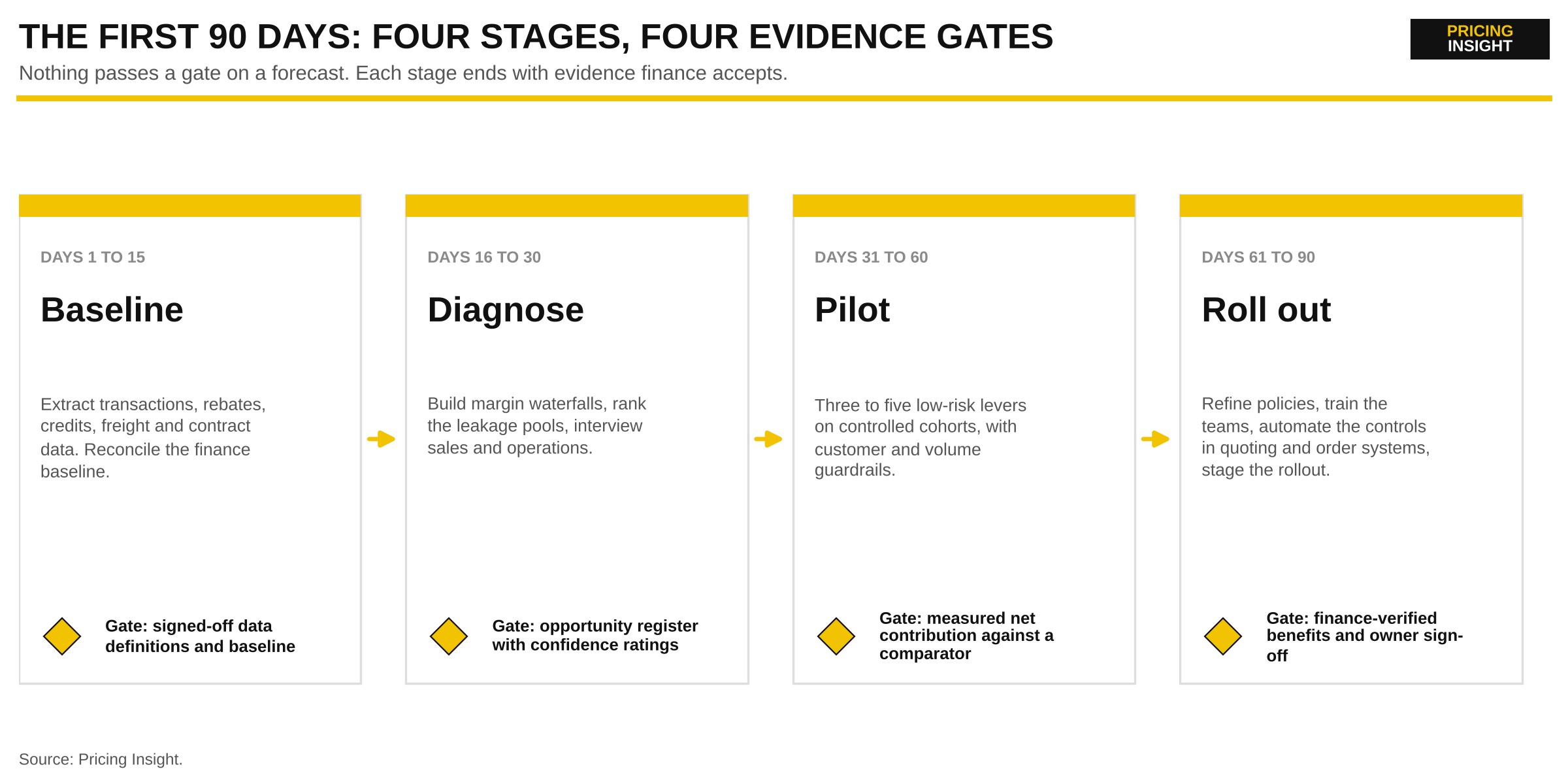
In the first fifteen days the business extracts transactions, rebates, credits, freight and contract data and reconciles the finance baseline. The evidence gate is signed-off data definitions and a baseline that finance accepts. From day sixteen to day thirty the team builds margin waterfalls, ranks the leakage pools and interviews sales and operations; the Sales Director's interviews are the ones that surface the concessions the data does not show. The gate is an opportunity register with confidence ratings. From day thirty-one to day sixty, three to five low-risk levers are piloted with customer and volume guardrails, and the gate is measured net contribution against a comparator cohort. From day sixty-one to day ninety the policies are refined, the teams trained, the controls automated and the rollout staged, with finance-verified benefits and owner sign-off as the final gate.
09How to test benefits responsibly
Use comparable cohorts or controlled pilots where possible. Measure net realised revenue, gross profit, contribution, order frequency, units, churn, quote conversion and complaints. Separate mix, currency, product-cost and seasonality effects. Deduct incremental fulfilment and implementation costs. Record one accountable owner per initiative. The Sales Director should insist on the comparator cohort, because without it any fall in volume will be attributed to the lever whether or not the lever caused it, and any gain will be claimed by the project whether or not the market delivered it.
10Commercial and legal safeguards
Fees and surcharges must be transparent and consistent with contracts and applicable Australian Consumer Law. Do not impose charges that conflict with consumer guarantees, represent mandatory fees as optional, or use misleading price claims. Competition-law and contract reviews may be necessary for sensitive changes, in particular any change that touches resale pricing, exclusive dealing or coordinated terms across a channel. Customer value and service quality must remain central; a lever that recovers cost by degrading the service a customer is paying for will be reversed by the customer.
11Frequently asked questions
Do we need a price increase to use these levers?
No. Most of the 50 levers act on concessions, cost to serve and mix rather than on list price. Approval bands, freight thresholds, complexity fees, rebate hurdles and credit audits each improve contribution without a headline increase. A list increase can sit alongside them, but it is not the starting point, and in a soft market it is often the lever with the highest customer risk.
How many levers should we start with?
Three to five. The first 90 days pilot a small set of low-risk levers with customer and volume guardrails, measured against a comparator cohort, before anything is rolled out across the book. The scoring method ranks the candidates by risk-adjusted annual contribution, and the Sales Director's view of customer acceptance decides the order within the top group.
How do we bring the sales team with us?
Start with the incentive, lever 50, so that the team is paid on the result the levers produce. Give the team the pocket margin report so that it can see the problem in its own accounts. Set the quotation desk up before the floors are published so that there is a fast answer to every exception. Then pilot with representatives who want to prove the case, and let their results carry the argument to the rest of the team. Negotiation and value-selling training equips the team to explain a charge rather than apologise for it.
When can a benefit be counted?
When it has been implemented and measured against a finance-reconciled baseline, with mix, currency, product-cost and seasonality effects separated and incremental costs deducted. An identified opportunity, an approved action and a measured result are three different things, and the board should be told which of the three it is looking at.
What are the legal limits?
Fees and surcharges have to be transparent and consistent with the contract and with Australian Consumer Law. Charges cannot conflict with consumer guarantees, mandatory fees cannot be presented as optional, and price claims cannot mislead. Sensitive changes may need competition-law and contract review before they go ahead.
12How Pricing Insight helps
The appropriate starting point is an evidence-led review of transactions, contracts and cost to serve, not an across-the-board price increase. Our Pricing Diagnostic and Quick Wins identifies the most material leakage pools, establishes a finance-reconciled baseline, prioritises the quick wins and sets out the implementation roadmap. The work runs in three linked workstreams.
Current-state pricing diagnostic
We extract transactions, rebates, credits, freight and contract data, reconcile the finance baseline, build the margin waterfalls by customer and rank the leakage pools. Interviews with the sales team and operations surface the concessions the data does not record. The output is an opportunity register with confidence ratings and a quick wins list that can start straight away.
Lever design and pilots
We design the controls for the levers that rank highest: approval bands and discount budgets, quantity-break and freight thresholds, complexity and service fees, rebate hurdles and credit policy. Three to five levers are piloted on controlled cohorts with guardrails agreed with the Sales Director, and the net contribution is measured against a comparator.
Implementation and rollout
We refine the policies, train sales and operations teams in explaining and holding the new terms, automate the controls in quoting and order systems and stage the rollout by customer group. Each initiative carries one accountable owner and a finance-verified benefit.
Discuss your next margin improvement initiative
The first conversation covers the leakage pools most likely to matter in your business, the evidence needed to size them and the sequence for testing them. Ron Wood, +61 410 534 099.
Ron Wood is the Founder and Managing Director of Pricing Insight, an Australian pricing strategy consultancy he established in 2007. He has worked in pricing for around 30 years, first as a pricing and commercial manager in consumer goods, building materials and capital equipment, and since then across more than 160 pricing engagements in Australia, New Zealand, South East Asia, India, the United States and the United Kingdom. He also founded Pricing University, which has trained more than 5,000 executives.
To discuss how these levers apply to your business, contact Ron Wood at info@pricinginsight.com.au or on +61 410 534 099, or visit Pricing Insight.
The financial bridge in this paper is a hypothetical worked example for explanation only. It does not describe any particular business and no figure in it should be read as typical or guaranteed. Legal references are general and are not legal advice.